


By Patrick Lawrence
 Consortium News
Patrick Lawrence for Consortium News
You have to hand it to Sara Jacobs, the California Democrat and the youngest member of the Golden State’s House delegation.
She has an O.K.–plus voting record — at least by Capitol Hill standards — as a member of the Armed Services and Foreign Affairs Committees, but this is not why you have to hand it to Sara Jacobs.
You have to hand it to Sara Jacobs because she has just forced the question of Donald Trump’s lapsing sanity into an open debate in the U.S. Congress.
Jacobs accomplished this during the very heated grilling of Pete Hegseth during his testimony in Armed Services hearings on Wednesday.
The defense secretary was a belligerently incoherent mess, but we already knew he was a hopeless Dummkopf, and his appearance on the Hill — his first since the U.S.–Israeli attacks on Iran began Feb. 28 — is merely par for his course.
Jacobs stole the show with her opening question when her time came. Here is a video of her five minutes with the microphone, and here is the query that may find some small place in the annals of the Trump II regime when they are written:
“Mr. Secretary, you are with the president a lot, and it pains me even to have to ask this about our president, but my constituents’ lives are at stake: Do you believe the president is mentally stable enough to be the commander-in-chief?”
Sara Jacobs, you go girl.
I asked Secretary Hegseth a straightforward, yes or no question today: Is Donald Trump mentally stable enough to be Commander in Chief?
He didn't say yes. And that speaks volumes. pic.twitter.com/ncWhEBAX9r
— Congresswoman Sara Jacobs (@RepSaraJacobs) April 29, 2026
The Trumpster’s mental instability — indeed, his relationship with reality — is much remarked upon these days.
Threatening to destroy one of humanity’s oldest civilizations, blowing his cool so badly his adjutants recently locked him out of the Situation Room so they could coherently discuss… the situation; “Open the Fuckin’ Strait, you crazy bastards,” and so on: It reaches the point where there is a better-than-even chance America’s rotund leader will not make it to the end of his term.
I see little chance of it, honestly.
And Sara Jacobs just pushed open the door, slightly ajar at this early moment, to 25th Amendment proceedings. O.K., she’s a Democrat in a GOP–controlled House, but there are now Republicans sporting beads of sweat over Trump’s failing sanity, and, in any case, they may not have a House majority come the midterm elections.
And here’s the thing. Donald J. Trump — setting aside clinical symptoms unrelated to the global calamity he has set in motion — has very good reasons, two of them, to lose his mind.
One has to do with American ideology and the other with Israel. It is important to know this because whoever succeeds Trump will be similarly taxed to stay compos mentis.
Trump is trapped. And whoever follows him will be trapped, too.
The Imperium’s Sunset Phase
Hegseth before the House Armed Services Committee on Wednesday. (C-Span)
It is not a good time, to put this point differently, to be president of these United States.
This was bound to be the case, I should add, once the imperium entered its sunset phase — which began, as I have argued severally in this space, on Sept. 11, 2001. And as many have remarked, if the Iran crisis forces one truth on Americans above all others, it is that the sun is going down even more swiftly than anyone could have anticipated.
Of the two reasons the Trumpster is discernibly slipping his grip, the first has to do with America’s exceptionalist ideology. America cannot lose in its confrontation with Iran for the simple reason America cannot lose anything. Defeats, reversals, failures — history altogether — are what befall other nations, never the United States.
This imperative, a function of a collective neurosis now four centuries old, cancels all possibility of a leader or leaders setting a wise, imaginative, even modestly courageous new course into the 21st century. Join me in counting this the essential tragedy of our fading republic.
Think of it. Fifty-one years after the rise of Saigon (as I insist we consider it), the United States has yet officially to acknowledge it lost the Vietnam war to the Vietnamese people. Officially, Washington still nurses the “peace with honor” delusion.
This is what I mean by Trump’s trap. He has lost the war he started with Iran — or at the very least he has no chance of winning it — but accepting defeat and repairing the damage of the error is simply beyond his reach. It is irrational, an ideological blocage, but the “American experiment” (curious phrase) has never been a rational proposition.
At the moment, DJT must listen to various military options to continue the Iran campaign, one more cockeyed than the next, while squirming in desperation to get out of it.
So does he descend into fabrications, fantasies and, let’s just say it, other symptoms of clinical psychosis — taking Hegseth and the rest of his cabinet with him as he watches the war he cannot win — but cannot lose — disrupt the global economy to the point that it drifts toward a depression which could match or exceed 1929.
Conversations & Questions
The New York Times building. (Ermell, CC BY-SA 4.0, Wikimedia Commons) I have to note some interesting conversations bearing on the trap wherein Trump finds himself. “The United States can accept some degree of geopolitical embarrassment as the price of ending our war with Iran, without that embarrassment being an era-defining debacle or inflection point.” This is Ross Douthat, the thinking man’s conservative, making his case for a rational way forward in an April 21 column in The New York Times. A couple of questions arise. Ross, do you honestly think the Trump regime can accept the humiliation and loss of credibility attaching to any retreat from the Iran debacle? I don’t. It would be a fine thing for America to accept that it has embarrassed itself before the world — a big step toward becoming “a normal nation” — but history is persuasive on this point. There is also America’s “civil religion” to think about. It remains far too strong to permit of any such acceptance. Second question, in two parts. Were the United States wise and brave enough to accept some “geopolitical embarrassment,” how could it be other than “era-defining?” And what under the sun is wrong with defining an era in this way? If America and the rest of the world need one thing more than any other, it is a humbler, post-hubristic, post-hegemonic American republic. I need to hear why Ross Douthat proposes the embarrassment but wants the present “era” to remain intact. Ben Rhodes is a curious figure. He served in the Obama administration as a consent-manufacturing propagandist but seemed aware his work was as insidious as it gets even as he got it done. Rhodes now writes opinion at the Times and has recently published an interesting piece on Graham Platner after traveling through Maine with the Down East oysterman running for a Senate seat as a left Democrat. This is an important piece. (And I accept Rhodes’s apology for his errant past). His conversations with Platner, an Iraq and Afghanistan veteran, ranged widely as they drove along in Platner’s pickup truck, but Rhodes, at heart a foreign policy man, is interested primarily in Platner’s “radical honesty” as to the imperium’s incessant violence in the post–Sept. 11 years and mainstream Democrats’ abject refusal to stand against it. On the past 25 years of the Pentagon’s invasions and interventions:
On the Democrats’ limp-wristed objections as Iran joins the list of forever wars while they vote consistently for bloated defense budgets and implicitly reaffirm the late-phase imperium’s reigning ideology:
On the current impasse in Washington:
In effect, Rhodes via Platner makes the case for a fundamental renovation of American foreign policy — a turn toward 21st century realities, chief among these the end of U.S. preeminence and the arrival of a multipolar order. Platner’s voice is to be altogether welcomed for this. Is such a turn possible — and possible via the Democratic Party, as both Rhodes and Platner implicitly propose? This is our question. And I simply don’t see it. The trap that springs on Donald Trump as we speak will spring again and again until the trap itself is destroyed. After Gov. Janet Mills’ withdrawal from the primary race, Platner, now the Democratic Party presumptive nominee, is looking ahead to the general election. Drop Site News, in an excellent piece published April 28, reports that billionaire donors — all of them from out of state — are spending multiple millions of dollars via a super PAC in support of Susan Collins, the doddering Republican incumbent Platner is at the moment projected to unseat. This is how the trap often springs. Part 2 follows below  Please make sure these dispatches reach as many readers as possible. Share with kin, friends and workmates and ask them to do likewise.
|


| Traducir—Translate! | |
| Make fonts bigger>>> | Resize text-+= |
PATRICK LAWRENCE: New Year’s Notes on Purported Leaders
European leaders in group photo with U.S. President Donald Trump and Ukraine’s President Volodymyr Zelensky during their Aug. 18, 2025, visit to Washington. (Simon Dawson / No 10 Downing Street/Flickr/CC BY-NC-ND 4.0)
By Patrick Lawrence
Special to Consortium News
 “Heaven is high and the emperor is far away.” So did Chinese peasants celebrate their distance from the Forbidden City over many centuries now past. I imagine a similar sentiment may prevail in the hyper-centralized People’s Republic.
When power is to one or another degree autocratic, power is best when power is distant. So it was for me, if briefly, as 2025 drew to a close.
I spent the Christmas holidays, courtesy of my kindly mother-in-law, in the Pacific Northwest and was blessedly far from post-democratic power in any of its manifestations.
The nearest elected official purporting to competence was Kim Lund, the mayor of Bellingham, Washington, whose purview extends to one of those downtown revitalization plans you often come across in our deindustrialized republic.
It seemed an occasion to view from afar those major figures who, for better or worse but decidedly the latter in almost all cases, now determine the destiny of what we call, a little quaintly at this point, the Western world.
I had never previously considered these people as if they make a single group, a motley (very) crew. And it has been an interesting exercise by way of some year-end conclusions.
Here in no particular order are a few of my “takeaways,” as headline writers at the mainstream dailies so tiresomely put it.
One, the distance between the Western powers’ purported leaders and their citizens is more or less complete. Power now operates in supreme sequestration.
Two, wars, a genocide, drone invasions, assassinations, deportation gangs, censorship, sanctions, eroded civil liberties, lawlessness: There is no assuming post-democratic electorates favor any of this over peace and a moral order.
No, people are better understood as resigned to impotence—stunned into silence as power is no longer answerable and they, those now ruled rather than governed, have no connection to their rulers.
We are all Ming Dynasty peasants now, to put his point another way.
“Two, wars, a genocide, drone invasions, assassinations, deportation gangs, censorship, sanctions, eroded civil liberties, lawlessness: There is no assuming post-democratic electorates favor any of this over peace and a moral order.”
Two, it is no use hoping for any alteration in the collective West’s course so long as this crowd of self-interested second-raters remains in office. These people have condemned us, while acting in our names, to regimes of wanton brutality.
Three and more significantly and imposingly, it follows that the systems and political processes that thrust them into positions far beyond their capacities have to be dismantled or otherwise radically reformed before there is a chance of restoring ourselves to any kind of just, humane order.
Four and reading out of Nos. 1, 2, and 3, post-democratic disempowerment and the West’s sponsorship of rampant disorder burdens citizens with great responsibilities.
Chas Freeman, the emeritus ambassador and energetic commentator, surprised me this past autumn by stating during a podcast that we—we Americans—have entered a pre-revolutionary period in American history. I will let Chas’s remark stand as an explanation of what I mean by responsibilities. The future is up to us, to put this point another way.
Finally, there are a few exceptions to this assessment of the West’s purported leaders, and we must look to them for slim rays of light—suggestions of what is still possible when people of integrity serve in high office genuinely in the names of those who put them there.
It is time to face these truths—long past time, indeed. The year to come will bear this out. The collapse of democratic processes and the prevalence of what looks like indifference but is better understood as resignation—these have landed the Western world with a mob of “leaders” who are clinically neurotic, narcissistic, sociopathic, megalomaniacal, operating well beyond their competence, or some or all of these in combination.
Only 20 years ago it was a not-done to speak or write of the West’s decline. One was a “declinist”—remember that word?—and this left one somewhat in the desert. Now that our late-imperial decline is beyond denying, who would have guessed that it would prove so shabby, so undignified, so embarrassing in its way—and, of course, so careless of human life and law.

Binyamin Netanyahu in court during his corruption trial, December 2024. (Oren Persico, The Seventh Eye, CC ASA 4.0)
Have you ever studied a photograph of Bibi Netanyahu—the features, I mean? I never miss a chance, so fascinating do I find his visage, and I urge this if you have not taken a close look. As any good psychiatrist or clinical psychologist will tell you, this is the face of a psychotic as defined in the good old DSM, the Diagnostic and Statistical Manual of Mental Disorders.
The Israeli prime minister’s record is well-enough known. A 76–year-old with a tenuous relationship with reality, I mean to say, is now the most powerful person in West Asia—and at this point well beyond.
But Netanyahu is not a Western leader, you say. Oh, no you don’t: The power Bibi exerts in Washington and most of the European capitals transcends geography by a long way. He takes a prominent place in this pencil-sketched group portrait. At writing, Netanyahu has just finished his fifth visit to President Trump during this, the Trumpster’s first year back in office. Think of it: A psychotic and an emotionally-arrested narcissist who seems to have something to prove to somebody, probably his father, spent the Monday of Christmas Week planning another military operation against the Islamic Republic — this one to destroy its missile program and air defenses. (Or far more.—Ed)
Caitlin Johnstone put it best in her Dec. 28 newsletter. “They’ve stopped making up pretend nonsense about nuclear weapons,” she wrote, “and now they’re just going, ‘We need to attack Iran because Iran is rebuilding its ability to stop us from attacking it.’”
There are also Netanyahu’s various predicaments at home to consider. He is on trial on multiple corruption charges, he faces elections in 2026 he is likely to lose, and he is cravenly beholden to the Zionist fanatics with whom he has stocked his cabinet. Does this mean Itamar Ben–Givr, Bezalel Smotrich, et al. have an indirect but powerful influence in global politics? I propose we skip the question, as I cannot bear to risk the answer.
During my Christmas idyll among the firs and soaring cedars of the Pacific Northwest, the others who came to mind were those across the Atlantic who account for what we call Core Europe. Kier Starmer, Emmanuel Macron, Friedrich Merz — the British prime minister, the French president, the German chancellor: I would write these guys off as palookas except that palookas are oafish louts who never get anywhere in life.
These three are oafish and loutish in their way but have got way too far. Since Merz’s election last spring they have formed a sort of triumvirate that more or less dictates Europe’s collective direction. Russophobes all — Merz the worst of them — they’ve got Britain and the Continent all stirred up about a purely imaginary Russian invasion while burdening their populations with generations’ worth of debt to keep the criminal regime in Kiev going in a war Ukraine lost (by my reckoning) more than a year ago.
Yet worse, across much of Europe, and certainly in the U.K., any expression of support for the Palestinian people is now effectively criminalized. As someone remarked on “X” the other day, you get arrested and jailed in Britain for denouncing Israel’s genocide in Gaza while the Starmer regime gives red-carpet welcomes to Israeli officials directly responsible for it.
What is our word for these people? To study them together, it seems to me it must be feckless or immature — juvenile, maybe, or underdeveloped. Accustomed to sheltering under the umbrella of American hegemony, they prove incapable of thinking or acting responsibly and so seek a new refuge in the citadel of “centrist” ideology, which is not the center of anything unless it is liberal authoritarianism.
A clinically disturbed prime minister, a solipsistic president bought by the Zionist lobbies, three Europeans without a leadership bone in their bodies: I refer repeatedly to these as the West’s “purported leaders” because they do not lead anything. Let me call them “PLs” for the rest of this commentary.

Ceremony for the inauguration of Catherine Connolly as President of Ireland, Nov. 11, 2025. (Office of the President of Ireland)
The PLs of our time are entirely comfortable in their sequestration from their citizens, as this leaves them free to act entirely in their own interests. And self-interest is fine if that is the god one wants to serve, but not when a grotesquely violent world order is the price of it. I celebrated last October, when the Irish elected Catherine Connolly their president by a very wide margin. It is a ceremonial post, O.K., but Connolly’s principled politics, notably but not only on Israeli terror and the Palestine question, stand for Ireland’s.
To bring this point home but briefly, the Irish now plan to turn the former Israeli Embassy, empty since its Zionist ambassador was hounded out of Dublin this past year, into a museum dedicated to Palestinian art and artifacts. Is this splendid or what? There is no beating the Irish gift for mixing irony, humor and politics. They have been at it for some centuries, after all.
I saw a map of Netanyahu’s flight path on “X” just before he departed for Mar-a–Lago over the weekend. His plane flew over Greece and Italy before turning sharply northward toward France so as to avoid Spanish airspace. This reminded me, although one needs no reminding, of the principled position the government of Pedro Sánchez has taken on Israel and its crimes.

NATO Secretary General Mark Rutte meeting in Spain with the country’s Prime Minister Pedro Sanchez on Jan. 27, 2025. (NATO/Flickr/CC BY-NC-ND 2.0)
Spain’s Socialist premier seems to miss no chance to denounce the Zionist regime. “Those responsible for this genocide will be held accountable,” Sánchez said in a speech this past year. And: “We do not do business with a genocidal state, we do not.”
To wit, the Spanish parliament imposed a comprehensive arms embargo on Israel last summer and immediately began to enforce it. In the autumn, Banco Sabadell, an old-line Barcelona institution, began freezing the accounts of Israelis.
There are other such honorable cases, although they may not be so forthright as the Irish and Spanish. Their righteousness is important in itself, of course, but also for what it shows the rest of us.
The PLs will be the end of the West’s story only if Westerners acquiesce to them. Resignation is not native to the late-imperial Western consciousness: It is conditioned. And there is a point to overcoming it.
 BEFORE you leave, PLEASE pay attention to this alert.
[t4b-ticker id="1"]
Print this article [bws_pdfprint display=’print’]
 This work is licensed under a Creative Commons Attribution-NonCommercial 4.0 International License •
ALL CAPTIONS AND PULL QUOTES BY THE EDITORS NOT THE AUTHORS

 PATRICK LAWRENCE
| Traducir—Translate! | |
| Make fonts bigger>>> | Resize text-+= |
Russian President Vladimir Putin and U.S. President Donald Trump on Aug. 15 in Anchorage, Alaska, after their summit. (Kremlin.ru/Wikimedia Commons/CC BY 4.0)
By Patrick Lawrence
Special to Consortium News
There is no saying yet whether Donald Trump will succeed in negotiating the end of the Ukraine war, or a new era of détente between Washington and Moscow, or new security relations between Russia and the West, or cooperation in the Arctic, or all the goodies to come of reopened trade and investment ties.
All this remains to be seen. Trump’s mid–August summit with Vladimir Putin in Anchorage may or may not turn out to be “historic,” a descriptive all presidents in the business of great-power diplomacy long for.
There are all sorts of reasons to harbor doubts at this early moment. Can Trump promise the Russian president peace given the policy cliques, the Deep State, the military-industrial complex, and other such constituencies that have so long and vigorously made certain no such thing breaks out?
Those who craft the Deep State’s subterfuge ops viciously destroyed Trump’s better policy initiatives during his first term — his initial attempt to reconstruct relations with Russia, those imaginative talks — too promising for their own good — with North Korea’s leader. The record suggests we had better brace for the same should Trump and his people do well in negotiations as the weeks — and it will be weeks at the very least — go by.
And so to the question of Trump and his people. Marco Rubio at State, Pete Hegseth at Defense, Steve Witkoff taking time away from his real estate ventures in New York, all subject to the president’s orders, none with any experience in statecraft: Is the Trump regime competent to navigate through a diplomatic process this complex and of this potential consequence?
Let us not count these people out, but it is hard to see it.
And finally, to the Russophobia that Trump brought forth as soon as he came to political prominence during the 2016 campaign season. I consider this the most formidable challenge Trump now takes on as he attempts to end a proxy war and bring relations with Russia into a new time.
I say this because Russophobia is about more, much more, than near-term geopolitical strategies and policy choices. This is a question that goes to the ideology that makes America America, to the collective psyche, to Otherness and identity (which are intimately related in the American mind).
It was interesting to hear Trump make reference to the Russiagate rubbish during his post-summit remarks in Anchorage. Here, according to the Kremlin’s transcript, is part of what he had to say as to the disruptive effects of the Russiagate years:
“We had to put up with the Russia, Russia, Russia hoax. He knew it was a hoax, and I knew it was a hoax, but what was done was very criminal, but it made it harder for us to deal as a country in terms of the business and all of the things that we would like to have dealt with. But we will have a good chance when this is over.”
This is fine, true enough so far as it goes. But behind Russiagate there is a century of history — two if you go back to the beginning. Trump may not understand this as he pursues his démarche toward Moscow — almost certainly he doesn’t, actually — but this is the magnitude of his project when viewed in the large. This is the history, in the thought he might accomplish something “historic.”
Can Trump put a long, regrettable past thoroughly into the past, or at least set America on a path such that it may finally embrace the 21stcentury instead of continuing to fall behind in it?
Of all the questions I pose here, this is by a long way the weightiest.
History’s Ebb & Flow
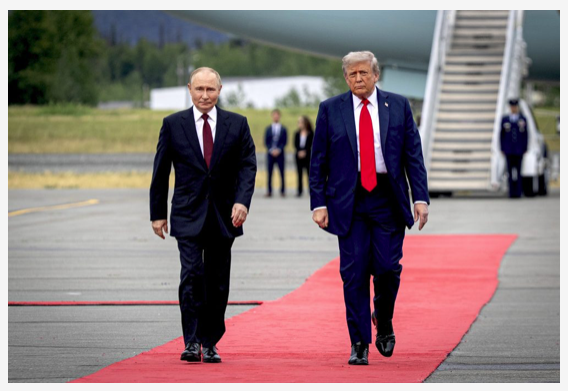
Putin getting red-carpet welcome by Trump at Joint Base Elmendorf-Richardson in Anchorage earlier this month. (DoD photo by Benjamin Applebaum)
This may seem a frivolous line of inquiry given the unrelenting prevalence of anti–Russian fervor abroad among America’s power elites. There is no faction in Washington on either side of the aisle — if, indeed, any such aisle any longer matters — that does not nurse one or another measure of Russophobic paranoia.
But the history of America’s Russophobia is to be read two ways. Animosity toward Russia, from the Czarist Empire to the Soviet Union and now to the Russian Federation, is a sort of basso ostinato in the history of U.S.–Russian relations. But we also find a top-to-bottom ebb and flow among Americans, in policy and popular sentiment alike.
Speaking straight into the poisonous state of U.S.–Russian relations, Putin went to considerable lengths in Anchorage to note the many occasions in the past when Russians and Americans took harmonious and constructive relations more or less for granted.
This story begins in the first decades of the 19th century, when the United States was but a half-century old and the West began to take note of the modernizations Peter the Great set in motion a hundred years earlier. Here is the ever-perceptive de Tocqueville in the first volume of Democracy in America:
“There are at the present time two great nations in the world, which started from different points, but seem to tend towards the same end. I allude to the Russians and the Americans. Both of them have grown up unnoticed; and whilst the attention of mankind was directed elsewhere, they have suddenly placed themselves in the front rank among the nations, and the world learned their existence and their greatness at almost the same time …. Their starting-point is different, and their courses are not the same; yet each of them seems marked out by the will of Heaven to sway the destinies of half the globe.”
Apposition from the first, then — if not opposition. Indeed, the idea of “the West” as a political construct arose during de Tocqueville’s time precisely in response to the rise of Czarist Russia. It was, thus, a defensive reaction from the first.
Seven decades later America swooned into the first Red Scare in response to the Bolshevik Revolution. And two more decades after that, what? With the World War II alliance against the Axis Powers, F.D.R., clever man, had Americans referring to Stalin as “Uncle Joe.”
Alas, the extraordinary powers of media and propaganda. No sooner was World War II over (and Roosevelt in his grave) than America plunged into the second Red Scare, a.k.a. the McCarthyist 1950s. And after that the détente of the late 1960s and 1970s, and after that Reagan’s “evil empire” nonsense.
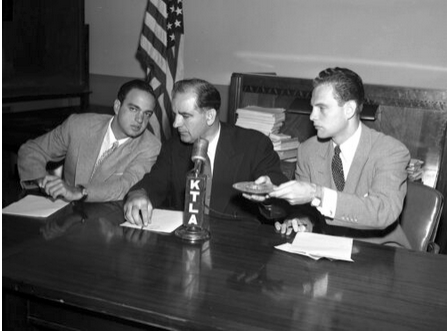
Sen. Joseph McCarthy, center, confers with Roy Cohn, chief counsel for House Un-American Activities Committee, Aug. 23, 1953. At right is G. David Schine. (Los Angeles Times/UCLA Library/Wikimedia Commons)
After the Soviet Union’s collapse we had the Russia-as-junior-partner years, when the inebriated Boris Yeltsin stood aside while Western capital raped the formidable remains of the Soviet economy. And then to the Putin years. What we live through now would amount to a third Red Scare, apart from the fact that Russia is no longer Red.
Looked at another way, U.S.–Russian relations are back where they more or less started. “Putin’s Russia,” as the phrase goes, is again America’s great Other, and by easy extension the West’s, just as it was two centuries back. Then as now, the project is to “make Russia great again,” as we might put it; then as now the West drifts into irrational reaction in response to the emergence of a nation of another civilizational tradition.
There is no missing the fungibility inherent in the U.S. stance toward Russia over the years, decades, and centuries — the extent, I mean, to which it is changeable according to changing geopolitical circumstances. It is not merely possible that the reigning Russophobia of our time will at some point pass. History’s lesson is that this is probable — maybe even inevitable.
But one man’s horse-trading and dealmaking will not make this happen, and I would say this is so especially if the man is Donald Trump. History itself will do this work. Its wheel will turn such that America’s alienation from Russia, and by extension the non–West, will prove too costly. This is already the case, providing one is willing to look instead of pretending otherwise.
At a certain point, to put this another way, refusing to accommodate the emergence of the new world order that stares the West in the face as we speak will come at a higher price than accommodating it.
In so many words, Donald Trump proposes an accommodation of just this kind. The extent to which his démarche toward the Russian Federation succeeds will be the extent to which America proves able again to transcend the Russophobia into which it has once more fallen.
Trump may not, once again, understand this, but I don’t see that this matters overmuch. He has taken a step on a path. For now, it remains to see how far down America is prepared to go.
BEFORE you leave, PLEASE pay attention to this alert.
[t4b-ticker id="1"]
Print this article [bws_pdfprint display=’print’]
This work is licensed under a Creative Commons Attribution-NonCommercial 4.0 International License •
ALL CAPTIONS AND PULL QUOTES BY THE EDITORS NOT THE AUTHORS

Patrick Lawrence
scheerpost
| Traducir—Translate! | |
| Make fonts bigger>>> | Resize text-+= |
Patrick Lawrence: ‘Completely & Totally Obliterated’
VP JD Vance and Trump. At times, Trump can't hide the cruelty written on his "tough guy" face.
I have heard many unhinged speeches by American presidents over the years, but — no risk of exaggeration here — Donald Trump’s as he declared “a spectacular military success” after seven B–2 bombers attacked three nuclear sites in Iran Saturday night is the barmiest of my lifetime.
“The nuclear threat posed by the world’s No. 1 state sponsor of terror?” “The bully of the Middle East?” There was this by way of a plunge into the crowded precincts of American paranoia:
“They have been killing our people, blowing off their arms, blowing off their legs with roadside bombs. That was their specialty. We lost over a thousand people and hundreds of thousands throughout the Middle East and around the world have died as a direct result of their hate.”
And for the good people out in Peoria, a decisive majority of whom, the polls say, oppose American aggression against the Islamic Republic: “I want to just say, we love you, God, and we love our great military.”
Let me remind readers, as rhetoric this base makes it easy to forget: The speaker of these words is the 47th president of the United States. Yes, the commander-in-chief.
It is difficult to take Trump’s four minutes in front of the microphone late Saturday evening the slightest bit seriously. But we must, precisely because what Trump had to say to his nation was so utterly unserious.
Donald Trump, to put this point another way, turns out to be worse than Donald Trump.
Vomitorium MaximumJingoists of the world, rejoice! |
It is natural, for those with some sense of history to compare Trump’s my-God-and-my-military talk with the more craven moments of the McCarthyist 1950s, or with the John Birchers. I say it is more useful to think of that famous remark Karl Rove made during an interview conducted by Ron Suskind a year and seven months after the Bush II regime invaded Iraq.
“Faith, Certainty and the Presidency of George W. Bush” was published in The New York Times Sunday Magazine in October 2004. Suskind identifies Rove, then an adviser to the Bush White House, as “the aide,” but it was soon enough known it was he Suskind had interviewed.
The memorable passage in the Suskind piece is this:
“Guys like me were ‘in what we call the reality-based community,’ which he defined as people who ‘believe that solutions emerge from your judicious study of discernible reality.’ … ‘That’s not the way the world really works anymore,’ he continued. ‘We’re an empire now, and when we act, we create our own reality. And while you’re studying that reality — judiciously, as you will — we’ll act again, creating other new realities, which you can study too, and that’s how things will sort out. We’re history’s actors … and you, all of you, will be left to just study what we do.”
America had by then given Iraqis and the rest of the world a bitter display of what results when a nation purports to conjure realities to its liking. Trump now takes on the same preposterous project, as the ungrounded language cited above indicates.
Bush II failed extravagantly in Iraq, and Trump’s new adventure cannot but come to the same fate.
Creating reality, as if the irreducible foundations of cognition and logic are mere irritants to be set aside, may look like the very zenith of hubristic power. It is not.
Reverberations of 9/11
The Iraq invasion and the bombing of Iran are to be read as acts of desperation — the conduct of a wounded, uncertain nation that assumed the defensive crouch when the Twin Towers went down in 2001 and history arrived on its shores — history, that process America all along thought was the burden of others.
We must bear this always in mind. Desperation is the mulch wherein recklessness germinates.
“Iran’s key nuclear enrichment facilities have been completely and totally obliterated,” Trump declared Saturday evening. Does this remind you of anything?
Maybe Bush II’s ridiculous appearance, in a bomber jacket no less after landing on board, to declare on an aircraft carrier off San Diego a few days after the Iraq invasion began, “Mission accomplished?” An infamous bit of staging,
We are already well down from “completely and totally.” By Sunday morning the Pentagon was trading in “severe damage,” a catch-all vocabulary such that there is no telling what it means.
Casting further doubt on the state of matters, a digital publication called Amwaj. media reported Sunday afternoon that Washington had advised Tehran in advance of its intent to bomb and indicated the limits of its targeting. Citing “a high-ranking Iranian political source,” Amwaj said this source “also confirmed that the targeted sites were evacuated, with ‘most’ of Iran’s stockpile of enriched uranium kept in secure locations.”
Amwaj.media has its head office in Britain and publishes news and comment on West Asia in Arabic, Farsi and English. I cannot verify this report, but I am not at all inclined to discount it. It conforms, certainly, with the Trump regime’s vigorous efforts to stress that it does not seek a full-out war with the Islamic Republic.
“We have no idea where this war will go,” The New York Times declared in the headline atop an opinion piece published in its Sunday editions. “It may appear like a tactical victory less than four hours after the bombs began to fall,” W.J. Hennigan writes, “but projecting any sense of finality about this ordeal is wildly premature.”
This is so by way of facts on the ground, as the expression goes. It is certainly unclear how “the Jewish state” will take it if Iran’s nuclear program has been damaged but remains extant. The Zionist fanatics who started all this seem willing to settle for nothing short of Trump’s “completely and totally.”
But I see finality aplenty when I turn the weekend’s events 180° and consider them from this perspective. Whatever the destruction at Fordow, Isfahan and Natanz by way of the “bunker busters” those B–2s dropped, the damage the Trump regime has done to itself and the nation it pretends to govern is nearly too extravagant to reckon.
Remember “Nous sommes tous Américains,” that celebrated headline atop an editorial Le Monde published shortly after the Sept. 11, 2001, attacks? I did not then think the United States had enjoyed the world’s approval so unreservedly for decades.
The slide began two years later, with Bush II’s wanton, unquestionably illegal invasion of Iraq. The policy cliques could not since have squandered the residual good will of the postwar decades more efficiently had they tried.
It was not a question of trying, of course. It has been a question since 2001 of those planning and executing U.S. policy simply not giving a damn what the rest of the world thinks — or wanting even to know what the rest of the world thinks.
Power Is All
Trump just decisively clarified the point, in my judgment. Nothing other than power matters to the Americans now. If this has been true since 2001, Trump makes clear there is no turning back from this: Power is all the United States has left to give the world — or impose upon it.
“There’s no military in the world that could have done what we did tonight, not even close,” Trump declared triumphantly Saturday night. “There has never been a military that could do what took place just a little while ago.”
What a thing to boast of. So hopelessly out of sync with the 21st century. No, no other military could have done what the American did at the weekend, and no other military would ever be sent on such a mission.
I cannot imagine what some metric of global good will toward America would register now that Trump has led the United States into what looks like another war. If “completely and totally obliterated” were on the dial, the needle would be close.
As widely reported, Trump colluded with the Israelis to deceive Tehran with the suggestion that talks toward a diplomatic settlement of the nuclear question would proceed in Oman two Sundays ago. And as the Iranians prepared for another round of negotiations, Israel launched its attacks the preceding Friday.
Sucker-punching. This now seems part of America’s diplomatic repertoire.
It is hard to believe any American administration would be this craven, but Trump did the same thing again when he stated last week he would take two weeks to give diplomacy a last chance. It was a matter of a few days before the B–2s flew.
When Seymour Hersh predicted this in “What I have been told is coming in Iran,” published in his Substack newsletter last Friday, I confess I thought Sy’s neck was out a touch too far this time. I leave readers to finish the thought.
The Washington policy cliques have been more or less indifferent to statecraft for decades. Diplomacy is for the weak nations, the powerful having no need of it, former U.N. chief Boutros Boutros Ghali wrote insightfully in his memoirs. Trump just burned the bridges diplomats are supposed to build — all of them.
Who — the Russians, the Chinese, the Africans, the Latin Americans, the Europeans, the East Asians, the Indians — who will engage the Americans diplomatically any longer but with deep suspicions, deep reservations, and a profound reluctance to trust? Not to mention a well of contempt.
This is grave far beyond the Iranians, in my view. Contrary to appearances these past 25 years, diplomacy is an essential 21st century technology. B–2s and bunker busters do not seem so to me. High-technology weaponry is deployed at an ever-rising cost.
Incessant breaches of international law, cavalier abuses of the sovereignty of other nations: This will go on for who knows how long. But Trump and his people and the neoconservatives who appear to control them just went some distance destroying all possibility that the U.S. might participate in the making of a new world order.
This matters nil in Washington now, but such an order materializes as we speak, and the day will come when this foreclosed prospect will be up for regret.
I read something else in Trump’s Saturday night speech. To me it was the culmination of weeks of irrationality, a frenzy of it that led — just as the Israelis hoped it would — to senseless attacks with no logical justification.
There seems to me another kind of finality to what Trump just did. He has destroyed — completely and totally, I fear to say — rational thought as the basis of action in the name of what historians of our time will record as a rear-guard defense of raw power.
A late-phase imperium cannot do what Trump just did and then return to sound deliberations, measured policy, sophisticated statecraft. I do not now see a path to any such return.
America has long been — since 2001, again — on the way into an era of unreality, as we may as well call it. Trump just gave the nation a final shove and slammed the door behind it, to put my point another way.
When the bunker busters fell Saturday night the Trump regime created a reality all right. Look at it. Take a hard look. This is essential if some new direction is to be discovered.
Print this article [bws_pdfprint display=’print’]
This work is licensed under a Creative Commons Attribution-NonCommercial 4.0 International License •
ALL CAPTIONS AND PULL QUOTES BY THE EDITORS NOT THE AUTHORS

Patrick Lawrence


| Traducir—Translate! | |
| Make fonts bigger>>> | Resize text-+= |
In his unrelenting perfidy, the man radiates malignity.
By Patrick Lawrence / Original to ScheerPostIt is some years since I described Benjamin Netanyahu as the most dangerous man in West Asia. That was back when we heard all about the menace of the Assad regime in Damascus, the Beelzebub otherwise known as Iran’s supreme leader, and other such unthinkably malign figures.
The Israeli prime minister just graduated. By any serious reckoning he is the world’s most dangerous man as of the shockingly reckless, altogether nihilist attacks he launched against the Islamic Republic in the early hours of Friday, June 13. I will get to Donald Trump’s place in the ratings in a sec.
In his initial announcement of Operation Rising Lion, Netanyahu asserted that Iran presents “an existential threat” to Israel and that he had no choice but to order an attack. This is nonsense, but we had better pay attention to the nonsense. With this loaded phrase, Bibi has effectively licensed the Zionist state to launch a nuclear weapon if these attacks fail to destroy all of the Islamic Republic’s nuclear programs, as seems likely. This is my read.
There is indeed an existential threat abroad as of last Friday. But it extends well beyond Iran and, indeed, West Asia. As the self-defined Jewish state’s long, dreadful record makes plain, it appears to recognize no limits to the violence it will inflict on others, its breaches of international law and the norms of the human cause, and the risks it will inflict on the world in the name of what amounts to a biblically authorized project of subjugation and domination.
To finish this point, the obsessed leader of a nuclear-armed nation never subjected to the terms of the Non–Proliferation Treaty has just attacked a non-nuclear nation it calls a mortal danger to Israel’s survival because of the nuclear weapons it does not possess. You do the math, as the expression goes.
“Operation Rising Lion,” for the record, is a reference to the Prophecy of Balaam, an infidel with a very mixed record but who impressed the ancient Israelites with his exceptional powers of divination. In the Revised Standard Version of Numbers, 23:24, we find him saying, “Behold, the people shall rise up as a great lion, and lift up himself as a young lion: he shall not lie down until he eat of the prey, and drink the blood of the slain.” So does Bibi, who has the Palestinians down as evil Amalekites straight out of the Old Testament’s mythologies, once again state his purpose.
Israel and Iran are now at war, as one Tehrani told The New York Times after she listened to explosions and watched the flicker fires out her window last Friday evening. All is changed now. Netanyahu has craved this war for decades, always justifying his lust — a clinically psychotic lust, it is right to say — by way of endless lies and an apparently bottomless paranoia. These lies and this paranoia just put the world in danger of a global confrontation. We are all Iranians now: I am perfectly willing to say this.
As to President Trump and the American role in this, there is no need any longer for any of us to deceive ourselves. I continue to insist, against many who think otherwise, that the Zionist state is to be understood as a recklessly over-indulged client and not the Übermeister of U.S. policy. It is a complex dynamic, I mean to say, but the Zionist state just got done what the imperium wants in its broader ambition to “reshape the Middle East,” as the neoconservative cliques who direct U.S. policy have long put it. As I have noted previously in this space, borrowing from spookspeak, Israel does Washington’s wet work in West Asia.
■
As many commentators have remarked in many places, the Israelis have a well-established practice of lying in matters to do with events, policies, the conduct of the Israel Defense Forces, and so on. All governments lie, as I.F. Stone famously contended on many occasions, but the Israelis are in a class of their own among the officially mendacious, it is fair to say.
The thing about the Israelis is that they continue to lie even after a given lie is exposed. Netanyahu, a ready-to-hand case in point, still goes on about how the Hamas militias who attacked southern Israel on Oct. 7, 2023, raped men and women, beheaded some babies and baked others in ovens, and so on. All of this has been exposed as false, the product of Israel’s hasbaraapparatus, the constantly-in-motion machine that produces propaganda for the consumption of international audiences. But Bibi nonetheless continues to retail these smears.
And this is the case with Netanyahu’s claims that, as of last week, Iran was on the very brink of producing nuclear weapons, and it was therefore urgent to stop it.
When he announced Operation Rising Lion, Netanyahu asserted, “It could be in a year, it could be within a few months — it could be less than a year.” Read this carefully. It is sheer fear mongering, not a stated fact in it. There is no more substance to these assertions than there has been since Netanyahu first started carrying on in this fashion in the early 1990s. Anyone aware of the record knows this is merely another in the long line of statements Netanyahu has made of this kind. Bibi knows all his “coulds” and predictions are groundless — Israeli intel and the Central Intelligence Agency have told him so — and he cannot but know those paying attention know he knows this. Now this transparent lie proves enough to start a war with two sides and risk a war with many.

On June 11, two days before the Israelis launched their attacks on Iran, a social media account going by The United States of Israel posted on “X” a timeline of Netanyahu’s claims that the Islamic Republic was about to cross the threshold and become a nuclear-capable danger. There are 20 entries, beginning in 1992 and ending earlier this year. In 1996 Iran was some months to one year away from building a bomb. In 2010 it was a year away, in 2021 months to a year, and so on.
I am not familiar with The United States of Israel and cannot vouch for every entry, but of those I know, they are all accurate. I think first of 2013, when Netanyahu addressed the U.N. General Assembly on Oct.1 with that infamously ridiculous graphic that readers may recall — the bomb shaped like a bowling ball with a fuse out of the top. The forecast then, a dozen years ago, was a year to nuclear capability.
I covered that occasion. It was one week after Hassan Rouhani, elected in June as Iran’s reformist president, addressed the General Assembly and courageously reached out a hand to propose the start of talks to govern his nation’s nuclear programs. Two years later, Tehran signed the Joint Comprehensive Plan of Action, which did so. It was exactly what Netanyahu wanted least, and Donald Trump obliged him when he scuttled the accord in 2018, a year after taking office.
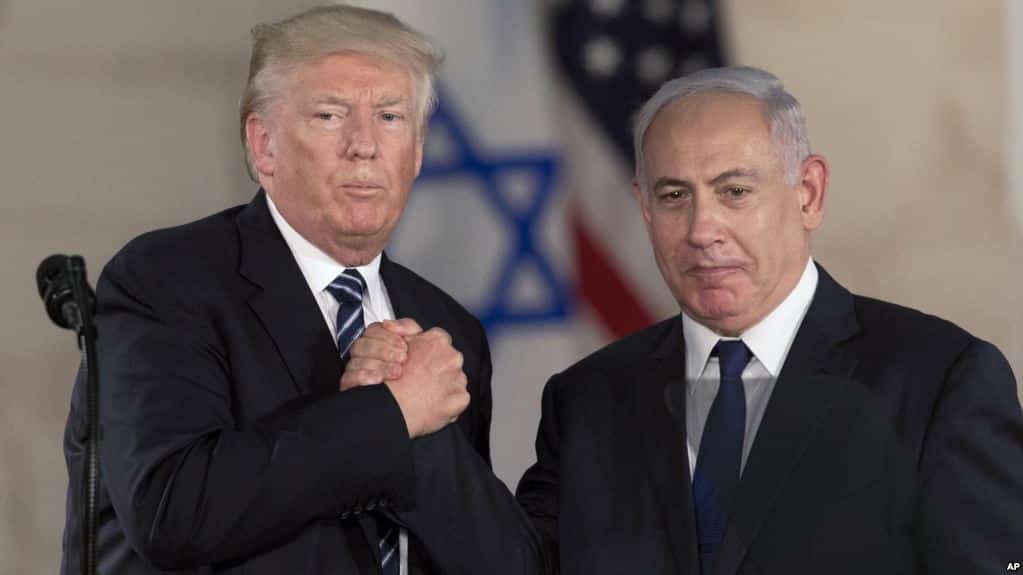
Trump and Netanyahu in 2017. It's an old bromance.
If readers are interested, The Intercept published a piece 10 years ago confirming many of these dates. It is now recirculating under its original headline, “Benjamin Netanyahu’s Long History of Crying Wolf About Iran’s Nuclear Weapons,” yet more fitting now than it was in 2015.
But never mind all that. Netanyahu has succeeded over the years in creating a sort of meta-reality that thrives in mainstream media as we speak. One must give him this.
Israel had no alternative but to attack, Bret Stephens, an Iran hawk of long standing, suggested in last Friday’s New York Times: “In plain English, Iran has been deceiving the world for years while gathering the means to build multiple nuclear weapons.” David French, another conservative Times columnist, in Saturday’s editions: “The necessity of stopping Iran’s march to a bomb is far more clear [sic] today than it was even three years ago.”
These commentators and others now place much weight on a report from the International Atomic Energy Agency charging that Iran has been in violation of its obligations under the Nuclear Non–Proliferation Treaty.
Some facts: The agency is an organ of the United Nations and has 35 members. It convened to vote on a resolution that was advanced by the United States, Britain, France and Germany. This resolution was presented Thursday, June 12, a day before Israel began attacking Iran. It passed with a vote of 19 board members in favor, three against (Russia, China, Burkina Faso) and 11 abstentions; two board members did not vote.
| Another fact: Practically all the international agencies and bodies created post-1945 were and still very much controlled, paid for and infiltrated by the West to do the US bidding. They are mostly used as critical "balance of opinion tippers" in America's eternal war of propaganda on the incautious masses. Furthermore, like OPCW (created to supervise chemical weapons), the IAEA has long been known to serve as a spy tool for the West, betraying information about "enemy" scientists (their identity, likely locations, etc. a useful datum when it comes to assassinating them, as Tel Aviv usually does, and recently proved), a nation's nuclear program, (again, with locations, makeup of projects, equipment, and so on), plus other info of use to Washington and its cabal to defeat or delay such programs, as needed. As circumstances strongly suggest in the current conflict, the IAEA certainly acted in this fashion regarding Iran.—Ed. |
These facts merit scrutiny. Why did four Western powers, which unanimously support Israel and oppose Iran, introduce this resolution when, by last Thursday, United States and European officials were already warning of an imminent Israeli attack? Why did 16 other nations — many of them non–Western, some of them (Canada, the Netherlands, South Korea, Japan) U.S. allies — decline to back the resolution? On the day of the vote, you may recall, the State Department withdrew its diplomatic staff from its embassy in Baghdad and encouraged the families of military personnel in the region to evacuate on a voluntary basis.
Iran’s foreign minister, Abbas Araghchi, immediately interpreted the IAEA’s censure as politically motivated, a preface to the Israelis’ operation the next day. Let us take care here: This view of events cannot be verified as so, but it most certainly cannot be dismissed.
The IAEA censure ["the fig leaf"] is contained in the four-page June 12 report. This is a highly technical document having to do with the agency’s access to nuclear-related sites in Iran and the Iranians’ official accounts of their nuclear programs in their regular contacts with the IAEA. The points of contention between the agency and the Iranians go back five years; the most recent of these dates to November 2024. Nothing happened last week or last month or the month before that to prompt the agency’s censure.
Here is a key passage in the document:
Noting with concern the Director General’s conclusion, most recently in GOV/2025/25, that these issues stem from Iran’s obligations under its NPT Safeguards Agreement and unless and until Iran assists the Agency is [sic] resolving the outstanding issues, the Agency will not be in a position to provide assurance that Iran’s nuclear programme is exclusively peaceful …
Does this read to you like a declaration that Iran is on the brink of nuclear-capability and must urgently be stopped? Or does this read as another in a long line of interim reports, the basis for further interaction of the kind that has gone on routinely for decades? Does this, or any other passage if you care to read the technical prose, support Bibi Netanyahu’s latest predictions as earlier quoted? Does it support the commentaries of David French and Bret Stephens? Put this report next to the assertions of these people and you have an across-the-board case of gross distortion.
Iran, in response to the IAEA censure, now threatens to withdraw altogether from the Non–Proliferation Treaty and pursue its nuclear capabilities in earnest. You can read this as a potential horror show or you can think about the principle of deterrence. I have been of the latter persuasion for many years in the Iranian case. Deterrence was held very high as a strategic concept during the Cold War decades. I regretted the circumstances that made deterrence necessary but saw the necessity of it. And now we have a nuclear-armed nation of many-times-demonstrated dangerous judgments threatening “a State without nuclear weapons,” as the IAEA refers to Iran. I come to the same conclusion.
■
Abbas Araghchi, Iran’s now-perturbed foreign minister, was due to travel to Oman Sunday, June 15, for further talks with the United States on a nuclear accord that would replace the agreement Netanyahu railed against even before it was signed and Trump abandoned. This is now off, for obvious reasons.
And so we come to the case of Donald J. Trump. I do not consider the American president to be as dangerous as Benjamin Netanyahu. He, Trump, may be stupider than Bibi, but he is not as unhinged. I count Trump Netanyahu’s enabler, and this is the role he just played.
Trump is as deep in the pockets of the Israel lobbies and various wealthy American supporters of the Zionist state as any other American pol, allowing for very few exceptions. But in his support of so dangerous an operation as Rising Lion, Trump may have outdone them all, it seems to me. It is one thing, condemnable enough, to back a genocide by way of limitless supplies of weapons, political support and diplomatic cover. Isn’t another to approve of aggression that carries the risk of global conflagration? The degree of cynicism strikes me as yet greater than Joe Biden’s, and I admit that is going some.
There was a day or so just before Netanyahu’s lion began to rise when Trump put Marco Rubio, his hapless secretary of state, out in front of the microphones and cameras to tell the world no, the U.S. had no prior knowledge of Israel’s plans and there were no “American airplanes” involved. It transpires that Rubio meant no jets with the “USAF” insignia painted on their fuselages.Newsweek reported the day the Israelis attacked that Israel has deployed a variety of American-made fighter jets in the Israeli inventory — F–35s, F–16s and F–15s — against the Iranians. You might ask whether this amounts to tacit consent, but don’t bother. The Israelis, ever eager to boast of America’s approval of all their malevolence, have clarified the matter.
Antiwar.com, the libertarian news site, reported June 13 that a senior Israeli official disclosed to The Jerusalem Post that the Netanyahu and Trump regimes colluded “to convince Tehran that diplomacy was still possible after Israel was ready to attack Iran.” As the Jerusalem Post reported, “The round of U.S.–Iranian nuclear negotiations scheduled for Sunday was part of a coordinated U.S.–Israeli deception aimed at lowering Iran’s guard ahead of Friday’s attack.”
Here is the able Dave DeCamp’s report in Antiwar.com and here is the Jerusalem Post’s. And here, for good measure, is how The New York Times played this story under the headline, “A Miscalculation by Iran Led to Israeli Strikes’ Extensive Toll, Officials Say.” Those foolish Iranians: They took the Americans at their word.
All this while, to complete the picture, Trump was on his Truth Social messaging platform with this kind of thing:
We remain committed to a Diplomatic Resolution to the Iran Nuclear Issue! My entire Administration has been directed to negotiate with Iran. They could be a Great Country, but they first must completely give up hopes of obtaining a Nuclear Weapon. Thank you for your attention to this matter!”
I like the flipped-off flattery, the upper-case nouns, and the exclamation points. Very Donald. So is what we read about in the above-cited publications.
I do not want to go on about how cravenly the U.S. so often conducts itself in matters of state. This has been noted often enough. But what the United States just did to Iran with the assist of its client seems to me the ne plus ultra of diplomatic betrayals. I can think of only one other case that offers a useful comparison.
That was when Vladimir Putin personally negotiated a settlement of the Ukraine crisis in its early stages. The Russian president invested heavily in the two Minsk Protocols, signed in September 2014 and February 2015, as a promising solution to the divisions evident in Ukraine after the U.S.–cultivated coup in Kiev in February 2014. He subsequently discovered neither Ukraine nor the Western powers that served as guarantors of these accords, France and Germany, ever had any intention of implementing them.
Essentially at issue in these two cases is trust and breaches thereof. A measure of trust is foundational in international relations. Without it there can be no constructive diplomacy, either between adversaries or, for that matter, among allies. Nations are that much closer to a default of hostility and potential chaos. The Europeans broke trust with the Russians when they abandoned the Minsk accords as soon as they signed them. Trump just broke trust with the Iranians. This is devastation of a kind — scorched-earth statecraft, we may as well call it.
To finish this point, do you think others do not notice this? The Chinese, to name the most critical case?
Trump and Netanyahu just executed the cheapest sort of good-cop, bad-cop routine with Tehran. It is a variant of Biden’s duplicity as he armed Israel with all it needed to proceed with its genocide in Gaza while claiming to fight “night and day” for a ceasefire. Biden betrayed the Palestinians, Trump the Iranians. They have both betrayed all of us. These are acts of desperation, in my final read. Let us not forget why this is, and in which direction history’s wheel turns.
Please share this story and help us grow our network!
Print this article [bws_pdfprint display=’print’]
This work is licensed under a Creative Commons Attribution-NonCommercial 4.0 International License •
ALL CAPTIONS AND PULL QUOTES BY THE EDITORS NOT THE AUTHORS