
[su_spoiler title=”Please make sure these dispatches reach as many readers as possible. Share with kin, friends and workmates and ask them to do likewise. ” open=”yes” style=”fancy” icon=”arrow-circle-1″]


| Traducir—Translate! | |
| Make fonts bigger>>> | [wpavefrsz-resizer] |
Behold: the rise of the machine.
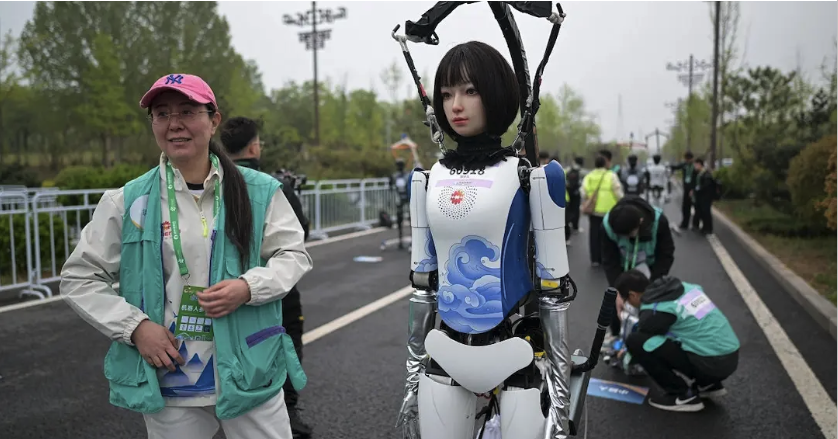
As Donald Trump’s trade war brings new levels of uncertainty to American manufacturing sector, one issue seems to have been vastly overlooked: China’s massive legion of robot workers.
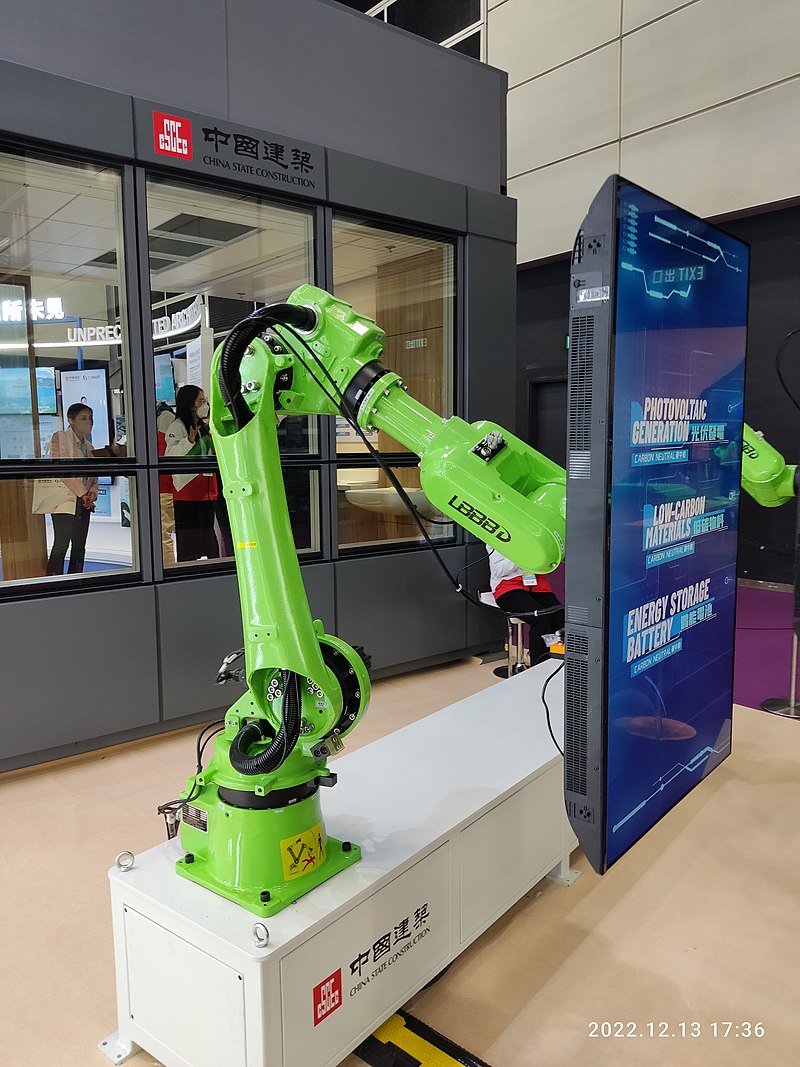
Automation on such a massive scale enables Chinese factories to pump out consumer and industrial goods at ever-decreasing costs, while fine-tuning product quality.
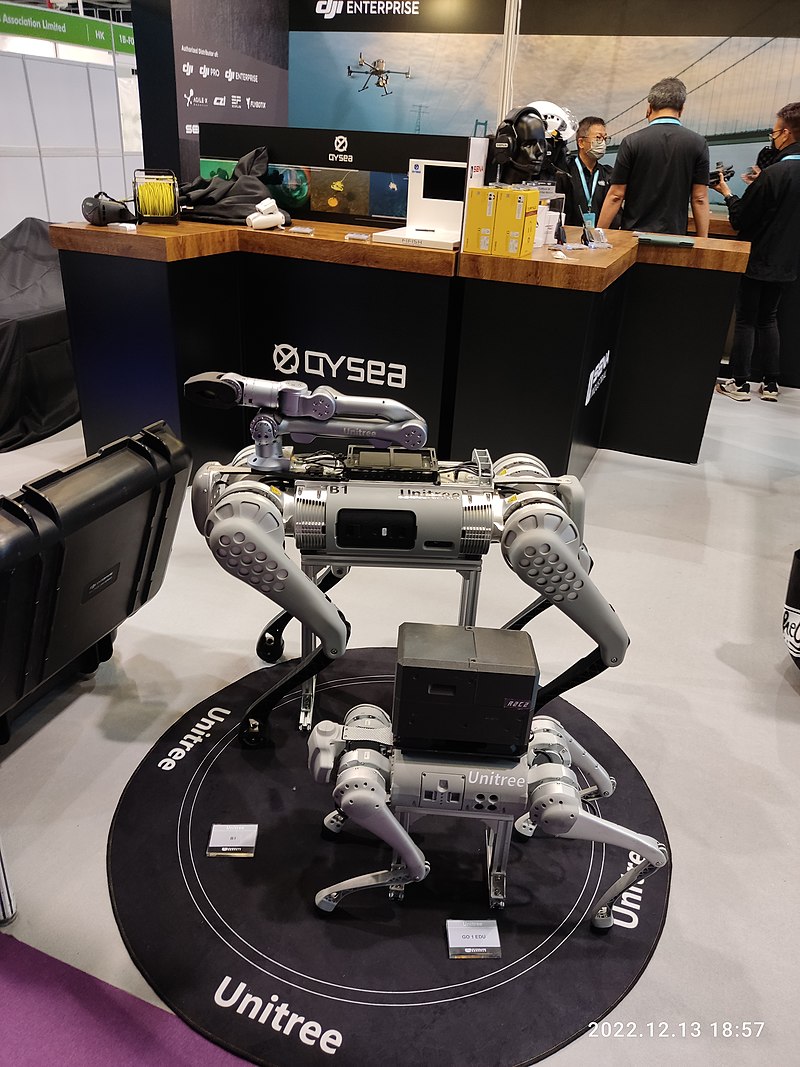

Chinese Pink robotic dog
The US, by comparison, is quickly falling behind in robotics. In the past years, American manufacturing has shifted from consumer and industrial goods to high-tech products like airplanes, medical devices, and advanced machinery. These gigs call for highly specialized skills that can’t easily be turned over to robot underlings — at least, not without dramatically shifting our robotics industry away from pie-in-the-sky startups to practical manufacturing efforts.
As it turns out, that’s exactly what China did to become the robo-mecca, starting in 2015 with a national strategy called “Made in China 2025.” As the name implies, the government-led effort laid out performance and quality benchmarks for Chinese manufacturing to hit by this current year, including in sectors like shipbuilding, electric vehicles, and high-speed rail.
Among the goals was capacity to produce 100,000 industrial robots a year, according to the state-run outlet China Daily. A recent report by the International Federation of Robotics found that between 2022 and 2023, China deployed over 276,00 roboworkers — over half of all robots installed throughout the globe, and the second highest annual industrial robotics deployment ever recorded.
Further complicating things for the US is unique access to heavy rare earth metals, which are crucial for high-tech manufacturing, particularly robotics. US factories are heavily reliant on these materials, giving China a huge bargaining chip in Trump’s trade war.
China may have a very old tradition in robotics
[su_note note_color=”#a5e0ef” radius=”0″]In the 3rd century BCE, a Taoist philosophical text called the Liezi, written by Chinese philosopher Lie Yukou, detailed the idea of a humanoid automaton. The text includes mention of an engineer named Yan Shi who created a life-size, human-like robot for the fifth king of the Chinese Zhou Dynasty, King Mu.[4] The robot was primarily constructed of leather and wood. It was capable of walking, singing, and moving all parts of its body.[4][/su_note]
Case in point, China halted the export of rare metals to the US earlier this month in response to Trump’s tariffs — prompting an outcry from his close ally Elon Musk, who said it would hinder his own robotics efforts — on top of other measures meant to strengthen Beijing’s position at the negotiating table.
Weeks later, Trump made the announcement that threatened tax rates on Chinese goods will “come down substantially,” suggesting that the Chinese government played their cards well.
It’ll likely be a while before we see who emerges the victor of this trade war, if anyone really “wins” at all. But if US leaders want to get serious about stepping up their manufacturing game, it seems there’s one obvious choice: stop quarrelling, and start cooperating with the clear winner in the robotics arms race.
More on China: Space Force Says a Chinese Spacecraft Is Practicing Dogfighting Maneuvers in Orbit
 Joe Wilkins is a contributing editor to Futurism. Full details about him can be found in his special bio page here.
[/su_spoiler]
Print this article [bws_pdfprint display=’print’]
[su_note note_color=”#f1efef” radius=”0″]The views expressed herein are solely those of the author and may or may not reflect those of The Greanville Post, although, if we publish them, we obviously find them noteworthy and valuable. [/su_note]
 This work is licensed under a Creative Commons Attribution-NonCommercial 4.0 International License •
ALL CAPTIONS AND PULL QUOTES BY THE EDITORS NOT THE AUTHORS

