
[su_spoiler title=”Please make sure these dispatches reach as many readers as possible. Share with kin, friends and workmates and ask them to do likewise. ” open=”yes” style=”fancy” icon=”arrow-circle-1″]

 Oliver Boyd-Barrett
Empire, Communication and NATO Wars

| Traducir—Translate! | |
| Make fonts bigger>>> | Resize text-+= |
The End of Normalization with Russia
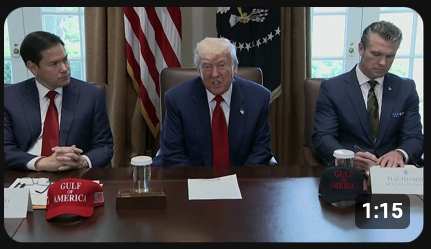
The Ukraine Mineral deal gives Trump the appearance of a success amidst an ocean of failure. On the same day as this absurdity, there is further evidence that even the strongest US “ally,” Japan, is now becoming angry. As Reuters recently reported that Japan is:
“Deeply concerned” about global economic fallout from U.S. President Donald Trump’s trade tariffs, Finance Minister Katsunobu Kato said on Thursday in the government’s strongest warning yet as the two nations began trade talks.”
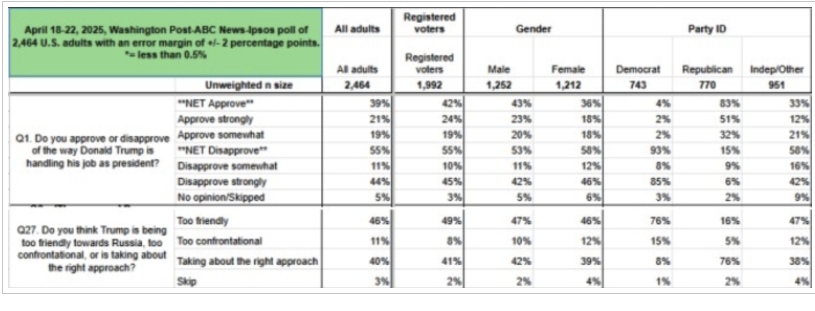
As Douglas Macgregor says today, Trump has subjected the entire globe to a “crisis of inconsistency.” And this will not end well. Least of all for the US.
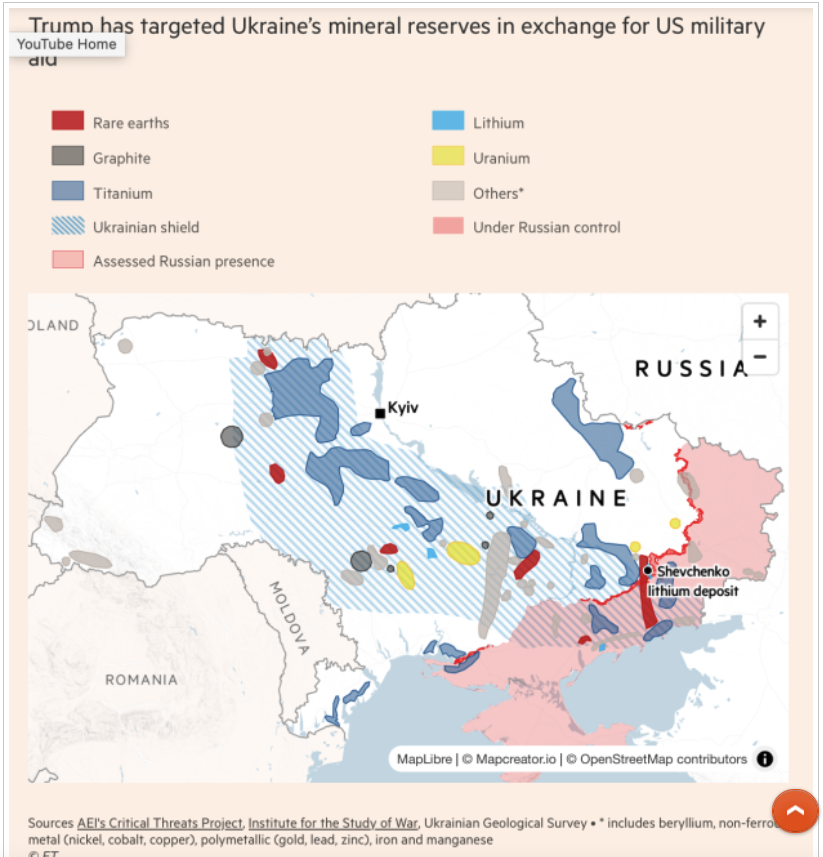
Note that the US does not need any of what Ukraine has to offer, not least rare earths that under more normal circumstances would be more readily available from Russia and China. This is even more the case with respect to oil, gas and aluminum which Macgregor says is what the deal mainly appears to be about.
The most valuable resources, Smith argues below, such as shale gas reserves and lithium deposits, sit disproportionately in parts of Ukraine currently or predictably soon to be under Russian control.
There is even some concern that the British have already signed some form of mineral deal with Ukraine and that Ukraine is selling the same stuff to more than one party.
All this presumes that the most attractive materials are actually accessible to available technology, which some sources doubt. Not to mention the low status of the Ukrainian negotiator who has signed the deal with US Treasury Secretary Bessant and the issue as to whether her signature or indeed the signature of any other member of what is now the unelected cabal of a regime that came to power as a result of a US-backed coup d’etat in 2014, would be regarded by Zelenskiy’s successors as remotely legitimate.
Although the deal does not include explicit US security guarantees to Ukraine, the AP reports that the Trump administration:
“Lifted its suspension of military aid and intelligence sharing for Ukraine, and Kyiv signaled that it was open to a 30-day ceasefire in the war with Russia, pending Moscow’s agreement, American and Ukrainian officials said Tuesday following talks in Saudi Arabia.”
So in the wake of the predictable failure of the Trump “peace proposal” carried to Putin by Witkoff last Friday, which has now been roundly rebuffed by the Kremlin as falling well short of Russian conditions for a permanent ceasefire as set out by President Putin in June 2024, Trump has now apparently resorted back to the war by restoring US weapons (apparently including air defense) and intelligence to Ukraine (although this is still a continuation of the last Biden tranche; it is questionable if a new tranche would be approved by Congress).
Yves Smith of Naked Capitalism has published one of the most extensive treatments available at the time of writing, and I will summarize the main points below. For the original article, see:
“We don’t know if the parties have included the usual caveat in US letters of intent, that the agreement is not binding or whether any durable commitment, whether now or in a definitive agreement, requires the approval of Ukraine’s parliament, the Rada, which would give Ukraine the ability to walk away from the scheme or force an improvement in its provisions.”
The agreement is now much more favorable to Ukraine: it provides for equal control by the US and Ukraine, applies only to new developments, and lasts only for 10 years
“We had warned from the outset that the so-called Ukraine “raw earths” deal conflicted with the US agreeing to a settlement of the Ukraine conflict by creating an economic incentive for the US to support Ukraine in retaining as much territory as possible.”
As Smith argues, the deal provides Trump with a pretext to continue funding the war. Having an economic interest in Ukraine’s survival would give the Administration a reason to keep Ukraine fighting.
A Ukraine source posted a purported summary of key terms:
The agreement on rare minerals between Ukraine and the USA has been signed. It is an agreement of net benefit to Ukraine compared to all previous iterations:
– Ukraine will have full ownership of the resources;
– The agreement only covers future exploration, exploitation and refining projects, not existing ones already in Ukraine’s operation;
– Ukraine will decide what these will be;
– A fund (called the Ukrainian Reconstruction Investment Fund for Reconstruction of Ukraine) will be set up in which Ukraine and the US have 50-50 participation without US veto power from the initial agreement projects;
– All Ukrainian companies that are responsible for energy resources remain 100% Ukrainian state-owned (Ukrnafta or Energoatom);
– It was agreed that Ukraine owes no financial debt for wartime economic aid to the US;
– The agreement is within the limits of Ukrainian law and in no way infringes on Ukraine’s economic sovereignty, indeed Bessent stated that the US strongly supports Ukraine’s accession to the European Union;
– It was agreed that the US will provide not only technological transfer for the development of the new projects, but also financial support on the basis of 50% of their value, but (ATTENTION!!!) also their protection, through anti-aircraft defense systems;
– Ukraine will also invest 50% from the state budget;
– ALL funds will be in the first years invested only in the reconstruction of Ukraine (over a period of 10 years);
Smith cites Moscow correspondent John Helmer:
“The US wants the Ukraine to repay, Trump’s words, Trump’s concept, the $100 billion to $300 billion number that counts to being the value of US assistance to the war so far. The Ukrainians have said we are taking that out, and that the US capital investment in mining rare earths and other minerals and energy in Ukraine, this capital contribution should be counted forward, to the future, for US military aid. Which means that the Ukrainians have gotten an undertaking that there will be ongoing US military assistance to the Ukraine. “
On the question of “equal” control, Smith argues that the amount invested by each party does not have to equate to their level of control. In any case, a true 50/50 deal is the kiss of death. One party has to be in charge from a governance perspective.
As for the war:
“There will be no negotiated settlement of the war between Russia and Ukraine. That means Russia continues to prosecute the war and take more territory until it sees fit to stop. For the sake of this thought experiment, assume Russia prostrates Ukraine, takes control of a big swathe of Ukraine in the south and east that includes Odessa, Mykolaiv, Dnipropetrovsk, Sumy, and Kharkiv oblasts, and installs a puppet government in western Ukraine with a neutral status and a limited degree of autonomy once denazification has been completed…
“One could see the Trump administration seeking compensation, and using the failure of Russia to oblige as a justification to seize the $67 billion in dollar-denominated Russian frozen assets as liquidated damages….To put it another way, the minerals pact was certain to be a source of conflict with Russia were it ever to get done. “
Addendum
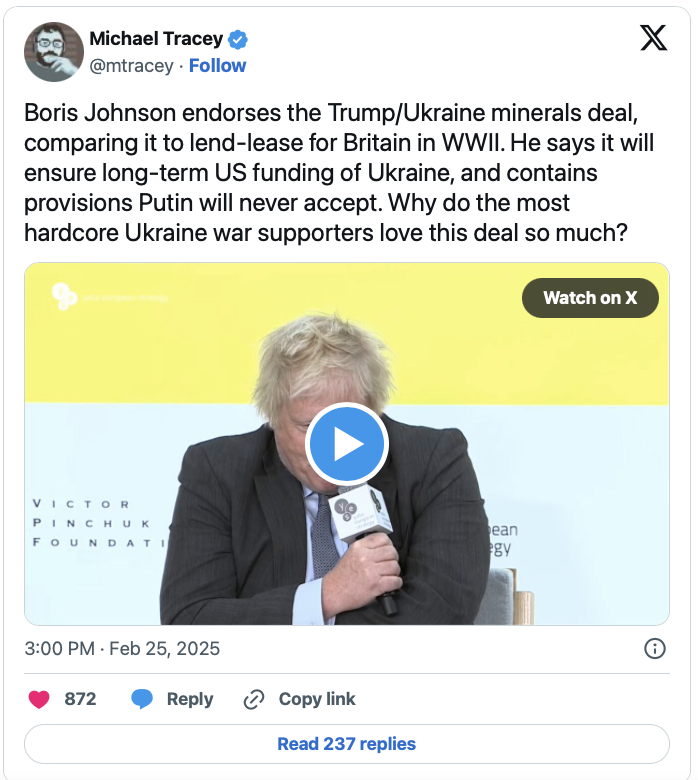
US-Ukraine Minerals Deal: Has Trump Agreed to Continue Military Support? Even if Not, Will He Fall for an Endowment Effect Trap?The US and Ukraine have agreed to an outline of terms for their so-called minerals deal. We don’t know if the parties have included the usual caveat in US letters of intent, that the agreement is not binding or whether any durable commitment, whether now or in a definitive agreement, requires the approval of Ukraine’s parliament, the Rada, which would give Ukraine the ability to walk away from the scheme or force an improvement in its provisions. The fact that the main provisions are now much more Ukraine favorable than at the outset means the Rada may well bless the agreement, particularly since the press has reported that the US will continue to provide military support for Ukraine, in the form of air defenses. As we’ll explain below, our prediction that this deal would be a spoiler as far as normalization of US-Russia relations look every bit as operative as we predicted from the get-go. We had warned from the outset that the so-called Ukraine “raw earths” deal conflicted with the US agreeing to a settlement of the Ukraine conflict by creating an economic incentive for the US to support Ukraine in retaining as much territory as possible. Even with the development opportunities not all that juicy, neocon pot-stirrers eager to add to the list of purported Russian dirty deeds will argue otherwise. The fact that the most valuable resources, such as shale gas reserves and lithium deposits, sit disproportionately in parts of Ukraine currently or predictably soon to be under Russian control would become another bloody flag. The fact that the most attractive assets are already being exploited (and as we’ll see below, are excluded from the current scheme) would not be mentioned in polite company. And even those on the Trump team who are more Russia-favorable will have their view of what this “deal” is worth tainted by the cognitive bias called the endowment effect.1 Humans have an odd tendency to value things they have as worth more than the same item not in their possession. And the “not Russia hostile” camp is also running into the headwinds of US public opinion. As John Helmer pointed out:
Another factor that will tend to poison Trump’s relationship with Russia is his failure to deliver on his loud and much-repeated pledge to settle the Ukraine conflict in 24 hours. Trump’s bluster and bullying were no match for the non-negotiable Putin or even the conniver Zelensky. The minerals deal is thus a timely distraction from this embarrassment. It may serve to bolster the barmy claim that somehow Trump won. From our February post, Trump Will End His Option of Walking Away from Project Ukraine with His Minerals Deal:
Before you think our take that a “raw earths” deal would give the US reason to protect its interest, even if it was more PR/vaporware than real, consider this section from the initial (and deemed to be outrageously one-sided) outline of terms:
As we pointed out in February:
Fast forward to the current state of play. A Ukraine source posted a purported summary of key terms. The text of Radu Hossu’s tweet:
The Financial Times account validates the notion (albeit in a much more hedged manner) that the Ukraine side sees the agreement as including air defense support:
John Helmer, in the aforementioned interview with Nima of Dialogue Works, confirmed our concerns, based on an earlier edition of the Financial Times story cited above. Starting at 17:45:
Mind you, the US is fabulously agreement incapable and Trump has managed to be even more so. The Trump side may have made this commitment, or insinuation, in bad faith. Or it may intend to take its chances with getting Congressional approval for what it will present as a limited arms package to protect its investment in Ukraine. Or it could resort to gimmickry, like guaranteeing a bond issue. If the Administration can’t get the spending authorized, it can tell Ukraine it tried. The pink paper in the story we quoted also said:
Now anyone who has worked on investments knows that the amount invested by each party does not have to equate to their level of control. Private equity and hedge fund limited partnerships are classic examples, with institutional investors providing nearly all the money yet legally relegated to a passive status, save for limited veto rights.2 However, based on having repeatedly advised financial institutions and investors on joint ventures, a true 50/50 deal is the kiss of death. One party has to be in charge from a governance perspective. Let’s consider another way that this deal looks set to become what Putin has called3 an apple of discord. There will be no negotiated settlement of the war between Russia and Ukraine. That means Russia continues to prosecute the war and take more territory until it sees fit to stop. For the sake of this thought experiment, assume Russia prostrates Ukraine, takes control of a big swathe of Ukraine in the south and east that includes Odessa, Mykolaiv, Dnipropetrovsk, Sumy, and Kharkiv oblasts, and installs a puppet government in western Ukraine with a neutral status and a limited degree of autonomy once denazification has been completed. Many commentators have argued the Ukraine minerals deal was worthless because no development could happen until the war was over, there was no assurance as to what territory would remain in Ukraine’s hands, and even if the country retained a fair bit of terrain, development would also depend on other basic infrastructure being in place, which was not a given (consider for starters electricity). But that is not how a legalistic finance person would think. They believe they hold valuable development rights. One could see the Trump administration seeking compensation, and using the failure of Russia to oblige as a justification to seize the $67 billion in dollar-denominated Russian frozen assets as liquidated damages. To put it another way, the minerals pact was certain to be a source of conflict with Russia were it ever to get done. The fact that the Administration pursued the deal so aggressively said it valued a splashy but low to no value win over normalizing relations with Russia. The US foot-dragging over simple steps to restore routine diplomatic operations, like returning seized embassy properties and setting up bank accounts for the payment of US expenses, indicated the US was unserious about the exercise independent of a Ukraine settlement. Or alternatively, this episode is yet another instance of Trump being all tactics and no strategy, pursuing opportunities and options with no consideration of whether they are taking Trump and the US to an attractive destination. ____
2 And those are virtually entirely for show. The right to trigger them is in the hands of an advisory committee….which the general partner stacks so that investors friendly to them hold a majority of votes. 3 With respect to the prospect of Russia taking control of Odessa. |
[/su_spoiler]
Print this article [bws_pdfprint display=’print’]
[su_note note_color=”#f1efef” radius=”0″]The views expressed herein are solely those of the author and may or may not reflect those of The Greanville Post, although, if we publish them, we obviously find them noteworthy and valuable. [/su_note]
 This work is licensed under a Creative Commons Attribution-NonCommercial 4.0 International License •
ALL CAPTIONS AND PULL QUOTES BY THE EDITORS NOT THE AUTHORS


Given the super-extraordinary performance of US/NATO “Air defenses” in the Red Sea and elsewhere, I wonder if their deployment to the Ukraine would overmuch impress the collective “Putin”. Seems like the Russians are holding the greater part of their powder dry for a real war. IMO, it might not be a good idea to test their resolve or capabilities based on the past performance of both sides.
Oh, I never suggested it would work. The US is about out of Patriots, which I believe is our best system. This is US exceptionalism running on brand fumes.
The other issue is, what private sector mining company wants to risk getting their facilities bombed in an active war zone? The mere presence of air defense indicates hostility, and no AD system is perfect.
Anything so vulnerable as to require AD surrounding it is a non-starter for civilian businesses. Imagine if Microsoft HQ had to put Patriots around the perimeter? Statistically, it is only a matter of time before one or two missiles get through.
Yeah, the US bonding itself with the most corrupt country in Europe and run by Nazis trying to put together a mining deal when the battle lines are still in motion. Oh, and much of the electrical grid is now ash which you kinda need for mines and most of the industry lies in what is now the Russian Federation. What’s not to like?
Yes, it should have occurred to me that this is actually just a big money laundering scheme where we have yet to discern how it operates.
When the war is over, the government of the rump Ukraine will have no legal obligation to adhere to the agreements of the previous criminal regime. I do slightly fret that it’s a propaganda victory for a certain floating pond biofilm of European politicians like Starmer and Macron, who will leverage that head of terms around air support for the next few months until silly season. Still, this is not a full agreement so either party can conceivably walk away without penalty.
Did you not read the post in full?
Ukraine even if the former state is legally disappeared (as opposed to a new government being regime-changed in) may still have an argument it has enforceable property rights. People who had gold and paintings stolen by the Nazis were sometimes able to recover them.. In other words, property rights under the former legal regime were sometimes considered to have survived the obliteration of the regime.
In other words, the default assumption that property rights are wiped clean in war is often not accurate, particularly since clearing up who has title to what is often a pre-condition to reconstruction. See here for one paper on this big topic: https://www.jstor.org/stable/3663092
With respect to this admittedly barmy-seeming agreement, IMHO it could easily serve to legitimate a US seizure of Russia’s dollar-denominated frozen assets.
I wouldn’t reply without reading the post, I know the brief. Appreciate your reply to my comment.
I haven’t read the full article you linked but will.
My understanding of international law on this subject is that there is a distinction made between private and public, where the contract is between the criminal regime and another country, versus private entities or individuals, who retain a right of restitution. If Ukraine granted rights of first exploitation to the US on Ukrainian public assets I think those can be disputed by a successor regime. My read of the text is that there is no enforcement mechanism or choice of forum for disputes, so good luck to anyone who bids on the assets.
If this is a treaty between the two states then the normal rules apply. They are different from the rights of individuals, because in general states do not have property rights in the normal property law sense. If the treaty has a withdrawal clause, which would be normal, then this or any other government can exercise it and stop the process. So it will be important to see whether the eventual treaty contains such a clause or not. In the case of a substantial change of regime (eg after some kind of civil war) a complicated thing called the doctrine of succession comes into operation, which is regulated by this treaty. Generally speaking, succession rights are voluntary (eg Russia has inherited a lot of treaty obligations from the former Soviet Union.) Of course commercial agreements between foreign companies and the state of Ukraine are a different, and even more complex issue.
I suspect that the Trump Admin, being who they are, will contract the management of the fund to a private sector fund manager. Normally that would make them just an agent and the most they might arguably have in “property” rights would be for their carried interest…..except in the US, that is typically just a profit share, while in other countries, a true “carry” comes about by having an economic interest (as in making an actual $ contribution to the fund, even if borrowed, so having downside risk).
And I may not have been clear…Trump as we know is not big on the fine points. So if there is any historical example of post-conflict parties successfully asserting their property rights (as in the old German Jewish account holders at Swiss Bank), Trump could toss that out as part of his pretext for seizing the Russian frozen assets to compensate for the US loss of Ukraine development rights. It merely has to be a talking point, as opposed to being sound.
Well, first, this isn’t a treaty. So it is not binding on a future Ukrainian or US government.
And second, states can have property rights, and assert them as in eminent domain (seizing private property for a public purpose, and sometimes not-so-public, as in Kelo.)
In fact, the whole US property law system derived from medieval England, where the King or Queen owned all the land. Feudal Lords were given an interest in land in exchange for providing the King with men and materials for the British Army. So in a sense, the US government does have property rights, and in some cases such as when an estate owner dies without any heirs or devisees, the property gets transferred to the state in a process called escheatment.
I’m saying this not to be pedantic but to point out that it is more of a grey area than people realize. Not sure how it works in France.
I’ve seen some accounts of the text which don’t look as if they are in treaty language, and that may make this discussion redundant. It’s true in any country, I think, that the “state” can own property (in England it’s known as Crown Property) and this is a relic of the procedure you mention above. But I’m not sure there’s any precedent for nations, as opposed to states, rulers etc. acquiring property or assets overseas by contract as a result of business deals. Embassies for example are not really “property,” they are considered the territory of the sending nation, and in some cases, as with the British Embassy in Paris one government pays another rent, although in that example it was the Duke of Wellington who took out a lease from Louis XVI, so it wasn’t really the same thing.
I think I did not understand the argument you were making on property rights. I got that you were saying that a state can’t own property on its own sovereign lands, but really, you were saying that generally, states don’t have property rights in other foreign states.
So, that makes sense – the US doesn’t have a way to get property rights in, say, Canada, because Canada is a foreign sovereign. Unless, as Trump says, they become the 51st state.
Private foreign investors are, of course, another matter. Most countries allow foreign ownership of property with some restrictions.
What I think falls apart with this agreement is that there is no way that a private foreign investor will take the risk of investing in hypothetical mineral rights in Ukraine when there is so much uncertainty and risk of force majeure clauses being invoked. There is a high likelihood of:
1. A future Ukrainian government repudiating the deal;
2. Russia taking significant portions of the remaining territories with the minerals.
(The second risk is so foreseeable as to likely not be considered force majeure. It could perhaps be another reason to invalidate the deal or walk away, because it appears to be an example of bad faith negotiating in promising something that you cannot possibly deliver, on the part of the Ukrainians.)
Then there is the problem that, because there is no security guarantee from the US, there is no enforcement mechanism should the terms of the deal be violated in one of the above scenarios.
TL;DR – I didn’t really grok your property rights argument; I think I get it now. And the whole deal is a pig in a poke, as they say.
The Russian and US government disagree with respect to Russian embassy property in the US. Admittedly that may be a special case, since embassies are supposed to be treated as foreign soil. But does that position regarding the reach of police extend to title?
The US has taken control of the Russian properties but both sides seem to have implicitly conceded the point that the Russia still own them but does not have the right to use them until the US returns control. Anyone who knows the fine point better, please pipe up.
If Zelensky and his gobernment/regime is “illegitimate”, why any contract they entered in would be legitimate?
Like somebody fraudulently gets the property docs of my house and sells it, that doesn’t mean the buyer has the right to kick me out from my place, does it?
Plus, Zelensky was elected on the promise to make peace with Russia…
I am sure you are right, just have two questions: US businesses abandoned a large # of properties and assets they had in Russia, so couldn’t the Russians respond tit-for-tat? Secondly, Alexander Mercouris (a former barrister, so presumably well-informed) has claimed that if those assets are fully seized Russia could pursue future international court actions to recover them. Now, I’d be the last person to dismiss the utter depravity & criminality of the “Rules-Based Order”, but I also understand that the IMF, World Bank, Bloomberg (the news service, not the oligarch) have strongly discouraged this type of criminality due to the knock-off effects? . . . Not the least of which is no other countries putting their assets into places where Mafia Don and his court could seize them for any made-up reason.
Thank you, just asking.