
[su_spoiler title=”Please make sure these dispatches reach as many readers as possible. Share with kin, friends and workmates and ask them to do likewise. ” open=”yes” style=”fancy” icon=”arrow-circle-1″]
 THE JIMMY DORE SHOW
HOSTED BY
Misty Winston • Kurt Metzger
| Traducir—Translate! | |
| Make fonts bigger>>> | [wpavefrsz-resizer] |

Sep 13, 2025 The Jimmy Dore Show PODCAST
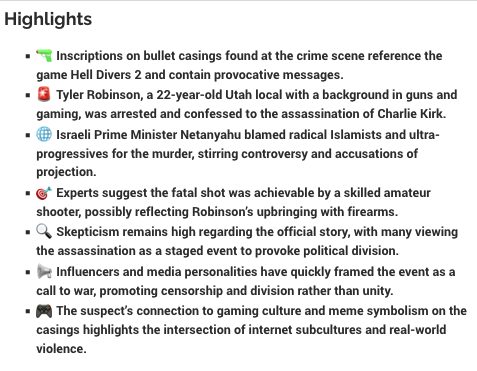
Following the manhunt for Charlie Kirk’s assassin, authorities reported a variety of details about the suspect, 22-year-old Tyler Robinson of Utah, including that he had engraved bizarre internet-inspired inscriptions on bullet casings, some referencing memes, antifascist songs, and even the video game Helldivers 2.
Guest host Misty Winston and Americans’ Comedian Kurt Metzger express skepticism about the official story, questioning whether Robinson could have acted alone and pointing out how meme culture and online radicalization seemed deliberately baked into the narrative. Israeli Prime Minister Benjamin Netanyahu, meanwhile, used media appearances to frame Muslims and progressives as responsible for political violence, which critics called projection, given Israel’s record on censorship and repression. The discussion concluded by suggesting that the shooting bore the hallmarks of a staged operation meant to inflame division, desensitize the public, and justify more censorship.
The video transcript discusses the assassination of Charlie Kirk, founder of Turning Point USA, and the arrest of the suspect, Tyler Robinson, a 22-year-old from Utah. It explores the suspicious circumstances around the shooting, including unusual inscriptions on bullet casings linked to a video game, and skepticism about the official narrative. The discussion includes political implications, with Israeli Prime Minister Benjamin Netanyahu blaming radical Islamists and “ultra-progressives” for the murder, a claim met with criticism for hypocrisy. The video also touches on the broader context of political violence, media manipulation, and societal division in the United States, highlighting concerns about orchestrated operations and the use of tragedy to fuel censorship and further polarization. Additionally, the video calls attention to the influence of internet and meme culture on modern shooters, noting the suspect’s apparent connection to gaming subcultures and online radicalization. The conversation ends with reflections on the desensitization to violence, the role of government and intelligence agencies in creating shooters, and warnings regarding the exposure of youth to online content that may contribute to radicalization.
 Key Insights
-
Weapon inscriptions reveal a fusion of real-world violence and virtual gaming culture: The inscriptions on the bullet casings, including phrases like “Hey, fascist catch” and arrow symbols, were linked to the video game Hell Divers 2. This suggests a troubling overlap where modern shooters incorporate internet meme culture and gaming references into real acts of violence, reflecting digital subcultures’ influence on radicalization processes. This trend complicates traditional understandings of motives behind such attacks and points to a new dimension of cultural impact on violence.
-
Tyler Robinson’s profile challenges typical narratives about political assassinations: Robinson is described as a white, Mormon, Utah local with a background in guns and gaming, wearing a Trump costume for Halloween. Despite political assumptions that might arise, the suspect does not fit neatly into stereotypical categories of political extremists from either side. This discrepancy fuels suspicion about the narrative’s completeness and raises questions about potential manipulation or orchestration behind the attack.
-
Netanyahu’s media tour and blame on Muslims and progressives illustrate political exploitation of tragedy: The Israeli Prime Minister’s public statements blaming radical Islamists and ultra-progressives for the murder of an American conservative figure exemplify how political leaders may use tragic events to advance ideological agendas. Netanyahu’s critique of “hypocrisy” in human rights discourse ironically mirrors accusations against his own government’s policies, highlighting the geopolitical and propaganda dimensions intertwined with domestic violence incidents.
-
The shot’s technical feasibility undermines claims of an inaccessible “professional hit”: Contrary to some opinions labeling the assassination as a complex professional sniper operation, firearms experts consulted suggest that the shot was not overly difficult for someone familiar with guns. This aligns with Robinson’s reported background and suggests the act could have been carried out by a trained amateur rather than a highly skilled assassin, impacting interpretations of the event’s planning and execution.
-
Widespread skepticism about the official story highlights distrust in government and media narratives: The video reflects a pervasive doubt among commentators and viewers regarding the authenticity of the information released about the assassination. References to past unresolved or suspicious shootings (e.g., Vegas, Trump assassination attempts) contribute to a narrative that such events may be staged or manipulated “ops” designed to serve political or social control purposes, reflecting deep societal mistrust in institutions.
-
Rapid media and influencer response emphasizing “war” and censorship risk deepening societal divisions: The immediate framing of Kirk’s death as a catalyst for conflict, alongside calls for firing or censoring dissenting voices, underscores how tragedies are often leveraged to justify further suppression of freedoms and escalate partisan hostility. This dynamic threatens social cohesion and distracts from constructive dialogue, instead perpetuating cycles of fear and division.
-
The connection between shooters and internet culture signals a new frontier for understanding radicalization: The suspect’s involvement with online gaming, specifically Hell Divers 2, and the use of coded language and memes on bullet casings reflect how digital environments may contribute to identity formation, motivation, and symbolic communication among perpetrators. This raises important questions about the role of online communities, media consumption, and psychological factors in fostering violent behavior, necessitating more nuanced approaches to prevention and intervention.
-
Online radicalization and psychological factors in shooters indicate complex social and mental health issues: The discussion touches on how shooters often have backgrounds involving social isolation, autism spectrum conditions, and SSRI use, combined with exposure to internet subcultures like furries or bronies, which may be exploited or manipulated by covert agencies or social engineering projects. This points to an urgent need for awareness and protective measures for youth vulnerable to harmful online influences.
-
⚖️ Political violence is embedded within systemic structures, complicating simplistic moral narratives: Commentary on the nature of political violence highlights that government authority is inherently backed by force and coercion, challenging the common portrayal of politics as peaceful discourse. Recognizing this systemic violence is crucial to understanding the broader context in which individual acts of political assassination occur, though this insight must be balanced with the condemnation of specific violent acts.
-
️♂️ Conspiracy theories and misinformation thrive amid opacity and media manipulation: The unclear and conflicting information about the assassination, suspect, and motives creates fertile ground for conspiracy theories and disinformation. This underscores the importance of critical media literacy and transparent investigations to prevent misinformation from exacerbating political and social instability.
-
Calls for unity over division emphasize the human cost of political violence: Voices urging Americans to see beyond partisan identities stress that neighbors are not enemies but individuals caught in broader propagandistic battles. This appeal highlights the potential for healing and collective resilience if society resists manipulation aimed at fomenting hatred and fragmentation.
-
The symbolic selection of Charlie Kirk as a target reflects the use of violence for political theater: Kirk’s role as a conservative influencer with a substantial following makes him a potent symbolic victim, regardless of the absence of deeper political threat. His assassination serves as a dramatic statement meant to provoke strong reactions and possibly justify policy shifts, censorship, or cultural warfare, demonstrating how political violence functions as spectacle and propaganda.
-
The event’s timing alongside other political developments (e.g., Epstein files vote) suggests possible strategic distractions: The coincidence of the assassination with unrelated yet significant political happenings hints at potential strategies to divert public attention or suppress inconvenient truths, reinforcing suspicions about coordinated manipulations within the political landscape.
-
Parallels with previous shootings indicate a pattern of “meme culture” shooters influenced by online trolling and identity politics: The practice of writing slogans or memes on ammunition and using coded language has been noted in other shootings, reflecting a disturbing pattern where performative aspects and internet culture merge with real-world violence, potentially as a tactic to maximize psychological impact and media attention.
Misty Winston on Twitter:  / sarcasmstardust
Misty Winston on Due Dissidence:  / @duedissidence

Sep 12, 2025
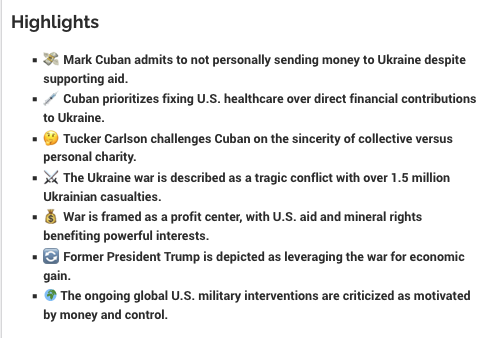
The video transcript features a contentious exchange between Mark Cuban and Tucker Carlson, along with commentary from a comedian reflecting on the geopolitical and ethical complexities surrounding U.S. support for Ukraine amidst ongoing war. The conversation opens with Carlson questioning Cuban about financial support for Ukraine, particularly given Cuban’s Ukrainian heritage. Cuban admits to not sending money personally, explaining that he is focused on fixing healthcare rather than directly funding the war effort. Carlson challenges Cuban, accusing him of hypocrisy and questioning the sincerity of collective aid when individuals do not contribute personally. The dialogue then shifts to a cynical critique of how war, specifically the Ukraine conflict, has become a profit center through U.S. military aid and mineral rights, with a sarcastic nod to former President Trump’s role in negotiating resource ownership. The commentary highlights the tragic human cost of the war—millions of Ukrainian lives lost—and condemns the continuation of conflict driven by profit motives, natural resource control, and oligarchic interests. The comedian closes by framing the war in a broader context of ongoing U.S. military interventions globally, asserting that these conflicts serve economic and political elites rather than humanitarian goals.
BEFORE you leave, PLEASE pay attention to this alert.
[t4b-ticker id=”1″]
[/su_spoiler]
Print this article [bws_pdfprint display=’print’]
[su_note note_color=”#f1efef” radius=”0″]The views expressed herein are solely those of the author and may or may not reflect those of The Greanville Post, although, if we publish them, we obviously find them noteworthy and valuable. [/su_note]
 This work is licensed under a Creative Commons Attribution-NonCommercial 4.0 International License •
ALL CAPTIONS AND PULL QUOTES BY THE EDITORS NOT THE AUTHORS

