
 Nima R. Alkhorshid
 DIALOGUE WORKS
chats with
LARRY C. JOHNSON

| Traducir—Translate! | |
| Make fonts bigger>>> | Resize text-+= |

 Dialogue Works
Streamed live Sep 29, 2025
Summary
The video transcript presents an extensive interview and discussion with Larry Johnson on September 29, 2025, covering multiple geopolitical and security issues. The conversation begins with a detailed examination of the controversial shooting of Charlie Kirk, dissecting the available evidence, debunking conspiracy theories, and highlighting inconsistencies in the official narrative. Larry Johnson critiques the claim that Tyler Robinson, allegedly the shooter using a .30-06 rifle, was responsible for Kirk’s death, based on ballistic evidence, wound analysis, and video footage. He suggests the shooting was a coordinated, organized plot potentially involving powerful interests opposed to Kirk’s political stance, particularly his criticism of Zionist influence.
The discussion then shifts to the broader geopolitical landscape, focusing on the ongoing conflict in Ukraine, U.S. foreign policy, and the role of European countries. Larry critiques the Trump administration’s inconsistent stance on Ukraine, NATO, and arms supplies, emphasizing that the U.S. is the primary driver behind the conflict, using Ukraine as a proxy against Russia. He warns about the dangers of escalation, particularly if new weapons like Tomahawk missiles are introduced, which could trigger broader warfare involving NATO members.
Further, Larry addresses the tension in the Middle East, especially between Israel and Palestine, and the potential for a wider war involving Iran. He highlights the Western narrative’s distortion regarding Iran’s nuclear ambitions and emphasizes Israel’s aggressive military actions in Gaza and the broader region. The conversation also touches on the shifting global order, with emerging powers like Russia, China, and India challenging Western dominance and colonial legacies, leading to a more multipolar or multinodal world.
The interview concludes with reflections on humanitarian crises, including the starvation in Gaza and the role of Western powers in perpetuating conflicts. Larry stresses the resilience of Palestinian groups and criticizes the hypocrisy of Western policies that label Hamas as terrorists while supporting other militant groups. Overall, the discussion presents a critical, often skeptical view of mainstream narratives, emphasizing misinformation, geopolitical manipulation, and the complexities behind major global conflicts.
Key Insights
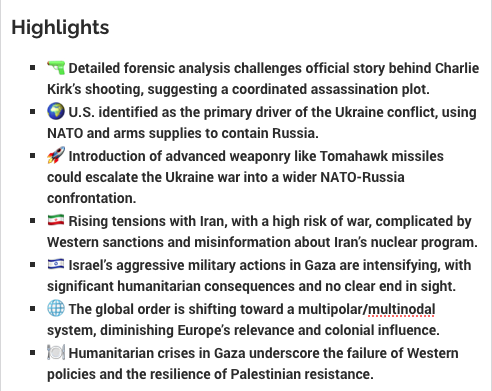
Ballistic and forensic evidence debunk conspiracy theories about Charlie Kirk’s shooter: Larry Johnson’s detailed examination of Kirk’s wound and the shooting dynamics reveals contradictions with the official narrative blaming Tyler Robinson and the use of a .30-06 rifle. The absence of arterial blood spurt and the nature of the wound suggest a different weapon or shooter, pointing toward a covert, organized assassination rather than a lone gunman’s act. This analysis highlights how forensic science can expose political manipulation and misinformation surrounding high-profile events.
️♂️ Disinformation and narrative control as tools to “poison the well”: The proliferation of conflicting stories and conspiracy theories around Kirk’s shooting appears designed to confuse public perception and divert attention from deeper truths. This tactic of “poisoning the well” ensures that no unified demand for accountability arises, showcasing how controlling narratives is pivotal in modern political power struggles.
U.S. leadership and strategy in the Ukraine conflict reveal proxy war dynamics: The United States, rather than Europe, is portrayed as the primary actor orchestrating Ukraine’s militarization and conflict with Russia. The strategic goal is to weaken Russia using Ukraine as a proxy battlefield, maintain NATO dominance, and limit Russia-China cooperation. This insight challenges common Western media portrayals of the conflict as a simple defense of Ukrainian sovereignty.
⚠️ Risk of escalation with advanced weaponry introduces global instability: The possible deployment of Tomahawk missiles by the U.S. to Ukraine, despite being older technology, carries the risk of provoking Russia into broader retaliation against NATO countries. This emphasizes the dangerous brinkmanship inherent in proxy wars where indirect engagements risk direct interstate war, especially with nuclear-capable powers involved.
Erosion of Europe’s geopolitical influence amid shifting global power centers: Europe is depicted as losing relevance due to its colonial hangover and inability to assert independent foreign policy, increasingly sidelined by the rising influence of Russia, China, and India. This transition to a diffuse, multipolar world challenges long-standing Western dominance and requires new diplomatic and strategic approaches.
Middle East conflict’s complexity and Western double standards influence regional stability: The interview highlights Israel’s aggressive military campaigns in Gaza and the broader region, juxtaposed with the Western narrative blaming Iran for regional instability. The nuanced critique reveals the hypocrisy in labeling Hamas as terrorists while ignoring Israeli state violence and supporting other extremist groups, complicating prospects for peace and fueling ongoing conflict.
Humanitarian crises as a symptom of geopolitical gamesmanship: The dire situation in Gaza, including starvation and limited aid, illustrates the human cost of geopolitical conflicts, where civilian suffering is often sidelined in favor of political and military objectives. The resilience of Palestinian groups underlines the limits of military solutions and the enduring nature of these conflicts.
Extended Analysis
Larry Johnson’s discussion underscores the importance of critical thinking and skepticism toward official narratives, particularly in politically charged incidents like the Charlie Kirk shooting. By applying forensic expertise and analyzing video evidence, Johnson dismantles simplistic accounts, illustrating how misinformation can be weaponized to obscure truth and protect powerful interests. This approach is vital in an era where media is saturated with conflicting information and propaganda.
The conversation’s pivot to Ukraine situates the conflict within broader geopolitical strategies, revealing how proxy wars serve as battlegrounds for great power competition. The U.S. role in militarizing Ukraine and sidelining European responsibility exposes the transactional nature of alliances like NATO and challenges common perceptions of Western unity and moral superiority. The discussion about advanced weapons systems and the potential for escalation serves as a cautionary tale about the unpredictable consequences of such conflicts, especially with nuclear powers involved.
In the Middle East context, the interview highlights the entrenched nature of Israeli-Palestinian tensions and the complicity of Western powers in perpetuating conflict through biased narratives and selective support. The critique of how Hamas is characterized versus other militant groups reveals the complexity of labeling terrorism and the political utility of such labels in international relations.
Finally, the broader reflections on a changing global order emphasize the decline of Western hegemony and the emergence of a more fragmented, multipolar system. This shift demands new frameworks for diplomacy and conflict resolution, moving beyond Cold War-era paradigms. Larry Johnson’s insights encourage viewers to question dominant narratives, recognize the interplay of power, and consider the human consequences of geopolitical maneuvers.
This comprehensive interview provides a multi-layered understanding of current global conflicts, combining detailed forensic analysis, geopolitical critique, and humanitarian concerns, making it a valuable resource for those seeking to grasp the complexities behind headlines and official statements.
 BEFORE you leave, PLEASE pay attention to this alert.
[t4b-ticker id="1"]
Print this article [bws_pdfprint display=’print’]
 This work is licensed under a Creative Commons Attribution-NonCommercial 4.0 International License •
ALL CAPTIONS AND PULL QUOTES BY THE EDITORS NOT THE AUTHORS

