
[su_spoiler title=”Please make sure these dispatches reach as many readers as possible. Share with kin, friends and workmates and ask them to do likewise. ” open=”yes” style=”fancy” icon=”arrow-circle-1″]
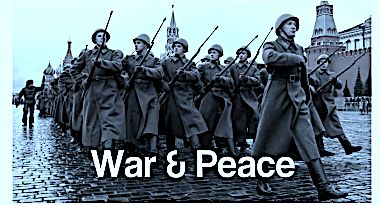
 Judge Napolitano

| Traducir—Translate! | |
| Make fonts bigger>>> | [wpavefrsz-resizer] |

Streamed live 12 hours ago (OCT 1, 2025)
Summary
The video features Judge Andrew Napolitano hosting a discussion primarily focused on the evolving situation in Russia and Ukraine as of October 1, 2025. The key guest, Professor Gilbert Doctorow, provides a nuanced analysis of Russia’s internal political climate, public sentiment, and the ongoing war in Ukraine. The dialogue explores the rising criticism within Russia’s political and elite circles toward President Vladimir Putin’s cautious military strategy and his restrained response to NATO’s incursions. There are indications of dissatisfaction among Russia’s political class and hints of a potential palace coup against Putin, although his general popularity among the working class remains relatively stable due to economic benefits they have experienced despite the war. The discussion also touches on the strategic implications of the war’s slow pace, the impact of Western sanctions and military aid to Ukraine, and the psychological warfare being waged by U.S. political figures such as Donald Trump and others, who publicly mock Russia’s military capabilities to unsettle Moscow’s leadership. The conversation ends with reflections on the uncertain future of the conflict, including the possibilities of a shift to a more aggressive Russian military stance or leadership changes in Moscow, highlighting the complexity and fluidity of the situation.
Key Insights
-
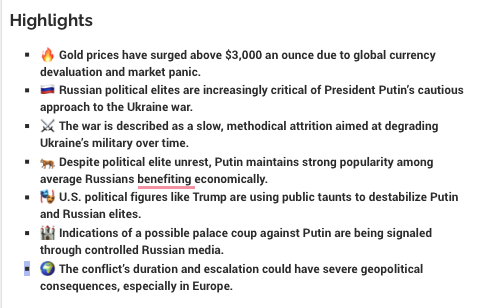
Gold as a Safe Haven Amid Currency Instability: The dramatic rise in gold prices reflects widespread distrust in paper currencies globally, with investors seeking tangible assets to preserve wealth. The narrative highlights how geopolitical instability and financial uncertainty are intertwined, driving demand for gold. This underscores the interconnectedness of global finance and geopolitics, where war and economic policies directly influence market behavior.
-
Internal Russian Elite Dissatisfaction vs. Popular Support: The divide between Russia’s political elite and the general populace is crucial. While working-class Russians enjoy economic gains such as higher salaries and subsidies despite the war, the political class is frustrated with Putin’s slow war strategy and perceived indecisiveness. This schism could destabilize governance if elite dissatisfaction translates into political action, indicating potential vulnerabilities in authoritarian regimes when faced with prolonged conflict.
-
Putin’s War Strategy: Attrition and Patience: The war is characterized as a war of attrition, deliberately slow to methodically degrade Ukrainian military capabilities for future security. This strategy reveals a long-term perspective rather than quick victory, suggesting Putin aims to weaken Ukraine over generations rather than through decisive battles. This approach, while cautious, risks prolonged conflict and escalates the potential for further international involvement and instability.
-
Psychological Warfare by Western Political Figures: The video reveals a deliberate use of public insults and provocations by figures like Donald Trump and U.S. officials as a tactic to unsettle Russian leadership and elite morale. This shows that modern conflict extends beyond battlefield engagements into information and psychological domains, where public narratives and media influence play strategic roles in political pressure and destabilization efforts.
-
Signals of a Potential Palace Coup: The increasing open criticism of Putin on Russian state-controlled television and discussions of leadership dissatisfaction suggest that factions within Russia might be preparing to challenge Putin’s authority. Although a coup would be illegal and dangerous, the video notes that historical patterns show such moves are often framed as necessary reforms to maintain stability, reflecting the opaque and precarious nature of elite power struggles in authoritarian contexts.
-
Restricted Media Access and Information Warfare: Difficulties in accessing Russian media programs from the West hint at the ongoing battle over information control. Both sides attempt to manage narratives, restrict opposing viewpoints, and influence international perceptions. This emphasizes the vital role of media and technology in modern conflicts, where information access can shape global understanding and diplomatic decisions.
-
Uncertain Future and Escalation Risks: The discussion closes with the acknowledgment that the future trajectory of the war and Russian politics remains unpredictable. The possibility of escalation to tactical nuclear strikes or leadership changes looms, and the extended conflict risks provoking further militarization in Europe. This uncertainty underscores the fragile nature of peace and the constant risk of sudden, transformative developments in geopolitical crises.
Extended Analysis
The video offers a comprehensive examination of the multifaceted crisis surrounding Russia’s war in Ukraine. Professor Doctoro’s insights illuminate the complex interplay of military strategy, political stability, public opinion, and international pressure. The slow, attritional approach to warfare suggests a leadership focused on long-term degradation of Ukraine’s military strength rather than rapid conquest, which frustrates some Russian elites who may desire a more decisive outcome. This internal conflict within Russia’s ruling class could weaken Putin’s grip on power and open the door to political upheaval.
The economic context is equally significant. Despite the ongoing conflict, many ordinary Russians experience economic improvements, which bolsters Putin’s popular support base. This economic cushion may explain why public approval remains high even as dissatisfaction spreads among the elites. It highlights how economic factors can provide authoritarian leaders with resilience during crises, complicating predictions about regime change.
Western political figures’ use of public taunts as psychological warfare reflects the modern nature of conflict, where media narratives and symbolic gestures are weaponized to erode adversaries’ morale. These tactics complement traditional military confrontations and emphasize the hybrid nature of contemporary geopolitical struggles.
Concerns about a potential palace coup reveal the delicate balance within Russia’s political system, where loyalty, power struggles, and perceptions of leadership efficacy shape the stability of the regime. Russian state media’s role in signaling elite dissent while maintaining control demonstrates the regime’s attempt to manage internal dynamics carefully.
Lastly, the video underscores the broader geopolitical stakes. The war’s continuation threatens to escalate tensions in Europe, potentially drawing in NATO and increasing risks of wider conflict. The future could bring either a negotiated peace, a shift to more aggressive Russian military actions, or a sudden political upheaval in Moscow, each with profound global consequences.
This detailed analysis, paired with market commentary on gold and economic indicators, paints a holistic picture of the interconnectedness of war, politics, economics, and global stability in this critical moment in history.
BEFORE you leave, PLEASE pay attention to this alert.
[t4b-ticker id=”1″]
[/su_spoiler]
Print this article [bws_pdfprint display=’print’]
[su_note note_color=”#f1efef” radius=”0″]The views expressed herein are solely those of the author and may or may not reflect those of The Greanville Post, although, if we publish them, we obviously find them noteworthy and valuable. [/su_note]
 This work is licensed under a Creative Commons Attribution-NonCommercial 4.0 International License •
ALL CAPTIONS AND PULL QUOTES BY THE EDITORS NOT THE AUTHORS


1 comment
I watched the entire interview this morning and I’m not sure that the West will be delighted if Doctorow is correct and has identified an important trend within the Russian citizenry. In a few hours (maybe a few minutes) Putin is expected to give an important speech that may have direct ramifications on, and may in fact be influenced by, the growing public opinion trends that Doctorow has identified. If the West is not happy with Putin and they would be pleased to see him go, they could be even more unhappy with who comes after. Alternatively, and more likely, Putin will adapt Russia’s strategy to be better in line with shifting public opinion, or he will speak directly to the citizenry in an effort to influence public opinion by explaining the wisdom and rationale of his current policy. The West is suffering a catastrophic defeat in Ukraine and it will be very interesting to see what Putin has to say in his upcoming speech. I think the West is entirely displeased with the deepening mess they have created in Ukraine and I expect Putin will provide an important announcement that will only increase their displeasure.