
[su_spoiler title=”Please make sure these dispatches reach as many readers as possible. Share with kin, friends and workmates and ask them to do likewise. ” open=”yes” style=”fancy” icon=”arrow-circle-1″]

 Ben Norton
Geopolitical Economy Report
| Traducir—Translate! | |
| Make fonts bigger>>> | [wpavefrsz-resizer] |

Summary
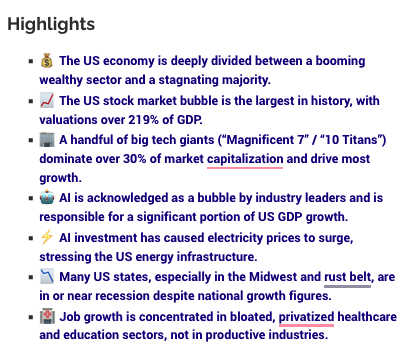
The video provides a comprehensive analysis of the current state of the United States economy, revealing deep structural problems masked by aggregate growth figures. While the headline US GDP and stock market indices suggest economic strength and growth, the reality for most Americans is quite different: a bifurcated economy where the rich—particularly the top 10%—benefit disproportionately, while the majority experience stagnation or recession. The economy of the wealthy is driven by massive financial and tech bubbles, especially in the stock market and artificial intelligence (AI) sectors. These bubbles have reached unprecedented levels, with the stock market’s valuation exceeding 219% of GDP, far surpassing previous historical peaks. The concentration of wealth and stock ownership in a handful of big tech companies—the so-called “Magnificent 7” or “10 Titans”—is extreme, with these few corporations driving most market growth while the rest of the economy remains stagnant.
The AI sector, heavily invested in by these tech giants, is also in a bubble, acknowledged by industry leaders like Sam Altman and Jeff Bezos, though Bezos frames it as a “good” industrial bubble. However, data shows that the majority of AI projects are failing to generate profits, and much of the stock price growth is driven by speculative investment rather than real economic value. This financial bubble is propping up the illusion of growth, while the real economy—especially in regions like the Midwest and Rust Belt—is in decline, with many states already in or at high risk of recession.
The video also highlights how AI investment is disproportionately influencing GDP growth, with some economists estimating that AI-related capital expenditures account for over 90% of US GDP growth in early 2025. This bubble is so large that it has caused electricity prices to soar due to the massive energy demands of AI data centers, compounding economic challenges. Government policies, particularly under the Trump administration, are criticized for favoring fossil fuel interests over renewable energy development, worsening the energy supply problem.
Finally, while sectors like healthcare and education are adding jobs, these are largely due to bloated, privatised, and inefficient industries rather than genuine economic health. The overall message is a warning: the US economy’s apparent strength is an illusion fueled by financial and tech bubbles that will eventually burst, causing severe damage to the broader economy and worsening inequality.
BELOW: Ignoramus Trump listening piously to Sam Altman, OpenAI-ChatGPT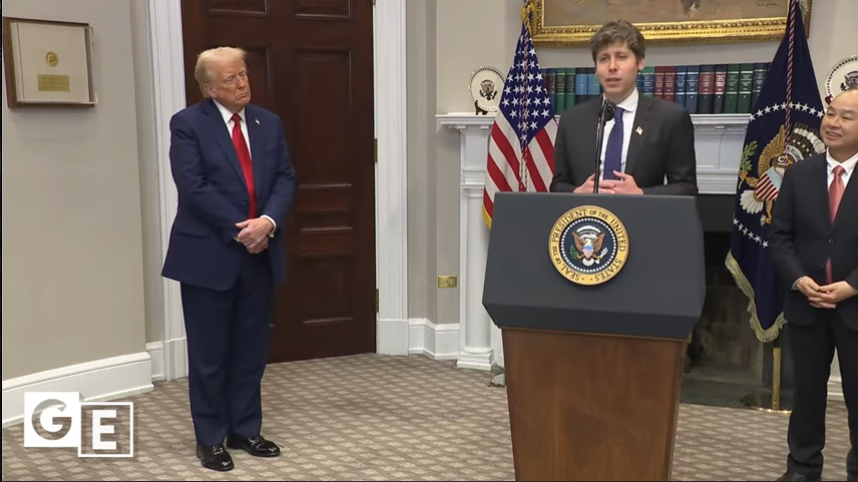
Key Insights
-
Economic Bifurcation and Inequality: The US economy is split into two distinct realities: a financialized economy benefiting the top 10%, and a stagnant or recessionary economy experienced by the majority. This bifurcation highlights systemic inequality and challenges the narrative of broad-based economic growth. The richest 10% account for nearly half of all consumer spending and a third of GDP, showing how skewed economic benefits have become. This concentration of economic power exacerbates social and economic divides and undermines overall economic resilience.
-
Unprecedented Stock Market Bubble: The Buffett indicator reveals that the US stock market’s valuation is more than double the size of the economy (219% of GDP), dwarfing previous bubbles like the dot-com and 2007 housing bubbles. This extreme overvaluation signals a highly unstable financial environment, driven more by speculation than fundamentals. The concentration of market cap in a tiny fraction of companies (0.12% of firms holding 30% market cap) further increases systemic risk, as the performance of the entire market hinges on a small number of tech giants.
-
️ The Tech Bubble and AI Speculation: The “Magnificent 7” (later expanded to 10 Titans) dominate market growth, fueled by massive AI investments. Despite heavy spending, 95% of AI pilot projects fail to generate profits, indicating a disconnect between investor enthusiasm and real economic returns. This speculative behavior, where fund managers collectively acknowledge overvaluation yet continue to invest, mirrors past irrational bubbles and suggests the market is driven by herd mentality rather than sound economics.
-
⚡ AI Investment’s Impact on the Economy and Energy: AI capital expenditure has become a major driver of GDP growth, possibly accounting for over 90% of growth in early 2025. However, the cost is enormous: AI data centers consume massive amounts of electricity, causing US energy prices to soar amid constrained supply. Government policies that hinder renewable energy development worsen this problem, creating a paradox where AI growth strains the very infrastructure needed to sustain it. This dynamic increases operational costs across the economy and risks undermining long-term economic stability.
-
Regional Economic Disparities and Recession Risk: Aggregate GDP growth masks significant regional disparities. States in the Midwest and rust belt, often dependent on manufacturing and deindustrialized, face recession or high risk thereof. These areas, representing a third of US GDP, are economically neglected compared to booming states like California and Texas, driven by tech and finance bubbles. This geographic divide has profound social and political implications, as large populations face economic hardship despite national prosperity narratives.
-
Job Market and Sectoral Imbalances: Job growth is minimal or negative across most sectors, except for healthcare and education, which expand due to demographic trends and inefficient, bloated privatized systems rather than genuine economic vitality. These sectors’ growth reflects systemic inefficiencies and rising costs, burdening average Americans with high expenses and limited benefits. This uneven job market underscores the fragility of the real economy beneath headline growth figures and points to structural weaknesses in labor markets.
-
⚠️ Systemic Risk of Bubble Bursting: The video warns that the stock market and AI bubbles are unsustainable and will eventually burst, potentially triggering a severe economic downturn affecting the entire country and even global markets. The financialization of the US economy means that a bubble collapse would devastate not only Wall Street elites but also the broader economy that depends on these sectors for growth. Policymakers and investors face profound challenges in managing this risk, as history shows bubbles can inflate well beyond fundamental values before collapsing, causing widespread economic damage.
Conclusion
The video offers a sobering and well-substantiated critique of the US economy’s current condition. Beneath the surface of aggregate growth and stock market highs lies a deeply divided economy where the majority of Americans face stagnation or recession. The enormous stock market and AI bubbles, centered on a handful of tech giants, create an illusion of prosperity that masks systemic inequality and regional economic distress. The overreliance on speculative investment and AI spending to drive growth is unsustainable and poses significant risks to the future stability of the US and global economies. The video calls for greater awareness of these structural problems and cautions that the eventual bursting of these bubbles will have far-reaching consequences.
BEFORE you leave, PLEASE pay attention to this alert.
[t4b-ticker id=”1″]
[/su_spoiler]
Print this article [bws_pdfprint display=’print’]
[su_note note_color=”#f1efef” radius=”0″]The views expressed herein are solely those of the author and may or may not reflect those of The Greanville Post, although, if we publish them, we obviously find them noteworthy and valuable. [/su_note]
 This work is licensed under a Creative Commons Attribution-NonCommercial 4.0 International License •
ALL CAPTIONS AND PULL QUOTES BY THE EDITORS NOT THE AUTHORS


1 comment
Ben Norton gave an excellent big picture breakdown of how the US economic/financial edifice is breaking down.
Here are other examples of how their systems are breaking down:
US soybean farmers voted for Trump, who then started a tariff war with China, causing China to cancel all newcrop soybean imports from USA, which will bankrupt many US soybean farmers.
Meanwhile USA bails out Argentina with $40 billion, helping Argie farmers export soybeans to China, contributing to bankruptcy of US soybean farmers.
You cannot make this up!!!
Trump is truly a stable genius!!!
https://www.youtube.com/watch?v=yjLu7107qfk
More heeelarious misery about the US soybean crash.
So sad it makes you laugh.
So funny it makes you cry.
https://www.youtube.com/watch?v=k8mzw7FOj5U
But that is just one “small” example of how stable genius Trumpty Dumpty is (mis)handling the US economy.
Eight Asian auto makers are pulling out of the USA, with loss of 42,000 US jobs. Of course, Trumpty Dumpty will never admit that ICE wrongfully arresting 300+ Koreans setting up a factory in the USA has anything to do with it. https://www.youtube.com/watch?v=Aja0Jno0q8g
https://youtu.be/0q0x1VBIFBo?si=8c2Nu_YdW4jljhS1
Over in wooden clog land…
The USA strong armed their Dutch poodles to confiscate the Chinese owned Netherlands based Nexperia company, causing the Chinese parent company to cut ties with that subsidiary and freeze all chip deliveries. This will have disastrous downstream effects for multitudes of European chip customers eg car companies, freezing their production lines and further damaging the collapsing European economies.*
https://www.youtube.com/watch?v=thFAZWZpgrU
Happy days!!
*Nexperia Netherlands lesson to the rest of the world: the people in those nether-regions are untrustworthy, do not invest there.