
[su_spoiler title=”Please make sure these dispatches reach as many readers as possible. Share with kin, friends and workmates and ask them to do likewise. ” open=”yes” style=”fancy” icon=”arrow-circle-1″]
 Danny Haiphong
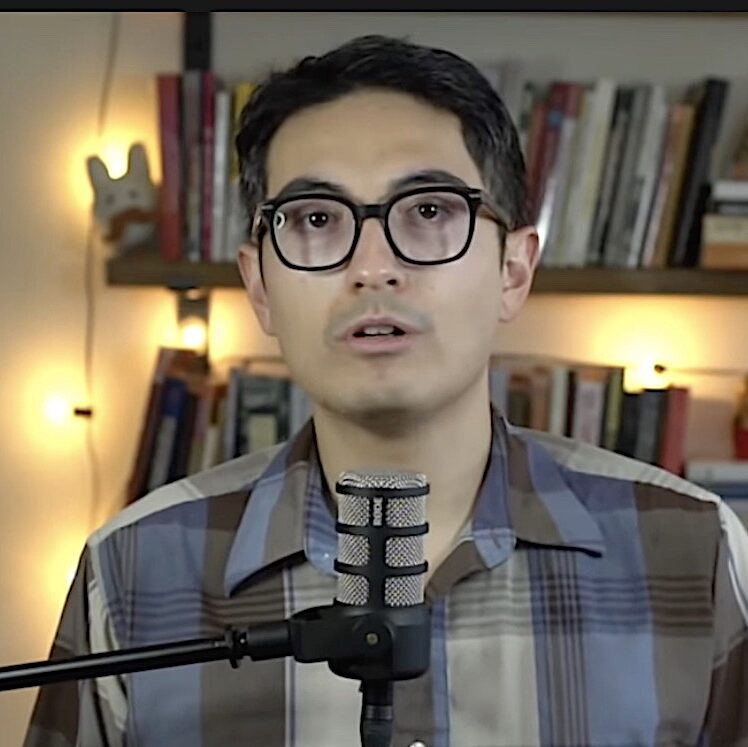 CHATS WITH
Mnar Adley • Katie Halper • Rachel Blevins • Camila Escalante
| Traducir—Translate! | |
| Make fonts bigger>>> | [wpavefrsz-resizer] |
Summary
The video presents a comprehensive discussion led by host Danny High Fong with a panel of expert journalists and commentators—Camila Escalante, Rachel Blevins, Mnar Adley, and Katie Halper—analyzing the current state of U.S. foreign policy under Trump’s return to power, focusing on its geopolitical consequences and failures. The conversation covers Trump’s faltering trade war with China, the ongoing conflicts in West Asia, especially Gaza, and looming U.S. military actions against Venezuela. The experts dissect the broader implications of U.S. imperialism, neocolonialism, and the motivations behind these conflicts, emphasizing resource control and geopolitical dominance rather than humanitarian concerns. The panel also highlights the growing fractures within the U.S. political right, including Trump’s base’s shifting attitudes towards Israel and U.S. wars abroad. They examine the narrative collapse surrounding U.S. propaganda efforts, particularly in Latin America, and the resilience of targeted countries like Venezuela and Sudan. The discussion culminates in reflections on the weakening U.S. empire, the rise of a multipolar world led by China, Russia, and allies, and the role of alternative media in exposing these realities.
Key Insights
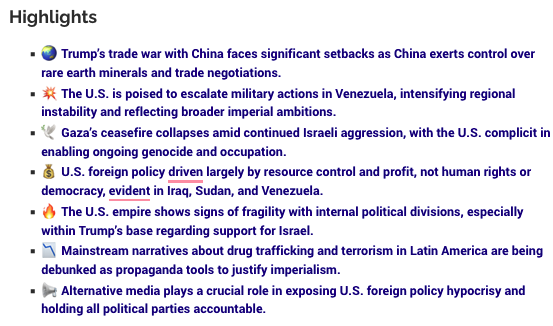
- Geopolitical Shift and U.S. Decline: The discussion reveals a clear pattern of the U.S. empire’s weakening grip on global affairs. China’s leverage over rare earth minerals and the Belt and Road Initiative, alongside Russia’s military resilience, underscores a multipolar world where U.S. unilateralism is increasingly untenable. This is exemplified by Trump’s concessions to China and the inability to resolve Ukraine’s conflict on U.S. terms. The empire’s pivot to “easier” targets like Venezuela reflects strategic recalibration rather than strength.
- ⚔️ Imperialism Masked as Counter-Narcotics and Democracy Promotion: The U.S. military operations in the Caribbean and Latin America, including the designation of Venezuelan groups as terrorists and drug traffickers, are largely a facade for resource extraction and geopolitical control. These actions violate international law and amount to covert warfare against sovereign nations, revealing imperialism’s true face beyond humanitarian rhetoric.
- ️ Venezuela’s Preparedness and Resistance: Contrary to U.S. expectations of a quick regime change, Venezuela’s robust military capabilities (e.g., S-300 missile systems), widespread militia mobilization, and regional solidarity present a formidable defense. This resilience is rooted in long-standing Bolivarian revolution efforts and external support from Russia and China, signaling that imperial ambitions will face strong resistance and potential quagmires.
- ️ The Privatization of War and Reconstruction: The panel highlights how U.S. and Israeli interests view war zones like Gaza not as humanitarian crises but as opportunities for real estate and corporate profiteering. The reconstruction plans are designed to benefit investors and multinational corporations rather than the displaced populations, continuing a cycle of destruction and exploitation seen in Iraq and other theaters.
- Narrative Collapse and Propaganda Failures: The U.S. attempts to link leftist governments in Latin America to drug cartels and terrorism are increasingly exposed as falsehoods intended to justify sanctions and coups. Simultaneously, the Palestinian struggle is misrepresented or erased in U.S. discourse, despite clear evidence of genocide, leading to growing skepticism and resistance both domestically and internationally.
- Fractures Within the U.S. Right and Shifting Public Opinion: The conversation uncovers a surprising shift within parts of Trump’s base, including influential conservative Christian figures, who are increasingly critical of Israel’s actions and the U.S.-Israel alliance. This fracture reflects broader disillusionment with establishment narratives and could influence future U.S. foreign policy dynamics.
- The Importance of Alternative Media in Exposing Truth: The panel stresses the critical role alternative media outlets play in countering mainstream misinformation, censorship, and propaganda. They provide nuanced perspectives on U.S. foreign policy failures and hold both Democratic and Republican parties accountable for their complicity in ongoing wars and imperialist ventures.
Expanded Analysis
The video’s core theme is the systemic failure and contradictions of U.S. foreign policy under Trump’s renewed administration. The first major focus is the U.S.-China trade war, where Trump’s aggressive tariff strategies have backfired due to China’s dominant control over rare earth minerals essential for military and technological applications. This reality forces Trump to concede and reconsider his approach, exposing the limits of American economic coercion against a rising global power. Meanwhile, China’s Belt and Road Initiative (BRI) and its alliance with countries like Sudan, which faces U.S.-backed destabilization efforts, show a broader strategic contest unfolding beyond mere trade disputes. The U.S. is reacting defensively, often through proxy wars and sanctions rather than direct confrontation, revealing a decline in unipolar dominance.
Parallel to this is the U.S.’s intensifying focus on Venezuela. The panel explains that U.S. military strikes in Venezuela are imminent, driven by the desire to control the country’s vast oil, gold, and mineral resources under the guise of combating drug trafficking. However, the experts emphasize that these claims are fabricated or exaggerated to justify intervention. Venezuela’s defense capabilities, bolstered by Russian military aid and a large, politically motivated militia, make a successful U.S. incursion highly risky. Moreover, the region’s political dynamics, including the upcoming inauguration of a right-wing government in Bolivia and U.S. influence over neighboring countries, reflect a concerted effort to undermine leftist governments and reassert neocolonial control.
In West Asia, the panel discusses the ongoing genocide in Gaza, spotlighting the catastrophic humanitarian consequences of Israeli occupation supported by the U.S. government. The ceasefire is depicted as fragile and largely performative, with Israel continuing violations and further land seizures in the West Bank. The reconstruction plans for Gaza are condemned as profiteering schemes designed to enrich U.S. and Israeli capitalists rather than aid the Palestinian people. This underscores the imperialist logic of war as business, where destruction is a prelude to privatized rebuilding and economic exploitation.
The conversation also explores a significant socio-political development within the U.S.: the erosion of unconditional support for Israel among some conservative Christian factions and segments of Trump’s base. Figures like Candace Owens and Tucker Carlson, despite their broader problematic stances, are cited as shifting opinions by criticizing Israeli policies, which could signal a realignment in U.S. domestic political attitudes toward the Middle East. This internal division complicates the traditional bipartisan consensus on foreign policy and could influence future U.S. strategies.
The panel critically examines the systematic narrative construction used by the U.S. to delegitimize left-wing governments in Latin America by associating them with drug trafficking and terrorism. This propaganda serves to justify sanctions, military interventions, and political destabilization. The experts argue that this narrative is collapsing under the weight of contradictory evidence and increased public awareness, partly due to social media and alternative journalism exposing these falsities.
Finally, the role of alternative media is lauded as essential in the current geopolitical climate. Unlike mainstream outlets that often serve establishment interests, these independent voices provide critical analyses, fact-checking, and coverage of underreported issues, helping audiences understand the complex realities behind U.S. foreign policy decisions. The panel encourages continued support for such media as a means to challenge imperial narratives and foster informed activism.
Conclusion
This in-depth discussion paints a sobering picture of the current U.S. foreign policy landscape under Trump’s second term, revealing a pattern of imperial overreach, strategic miscalculations, and growing domestic and international resistance. From the faltering trade war with China to the looming military strike on Venezuela, and from the ongoing Palestinian genocide to the destabilization of Sudan, the U.S. empire is revealed as desperate yet increasingly constrained. The shifting attitudes within the U.S. political right and the critical role of alternative media offer some hope for greater accountability and resistance to imperialist agendas. However, the path forward remains fraught with challenges as global powers recalibrate and the multipolar world continues to emerge.
BEFORE you leave, PLEASE pay attention to this alert.
[t4b-ticker id=”1″]
[/su_spoiler]
Print this article [bws_pdfprint display=’print’]
[su_note note_color=”#f1efef” radius=”0″]The views expressed herein are solely those of the author and may or may not reflect those of The Greanville Post, although, if we publish them, we obviously find them noteworthy and valuable. [/su_note]
 This work is licensed under a Creative Commons Attribution-NonCommercial 4.0 International License •
ALL CAPTIONS AND PULL QUOTES BY THE EDITORS NOT THE AUTHORS


1 comment
The great mistake of Americans is that they saw Mr. Trump as a joke. His second election makes them aware that he is not. He is like a militant Theodore Roosevelt, dedicated to Empire. For that he is fully on the side of big business which Roosevelt was not. And Trump prepares the US population for the efforts of Empire, to be a tough, taut and hard nationalistic “Volk”. That is more difficult to do with the Americans to Mr. Trump’s frustration than with the self- disciplined Germans. Empire is bloody and not easy as Napoleon already recorded, it slowly is eaten away by the small mice in an Alvaro Enrique type manner.