
[su_spoiler title=”Please make sure these dispatches reach as many readers as possible. Share with kin, friends and workmates and ask them to do likewise. ” open=”yes” style=”fancy” icon=”arrow-circle-1″]

Elina Xenophontos
| Traducir—Translate! | |
| Make fonts bigger>>> | [wpavefrsz-resizer] |
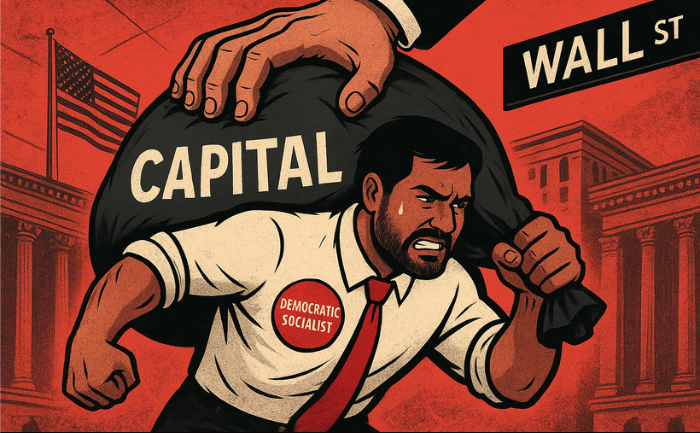
Although I understand the enthusiasm of many in reaction to Zohran Mamdani’s success in the recent NYC elections — it is quintessential to apprehend the structural limitations that shall obstruct his agenda, and the potential long-term consequences that his election can have upon the American left.
Being a Democratic Socialist, Mamdani believes that socialism can be achieved via the gradual implementation of reforms within the existing state apparatus. In other words, Democratic Socialists believe that the liberal-capitalist structures that have been put in place to serve the interests of profit-driven capital, can simultaneously serve as the medium by which to advance working class interests. Such a contradiction however fails to account for the inherent class antagonisms embedded within capitalist society.
Democratic Socialism is thus premised upon an ideological fallacy that fails to accurately assess the internal economic dialectics of capitalism, the base, and its relationship with the superstructure. This critical miscalculation has historically coerced even the most well-intentioned advocates of Democratic Socialism to concede to capital – ultimately betraying the working class interests that they were meant to represent.
This inherent failure is clearly illustrated by Mamdani’s policy proposals when analysed within the structural framework of the U.S. capitalist mode of production — that is both legally and economically, not designed for redistribution. Rather, its institutional infrastructure is primarily geared towards the preservation of private property, financial markets, and inter-state competition.
Thus, in this article I shall outline some of the key policies that Mamdani has proposed in his campaign, and assess their materialist limitations within the capitalist superstructure of the U.S financialised system.
The Mamdani Plan: A $100 Billion Housing and Welfare Agenda
Throughout his political campaign, Mamdani has outlined an ambitious social welfare program. This program would include substantial social housing policies, such as: rent freezes for all tenants living in rent-stabilized apartments, and the construction of 200,000 new rent-stabilized units over the course of the next decade, which would be built and developed by the public sector. Mamdani has also pledged to increase the funding for NYC’s housing agencies, such as the the NYC Department of Housing Preservation and Development’s (HPD), the Department of City Planning (DCP), and the New York City Housing Authority (NYCHA) – as well as funding for all government social programs that produce 100% affordable housing.
Such programs would include the Senior Affordable Rental Apartments Program, which produces 100% affordable low-income housing for seniors, and an increase in HPD’s Extremely Low and Low-Income Affordability Program, which produces 100% affordable housing for families of four, who earn less than $72,000 annually.
Mamdani has also stated that he plans to expand upon the NYC Human Resources Administration’s Master Lease Program, which helps create subsidized housing for families at risk of eviction.
To fund such a socially progressive housing agenda, Mamdani has stated that he shall “commit $100 billion over the next 10 years,” by targeting the wealthiest sectors in NYC. More specifically, he pledged to raise the Corporate Tax rate that currently stands between 6.5% and 7.2%, to 11.5% — replicating the Corporate Tax rate of New Jersey. According to Mamdani, this would raise $5 billion a year in revenue for NYC. Similarly, Mamdani wants to impose a 2% increase on the New York City Income Tax that currently stands at 3.9%, for anyone making over $1 million a year – which would allegedly accumulate $4 billion in annual tax revenue.
This amounts to almost $10 billion a year in tax revenue, specifically for housing – more than quadrupling the capital funding for housing, that currently stands at $2.6 billion per year.
Other vital social programs and policies promoted by Mamdani would include, universal childcare, city-owned grocery stores, free bus transportation for New Yorker City residents, and an increase in minimum wage from $16/hour to $30/hour.
These ambitious social programs however, face significant legislative and federal obstacles that have been established in order to safe-guard the interests of capital — hence re-affirming the Marxian notion that the superstructures are established in order to preserve the base, and vice versa.
Dillon’s Rule, State Authority, and the Preservation of Capital in U.S. Governance
Given that the US is a federal state, the legal framework for minimum wages, corporation tax, income tax, and healthcare — is exclusively set at the state level, not the local one. As per Dillon’s legal doctrine, under the U.S. federal system — states hold significant power, whilst cities are legally considered as “creatures of the state.”
This principle dictates that municipal governments only have the powers that are either: expressly granted to them by the state, implied from those granted powers, or essential to the municipality’s existence.
The legislative authority of the State of New York reaffirms this very principle within its own Constitution, under Article IX. Therefore, as per the very legal structure of the US Federal system — the State Legislature and Governor in Albany retains ultimate authority over matters of “state concern.” Healthcare, insurance regulation, minimum wages, and major taxation, are unequivocally considered matters of state concern.
In practice, this effectively means that cities like New York can propose local ordinances, but they can’t exceed certain thresholds without the approval of the State Legislature and the Governor of New York. In fact, the so-called “moderate” Democratic Governor of New York, Kathy Hochul, has stated that Mamdani’s Progressive Tax proposal, and his aim to increase Corporation Tax, are “out of the question” — already obstructing key principle policies that Mamdani requires in order to execute his ambitious social welfare programs.
Consequently, if Mamdani attempts to; establish universal childcare, increase Corporation Tax to 11.5%, raise Income Tax for the 1% by 2%, and set a $30/hour Minimum Wage —the Governor shall out-right reject it, and the State legislator would simply pre-empt it, meaning that they shall be considered legally void, as state law reigns supreme.
The reason for these administrative and legal obstacles, as aforestated, are rooted in the internal logic of capital, that strives to preserve surplus value at all costs. After all, the role of the State within bourgeois capitalism is not a neutral one, but rather, it is to create and maintain conditions favourable for capital accumulation (profit-making) – serving the interests of the owning class.
Policies that would double Corporation Tax, raise taxation for the most affluent members of society, increase minimum wage and establish universal childcare in the world’s largest finance capital — directly threatens the profit margins of the FIRE [ Finance, Insurance and Real Estate] sector, which is the very bread and butter of the NYC economy.
This would therefore endanger NYC’s interstate and global competitiveness, asphyxiating the very working class people that Mamdani is attempting to support. This is the consequence of capitalist mobility, that is a pillar of liberal democracies – as it permits the wealthiest of society to bypass such policies, by easily altering to cheaper geographic locations, and as such, placing the economic cost upon the working class itself.
Hostage to Capital: The Political Economy of New York’s Bourgeoisie
To illustrate this capitalist paradox, one of the core reasons that the bourgeois political class and its legislative branch would refrain from increasing Corporation Tax, is because it would diminish the profit margins of businesses in New York, and NYC specifically. Though distinct from Marx’s notion of the tendency of the rate of profit to fall (TRPF), these policy-driven squeezes on realized profit can accelerate the TRPF — especially in a financial capital such as NYC, that is already facing immense interstate and global competition.
For perspective, other States in the US, such as Texas, have no Corporation Tax at all — which has been attracting the largest corporations in the U.S that are seeking to increase their profit margins. In fact, New York’s Corporate Tax rate is already higher than the national average and much higher than other leading business-friendly states.
For comparison, the New York Corporate Tax rate is more than double the rate of states like North Carolina (2.5%) and Arizona (4.8%), and nearly seven times the rate of states with no Corporate Income Tax at all, like Texas, Nevada and Wyoming.
What’s more, is that New York’s tax system becomes even more burdensome and complex, when one considers the state’s unique combination of Capital Base Tax, Fixed Dollar Minimum Tax and the MCTMT — a unique combination of taxes that is not found in any other state, in addition to the NY’s higher Corporation Tax.
For context, Capital Base Tax is a tax on a company’s assets or investments in New York, not its profit – meaning that even if a company is not profitable or even losing money, it will still be taxed for having infrastructure, property, or equipment in New York. Very few states have a tax structured this way, and it is a major deterrent for capital-intensive businesses.
Similarly, Fixed Dollar Minimum (FDM) Tax, is a mandatory annual fee for the privilege of being incorporated in New York. This tax must be paid, even if the company has zero income, zero capital, and zero activity. While other states have franchise taxes, New York’s FDM can be very high (up to $200,000) for large companies, making it a fixed cost that doesn’t exist in no-tax states like Texas.
Finally, MCTMT (Metropolitan Commuter Transportation Mobility Tax), is a direct payroll tax on employers in the NYC area. Such a tax directly increases the cost of employing people in the state’s economic engine, making it more expensive to hire and retain talent compared to states without such a tax. The MCTMT in combination with Mamdani’s goal to double minimum wage, will significantly impact the profit margins of the business class in NYC, which shall have detrimental impacts on the working class, as we shall see later on in this article.
It is thus no coincidence that the New York Tax model has been consistently ranked as “poor” by independent organizations that analyse state tax codes. In fact, the Tax Foundation’s 2024 State Business Tax Climate Index, specifically ranked New York in the 49th position out of 50 states, for its overall business tax climate – identifying its Corporate Tax structure as the main cause for its inferior ranking.
Consequently, if Mamdani was to successfully convince the Governor of New York to increase Corporation Tax by almost double the amount, in a state that already ranks as one of the most tax-burdened states in the US — this would significantly impact the profit margins of bourgeoisie.
As the capitalist mode of production is geared by the need to constantly maximise profits — within the constraints of a system where profit is always diminishing due to relatively static demand — businesses will seek means by which to sustain their profit margins. Such means would include mass layoffs of workers, as surplus value is intrinsically tied to the exploitation of labour. This will become particularly aggravated if Mamdani were to succeed in doubling the minimum wage, which in conjunction with the MCTMT, would quadruple costs for capital – further incentivising mass layoffs.
Furthermore, in order to counter the impact on their profits, capital would choose to relocate to other cost effective hubs, such as Dallas in Texas, “where the booming financial district – nicknamed “Y’All Street” – benefits from a lower-tax and lower-regulation environment than New York.” This is precisely why The Telegraph just days ago, published an article stating that New York Bankers are fleeing to Texas.
In fact, just earlier this year, the New York Stock Exchange “announced plans to reincorporate NYSE Chicago as NYSE Texas, establishing its headquarters in Dallas”— “a move that places it in direct proximity to the Texas Stock Exchange—an upstart that has been drawing national attention since unveiling its plans last year.”
This trend becomes all the more lucid when one considers that major companies like Tesla, Oracle, Hewlett Packard Enterprise, and Charles Schwab, have moved their headquarters from California to Texas in recent years, whilst many of Wall Street’s back-office operations centres have moved to states like Texas, Florida, and North Carolina. Goldman Sachs for instance established an enormous campus in Dallas.
Up until this stage, although New York had a more significant tax burden for businesses — the reason they remained in NYC was primarily due to the fact that NYC is a dense, global hub for finance, tech, law and media — as well as a talent pool for hedge funds, financial analysts and traders. It also possesses key infrastructure and market access with direct flights to other major global financial and business centres, which is critical for international corporations.
However, these factors no longer remain exclusive to NYC, and if Mamdani was permitted to significantly increase Corporate Tax and Minimum wages within the current material realities of NYC — the unique benefits of being in NYC, that otherwise would “justify” the higher tax and operational costs — may diminish.
Therefore, any increase in Corporate Tax and the Minimum Wage—particularly without a corresponding rise in productivity—risks triggering a cascade of adverse effects. Businesses, facing higher operational costs, would likely respond by raising consumer prices and reducing their workforce. This would leave many workers confronting both unemployment and a higher cost of living. Simultaneously, the social programs that Mamdani would have put in place to serve the working class would themselves be undermined, as the very tax revenues they would depend on, would shrink due to declining business activity and investment.
This dynamic underscores the quintessential role of capital mobility in liberal-capitalist economies. The ability of capital to cross jurisdictional lines permits the bourgeoisie to evade redistributive policies, a manoeuvre that is particularly potent in a federal system like the United States. In praxis, this causes much of the burden of such policies to be passed down to the working class, that they are in fact meant to aid. Thus, any attempt by New York to fund social improvements by significantly taxing wealth would be instantly penalized by capital markets and corporate decision-makers.
Unlike other cities with a broader industrial base, the NYC economy is heavily dominated by the FIRE sector — meaning Finance, Insurance and Real Estate. This sector is the undisputed cornerstone of the city’s economy, functioning as the largest contributor to its GDP, a primary generator of high-wage employment, municipal revenue, and the central conduit for political influence, capital flows, and global investment.
Any policy perceived as a threat to FIRE sector profitability would erode investor confidence, depress asset values, and heighten the risk of capital flight. This would not only risk a fiscal crisis for New York City but could also jeopardize the stability of the broader U.S. economy, given the city’s critical role as the nation’s financial hub.
After all, NYC is the central nervous system of American capital, which is why the FIRE sector remains anchored in NYC, due to their dependence on federal infrastructure, such as the Federal Reserve, Treasury, SEC, and the global dollar system—which cannot be replicated elsewhere, constraining the full mobility of financial capital.
This is why it is important to note that while some capital may seek lower-tax jurisdictions in states like Texas, the structural dependence of the FIRE sector on federal infrastructure and the global dollar system— does limit full capital mobility, meaning that local policy shocks could still produce systemic consequences beyond NYC itself.
The long-term repercussions of a significant disruption to the profits of Wall Street couldpotentially cause a credit crunch, making loans more expensive and scarce for businesses, consumers, and municipalities nationwide. It could freeze the capital markets that companies rely on and undermine the U.S. dollar and Treasury market—that is the bedrock of the global financial system. In essence, the city’s financial industry is a critical piece of national infrastructure; its crisis would ripple into a tidal wave, causing mass job losses, skyrocketing borrowing costs, and a deep recession, proving that the stability of the entire U.S. economy is inextricably linked to the health of New York’s financial hub.
Within the structural framework of capitalism, such a crisis could be an opportunity for transnational conglomerates to; monopolise more of the market share by driving out small to medium size businesses who lack the requisite revenue reserves in order to withstand such a market crisis, which in turn numerically increases the available army of labour reserve to be exploited by the bourgeoisie. Such a crisis would also fuel stock and bond markets via the use of arbitrage opportunities, such as stock buy-backs and vulture capitalism — where private equity and hedge funds purchase distressed debt and companies at a deep discount, and sell them at a large profit margin.
This is the nature of capitalism. A financial crisis is not merely a market failure but a violent expression of capitalism’s inherent contradictions, functioning as a powerful engine for the centralization of capital. However, this strategy of “disaster capitalism” is a Faustian bargain; by relentlessly immiserating the proletariat and pushing the system toward a more profound collapse, the ruling class risks unleashing the very revolutionary conditions that could lead to its own expropriation.
Having stated the above, the impact that such a crisis in NYC shall have on the dollar, and its status as the global reserve currency, shall be the ultimate blow to US imperialism – a risk that the state, which is acting as the executive committee of the bourgeoisie — is not willing to take. This is precisely why the legislative and political leadership of New York, shall not permit the vast majority of Mamdani’s policies.
Even if they were to do so, the ultimate impact would deteriorate the material conditions of the working class to such a degree that it would offset the advantages of Mamdani’s social welfare programs.
Housing as a Contradiction: Use-Value vs. Exchange-Value in NYC’s Real Estate
Mamdani’s ambitious housing program, while socially progressive, also illustrates a fundamental structural contradiction under capitalism. By constructing large quantities of rent-stabilized housing directly through the state — with the state acting as a developer — the government enters into direct competition with private developers and construction firms. This would reduce revenues for construction companies and erode profitability in the broader real estate sector, which is a core component of NYC’s capital accumulation.
Additionally, the influx of state-built affordable units and freezing the rents for rent-stabilisedhousing — shall provide a substantial influx of cheaper rental alternatives for the average NYC citizen. More perspective, according to the current data, “nearly a million apartments in NYC are rent-stabilized, which accounts for more than 40% of all rental units in the city.”
If Mamdani therefore freeze the rents for 40% of the rental units of all NYC, throwing out the annual 3% increase, whilst also building an extra 200, 000 such units — this shall create a downward pressure on the broader rental market, as private-market tenants may substitute into the more affordable units. This risks diminishing property values and most crucially, reducing property tax revenues, that the city relies on to fund the very social programs intended to benefit the working class.
For context, as much as 45% of the city’s budget, stems from property taxes. In fact NYC primarily uses the income capitalization approach to value properties, meaning that the city doesn’t just tax the physical building; it taxes its assessed value, which is based on its potentialto make money, i.e. rent — generating a system that is built on the assumption that this value will always go up. Subsequently, within the parameters of the income capitalisation approach that is used to tax property in NYC — if Mamdani were to implement rent caps even on rent-stabilised property, this can cause the value of properties to depreciate over all. This shall in turn dramatically reduce the city’s tax revenue which is highly dependent on the speculative prices of the real estate sector — meaning that NYC will lose the much needed revenue it requires in order to fund the social programs that Mamdani is advocating for.
In Marxist terms, this demonstrates a tension between use-value and exchange-value: while housing as a use-value is expanded for residents, the exchange-value of real estate and the profitability of capital are suppressed. This contradiction underscores how even well-intentioned reforms can encounter structural limits under capitalism, as they collide with the imperatives of profit maximization, potentially triggering layoffs, capital flight, or reduced investment, all of which could inadvertently undermine the material conditions of the working class the policies aim to improve.
The housing crisis cannot be solved by building more affordable units or taxing the rich. It can only be resolved by the abolition of private property in land and the means of housing production—that is, the socialization of housing and land, removing them entirely from the circuit of capital accumulation. Mamdani’s plan, while perhaps the most progressive proposal on the table, is ultimately a fight for better terms within a system that is, by its nature, exploitative. The real conflict is not over tax rates or zoning, but over who controls the city—the class of landlords and financiers, or the class of tenants and workers.
Universal Childcare & Reform Within a FIRE-Dominated Economy
Mamdani’s proposed universal childcare would also directly threaten the profitability and structural dominance of the FIRE sector, particularly finance and insurance.
By shifting essential services from private provision to state provision, these programs would cut through the customer base of private insurers, hospital conglomerates, childcare corporations, and the private equity firms that increasingly own them — thereby eroding revenue streams, depressing asset values. As a consequence, this would make these industries less attractive for investment, which ultimately affects the speculative market bubble that is the NYC economy.
As aforementioned, given that the city’s fiscal architecture relies heavily on the profitability of the FIRE sector, any reduction in private-sector earnings would also diminish corporate, payroll, and commercial property tax revenues — once again undermining the very funding base required to sustain expansive social programs.
Moreover, universal healthcare and childcare would significantly increase worker bargaining power by reducing dependence on employers for survival, thereby weakening labour discipline and raising the cost of labour extraction—an outcome fundamentally at odds with the imperatives of capital accumulation.
Conclusion: Capitalism’s Discipline and the Fate of Democratic Socialism
For these reasons, the political class would reject a substantial number of Mamdani’s reforms, not merely out of ideological opposition, but because they threaten the material preconditions for profit, investment, and class domination.
Having said that, even if the state were to permit Mamdani to implement his ambitious social programs, all the benefits that would have been realised from their implementation, would instantly be offset by the inherent rules of capitalism. As NYC depends on the FIRE sector for its tax base, credit rating, property values, and employment; any policy that reduces their profitability, risks triggering capital flight, investor retaliation, bond market punishment, and a fiscal crisis — making socialist reforms structurally impossible.
This is how capitalism disciplines reform, which is why Mamdani’s policies, no matter how well intentioned, cannot materialise within the capitalist mode of production — especially within the current later stages of the capitalist US financialised economy. As the U.S is collapsing upon its own contradictions, it no longer has the tools to facilitate the sort of social welfare programs it once could, in order to subdue the class conscious awareness of the masses.
With debt and market speculation bubbles forming the basis of the US economy, as well as the competitive threat of China — the U.S has no choice but to bleed the working class in order to delay its inevitable demise. Either that, or the US must socialise its mode of production – something the bourgeoisie is unwilling to do.
Given that Mamdani’s policies will fail for the most part, this failure will not be blamed on the system, but on the reform itself — discrediting the socialist project for a generation. This is the trap of democratic socialism: it fights a war on a battlefield designed by its enemy, with weapons that are pre-set to fail. The outcome is not an advance, but a rout, and it’s the working class that will pay the price.
This is not to state that reforms themselves have not historically been progressive – they have. In fact, even prior to the October Revolution itself, reforms allowed the working class and peasantry to organise and mobilise against the state apparatus — setting the stage for revolution.
However the material conditions in the US at present, are vastly different, and as such, failures of perceived socialist politicians like Mamdani – will significantly undermine the faith of the working class in socialism, as well as other alternatives to capitalism.
As always, thank you to all my subscribers for supporting my work, especially the paid subscribers as my work is fully sponsored by all of you. I would not be able to do what I do without you. Whether it be via my Patreon, Substack, or you may Buy Me a Coffee – all contributions are seen and valued. Thank you all again

[su_note note_color=”#ebf1f7″ radius=”17″] Elina Xenophontos: As an international law and economic globalisation specialist, with years worth of experience in policy via the study of macroeconomics, I hope to use my knowledge and expertise to help others analyse the geopolitical economy. In order to combat imperialism we must arm ourselves with the power of knowledge, so as to mobilise and organise. This is what I hope to achieve via the work that I shall be producing, so as to help provide people with the tools requisite so as to combat the ruling capitalist class and its imperialist agenda.[/su_note]
 BEFORE you leave, PLEASE pay attention to this alert.
[t4b-ticker id=”1″]
[/su_spoiler]
Print this article [bws_pdfprint display=’print’]
[su_note note_color=”#f1efef” radius=”0″]The views expressed herein are solely those of the author and may or may not reflect those of The Greanville Post, although, if we publish them, we obviously find them noteworthy and valuable. [/su_note]
 This work is licensed under a Creative Commons Attribution-NonCommercial 4.0 International License •
ALL CAPTIONS AND PULL QUOTES BY THE EDITORS NOT THE AUTHORS

