
 Gabriel Salazar
HISTORIADOR

| Traducir—Translate! | |
| Make fonts bigger>>> | Resize text-+= |

Summary
In this episode of Diálogos Ciudadanos, hosted by the Universidad de las Américas, the distinguished Chilean historian, sociologist, and professor Gabriel Salazar offers a profound analysis of Chile’s current socio-political crisis within a global context. Salazar frames the present moment as one of unprecedented complexity and crisis, characterized by the collapse of neoliberal models, global political fragmentation, and a deep crisis of democracy and citizen representation. He highlights the erosion of traditional institutions and ideologies, the rise of populism and nationalist discourses, and the growing disconnection between citizens and the political class.
Salazar argues that the neoliberal economic model, once seen as unshakable, is now in crisis, and Chile represents a paradigmatic case of this failure. He contextualizes the political disillusionment in Chile through historical patterns of citizen marginalization and the failure of political representation for over two centuries. Importantly, he identifies a persistent crisis of democratic legitimacy, where voting has become a ritual devoid of genuine citizen mandate or empowerment.
The conversation touches on the failed attempts at constitutional reform in Chile, emphasizing the political elite’s resistance to genuine citizen participation and sovereignty. Salazar praises the spontaneous, leaderless social uprising of 2019 as a genuine expression of citizen dignity but laments the political class’s inability or unwillingness to respond meaningfully. He notes the retreat of citizens into local communities as a cultural, though not yet political, phenomenon of resistance and self-organization.
On the global stage, Salazar warns of the dangers of escalating geopolitical tensions, including the risk of nuclear conflict, while also observing the shifting alliances and the demise of a truly globalized neoliberal order. Regarding Chile’s future, he expresses cautious optimism rooted in the resilience of life and human dignity but stresses that real solutions must emerge from active, collective citizen engagement and a revived culture of sovereignty. Salazar calls for a reinvention of democracy, grounded in participatory, mandate-driven political processes, drawing on historical practices of popular accountability such as the “juicio de residencia.”
Key Insights
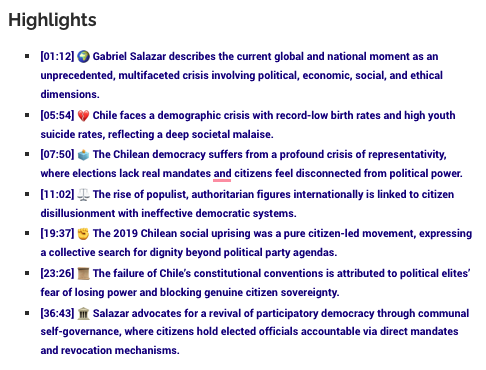
[01:12] 🌐 Unprecedented Global Crisis: Salazar situates the current era as a profound historical crisis marked by the breakdown of neoliberal capitalism, global political fragmentation, and the erosion of grand ideological narratives. This crisis is multifaceted—encompassing economic, political, military, and ethical dimensions—and cannot be fully understood or resolved by any single academic discipline or institution. It demands a holistic, human-centered approach that prioritizes the lived experience and agency of individuals. This insight is crucial for understanding why traditional political and intellectual frameworks fail to address today’s challenges.
[05:54] 📉 Demographic and Social Malaise in Chile: The drastic decline in Chile’s birth rate, now at a historic low of 1.16 (well below the replacement rate), paired with the highest youth suicide rates in Latin America, signals profound social distress. Salazar interprets these trends as symptomatic of a loss of meaning, community, and future orientation among Chileans. This demographic crisis reflects not only economic or policy failures but deeper cultural and existential ruptures, highlighting the urgency of reconnecting citizens to values of dignity, reproduction, and collective well-being.
[07:50] 🗳️ Crisis of Democratic Representativity: Salazar critiques the prevailing electoral system as a mechanism that reduces voting to a consumer choice devoid of real mandate or accountability. The secret, individual vote becomes a ritual that empowers political elites who are financially supported by citizens but remain unaccountable, leading to a cyclical pendulum of ineffective leadership. This systemic flaw breeds widespread political alienation and mistrust, contributing to the rise of populism and authoritarian appeals. Understanding this insight is essential for comprehending why democratic institutions are increasingly delegitimized in Chile and elsewhere.
[11:02] 🔄 Populism as a Symptom of Political Disillusionment: The success of populist leaders like Bolsonaro, Trump, and Meloni is linked to citizens’ frustration with political systems that fail to deliver solutions or represent their interests. Salazar explains that when democratic mechanisms are perceived as hollow, citizens may gravitate toward strongman figures promising direct, authoritarian action. Yet in Chile, a significant difference is the recent rejection of such figures, indicating a complex citizen response involving withdrawal from national politics and retreat into local communities—signaling potential for alternative forms of political engagement.
[19:37] ✊ 2019 Social Uprising as Citizen Dignity Reclaimed: The 2019 Chilean protests were unique in their leaderless, nonpartisan nature, representing a spontaneous collective assertion of citizen dignity and refusal to accept the status quo. Salazar emphasizes that this was not a mass movement following political leaders but a grassroots expression of widespread dissatisfaction and desire for meaningful change. This moment exemplifies the power of citizen agency outside traditional political frameworks and underscores the need for new models of political participation and sovereignty.
[23:26] 🏛️ Failure of Constitutional Reform Due to Elite Resistance: The political class’s fear of losing power led to the dilution and eventual failure of the constitutional conventions. Salazar highlights the contradiction between grassroots demands for popular sovereignty—embodied in proposals for binding communal assemblies—and the political elite’s maneuvers to maintain control through traditional electoral structures. This dynamic illustrates how institutional inertia and elite interests block democratic renewal, perpetuating systemic crises.
[36:43] 🗳️ Call for Participatory Democracy and Popular Sovereignty: Drawing on historical practices such as the juicio de residencia, Salazar advocates for a reinvention of democracy centered on collective deliberation, direct citizen mandates, and mechanisms for holding officials accountable, including revocation of office. This model contrasts sharply with the current disempowering electoral system and offers a pathway to restore citizen dignity and political efficacy. Salazar’s proposal resonates with global debates on democratic renewal and participatory governance.
[31:46] ⚔️ Global Geopolitical Tensions and the New World Order: Salazar warns that global powers are engaged in a precarious balance of power, marked by nuclear brinkmanship and shifting alliances. Although an all-out nuclear war is unlikely, the world is “playing at the limit,” with significant risks from military escalation and violations of international law. The end of the post-Cold War neoliberal globalization era introduces uncertainty and competition, affecting countries like Chile that have based their models on neoliberalism. This insight situates Chile’s crisis within broader global transformations, emphasizing interconnected challenges.
Conclusion
Gabriel Salazar’s interview offers a sweeping diagnosis of Chile’s political and social crisis, deeply intertwined with global upheavals and the disintegration of neoliberal consensus. His historical perspective reveals the persistent failure of political representation and democratic legitimacy, the emergence of citizen-led social movements, and the critical need to reimagine democracy as a participatory, mandate-driven process rooted in local communities. Salazar’s cautious optimism rests on the resilience of life and human dignity, calling for renewed citizen engagement to navigate the complex challenges ahead. His reflections provide invaluable context for understanding not only Chile’s present but also broader global trends in governance, democracy, and social cohesion.
 BEFORE you leave, PLEASE pay attention to this alert.
[t4b-ticker id="1"]
Print this article [bws_pdfprint display=’print’]
 This work is licensed under a Creative Commons Attribution-NonCommercial 4.0 International License •
ALL CAPTIONS AND PULL QUOTES BY THE EDITORS NOT THE AUTHORS

