Finian Cunningham


| Traducir—Translate! | |
| Make fonts bigger>>> | Resize text-+= |
Killing Democracy: Western Imperialism’s Legacy of Regime Change and Media Manipulation
EDITOR'S PREFACE
The authors—Finian Cunningham, Daniel Kovalik, Jeremy Kuzmarov, KJ Noh, Ron Ridenour—follow in the tracks of unbribable historians and political scientists like Gabriel Kolko, Michael Parenti, C. Wright Mills, Ed Herman, Charles Beard, and others, and of brave journalists like Wilfred Burchett, John Gerassi and James Aronson. They comprise a thin but unbroken line of anti-imperialist thinking and resistance.
As we stare into the abyss of a cynically camouflaged tyranny in much of the collective West, a system of stunning mendacity driving humanity inexorably to either nuclear war or massive impoverishment, their testimony is more precious than ever. Yet none of these voices is exactly a household name among Western publics, their marginalisation, as we could expect, the direct result of unrelenting corporate censorship, cultural ghettoisation, massive idiotic distractions (just think NFL matches and the obsession with Taylor Swift), and a regime of institutionalised disinformation and ignorance that permeates the consciousness of billions still imprisoned in the ludicrously labelled "Free World."
Our duty is therefore clear: We must learn the facts and share them clearly, urgently, and with the zeal of people fighting for their lives, because we are. With the remnants of our personal sovereignty and freedom we must fight for the construction of a just, rational, and truly compassionate world. At this point, with a long history pointing the way and warning about possible errors, the ultimate outcome cannot be doubted.
People fighting in the same trench as the authors have provided wonderful and well-deserved endorsements. This volume is really a genuine standout, a formidable tool to widen one's comprehension of history (most of the time alarmingly adulterated), its tightly packed wisdom easily outstripping shelffuls of similar works. Fascism by algorithm is already here. The lights are indeed going out all over the place. This publication, like many others of its kind could be gone tomorrow. In such circumstances, those who resist must become both medium and message.
Let me reiterate, therefore, my earlier request: Get the facts. Purify your mind of the accumulated garbage and confusion deposited there by a whorish and ubiquitous cultural system totally lacking in decency and even elementary morality. In other words, empower yourself. Disarm the politically noxious effects of the West's justly feared "soft power". Then plant your flag wherever you think it will do the most good, and act.
—PG
“Killing Democracy illustrates how the Western military-industrial-financial-digital-academic-media-complex has subverted democracy and led to wars and misery throughout the world. Where is hope? In resolute push-back by civil society, in the alternative media, in the awakening of the global majority. BRICS, SCO, BRI are gradually replacing the imperialistic neo-colonialism of the U.S. and Europe and moving toward multilateralism under the UN Charter.”
—Alfred de Zayas, United Nations Independent Expert on the Promotion of a Democratic and Equitable International Order. Author of The Human Rights Industry
“Killing Democracy provides a vital public service, sharply exposing the destructive actions of Western governments and the crimes they commit with the complicity of the so-called mainstream media. This important book functions as an antidote to state-corporate narratives, empowering the public against a system of rampant capitalism that exploits the global majority and gravely threatens our life-sustaining planet.”
— David Cromwell, Editor of Media Lens, and co-author with David Edwards of Propaganda Blitz: How the Corporate Media Distort Reality
Chapter 1
Illusory Democracy: From Imperialist Wars to Regime Change
Written by: FINIAN CUNNINGHAM
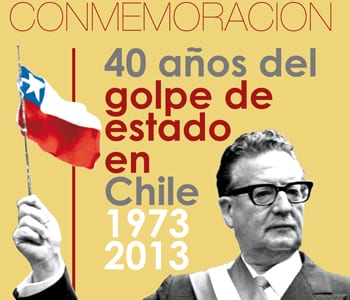
Henry Kissinger, who served as the National Security Advisor and Secretary of State to U.S. President Richard Nixon, had no qualms about the overthrow of Chile’s elected president in 1973. Kissinger said the CIA-backed coup was carried out to protect the U.S. position of power in the Western Hemisphere.
In his memoirs, he reflected on the coup by stating:
“I cannot accept the proposition that the United States is debarred from acting in the gray area between diplomacy and military intervention.”1
The “gray area” that Kissinger casually mentions is, in plain language, a criminal regime change – meaning the illegal interference in a sovereign nation to overthrow an elected government that the United States disapproves of.
This book surveys the history of U.S. regime-change operations, how the covert policy has been developed in the years after the Second World War, and how the U.S. and Western mainstream news media has systematically covered up the criminal policy.
The cumulative effect has been to afford impunity to successive U.S. governments and Western allies to continue repeating such interventions, even though regime change is explicitly outlawed under international law. The consequence is a fatal erosion of international law, leading to continual conflict in international relations as well as a hollowing out of Western democracies.
That Henry Kissinger could speak so casually about violating another nation reveals several facets: the myth of United States’ democratic virtue and proclaimed respect for international law; the callous disregard for destructive consequences of such action; and the lack of controversy in the Western media as a result of Kissinger’s criminal admission, which demonstrates how obedient Western media is in complying with assumed acceptable conduct.
Threat of a Good Example
 In September 1970, Chile elected socialist President Salvador Allende. Allende did not threaten the United States or express any hostility. His “threat” was merely being that of a good example. The United States feared that a socialist government in Chile would inspire the rest of the continent. Nixon and Kissinger set about unleashing the CIA to overthrow the Chilean government.
On news of the election, Kissinger remarked to a White House aide:
“I don’t see why we need to stand by and watch a country go communist due to the irresponsibility (sic) of its own people.”2
A U.S. economic blockade was imposed to make the Chilean economy “scream,” as Nixon put it. The ensuing hardship was designed to destabilize the Allende government. Then, the chief of the armed forces, General René Schneider, was assassinated on October 22, 1970, in an ambush organized by the CIA after he refused to lead a military coup against his president.3
In September 1973, Washington finally succeeded in staging a coup d’état led by General Augusto Pinochet. Allende is widely believed to have committed suicide in the presidential palace in Santiago as it came under full-scale military assault. Chilean democracy was destroyed by the “leader of the free world.” Pinochet headed a military dictatorship that lasted for 17 years. Thousands of Chileans were murdered, disappeared, and tortured by the new regime with the full support of Washington. It is estimated that, proportionate to the population, the number of Chilean people who were killed by the Pinochet regime is equivalent to 150,000 U.S. citizens. Kissinger would later congratulate Pinochet for his “great service to the West.”
Thus, the “gray area” of U.S. covert actions, which Kissinger matter-of-factly referred to, is far from dull and trifling, as he implies. It is bright red with the blood of countless people who have fallen afoul of Washington’s criminal subversion of their national sovereignty and democratic rights. As this book will show, numerous nations have been destroyed by the U.S. policy of regime change.
Since the end of the Second World War in 1945 and the establishment of the United Nations in the same year, it has been explicitly illegal under international law to interfere in the affairs of other nations. Regime change, economic coercion, and political destabilization by propaganda campaigns are violations of the UN Charter, which upholds the sanctity of national sovereignty and territorial integrity.
Of course, the most extreme form of foreign interference is the use of military force and aggression. That too is explicitly banned under the UN Charter. Military force can only be used under specific, limited conditions of self-defense.
Trashing the UN Charter
Even though the United States and its Western allies are signatories to the UN Charter as founding members, their signatures have not deterred them from violating international law. The case of Chile and the CIA-led coup to overthrow President Allende in 1973, replaced by a murderous military dictatorship, is a textbook example of criminality. Yet one of the architects of this crime, Henry Kissinger, showed no remorse, let alone faced prosecution. Kissinger was awarded the Nobel Peace Prize in 1973 for negotiating an end to the Vietnam War, a war that the U.S. had illegally started.
The “threat of a good example,” as presented by Chile, was repeated elsewhere, and each time the United States moved ruthlessly to destroy the “threat.” One of the earliest examples of regime-change policy in action was Iran in 1953, where a nationalist government led by an elected prime minister was overthrown by the CIA and British MI6 (see Chapter 3). Typically, the enemy of the Western powers is an independent government whose objective is the sovereign use of the nation’s resources to benefit the development of its people. Iranian Prime Minister Mohammad Mossadegh wanted to harness Iran’s oil wealth for his people rather than for British and American oil companies. For this “crime”, Washington and London got rid of Mossadegh and installed a monarch, the Shah, who ruled with an iron fist for the next quarter of a century and, importantly, ensured the flow of oil profits to his Western patrons.

Mural supporting Arbenz, and showing the US flag as a pirate flag. Not much has changed in 75 years.
Likewise, the socialist government of Guatemala in 1954, led by President Jacobo Árbenz, met the same fate (see Chapter 4). His “crime” was that he wanted to reform land ownership to benefit the landless peasants, instead of the Boston-based United Fruit Company. The U.S. company, known as “El Pulpo” (the octopus), had been exploiting Guatemala’s rich agricultural lands for decades to export bananas for American consumers, while the landless peasants suffered in poverty and hunger. In daring to feed his people, Árbenz committed an unpardonable threat to U.S. corporate and strategic interests and was overthrown in a CIA- sponsored coup.
Military Dictatorships for Western Profit
In both cases, Iran and Guatemala, democratically elected governments were replaced by U.S.-backed military dictatorships that terrorized the populations while serving U.S. capitalist interests. The pattern emerges: as seen with Iran, Guatemala, and later Chile, democracy and independent national development are intolerable to the United States and its Western imperialist allies. Repressive regimes that crush democracy, violate human rights, and rule by reign of terror to subjugate their populations are the preferred models for U.S. and Western “interests”.
The modus operandi is remarkably consistent. In Brazil, in 1964, President João Goulart professed a moderate version of social democracy and independence. His government was toppled by a CIA-backed coup and replaced by a military dictatorship for the next 20 years until the nation regained the democratic process in a hard-won struggle.
Washington orchestrated regime-change operations and support for military dictatorships in other Latin American states during the 1960s, 1970s, and 1980s, including Argentina, Bolivia, Uruguay, and Paraguay. Under the direction of the United States, these regimes participated in Operation Condor, which ran assassination programs against leftist opposition political figures. Tens of thousands of political “enemies” were kidnapped, tortured, killed, or disappeared in Operation Condor.4
The objective was to ensure that Washington's regime change policy would not be challenged. To the immense credit of the Latin American people, their courageous struggle for democratic independence succeeded in overturning the military juntas imposed on them by Washington, returning their countries to democratic control.
Still, we need to hold Washington and its Western allies to account for their criminal legacy. This is not just a matter of historic justice. Not holding Western governments to account for past crimes affords impunity and enables the repetition of regime-change practice. Without enforcing the principles of justice and upholding international law, international relations are continually prone to chaos and conflict. The law of the jungle prevails, as in the decades before the UN Charter was established, a brutal period of imperialist might-is-right conduct which culminated in two world wars.
Why should the United States and its Western partners be permitted to act above the law? They are signatories to the UN Charter, and they should be held to account if they violate the fundamental legal order. Either there is a law for all or there is none at all.
For 80 years, since the founding of the UN Charter, the United States has gotten away with murder on a massive, global scale. No other nation in history has waged as many wars and illegal subversions against other countries. Unfortunately, the post-World War II period is not an aberration. It is consistent with centuries of Western state aggression towards other nations. European neo-colonialism and U.S. imperialism did not stop after the establishment of the UN Charter, as we are led to believe, like some happy ending in history.
U.S. 250 Years of War
Since the founding of the United States as a republic in 1776, its rulers have waged wars and other violent interventions during every decade of its nearly 250 years of existence. The U.S. Congressional Research Service has documented well over 200 wars and overseas military interventions by the United States since its founding.5
This span of history greatly transcends the period of the Cold War, which lasted for just over 45 years from 1945 until 1991, when the Soviet Union collapsed. That nearly five- decade period is often regarded as a unique episode in which ideological rivalry between the United States and the Soviet Union resulted in “mistaken” interventions and “misguided” wars. For example, the Korean War, the Vietnam War, and numerous proxy conflicts in Latin America and Africa.
However, over the past 35 years, since the end of the Cold War, the United States has expanded military interventions in every part of the world. We have now entered a period of “endless wars” and seemingly unbridled interference in foreign nations. As this book goes to publication, there are well-founded fears that the Trump administration is preparing to launch a war on Iran or Venezuela.
Observers speak of a new Cold War between the United States, Russia, and China. Yet this geopolitical standoff was supposed to have ended more than 30 years ago.
The discomfiting truth is that warmongering by Washington was not an unfortunate byproduct of the five- decade Cold War period. Such warmongering existed long before the Cold War started and long after it ended. One must conclude, therefore, that such relentless aggression is an inherent feature of imperialist status, whose power is premised on acquiring global dominance. This kind of candid public discourse is off-limits in the Western mainstream media. To criticize the United States as a belligerent rogue regime is simply impermissible, even though that criticism can be substantiated by the historical record.
Wars, regime-change operations, coups, proxy wars, and economic warfare (sanctions) are all forms of aggression that the United States has engaged in, often with the complicity of other Western states. The record of conduct can be accurately defined as “state terrorism.”
No other modern nation comes close to matching the criminal record of the United States in waging wars and other forms of aggression.6
Every continent has been blighted. Latin America has certainly suffered the most from U.S. interventions. However, so too have Africa, Asia, the Middle East, and, as we shall see, Europe, even though the latter is part of the Western alliance and is considered an ally of Washington. In Chapter 2, we examine how the United States has intervened in elections to prevent socialist parties from gaining power, as seen in Italy and France during the late 1940s. We also look at how the U.S. used violent covert measures known as Operation Gladio to influence European elections. Thus, the policy of regime change has worldwide application. European nations are deemed “allies” so long as their governments comply with Washington’s geopolitical interests. In reality, the European states are merely vassals under U.S. hegemony, or as Washington likes to style itself, the “leader of the free world.”
Cold War Cover for Imperialist Aggression
The Cold War between the United States and the Soviet Union from 1945 until 1991 provided a convenient cover for Washington to wage war and covert operations. The pretext was always to defend “freedom” and “democracy” from “godless communism.” American leaders invoked this pretext for scores of wars, proxy wars, and regime-change operations. The alleged “ends” (freedom, democracy) justified the means, no matter the cost in lives.
In 1965, the CIA orchestrated a coup against Indonesian President Ahmed Sukarno, who, like others we have mentioned here, was intent on delivering independent development for his people after gaining freedom from Dutch colonialists. Sukarno was a staunch anti-imperialist and a leading figure in the creation of the Non-Aligned Movement of developing nations during the Cold War. The United States, however, cited the alleged threat of a Soviet takeover of Indonesia as a cover for backing the seizure of power by General Suharto. The new regime went on to murder between 500,000 and 1 million suspected leftists whose names were supplied by the CIA and British MI6.7 (See Chapter 16.)
Suharto ruled as a ruthless military dictator and notorious kleptocrat for three decades until 1998. Washington supported Indonesia’s invasion of East Timor in 1975, annexing the territory and unleashing a genocide of 200,000 Timorese.
The Vietnam War (1964-75), which led to the killing of 3 million Vietnamese and the mass murder of neighboring Laotians and Cambodians through secret aerial bombardment initiated by Nixon and Kissinger, was the horrendous outcome of regime change by the United States that started in 1954.
Washington rejected the Geneva Peace Accords signed after the French colonial forces were defeated at Dien Bien Phu. Washington installed a puppet regime led by Ngo Dinh Diem and partitioned the country into Communist North and pro-U.S. South. Dissatisfied with their puppet’s political instability, the CIA overthrew and murdered Ngo Dinh Diem in 1963, paving the way for full-scale war.8
This rampant criminality bordering on the absurd was also seen in the tragic case of the Dominican Republic in Uncle Sam’s Caribbean backyard. The U.S. installed Rafael Trujillo as dictator in the 1930s to safeguard American business interests. Trujillo gained a reputation as one of the most bloodthirsty despots backed by Washington. After 30 years of rule, “El Jefe” (the boss) was no longer useful for his U.S. patrons. It’s a hazardous predicament that many other American-backed dictators have encountered, for example, Saddam Hussein in Iraq, Manuel Noriega in Panama, and Suharto in Indonesia. The CIA helped organize the assassination of Trujillo in 1961.9
His successor was the CIA-favored Juan Bosch, who quickly fell out of favor and was deposed by the Americans in 1963. Finally, to restore order on its own terms, Washington chose to order a full-on military invasion of the Dominican Republic in 1965, after which strongman Joaquin Balaguer was installed and ruled with a reign of terror, claiming 11,000 victims of torture, disappearance, and murder.10 Years later, U.S. President Ronald Reagan eulogized Balaguer on his death in 2002 as a “driving force for democracy.”
Switching to Africa, it would be remiss not to mention the tragic case of the Congo and its charismatic Prime Minister Patrice Lumumba. The giant, resource-rich Central African country gained independence in 1960 from Belgium after centuries of barbaric exploitation. Lumumba’s new African state was viewed by Washington and the other Western powers as another intolerable “threat of a good example” to other nations aspiring for independence. U.S. President Dwight Eisenhower, the wartime General who was hailed for liberating Western Europe from Nazi occupation, sanctioned the murder of Lumumba.11
The CIA and Belgian colonial forces kidnapped and assassinated Africa’s rising star leader in January 1961. His democratic government was replaced by the U.S.-backed dictatorship of Mobutu Sese Seko, who ruled as a despotic kleptocrat until he was forced to stand down in 1997 by popular opposition and regional war.
Nazis Defeated, But Fascism Lives
Eisenhower milked his wartime heroic role against Nazi Germany and invoked that role to fend off some critics who accused his presidency of imperialist conduct. True, he led the Allied D-Day landings in June 1944 in Normandy, which then pushed back the Third Reich occupation of Western Europe. But the Soviet Union had been fighting the Nazi war machine since June 1941, and after the battle of Stalingrad in 1943, the Red Army broke the back of Hitler’s Wehrmacht. The raising of the hammer and sickle flag above the Reichstag and Hitler’s bunker in Berlin in May 1945 is proof of the Soviets’ decisive role in defeating Nazi Germany and winning the Second World War. In other words, the Western allies, led by Eisenhower, were secondary to the main event.

Soviet soldiers raising the red flag over Branderburg Gate in Berlin, May 1945.
Nevertheless, Eisenhower invoked his wartime credentials to win two terms in the White House from 1953 to 1961. Yet, “Ike” had no scruples about using fascist aggression – albeit covertly – to order the assassination of foreign leaders and topple their governments, as he did in the Congo, Iran, Guatemala, and Cuba (see Chapter 5). These stark contradictions should require earnest contemplation and study in order to assess the West’s claims of virtue and democratic credentials. Such critical inquiry by the public is thwarted by the Western media’s reluctance to hold power to account by fully reporting the facts of history.
Understandably, one may feel overwhelmed by the sheer volume of historical wrongdoing. Still, we need to become aware of the history to appreciate the scope of criminal conduct by the United States and its Western allies. A big part of the reason why such a study may seem daunting is that history has largely been obscured by the Western media. For many readers, it may be a revelation that such wanton criminality has been practiced over such a long period with so little legal accountability. The lack of accountability is partly attributed to the dearth of public awareness, which, in turn, is due to the failure of the Western mainstream media to report on the record of criminal violations against international law by the United States and its Western allies. This failure of the Western media is not a passive defect. The media has deliberately covered up by omission or distortion, and by peddling false pretexts.
Debunking Western Myths
In reading this book, we need to dispel certain myths that have been ingrained. The first of these myths is that the United States and its Western allies are benign democracies upholding law and order. The United States and other Western nations may have democratic forms, such as periodic elections. But in many real ways, the U.S. is, first and foremost, an imperialist state, as are its allies. It is an empire whose global power is based on the maxim that “might is right” and the compliance of other nations, which are treated as vassals, not as equals, as the UN Charter enshrines. Any nation that does not comply with the diktat of U.S. interests is liable to be suppressed or removed through coercion, bullying, aggression, regime change, and ultimately military attack.
The conventional, ingrained view of the United States is that it is a premier example of democracy. American presidents continually assert that the United States is the “beacon” of the world for democratic freedom. Admittedly, this conventional view is waning as more people around the world become aware of the darker reality of U.S. conduct. Polls show that an increasing number of people worldwide actually view the United States as the biggest threat to global peace and order, not Russia or China, which the U.S. and Western media continually portray as the “enemies of democracy.”12
Several respected historians and writers have cogently challenged the vainglorious proclamations of American virtue. Michael Parenti’s book, Democracy for a Few, documents how the foundation of the U.S. was always based on a selective idealism.13 The U.S. Constitution, drawn up in 1787 by the Founding Fathers, did not extend democratic rights to poor white colonial settlers, nor to Indigenous Americans, nor to millions of African slaves. Those rights were only gained after decades of bitter and bloody struggle against the ruling class. By contrast, from its earliest beginnings as a new republic, the U.S. rulers excelled at idealizing their policies and practices in the righteous rhetoric of divine virtue.
Oliver Stone and Peter Kuznick, in The Untold History of the United States, quote the sixth president, John Quincy Adams, on July 4, 1821, condemning British colonialism and warning his nation to avoid “wars of interest and intrigue” lest it lose the spirit of the new republic “on the altar of empire.”14 Subsequent decades show that Adams’ advice was ignored as the United States transformed into an imperial power, first through the genocidal conquest of the native population and, secondly, through the subjugation of hemispheric neighbors. The Spanish-American War (1898) was a pivotal moment when the United States assumed imperial status, annexing the territories of Hawaii, Guam, Puerto Rico, the Philippines, and Cuba. As Stone and Kuznick point out, various U.S. statesmen were urging imperialist expansion to counter European rivals. From 1900 to 1930, the United States deployed its navy and army to repeatedly invade and occupy Cuba, Dominican Republic, Guatemala, Haiti, Honduras, Nicaragua, Mexico, and Panama in an orgy of violent conquest, euphemistically referred to as the “Banana Wars”.

To this day, Woodrow Wilson enjoys an undeserved idealized image despite his racist and often unconstitutional postures. A southerner, he permitted racial segregation in federal agencies, endorsed nativist views in immigration policy, and openly persecuted antiwar dissidents during World War I through laws like the Espionage Act of 1917 and the even stricter Sedition Act of 1918, which criminalized criticism of the war effort, the government, and the military, leading to thousands of prosecutions, jailings (including labor leader Eugene V. Debs), and suppression of free speech.
This was while President Woodrow Wilson was declaring the United States “the savior of the world” for allegedly bringing peace and “equality of nations” after the First World War in 1919. Wilson’s self-regarding rhetoric about presumed U.S. virtue became a mainstay of subsequent American presidents who proclaim their nation to be “exceptional,” “indispensable,” and the world’s leader for freedom and democracy. This idealized view is patently false when the truth of history is permitted into discussion. But the false narrative is a powerful belief because it has been repeated ad nauseam by the U.S. and Western media. Dissenting, critical voices are not allowed to have a fair say in public discourse by the establishment media, despite the professed right of free speech.
Western Media Serving Imperialism
This brings us to a second important myth that needs to be dispelled. The Western media pays lip service to freedom of speech and thought. But in practice, the media is more concerned with “narrative control” than truth-telling. Here we acknowledge the groundbreaking analysis of writers like Edward Herman and Noam Chomsky, whose book, Manufacturing Consent, convincingly demonstrates that the Western news media operates as a propaganda system for promoting state and elite corporate interests, not the broad democratic public interest.15
Norman Solomon’s War Made Invisible is an excellent source for understanding how the Western mainstream media function to promote and conceal unlawful conflicts for elitist, imperialist objectives while claiming, ironically, to serve the public’s interest and holding those who abuse power to account.
Solomon describes the establishment media as bludgeoning any critical thinking or questioning. His criticism of U.S. media applies to European media, too.
“The essence of propaganda is repetition. The frequencies of certain assumptions blend into a kind of white noise, with little chance of contrary sounds to be heard or considered. In the United States, the dominant media discourse and standard political rhetoric about the country’s military role in the world are like that.”16
Another insightful media critic is the late Robert McChesney, who contended in his book, Rich Media, Poor Democracy, that elite corporate control of mainstream news media is fundamentally in conflict with the democratic rights of the majority.17 McChesney was particularly concerned by the huge concentration of media ownership by a handful of corporations. In the United States, around six conglomerates own most of the news media outlets. This extreme concentration of ownership is a result of government policies that loosened legal restrictions on media ownership, which, in turn, followed from constant lobbying of lawmakers by the corporations. The governing boards of media companies are typically tied up with big banks and other big businesses, including those of the military-industrial complex. Thus, the mainstream media tends to reflect the worldview of Corporate America, which is usually best served by imperialist conduct to secure overseas markets and resources. That explains why, invariably, the Western mainstream media dutifully make the case for launching wars or regime-change operations under false pretexts. They hear their master’s voice.
To test the criticism of the U.S. and Western media as a propaganda system, just ask yourself why the history of U.S. regime change is not more widely known. In the following chapters of this book, we hope to demonstrate how the Western mainstream media have served to cover up the criminal conduct of the United States and its Western allies, primarily in the realm of regime change but also more generally across the wider score of imperialist war and aggression.
Oligarchy, Injustice, Violence
For those who might think this criticism of the United States and other Western states is overstated and unfair, we would do well to heed the words of the late U.S. President Jimmy Carter. In 2015, Carter lamented that the United States was no longer a democracy.18 He said it had degenerated into an oligarchy ruled by concentrated wealth and corporate power. In this context, free elections are only an empty routine, of little benefit to the majority of citizens. As if to underscore that, in the current administration of President Trump, there were an unprecedented 16 billionaires in his cabinet, in addition to Trump himself.19 In other words, this is rule by the rich for the rich, not by the people for the people.
On another occasion, in 2019, Carter condemned the United States as the most belligerent nation in history.20 Its record of constant war-making and violating the rights of other nations is, as we noted above, truly “exceptional.” It is both shameful and disturbing that the function of the corporate-controlled news media is to keep the truth from the public. It is telling that those grave comments by elder statesman Jimmy Carter, the 39th president of the United States, received negligible attention in the mainstream media.
It is a pity that we do not have politicians and media in the United States or Europe with the integrity and honesty of military veteran, Smedley D. Butler. Butler was a highly decorated soldier who served as a Major General in the U.S. Marine Corps during the early imperialist decades from 1900 to 1930. In his later life, Butler became an ardent opponent of U.S. imperialist policy and its deceptively self-righteous rhetoric. His short book, War is a Racket, published in 1935, is still a classic, if little-known, anti-war critique.
Summing up his long military career, Smedley Butler wrote:
“I served in all commissioned ranks from Second Lieutenant to Major-General. And during that period, I spent most of my time being a high-class muscleman for Big Business, for Wall Street, and for the Bankers. In short, I was a racketeer, a gangster for capitalism.
“I helped make Mexico, especially Tampico, safe for American oil interests in 1914. I helped make Haiti and Cuba a decent place for the National City Bank boys to collect revenues in. I helped in the raping of half a dozen Central American republics for the benefit of Wall Street. The record of racketeering is long. I helped purify Nicaragua for the international banking house of Brown Brothers in 1909-1912. I brought light to the Dominican Republic for American sugar interests in 1916. In China, I helped to see to it that Standard Oil went its way unmolested.”21
This present book seeks to share the same spirit of frank, forthright criticism of the crimes and pretenses of Western governments, and the complicity of Western mainstream news media in covering up systematic criminality.
People of the World, Unite!
Finally, we might add that this book is not intended as a criticism of U.S. and European citizens. Far from it. When we criticize and condemn the United States and its Western allies, we are taking aim at the corporate ruling class of these nations. The national security state of elite corporate wealth, unaccountable intelligence agencies, the warmongering military-industrial complex, and the propagandistic media are not representative of the majority of citizens and workers.
In the United States and Europe, the ruling class comprises less than 1 percent of the population yet controls most of the wealth. Social inequality is growing at an accelerating rate, defying logical democratic needs and control. The corporate state and its obscene inequality under capitalism are manifestations of extreme injustice, inhumanity, and violence. It should not be surprising, therefore, that the same state is the source of imperialist predation and violence - from wars and foreign aggression to regime-change operations and other covert intrigues. American and other Western citizens are as much victims of this barbaric and dysfunctional system as are the majority of people around the world.
This book is intended to galvanize all citizens through a better understanding and to build solidarity in the pursuit of a genuinely more democratic, humane, and peaceful world.
Chapter 2U.S. Regime-Change Policy: Historical OverviewWritten by: FINIAN CUNNINGHAM U.S. presidents, politicians, and pundits often boast about “American exceptionalism” – the notion that the United States is uniquely blessed with democratic virtues. This self- regarding view has a very real and much darker side. For a start, it implies an assumption of superiority over all other nations, which manifests in the prerogative that “might is right” and unaccountable abuse of power. Secondly, the notion of exceptional virtue is an astounding distortion of reality. The harsh truth is that the United States is indeed exceptional, not for presumed nobility, but for its systematic criminal conduct against other nations. Its record of violations of international law is incontestable and incomparable. No other nation in history has committed as many transgressions of the UN Charter – the ultimate legal standard governing international relations. In Chapter 1, we looked at the United States’ long history of relentless war-making and belligerence. The scale of violence negates the very concept of the U.S as a law-abiding democracy. This book focuses on a narrower form of aggression – regime change – and how the Western news media play a vital role in enabling this criminal policy. Regime-change policy refers to instances where the United States has engaged in overthrowing foreign governments. Often, the launching of war overlaps with regime change. Arguably, all wars share the ultimate objective of overthrowing the government of a designated enemy state and installing a new regime that is more pliable toward the interests of the aggressor. In that way, to paraphrase Prussian military theorist Carl Von Clausewitz, war is an extension of regime change by more extreme means. In this present book, we are looking at the policy of regime change before it reaches the level of all-out military intervention. This is where the United States deploys a variety of covert actions to destabilize and topple the targeted foreign country. This can involve:
Information warfare is a critical component in regime change. And this is where the U.S. and Western mainstream news media play a cardinal role. Typically, when a country is targeted for regime change, the news media mount a campaign of highly negative reporting and commentary on the government of that country. The aggressive propaganda alone can be destabilizing, and it provides a pretext for other illegal covert actions. The distorted media reporting also obscures the U.S. culpability in illegal interference. This book looks at the systematic role played by the Western news media in enabling regime change. Exceptional Rogue ConductSince the end of World War II, over a span of 80 years, the United States has committed at least 100 documented regime-change operations against foreign nations. The geographical range covers every continent. If we include the number of countries openly attacked militarily by the U.S., the total number of aggressions would easily number in the hundreds. Several historians have documented this “exceptional” record of rogue conduct and belligerence. The late William Blum wrote several books, including Killing Hope and Rogue State, that carefully compiled the instances of American aggression.1 Two other excellent historical reference books are Overthrow by Stephen Kinzer2, and The United States of War by David Vine.3 Lindsey O’Rourke, at Boston University, documented 70 U.S.-backed regime-change operations during the Cold War years from 1947 to 1989.4 It is important to note that the policy of regime change did not stop with the end of the Cold War, when the Soviet Union ceased to exist in 1991. Far from it, this method of covert aggression has intensified. For example, the United States has targeted Haiti (1994), Russia (1996), Ukraine (2004 and 2014), Venezuela (2002, 2015, 2017, 2019, 2025), Bolivia (2019), and Georgia (2003 and 2024). More overt regime change operations using full-on military attack were seen in Afghanistan (2001), Iraq (2003), Libya (2011), Syria (2011- 2024 present?), and Iran (2025). In this book, we will look in detail at some of these and other cases. Below is a sample list of countries subjected to U.S. regime-change operations since 1945 to the present, ranging from electoral interference to violent assault. Some of these operations are still underway, and more information will no doubt emerge in due course to confirm the level of covert involvement. 1940s: China, Soviet Union, Italy, France, Greece, Syria 1950s: East Germany, Guatemala, Hungary, Iran, Japan, Philippines, South Korea 1960s: Bolivia, Brazil, Cuba, Democratic Republic of Congo, Dominican Republic, Ecuador, Greece, Indonesia, Iraq, Peru, South Vietnam 1970s: Afghanistan, Angola, Australia, Bolivia, Cambodia, Chile, East Timor, Iraq, Jamaica, Laos, Mozambique, Thailand, Uruguay 1980s: Chad, El Salvador, Grenada, Haiti, Honduras, Nicaragua, Panama, Suriname 1990s: Albania, Bulgaria, Colombia, Haiti, Russia, Somalia, Yugoslavia 2000s: Afghanistan, Georgia, Iraq, Serbia, Ukraine, Venezuela 2010s: Bolivia, China, Honduras, Libya, Syria, Ukraine, Venezuela 2020s: China, Georgia, Iran, Moldova, Romania, Serbia, Slovakia During September and October 2025, as this book was going to press, there was a surge in anti-government protests in several countries, including Indonesia, Madagascar, Morocco, Nepal, Peru, and the Philippines. The youth-led demonstrations, labeled “Generation Z”, have been attributed to deep-seated grievances with political corruption and economic hardship.5 Some analysts have claimed that the United States is orchestrating the protests in Asia to undermine China.6 It should be noted that the list cited here is not a complete inventory of all such covert attacks on foreign nations by the United States. Readers can consult the comprehensive studies cited above by William Blum and Lindsey O’Rourke, among other sources. The compilation presented here is meant to convey to the reader the wide sweep in geography and decades over which the policy of regime change has been conducted, right up to the present. It should also be noted that not all regime-change operations succeed in delivering the strategic objectives for the U.S. At times, the intervention fails to produce the desired regime change. Also, a country can be targeted more than once in different decades, or even during the same decade. Some observations should be clarified. It should be noted that the U.S. covert policy has been applied not just against official adversaries such as the Soviet Union and China, but also against Western allies, for example, in Italy, France, and Greece, going back to the 1940s and 1960s. Those instances involved the CIA interfering in elections to damage the prospects of communist and socialist parties by using media “dirty tricks.” Another example of targeting allies was in Australia in the early 1970s, when the CIA and British MI6 conspired to oust Prime Minister Gough Whitlam due to his opposition to the Vietnam War. Whitlam denied U.S. access to Australian territory for transporting military supplies to the war in Vietnam. In 1975, he was forced out of office not by the electorate but after U.S. and British intelligence agencies exerted pressure on Australia’s Governor-General to “dismiss” him over mounting political problems.7 More recently, there is evidence of the U.S. and aligned European NATO states seeking to destabilize European governments that are opposed to the ongoing NATO proxy war in Ukraine against Russia. The Hungarian, Slovakian, and Serbian governments have called for an end to the war by halting military supplies to Ukraine and normalizing ties with Russia. All three countries have subsequently encountered an upsurge in street protests over other issues, and the governments have alleged that the public disturbances are orchestrated by external actors to destabilize the states.8 In Romania, the U.S. and the aligned European Union are implicated in preventing a presidential candidate from winning in 2024 and 2025 because of his policy to normalize relations with Russia.9 Contempt for DemocracyThe past and present practice of regime change constitutes a grave transgression of the core notion of Western democracy and the sovereignty of elections. The United States declares itself to be the “leader of the free world” and the “defender” of Western democracies. The actual historical record shows that the U.S. treats democratic rights not as an absolute principle but rather with selective contempt by meddling in the affairs of other nations, including supposed allies. The rich irony is the hysteria that engulfed the U.S. and European governments and media, claiming that Russia and China were interfering in Western elections. Recall how, for four years during the first Trump administration (2017-2021), the Western media was saturated with the allegation that Russia had swayed the 2016 presidential election in favor of Trump. The whole “Russiagate” narrative turned out to be a hoax.10 The alleged “Russian interference” is hardly mentioned now during Trump’s second term, further proof that the accusations were baseless hysteria hyped by media manipulation. Isn’t it amazing how the entire Western news media was transfixed for four years with anxiety about Russian election interference and Trump being a “Kremlin stooge” and then all that animated concern suddenly disappeared? Meanwhile, in the real world where the U.S. interferes in countless countries’ elections, including in Russia in 1996 to get the corrupt and feckless Boris Yeltsin re-elected, the Western media hardly mentions those actual breaches of sovereignty and international law. Russia and China Top TargetsAnother notable point about the above list of regime- change operations is that the early practice was applied to the People’s Republic of China and the Soviet Union from the late 1940s onwards. In the case of China, after the 1949 civil war was won by Mao Zedong and the communists, the CIA colluded with the defeated nationalists led by Chiang Kai-shek to set up commando bases in Burma (Myanmar) and Taiwan, from which they tried to destabilize the central government in Beijing. As we will see in Chapters 16 and 17, the objective of U.S. regime change in Beijing continues to this day. In the case of Russia, soon after World War II, the CIA and British MI6 deployed former Nazi fascists in Ukraine and the Baltics during the late 1940s and 1950s to destabilize the Soviet Union. That may strike some readers as a shocking revelation. The U.S. and Britain, who allied with the Soviet Union to defeat Hitler, subsequently co-opted Nazi remnants to covertly attack the Soviet Union.11 As with China, the Cold War may be officially over since 1991, but the policy of regime change has continued against Russia, as can be seen from the CIA-orchestrated strategy of the 2014 coup in Ukraine (see Chapter 14). The coup brought neo-Nazi Ukrainian factions to power in Kiev. The subsequent weaponizing by NATO of the neo-Nazi anti-Russian forces, and the ongoing proxy war that erupted in February 2022, which has included air attacks on Moscow and other cities with long-range NATO drones and missiles, fits within a long- term policy aimed to subvert and subjugate Russia. Former President Joe Biden and Pentagon officials let slip on a couple of occasions that they were seeking regime change in Moscow, and then were forced to deny it.12 Since early 2025, current U.S. President Donald Trump has expressed an interest in normalizing relations with President Vladimir Putin and ending the proxy war in Ukraine. But it remains to be seen how credible his statements are in terms of reversing a strategic policy to weaken the Russian government, a policy that has been in place for eight decades. Notably, during the summer of 2025, Trump shifted to a more hawkish tone towards Moscow, considering the supply of U.S. Tomahawk cruise missiles to Ukraine with a range of 1,500-2,000 km to strike deep inside Russia, a bellicose move that goes beyond what the Biden administration oversaw.13 Thus, Trump’s talk about peace with Russia appears superficial and unconvincing. Such rhetoric must be set against a U.S. policy for regime change in Russia that dates back to the October Revolution in 1917. Under President Woodrow Wilson, the U.S. and other Western allies attacked the Soviet Union in 1918-1920, joining with White Russian counterrevolutionary forces to overthrow the Bolshevik government.14 We will look at the continuity of regime change policy towards Russia and China in the context of a new Cold War in Chapter 13. Unequivocally, the historical record shows that regime change is a continuing and constant practice in U.S. foreign relations. It may be largely unspoken and covert, but it is unrelenting. One can say the same about the general U.S. conduct of wars and proxy conflicts. The term “forever wars” has become a common lament among American citizens and many other people around the world. One could add, too, “forever regime-change operations”. Ages-Old Imperial PolicyIn the pursuit of regime change, we should acknowledge that the United States is by no means exceptional in this respect. The conduct is as old as the history of empires and nations. The difference today is that it has become a hidden practice, owing to potential legal and political consequences. In the modern age, under the UN Charter, regime change is officially designated as a grave crime. Therefore, it must be done covertly, by stealth or with false, justifying pretexts. In earlier eras, regime change was an open prerogative of empires. During the 16th century, the dark arts of inter-state subversion were formulated by Florentine diplomat and philosopher Niccolò Machiavelli. Machiavelli advised the young Medici princes on how to control neighboring principalities by toppling rivals and promoting local nobles to do their bidding. “A prince, moreover, who wishes to keep possession of a country that is separate and unlike his own, must make himself the chief and protector of the smaller neighboring powers. He must endeavor to weaken the most powerful of them, and must take care that by no chance a stranger enters that province who is equally powerful with himself.”15 Machiavelli’s ruthless advice was honed from his studies of the ancient Roman, Greek, and Persian Empires. His words resonate to this day because imperial conduct still pertains, albeit in an undeclared, covert way. The above excerpt is reflected in the contemporary application of the U.S. Monroe Doctrine for exerting control over the Americas by installing regimes to do Washington’s bidding. From Renaissance Europe to the Reformation in the 16th and 17th centuries, European monarchs were often plotting the downfall of regional competitors to be replaced by more accommodating ones. As Lindsey O’Rourke recounts: “During the Reformation, both Catholic and Protestant leaders sought to assassinate their foreign rivals, most notably Philip II of Spain’s attack on William of Orange, the leader of Holland. During the 1570s and 1580s, foreign leaders tried to assassinate Queen Elizabeth I of England at least twenty times. She employed assassins herself in Ireland.”16 During the 18th and 19th centuries, the British and French colonial powers routinely deposed of foreign rulers throughout Africa and Asia, substituting them with subservient despots. The United States, as a rising imperial power in the late 19th century and early 20th century, had no qualms about invading its American neighbors and installing brutal dictators who would follow the line for U.S. interests. Some notorious examples of U.S.-imposed dictatorships in Central America during the 1930s were Anastasio Somoza in Nicaragua, Rafael Trujillo in the Dominican Republic, and Jorge Ubico in Guatemala. As already noted, President Wilson ordered a military invasion of Soviet Russia in 1918 for regime change. 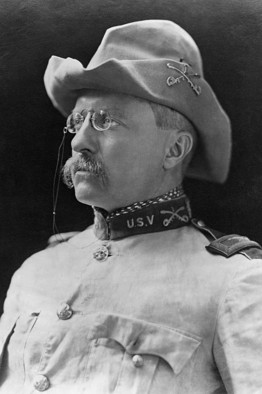 TR in the uniform that confirmed his political manhood. Thus, for centuries, the practice of regime change was standard practice for imperial powers acting openly and boasting of their power. President Teddy Roosevelt (1901-09) declared himself an “imperialist” as he carved out the Panama Canal. However, after World War II and the horrors associated with it, imperialism and foreign aggression became taboo. There was a widespread belief that the era of imperialism was finished, seen as something repugnant and unacceptable in a modern, civilized age. There was a new dawn of hope with the establishment of the United Nations amid the ashes of the world’s most catastrophic war. Heralding New EraThe year 1945 is supposed to have ushered in a new era of world democracy and international order, categorically outlawing imperialist conduct. Before 1945, it was effectively a free-for-all for imperialist powers to dominate and subjugate any smaller nation. That “law of the jungle” condition led to the outbreak of the First and Second World Wars between rival powers. After 1945, what is exceptional about the last 80 years is the explicit illegality of any nation engaging in aggression. It doesn’t mean that such aggression has been prevented. Sadly, it has not. The postwar period is replete with wars and conflicts. But what is significant is that aggression and conflict were formally defined and explicitly prohibited. This followed from the establishment of the United Nations and the UN Charter. The Charter became the ultimate standard of international law. Ravaged by the horror of World War II and an estimated death toll of 70-90 million, the international community vowed to banish all forms of aggression and conflict. It was a watershed moment in historical development deserving the highest praise and one that still serves as a model for peaceful international relations. The Charter stipulated that all nations were equal, that the sovereignty and territorial integrity of nations were inviolable, and that the use of violence by nations was forbidden except in rare, strictly qualified cases of self- defense. Article 2 (4) states: “All members shall refrain in their international relations from the threat or use of force against the territorial integrity or political independence of any state, or in any other manner inconsistent with the purposes of the United Nations.”17 The United States was a key founder of the United Nations, along with the Soviet Union, China, Britain, France, and over forty-five other countries. The UN has since expanded to comprise 193 nations. The conference establishing the world body was held in San Francisco in June 1945, a month after the defeat of Nazi Germany. The Charter provided a noble vision of world harmony and the legal means to ensure peace by outlawing acts of aggression, including interference in the internal affairs of nations. From the outset, therefore, it should be stated that the policy of regime-change is a grave crime under international law, as stipulated in Article 2 (4). Reality DisconnectSince the founding of the United Nations, all [major] Western states have engaged in criminal interference in foreign countries. Britain and France have a long and damning record of covert subversion against former colonial nations in Africa and Asia. Sometimes, the British and French collaborated with the United States in regime-change operations. Western accusations have been leveled against the Soviet Union (and later Russia) and China. But the alleged infractions by Russia and China are often exaggerated and relatively minor compared with the magnitude of documented violations by Western states. Incontestably, there is no other nation that has transgressed the UN Charter and international law so frequently, so systematically, so wantonly as the United States. It is truly in a category of its own for its exceptional record of criminal conduct, both in terms of regime-change and the waging of wars. This should be the real meaning of “American exceptionalism” as opposed to the sentimental myth about democratic virtue. The disconnect between reality and myth is yet again the achievement of Western narrative control enabled by the propaganda function of its news media. Regime Change as Foreign PolicySignificantly, the U.S. embarked on a criminal enterprise almost as soon as the UN Charter was signed. U.S. President Harry Truman oversaw the creation of the Central Intelligence Agency in 1947. The CIA assumed the covert role of asserting American power and influence over foreign nations. Covert action entailed the use of assassination of foreign leaders, sabotage of their social order and infrastructure, and violent coup d’état. The earliest documented coups were in Iran in 1953 and Guatemala in 1954. We will look at these clandestine operations in more detail in Chapters 3 and 4, and especially how the U.S. and Western media played a vital role in facilitating them. Even before those more daring criminal aggressions were launched, the CIA interfered illegally in Italy in 1948 with a dirty tricks campaign to ensure the Communist Party would not win national elections against the U.S.-backed Christian Democrats. The Agency was also involved in fomenting a coup in Syria in 1949, as we will see in Chapter 12. An interesting side note is that U.S. diplomat John Peurifoy was part of Washington’s coordinating team setting up the UN founding conference in San Francisco in 1945. Peurifoy later became the ambassador to Greece in 1950, where he liaised with the CIA to interfere in elections to keep the communists out of government. More notoriously, Puerifoy then became ambassador to Guatemala, where he played a decisive role in executing the violent coup against President Árbenz in 1954. That anecdote speaks volumes about the wider political culture of duplicity and hypocrisy in Washington. Within the U.S. government, including at the presidential level, it was understood that the covert policy entailed a blatant violation of the UN Charter and international law that Washington was a co-creator and signatory of. The inescapable conclusion is that all official rhetoric in Washington about supporting world democracy, equality of nations, international law, and upholding security and peace was, and is, flagrantly disingenuous. In short, the United States’ signature on the UN Charter is a fraud and a lie, as are those of its Western allies. A good question is: Why is regime change such an essential policy for the United States? Why are the U.S. and its Western partners driven to such relentless criminal conduct? The answer is that regime change is an instrument for controlling other nations to serve U.S. global power. The U.S. views itself primarily as the world’s dominant power. Regime change is conducted to ensure that the hierarchical structure prevails. The nations of the world must serve American corporate interests by making their natural resources available for U.S. convenience and exploitation. Regime change is a modus operandi to make sure foreign countries are subservient to the interests of American-led Western capitalism. The U.S. military is a blunt tool, and military aggression is an extreme measure if needed. But regime change is the preferred, more efficient tool because it avoids the large costs of open military force and minimizes legal and political repercussions through its covert character. Essential for EmpireThe policy of regime change is part and parcel of being an empire. It is an essential tool for expanding the empire and subsequently for maintaining it. The policy is particularly important when there are potential rivals to ward off. An empire is akin to having a monopoly. It doesn’t tolerate competitors, only vassals. In a globalized economy, the U.S. empire demands absolute global power and deference from others. This zero- sum dominance is what is called “hegemony”. All other nations are effectively vassals to the needs of American corporate capitalism. Western states are described as “allies”. But these states, or rather their ruling class, must be subservient to Washington’s economic and financial policies. As we saw above, the U.S. interference in European internal politics is predicated on preventing any dissent by European governments from Washington’s geopolitical interests. A clear example of this dominance is seen in the way that the United States has imposed a policy, since the first Trump administration (2017-2021), to cut off Russia as the main energy supplier to Europe. Few European governments have ever challenged this U.S. diktat. Germany, France, Britain, and others have willingly adopted the anti-Russia agenda instigated by Washington, even though the policy has been ruinous for European economies from the loss of affordable Russian oil and gas.18 We should point out here that American corporate capitalism is for the exclusive benefit of a tiny minority ruling class that shares class interests and privileges with the elite of other Western states. The majority of American citizens are not served well by corporate capitalism. They are increasingly victims of a predatory system, as are the majority of European citizens and the rest of the world’s people. The exclusivity of U.S. global power is the cause of its hostility towards nations that do not assent to its desired dominance. China, Russia, Iran, and Venezuela, among others, are viewed as a threat to U.S. power because they assert their sovereign right to economic and financial independence. Those nations do not comply with the unipolar order decreed by the United States’ rulers, and they are, therefore, targeted with aggression and regime-change policy. Even smaller nations that do not have strong economic power are subjected to U.S. hostility: Bolivia, Cuba, Nicaragua, North Korea, Yemen, and others incur wrath because Washington’s lust for global dominance cannot abide any dissent, no matter how small. This is the tyranny of imperialist hegemony. Challenge to U.S. Global PowerIn recent years, Brazil, Russia, India, China, South Africa (BRICS), and many other nations of the Global South have been charting a new course for a multipolar world that emphasizes mutual respect and cooperation among nations. Such a new order is not unprecedented. It is consistent with the vision of the United Nations as set out 80 years ago.19 For U.S. global power, the emergence of a multipolar world of equality and national sovereignty is anathema. That’s because it conflicts fundamentally with the imperialist, zero- sum function of the United States. The U.S.-dominated Western order is a neo-colonial system based on the exploitation of vassals. Thus, regime change and wars are constant, unavoidable manifestations of how U.S. global power has evolved. This was not merely an aberration of the Cold War arising from a perceived ideological rivalry with the Soviet Union. Not that the Cold War provided any acceptable excuse for illegal conduct. But one could, perhaps, rationalize that regime change was a strategy to counter a perceived superpower enemy. In retrospect, it is clear that regime change was not an accident of the Cold War. It has continued to be pursued by the United States for more than three decades since the Soviet Union collapsed in 1991. Russia, China, and other BRICS nations have no ideological intention to conquer the United States. The only ideological opposition is their refusal to submit to U.S. global domination. The oft-stated commitment by the BRICS to a peaceful international order in keeping with the UN Charter is legitimate and laudable. It represents a fulfillment of the Charter, as originally envisaged. But here is the harsh truth: a law-abiding world order is an existential threat to the United States. Peaceful relations between nations, based on “win- win” cooperation and development, make U.S. global power redundant. That explains why President Trump has lashed out at the BRICS as “anti-American” and has vowed to break up the bloc.20 Hence, Washington’s imperial definition of power and its covert policy to maintain it necessarily means violating the UN Charter and international law. Put another way, the U.S. and its global hegemonic ambitions are the fundamental threat to world peace. Washington’s policy of regime-change is a weapon against peace. Western Democracies TargetedFittingly for a would-be global power, the policy of regime change applies in scope to potentially all nations of the world. Primarily, of course, the policy is directed at nations that are designated as official enemies, that is, nations which explicitly refuse to bend their knee to Washington’s writ. But it is an eye-opener and instructive that covert U.S. action applies to nations that are designated as allies. We have already seen how the CIA’s earliest violation of the UN Charter was its interference in Italy’s elections to undermine the Communist Party. {In alliance with the Christian Democrats and the Vatican.—Ed] Similar dirty tricks campaigns were also conducted in the late 1940s in France and Greece to sway the electorate from voting for communists. Again, it has to be stated, such interference in the internal political affairs of other nations is a violation of the UN Charter. Soon, however, the U.S. would embark on a more sinister covert action against European nations. “Operation Gladio” involved secretly staging terrorist attacks across Europe to smear left-wing political parties. As historian Daniele Ganser has documented, Gladio was created by the CIA in collusion with Britain’s MI6 and other European military intelligence agencies.21  The Bologna train station massacre was a Gladio attack perpetrated to blame the left. Gladio was and remains a subterranean terrorist tool of NATO. Google Operation Gladio today and see the filth that comes up. These shadowy paramilitary networks were set up in the late 1940s and are believed to be still active. During the 1960s, 70s, and 80s, Gladio operatives committed numerous acts of terrorism across Europe that were falsely blamed on left-wing extremists. The purpose was to discredit socialist political parties. The most heinous terror attack was the bombing of a train station in Bologna, Italy, in 1980, which killed 85 people.22 The existence of these groups only came to light in 1990 after judicial and parliamentary inquiries were carried out in Italy. Former prime minister Giulio Andreotti confirmed the network’s existence amid a public outcry. The initial purpose for setting up Gladio and other such clandestine groups was to act as a “stay behind” guerrilla network in case of a Soviet invasion of Europe. But as Ganser points out, that rationale morphed into covert action against legitimate European political parties. “The real and present danger in the eyes of the secret war strategists in Washington and London was the at- times numerically strong communist parties in the democracies of Western Europe. Hence, the network, in the total absence of a Soviet invasion, took up arms in numerous countries and fought a secret war against the political forces of the left. The secret armies… were involved in a whole series of terrorist operations and human rights violations that they wrongly blamed on the communists in order to discredit the left at the polls.”23 Operation Gladio was run by the CIA and the military intelligence counterparts of NATO countries. It is integrated under a secret NATO command. Ironically, [and cynically] the U.S.-led North Atlantic Treaty Organization, founded in 1949, claims to defend peace and security for the Western Hemisphere. According to Ganser, the Gladio terrorist network was embedded in all major European states, including Britain, Belgium, Denmark, France, Germany, Italy, and the Netherlands. Officials in these countries have, at times, under public pressure, quietly admitted the existence, but the network remains above scrutiny by governments, the courts, and national law enforcement services. In short, it is a blatant attack on the democratic process and a violation of the UN Charter, international law, and domestic laws. There are echoes of the CIA-run Operation Condor in Latin America in the 1970s and 80s, where political opponents to U.S. imperialist interests were repressed and murdered.24 Obviously, the scale of violence is much less in Europe, for legal and political reasons, but the principle is the same: covert action to subordinate governments and populations into obedience. In Europe, Gladio’s clandestine activities were, and likely still are, aimed at managing the electoral process to ensure that political parties coming to power are amenable to U.S. interests and comply with its transatlantic dominance through the NATO alliance. Gladio is an extension of regime- change policy by acting to prevent any European alternative to the existing pro-U.S. conformity. It is important to bear in mind that when Washington speaks of its Western “allies”, it is not referring to the general populace, but rather the alliance between ruling elites, who are often not representative of citizens and their interests. Hence, the unelected powers and national security agencies of the U.S. are working with European counterparts who share the same geopolitical and class interests. The term “allies” is more accurately a network of the Western ruling class, a network whose loyalties are not to the nations they belong to nor the populations within them, but rather to a transnational imperialist order headed up first and foremost by the U.S. ruling class. Media Complicity in Imperialist CrimesSurely, one would think, the Western news media should be raising alarms, putting tough questions to the authorities, demanding public investigations, and so on, regarding Operation Gladio and other covert actions. The complacency of the mainstream news media is not an unfortunate defect in the media’s otherwise supposed integrity and independence. The Western media’s obedience is systematically designed to be that way. As we shall see in Chapter 7, the postwar era of stealth imperialism and covert operations was embarked on in tandem with a deliberate strategy to control the news media. Narrative control, or propagandizing the public mind, was a top priority for the CIA and its Western counterparts. To that end, the Western media was institutionally co-opted to enable covert actions. [This was easy, given the class interests of the billionaires who own the mainstream media.—Ed] The media’s role is not just to cover up the whole scandal of regime change and covert action by the United States and its Western allies. In addition, and vitally importantly, the media’s role is to sell illusions of “freedom of the media”, “democracy”, and “moral legitimacy” of the United States government and its Western allies. The illusions are insidious and potent because there is a semblance of “free press” and “free elections,” which tends to contradict dissenting claims. The implications are darkly disturbing. With their incorrigible policy of regime-change, the U.S. and its Western allies stand in total violation of international law. The concept of democracy is thrown into disrepute. It means that shadowy, unelected power in the form of the CIA and its Western state counterparts has no respect for democratic institutions and the sovereignty of the people. The logical nadir of this anti- democratic power is explored in Chapter 6 with the assassination of President John F Kennedy in 1963, and the detrimental implications for claims about Western democracy are assessed in Chapter 18. Dire, too, are the implications for the entire Western news media industry as a credible source of information. Polls show a collapse in public trust of the media.25 And no wonder, because people can sense the lies that have been told on an industrial scale. The much-vaunted pillar of democracy has crumbled, as evinced by the Western media’s systematic cover-up of criminal regime-change conduct. That failure has, in turn, led to a syndrome of impunity, whereby the U.S. and its Western allies repeatedly violate international law. It’s a self- reinforcing vicious cycle. This book aims to demonstrate how Western news media have served as a propaganda service for imperialist interests, and not for the interests of democracy, the public, or international law and peace. We examine how the policy of regime-change was formulated in the post-1945 era and how the control of the Western news media was an integral part of that far-reaching covert strategy. If the Western public is unaware of the crimes committed by their governments over the past eight decades, it is because the Western media has functioned as a powerful propaganda system of lies, narrative control, and manipulation of the public. That negates the very Western notions of democracy and freedom. Every regime- change operation carried out by the United States and its allies has been dutifully concealed by the U.S. and Western media. Sometimes, the Western media admit only decades later, after many years of cover-up. But by then, it’s too little, too late. The damage has been done. To take one glaring example: The New York Times purports to be the most respected journalistic news outlet in the United States and one of the most prestigious in the world. It is referred to as the “newspaper of record.” The record shows, however, that this self-appointed bastion of journalism and democratic integrity has loyally covered up, distorted, or whitewashed every coup and regime-change operation that the U.S. government covertly carried out over the past 80 years.26 It is by no means a singular failing of The New York Times. All mainstream U.S. media outlets, as well as European counterparts, have similarly failed to report accurately or truthfully about the biggest rogue nation on Earth. Alternative Media Exposing EmpireDespite the media’s systematic cover-up, public awareness of regime-change operations by the United States has nevertheless grown over the past eight decades. The increased awareness is largely due to the critical reporting of alternative, independent media who are often disparaged by the mainstream as “fake”, “conspiracy theorists” or “Russian disinformation”. The development of the internet greatly expanded the benefits of global communications and helped expose the conduct of regime- change operations and other covert imperial crimes. For this reason, alternative media are increasingly subjected to unjust censorship by Western governments. Still, however, the truth is out, and cannot be suppressed. This book is a contribution to the pursuit of truth and greater public awareness. Crimes and injustice on a massive scale cannot be erased. The coups d’état that the U.S. and its Western allies have engaged in are remembered by the people in countries that have been targeted, especially the people of the Global South, who, arguably, suffered most at the hands of Western imperialism. Much of the hostility between Iran and the United States, for example, stems from Iranian popular awareness and anger over the 1953 coup orchestrated by the CIA and MI6 against an elected and much-loved prime minister, Mohammad Mossadegh. Despite the Western media cover-up, the accumulation of regime-change crimes over decades inevitably translates into a growing consciousness about such crimes. Even among the Western public, there is at least a vague sense that the United States and other Western powers are guilty of covert interference against foreign nations. Still, one might almost marvel at how such a vast scale of criminal history is not more widely known among the Western public. How could such rampant criminality by the U.S. government and Western accomplices be hidden from public knowledge? This book aims to provide a fuller understanding of the sheer scale of criminality against international law and the propaganda function of the complicit news media. The gross interference in other countries by the U.S. and its Western partners has been incalculably destructive to peaceful international relations. As the chapters in this book demonstrate, regime-change practices have led to decades of conflict and underdevelopment. The cause of genuine human development has been sabotaged, often with terrible consequences for whole generations of nations. World peace remains elusive, hunger and poverty are rampant, and the threat of all-out war is an unconscionable, ever-present danger. The UN Charter and its legal standards have been eroded by the impunity of the United States and its imperialist partners, imperiling global security. That is the shameful legacy of Western regime-change crimes and the complicity of the establishment media. If the world is to survive and progress, the UN Charter and its laws of peace must be restored. That restoration requires truth and accountability. |

 BEFORE you leave, PLEASE pay attention to this alert.
[t4b-ticker id="1"]
Print this article [bws_pdfprint display=’print’]
 This work is licensed under a Creative Commons Attribution-NonCommercial 4.0 International License •
ALL CAPTIONS AND PULL QUOTES BY THE EDITORS NOT THE AUTHORS