

 Oliver Boyd-Barrett


| Traducir—Translate! | |
| Make fonts bigger>>> | Resize text-+= |
DATELINE: Uh Oh. Troumple in Venedise amid the Quicksands of Colombia, Cuba, Iran and Mexico • OLIVER BOYD-BARRETT • JAN 10, 2026
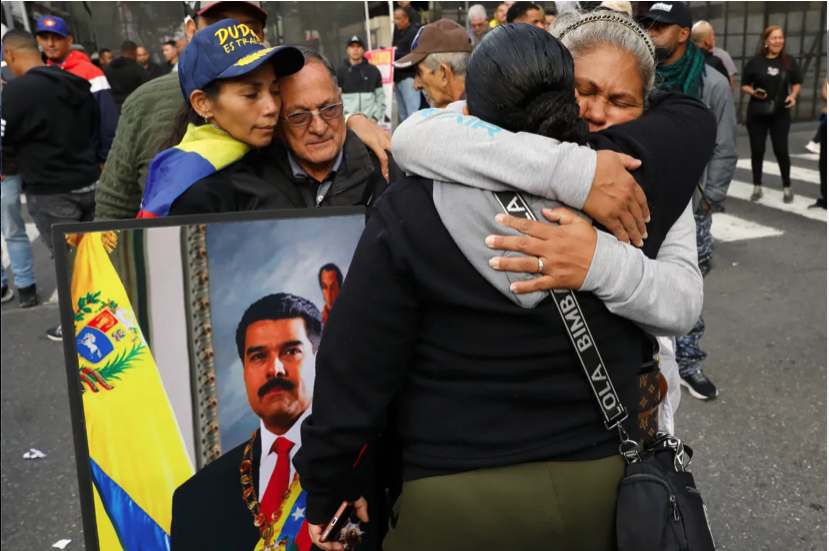
Supporters of Venezuelan President Nicolas Maduro embrace in downtown Caracas, Venezuela. [Cristian Hernandez/AP Photo]
Axios reported on Saturday January 10, a week after the US abduction of Nicolas Maduro, President of Venezuela, that US President Trump had declared a national emergency “to shield Venezuelan oil revenue held by the US government from seizure by private creditors.” The US administration has recently declared its intention to manage Venezuelan oil sales and revenue indefinitely. In an order signed on Friday, Trump claims that the loss of control of Venezuelan oil revenue would be a threat to US national security (even though the head of Exxon has told Trump that Venezuela is “uninvestible,”) implying that it would involve a dangerous influx of illegal immigrants and illicit narcotics to the US, and that it would be a boon to “malign actors” like Iran and Hezbollah.
(In Iran, by the way, the narrative of mainstream Iranian media such as PressTV and Tasnim news agency is that the situation is currently stablilizing, doubtless in response to strongly coercive State measures. While it is natural, if not necessary, to be skeptical of claims by Iranian authorities about foreign-backed militia, the history of the country and of its leading US-supported and financed dissident armed machinery, MEK (not to mention the perennial interference of Israel’s Mossad recently fingered by Mike Pompeo’s tweet to the effect that Mossad agents were intimately involved in the unrest, according to Caitlin Johnson today at (Caitlin)) also counsels against being overly impressed by Western accounts of unrest in the country. Their accounts are now even more problematic given Iran’s shutdown of the Internet from Thursday. The immediate crisis in Iran is a result of the sinking value of the currency, and this may put a question mark over the future of Iran’s current civilian leader Pezeshkian, who has shown himself wobbly in Iran’s eternal political balancing act vis-a-vis the West.
Meanwhile, what is the relevance of US strikes this weekend in Syria, supposedly against the Islamic State (the NYT reports the attacks on more than 70 suspected Islamic State targets across central Syria, including weapons storage areas and other operational-support buildings). Who would have thought ISIS would be this strong given that it had been thoroughly suppressed and subdued under Assad, excepting, of course, in and around Turkish-protected Idlib, the headquarters of HTS - the terrorist force that brought the current Trump-adored new but totally illegal leader of Syria into power on December 8, 2024? The NYT conveniently claims that US intelligence had advised Congress last year that the Islamic State would try to exploit the end of the Assad government to free 9,000 to 10,000 ISIS fighters and about 26,000 of their family members then detained in northeastern Syria, and revive its ability to plot and carry out attacks.
Additionally, there were reports earlier this year of clashes in Aleppo between the US and Israeli-backed Kurdish SDF and Syrian forces, just at the time that it had been expected that SDF would agree to be assimilated into the Syrian army. Is all this in some way associated with preparations for the next US-Israeli attack on Iran, especially likely now that Trump has virtually given his assurance that there would be such an attack in the event of further deaths resulting from clashes between Iranian authorities and protesters. There have been no shortages of such causes of conflagration.
There is an unbelievingly insulting movement, doubtless originating from the USA and MEK, for the restoration of the discredited and cruel Pahlavi dynasty - installed by the US and Britain following their overthrow of Iran’s first democratically elected leader, Mohammad Mossadegh in 1953).
Back to Venezuela of January 9, 2026, the US naval blockade has significantly intensified. While several high-profile seizures have occurred in the last 48 hours, a substantial flotilla of tankers has successfully defied it and is currently navigating toward international markets. Nonetheless, a report for the Orinoco Tribune concludes:
The US blockade of Venezuela is materially imperfect and extremely hard to enforce, despite the unprecedented level of US warships in the area. However, oil experts have reported that Venezuelan inventories have begun to rise. If they reach their peak, the country will be forced to close oil rigs, with terrible implications for Venezuela’s oil production recovery.
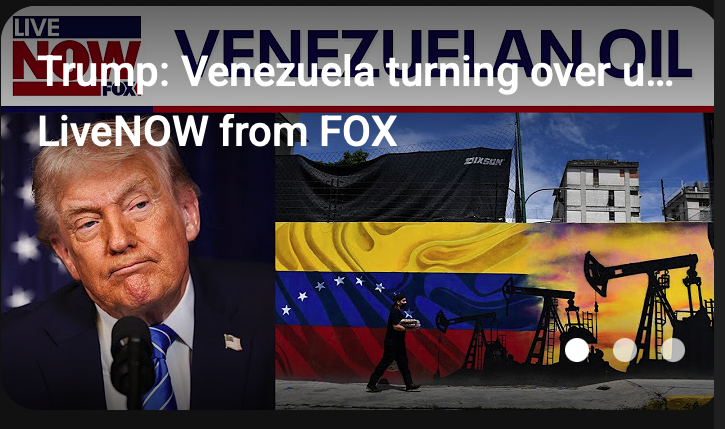
The situation this weekend suggests that the US has not really reckoned with Venezuela’s indebted status and with those interests that have potentially legal claims against its wealth, or with the fact that the scope for legal challenges to US control of Venezuelan oil in international courts will be considerable. The notion that Venezuelan oil (currently 2% of global supply) is going to provide an immediate boon of many millions of barrels to Trump’s personal care, and that it could protect global oil markets in the event of an Iranian closure of the straits of Hormuz if and when the US and Israel stage their next strike on Iran, looks less than wholly convincing. (see Larry Johnson’s analysis here - Johnson). A decade ago, the Russians (Rosneft) had already pulled out of what they considered a losing prospect in Venezuela.
Later on Saturday afternoon (California time) the Guardian reported that the US was urging its citizens to flee Venezuela amid reports that armed “pro-regime militia” (you know, the kind of people who defend themselves against foreign invaders and abduction of their leaders), known as the colectivos (a Chavez socialist or communitarian initiative), were setting up roadblocks and searching vehicles for evidence that the occupants were US citizens or supporters of the US abduction of Maduro. US citizens are being advised to leave immediately now that some international flights from Venezuela have restarted. Since 2014, almost eight million people have fled hunger and poverty in Venezuela. Close to three million have settled in Colombia. The Unherd reports claims that locals must also contend with guerrillas from the National Liberation Army, or ELN, which has an estimated 5,000 fighters. Active on both sides of the border, the ELN is a fierce backer of Chavismo.
Inside Venezuela, the illegal Trump intervention has killed up to a hundred people, exacerbated inflation and enhanced domestic instability. A source from the border between Colombia and Venezuela told UnHerd that with its web of guerrillas, gangsters, soldiers and political police, the frontier city of San Antonio del Táchira speaks vividly to explosive problems in Venezuela and the dangers of them spilling into more violence — amid Trump’s new “Donroe Doctrine” of open aggression in Latin America (see UnHerd).
Notwithstanding initial reports of defiance from new President Rodriguez, the Orinoco Tribune reported that on Friday January 9 (Orinoco Tribune), Venezuela announced that it had begun “an exploratory diplomatic process” with the United States to resume bilateral relations, according to a statement released by Foreign Minister Yván Gil. A delegation of diplomatic officials from the US State Department arrived in Caracas on Friday to conduct technical and logistical assessments related to the resumption of diplomatic operations. Similarly, Venezuela will send a diplomatic delegation to Washington to carry out the corresponding tasks. On Thursday, Deputy Nicolás Maduro Guerra, the son of President Nicolás Maduro, explained during an international webinar that this plan was drafted before the US military attack against Venezuela, as was the plan to sell Venezuela’s overstock inventories to the US regime.
Also casting some doubt on the authenticity of Rodriguez's defiance is an NYT story (NYT) from January 10th that she had enlisted U.S. military support to return an oil tanker owned by a political rival previously close to the Maduro family that had left the country without permission.
“The tanker, called alternatively Olina or Minerva M, left a port in eastern Venezuela late last weekend without the authorization of port authorities or the state oil company in the chaotic hours that followed Mr. Maduro’s downfall, according to satellite imagery and the people close to the government.
The state oil company, known as PDVSA, said it was never paid for its crude.
The tanker “launched without payment, nor the authorization of Venezuelan authorities,” PDVSA said in a statement on Friday, adding that the U.S. government aided its return. Mr. Trump echoed the claim the same day, saying that the tanker “departed Venezuela without our approval” and was returning to Venezuela “in coordination” with Ms. Rodríguez.”
Disregarding the quagmire that he has created in Venezuela, or perhaps because he wants to distract attention from that one by creating new ones, Trump now recklessly threatens Mexico with land invasions and is supporting the “cause” of Marco Rubio, his own Secretary of State, as the next President of Cuba.
Meantime in another part of the world that is testimony to the marvellous foreign policy achivements of the Great Peace Maker (GPM) (who has been reported to have made arrangements to meet with Venezuelan opposition leader Maria Corina Machado next week, since she has offered to share with him the Rubio-instigated Nobel Peace Prize recently awarded her - although the Nobel Peace Prize Committee says that the prize cannot be transferred or shared, but who cares about silly rules?). It appears that the recent Russian Oreshnik strike in Western Ukraine that was thought to have been targeted on a major gas reserve facility may instead have been an intended hit on a military target.
There was no clear evidence of a major explosion of the kind that might have been expected had it been a methane gas facility. The target may have been located inside Lvov, supposedly an air base and a repair facility adjoining the base. This may have been functioning to repair MiG fighters or F16s. The warheads on the Oreshnik may have been inert but that the weapon’s damage was kinetic only (as is sometimes argued in the case of the first Oreshnik strike on Pivdenmash in Dnipro on November 21, 2024).
I am beginning to wonder whether the whole story about an Oreshnik in Western Ukraine is nonsense or if something serious was awry with this attack. It seems unlikely to me that Russia would have used an Oreshnik merely to hit a military base unless perhaps the missile, which is only now coming off production lines in steady volume, was deemed the only one that could cover the necessary distance. The Oreshnik can carry multiple warheads and perhaps struck different targets in Lvov. If the story is basically correct then it may suggest that the Oreshnik is capable of hitting targets in densely populated areas without causing very great collateral damage. It is reported that Russia provided advance notice of the launch to the US; the target or targets would not have been known in advance; a feature of the missile is that its high speed makes it more or less impossible to shoot down. If there was an Oreshnik attack, then it is entirely plausible that it was intended as a reprisal for an attempt by Ukraine (under CIA direction, since even mainstream US media now appear to concede that it is the CIA that is running Ukraine’s drone war) on President Putin’s Valdai residence in Novgorod which is also a nuclear command post (and, Gilbert Doctorow claimed earlier today in an interview with Glenn Diesen, the residence of Putin’s common law wife - I believe her name is Alina Kabaeva - and Putin’s children of that relationship…I am advised, by the way, that this is all far from certain).
Even if the basic Oreshnik story is correct, it can be argued that it actually has less immediate significance than the missile and drone bombardment that Russia carried out in the same time period or just before it against energy and water-treatment facilities in Kiev, leading the city’s mayor to encourage those who can to leave the city “on a temporary basis.”
Former Russian President and Putin loyalist (but “hardman,” whose defiant statements to the West likely represent the views of many if not most senior members of the Russian military with whom he regularly interacts) Dmitry Medvedev, has posted a picture of the Oreshnik strike on X as evidence of what he says will happen to the Europeans if they insist on putting boots on the ground in Ukraine. (Medvedev can take credit for the rise of the geopolitical theory of multipolarity - although I am advised that credit for originating the term may be attributed to former Soviet prime minister Yevgeny Primakov - in the case of the so-called Medvedev doctrine, which refers to a 2008 Russian foreign policy framework announced by President Dmitry Medvedev, emphasizing a multipolar world, adherence to international law (especially concerning Russia's neighborhood), protecting Russian citizens abroad, and rejecting unilateral global dominance by any single nation, particularly the US. It's a shift from a unipolar vision which also asserts Russia's right to have "privileged interests" in its "near abroad.”
Although this, and the Oreshnik strike (assuming it happened) may seem to suggest that Russia has indeed found its backbone in the face of severe setbacks to its interests and allies in Syria and in Venezuela, and the recent agressions on Russia’s “shadow fleet” on the high seas, involving about a dozen tankers so far (a relatively small percentage of a trade that may involve many hundreds of ships) but I would say that it merely confirms that Russia continues to focus its military tactics only on Ukraine and never yet on the territories of those countries which have been central to the quarter-century program of Western and NATO provocation against Russia.
We can expect early next week that the Graham and Blumenthal “bone-crushing” sanctions bill against Russia will reach the US senate, likely to pass.
 BEFORE you leave, PLEASE pay attention to this alert.
[t4b-ticker id="1"]
Print this article [bws_pdfprint display=’print’]
 This work is licensed under a Creative Commons Attribution-NonCommercial 4.0 International License •
ALL CAPTIONS AND PULL QUOTES BY THE EDITORS NOT THE AUTHORS

