

 Richard Wolff

| Traducir—Translate! | |
| Make fonts bigger>>> | Resize text-+= |

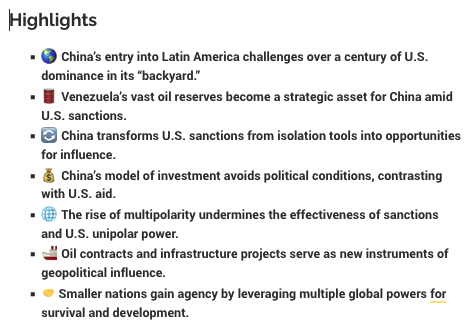
The video explores the profound geopolitical transformation occurring as China expands its influence in Latin America, particularly through its deepening partnership with Venezuela. Traditionally, the United States maintained dominance in the Western Hemisphere via the Monroe Doctrine, sanctions, military interventions, and economic leverage. However, China’s entry into Venezuela—home to the largest proven oil reserves globally—challenges this unipolar dominance by providing an alternative model of influence based on economic investment without political conditions. As the U.S. employed sanctions to isolate Venezuela, China stepped in with loans repayable in oil, infrastructure investment, and energy contracts, effectively turning U.S. sanctions into opportunities for itself and Venezuela.
This shift signals a broader global trend toward multipolarity, where sanctions lose their effectiveness because sanctioned states can pivot toward alternative powers like China. China’s approach contrasts with U.S. conditional aid by avoiding demands for "political reform" (toward savage capitalism), and focusing on pragmatic resource-for-infrastructure deals. Venezuela’s survival under sanctions, enabled by China, serves as a powerful symbol for other countries under U.S. pressure, such as Iran and Russia, demonstrating that economic survival and sovereignty outside Washington’s orbit are possible.
The discussion further emphasizes oil’s strategic significance—not just as an energy commodity but as a geopolitical lever. Venezuela’s massive reserves have historically tied it to U.S. influence, but China’s involvement reshapes this dynamic, securing long-term oil contracts that insulate Beijing from global market volatility and diminish U.S. leverage. This realignment also undermines the traditional global economic architecture dominated by U.S.-led institutions like the IMF and World Bank, as China offers alternative financial systems, infrastructure financing, and trade arrangements.
Ultimately, the video portrays China’s partnership with Venezuela as emblematic of a new era in global politics—a shift from unipolar dominance enforced by sanctions and military might to a multipolar order negotiated through economic contracts and strategic investments. This transformation not only threatens U.S. hegemony but enhances the agency of smaller nations, allowing them to navigate between competing global powers and secure survival and development on their own terms.
Key Insights
️ Oil as Geopolitical Leverage Beyond Commerce: Venezuela’s oil reserves are not mere commodities but critical levers of global power. Control over these reserves shapes energy security, economic flows, and international alliances. China’s acquisition of discounted Venezuelan oil secures its industrial base and provides leverage against the U.S.-dominated energy landscape, signaling a strategic shift in how energy resources influence geopolitical relations.
Sanctions’ Effectiveness Eroded by Alternatives: U.S. sanctions depend on monopolizing global financial and trade networks. China’s willingness to finance sanctioned states in yuan, accept repayment in commodities, and invest in infrastructure creates alternative lifelines, eroding sanctions’ ability to isolate adversaries. This dynamic in Venezuela exemplifies how multipolarity weakens traditional U.S. tools of coercion, forcing a recalibration of global power strategies.
Multipolarity Redefines Global Order:The transition from a unipolar to a multipolar world reshapes the decision-making environment for smaller nations. Countries like Venezuela can now play great powers against each other, increasing their bargaining power and autonomy. This redistribution of influence dismantles the narrative of inevitable U.S. dominance and introduces complexity and competition into global diplomacy.
China’s Non-Interference Model Appeals to Sovereign States: Beijing’s strategy of offering aid and investment without demanding political reforms resonates with countries weary of Western conditionality. This approach enables China to build durable partnerships based on pragmatic economic interests, cultivating loyalty while avoiding the reputational risks and resistance often triggered by U.S. demands for governance changes.
️ Infrastructure as Long-Term Influence:Chinese infrastructure projects in Venezuela—ports, housing, railroads—are more than economic ventures; they create durable dependencies that embed China into the country’s development trajectory. Unlike military interventions or sanctions, which can be reversed or resisted, these investments become structural fingerprints of Beijing’s influence, difficult and costly to undo.
Financial Instruments as Modern Power Tools: Loans tied to oil shipments and credit extended in yuan represent a new form of economic diplomacy. These financial arrangements bypass Western-controlled systems and secure Chinese access to energy resources while providing sanctioned states with crucial funding. This mechanism reconfigures global finance by fragmenting the dollar’s dominance and empowering alternative economic architectures.
U.S. Hegemony’s Fragility Exposed: The case of Venezuela highlights the limits of American global leadership. Sanctions that once guaranteed compliance now risk bolstering rival powers. Each sanctioned state rescued by China or Russia chips away at the aura of U.S. inevitability, forcing Washington to confront the reality that dominance through coercion is no longer sustainable in a world where multiple centers of power coexist and compete.
Conclusion
The narrative of Venezuela and China’s partnership encapsulates a seismic shift in global geopolitics. China’s strategic investments and contracts in Venezuela transform oil, finance, and infrastructure into tools of influence that circumvent traditional U.S. mechanisms like sanctions and conditional aid. This dynamic not only sustains Venezuela amid economic isolation but also signals to other nations that survival and sovereignty outside the American orbit are achievable. The emergence of multipolarity dissolves the certainty of U.S. dominance, empowering smaller states to navigate a more complex international order shaped by competing great powers. As the U.S. faces the erosion of its coercive tools, China’s rise exemplifies a new era where power is exercised through economic partnerships and pragmatic diplomacy rather than military might or unilateral sanctions. This transformation, quiet yet profound, is redefining global alliances, economic flows, and the very architecture of international influence.
 BEFORE you leave, PLEASE pay attention to this alert.
[t4b-ticker id="1"]
Print this article [bws_pdfprint display=’print’]
 This work is licensed under a Creative Commons Attribution-NonCommercial 4.0 International License •
ALL CAPTIONS AND PULL QUOTES BY THE EDITORS NOT THE AUTHORS

