PATRICE GREANVILLE

| Traducir—Translate! | |
| Make fonts bigger>>> | Resize text-+= |
| I recently joined some esteemed colleagues at the China Writers' Roundtable to discuss some issues of pressing interest heavily distorted or suppressed by the mainstream media. Below is the video report on that specific meeting. —PG |
Summary of Discussion
This extensive discussion centers on the complex geopolitical dynamics shaping the current global order, particularly focusing on China, Russia, Iran, and their strategic responses to Western imperialism led by the United States. The conversation critiques Western interventionist policies, contrasts them with China’s non-interventionist approach, and analyzes how these differing strategies impact conflict zones like Palestine, Syria, and Xinjiang. The speakers explore the historical and cultural reasons behind China’s policy of non-interference, its long-term strategic vision, and the challenges posed by Western attempts to destabilize Eurasian powers.
A key theme is the evolving alliances among Eurasian powers, including the imminent military pact between Iran and Russia, and the comprehensive strategic partnership between China and Russia aimed at establishing a new security architecture to counter Western dominance. The dialogue also delves into regional issues such as the situation in Xinjiang, emphasizing China’s extensive surveillance and counter-terrorism efforts, and the geopolitical significance of mutual defense treaties connecting Russia, Iran, China, and North Korea.
Europe’s political fragility and loss of sovereignty due to EU and NATO dominance is discussed, highlighting the cultural and ideological brainwashing that undermines opposition movements and fosters compliance with Western agendas. The participants critique Western liberal democracy as a failed model marked by imperialism, war, and social decay, contrasting it with China’s aristocratic oligarchic system which they argue prioritizes merit, stability, and effective governance.
The conversation touches on military strategy, particularly Russia’s measured approach influenced by Chinese long-term thinking, and the limitations of Western responses that risk escalation to nuclear conflict. The role of information warfare, cyber warfare, and economic sanctions are also examined as tools of Western power projection, alongside discussions of how China and Russia are increasingly asserting strategic pressure on the West.
The dialogue concludes with reflections on democracy measurement, emphasizing practical governance effectiveness and citizen responsiveness over Western-style protest rights, and ends with a consideration of the importance of continued dialogue among like-minded intellectuals to navigate this turbulent geopolitical landscape.
BRIGHTEON VIDEO (Since YouTube is more prone to censorship.)
China Writers Frans Vandenbosch, Irene Eckert, Jeff J. Brown (Host), Patrice Greanville and Quan Le gather for a 2025 "crystal ball" discussion.
Location: https://www.brighteon.com/0287171e-3414-4927-877c-dcf84a8540f2
Key Insights
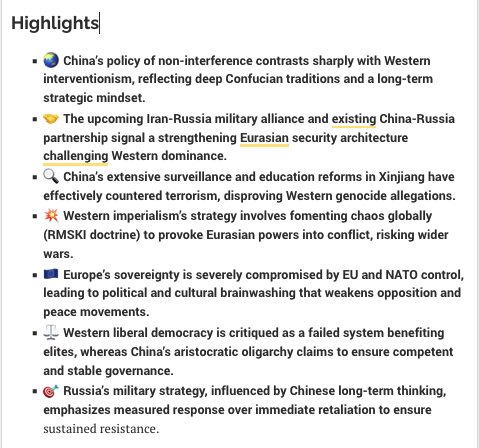
China’s Non-Interference as Strategic Wisdom: Rooted in Confucianism, China’s refusal to intervene militarily abroad is not passive but a calculated strategy to avoid traps set by Western powers. This approach protects China’s interests by maintaining stability and avoiding direct confrontation, forcing adversaries to reveal themselves as aggressors. This long-term thinking contrasts with the West’s short-term, interventionist mindset, which often exacerbates conflicts and undermines sovereignty.
Eurasian Security Architecture as a Counterweight: The emerging alliance framework between China, Russia, and Iran—highlighted by the imminent Iran-Russia military pact—represents a concerted effort to build a multipolar world order. This alliance aims to end the colonial and imperial order imposed by the West, fostering regional peace and prosperity within their spheres of influence. The inclusion of North Korea strengthens this bloc, creating a strategic triangle that challenges Western geopolitical hegemony.
Xinjiang’s Counterterrorism Model and Western Misinformation: The discussion reveals that China’s efforts in Xinjiang, including surveillance and education reforms, have significantly improved security and social cohesion. The increase in the Uyghur population contradicts genocide claims, exposing Western propaganda. China’s sophisticated monitoring systems and cultural reintegration programs reflect a unique civilizational matrix resistant to Western-style subversion and misinformation campaigns.
Western Strategy of Global Chaos (RMSKI Doctrine):The West’s approach to maintaining global dominance involves instigating conflicts and chaos, such as in Palestine and Syria, to provoke Eurasian powers into costly wars or missteps. This strategy aims to weaken rivals by drawing them into unwinnable conflicts or escalating tensions to a global scale. Russia and China’s restraint in places like Syria and Ukraine reflects their awareness of this trap and their preference for strategic patience.
European Loss of Sovereignty and Cultural Brainwashing: The speakers highlight the profound weakening of European states under EU and NATO control, which they describe as totalitarian and fascist structures. This loss of sovereignty is compounded by widespread cultural and educational brainwashing that fragments opposition movements and suppresses genuine peace activism. The dominance of pro-Western elites and the marginalization of alternative voices perpetuate European complicity in Western imperial agendas.
⚖️ Critique of Western Liberal Democracy versus Chinese Aristocratic Oligarchy: Western democracy is characterized as an oxymoron—a system that serves elite interests rather than the people, producing wars, inequality, and societal decay. In contrast, China’s political system is framed as a meritocratic aristocratic oligarchy, where political power is reserved for the intellectually and morally qualified, ensuring stable governance and long-term planning. This model challenges Western assumptions about democracy and governance.
Russia’s Long-Term Military Strategy Inspired by China: Putin’s strategic patience and avoidance of immediate escalations reflect a Chinese-influenced long-term approach to conflict. This method prioritizes preserving strength, waiting for the enemy to overextend, and delivering decisive blows on favorable terms. It contrasts with Western impatience and reflexive militarism, which risks rapid escalation and potential nuclear conflict. This insight underscores the importance of understanding cultural and strategic differences in global power competition.
Information and Cyber Warfare as Frontlines of Modern Conflict: The discussion underscores the growing importance of cyber capabilities, citing China’s recent victory over the US Navy in electronic warfare. These non-kinetic battles are crucial in shifting tactical advantages and exposing vulnerabilities in Western military and informational dominance. Control over information flow and technological infrastructure is as significant as traditional military power in today’s geopolitical struggles.
The Role of Africa in Geopolitical Realignments: The emergence of Africa as a player rejecting Western colonial control and aligning with Eurasian powers is pivotal. By expelling traditional Western colonial influences, African nations can disrupt Western access to critical commodities and energy resources, thereby weakening the Western bloc economically and strategically. This realignment reflects a broader global trend toward multipolarity and decolonization.
Measuring Democracy Beyond Western Metrics: The discussion challenges conventional Western metrics of democracy, which emphasize protest rights and electoral formalities, proposing instead a focus on government responsiveness and problem-solving effectiveness. China’s complaint mechanisms and governance responsiveness offer an alternative model that prioritizes social stability and practical outcomes over performative freedoms. This reframing invites reconsideration of how democracy should be defined and evaluated globally.
️ The Importance of Long-Term Vision in Geopolitics:The speakers stress that the struggle against Western imperialism and the building of a new global order will span generations. Success depends on sustained effort, strategic patience, and cultural resilience, rather than quick fixes or immediate military victories. This understanding calls for a paradigm shift in how geopolitics and international relations are approached, moving beyond reactive policies toward comprehensive, patient statecraft.
Conclusion
This dialogue provides a deep and nuanced understanding of the contemporary geopolitical landscape, emphasizing the strategic foresight of China, Russia, and their allies in countering Western imperialism. It highlights the cultural, historical, and ideological foundations underpinning these powers’ approaches while exposing the weaknesses and contradictions of Western liberal democracy and interventionism. The conversation stresses the critical need for long-term planning, multipolar cooperation, and resilience in the face of Western attempts to sow chaos and maintain dominance. It also points to the importance of redefining governance and democracy in ways that reflect diverse cultural realities and practical effectiveness rather than ideological dogma.

All image captions, pull quotes, appendices, etc. by the editors not the authors.
YOU ARE FREE TO REPRODUCE THIS ARTICLE PROVIDED YOU GIVE PROPER CREDIT TO THE GREANVILLE POST VIA A BACK LIVE LINK.
 This work is licensed under a Creative Commons Attribution-NonCommercial 4.0 International License