DIALOGUE WORKS
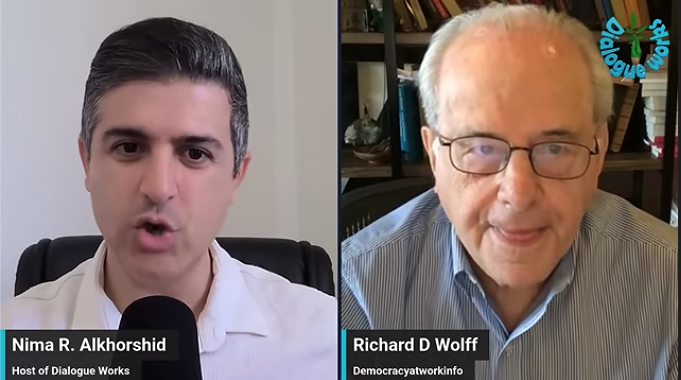
Nima Alkhorshid • Prof. Richard Wolff
Richard Wolff /TRUMP CAVES: The Era of American Dominance is OVER
Summary
The podcast episode, recorded on June 18, 2026, features an in-depth discussion with Professor Richard Wolff regarding a sudden and significant development in U.S.-Iran relations—a 14-point Memorandum of Understanding (MOU) signed digitally by then-President Donald Trump and Iranian President Pzkan. While this MOU marks a historic diplomatic moment, Wolff emphasizes its non-binding and conditional nature, framing it as an initial step rather than a peace treaty or decisive resolution. Key immediate consequences include the opening of the Strait of Hormuz and resumption of oil exports in the Gulf, benefiting Iran and neighboring states economically.
However, the document is deeply contingent on political developments, especially concerning Israel’s role in the region. For the MOU to fully function, Israeli troops must withdraw from southern Lebanon, and cross-border attacks must cease—a scenario that Wolff contends only the United States can enforce due to its support for Israel. The discussion also highlights internal U.S. political divides, with Trump split between his base’s factions—some welcoming the MOU as pragmatic, others categorizing it as a betrayal, given the long-standing demonization of Iran.
Wolff broadens the conversation to examine the broader implications of this deal, asserting the agreement symbolizes a notable decline in American global power and imperial influence. He compares U.S. military failures in Vietnam, Afghanistan, and Iraq with the current inability to coerce Iran via sanctions or air power, reasserting Iran’s success as a form of anti-imperial resistance. The discussion further touches on the economic pressures, particularly on oil reserves and global markets, the shifting geopolitical alliances involving Russia, China, and the BRICS countries, and the reconfiguration of global supply chains inspired by recent crises.
A noteworthy point of reflection is the ‘second revolution’ in Iran—a popular socio-economic resilience bolstered by the war, sanctions, and the reassertion of Iranian sovereignty, particularly over the Strait of Hormuz. This unity contrasts with previous internal social conflicts, including tensions over hijab enforcement, which have now diminished as the Iranian people coalesce around national survival and sovereignty. The conversation closes on the cultural and political shifts within Iran, with society appearing more open and internally unified despite facing external pressures, and a reflection on Trump’s legacy amid domestic and international challenges.
Highlights
- [00:05] 🇺🇸📜 Sudden signing of a 14-point U.S.-Iran Memorandum of Understanding by Trump and Iranian President Pzkan.
- [08:11] 🛢️🌊 Immediate reopening of the Strait of Hormuz and resumption of Gulf oil shipments, boosting regional economies.
- [09:32] 🇮🇱⚔️ The critical role of Israel’s troop withdrawal from southern Lebanon in implementing the memorandum.
- [15:15] ✈️💥 Iran withstands extensive U.S. military pressures without ground troops, signaling a decline in American imperial power.
- [27:00] 🔄🌍 Global supply chains and military alliances need urgent strategic reevaluation post-agreement.
- [43:49] 🔥🇮🇷 The deal perceived in Iran as a ‘second revolution’ reaffirming national sovereignty and resistance to U.S. imperialism.
- [56:08] 👥🤝 Societal unity in Iran emerging from conflict and sanctions, with diminishing internal social tensions such as hijab enforcement.
Key Insights
- [01:22] 📝 Historic but Non-Binding MOU: The MOU signed by the U.S. and Iran, although historic, is more a statement of intent than a binding agreement. The conditional language leaves implementation uncertain and heavily dependent on political will and evolving circumstances, reflecting the fragile nature of U.S.-Iran relations. This diplomatic nuance cautions against interpreting the document as a peace treaty or decisive victory.
- [03:36] ⚖️ Perceived U.S. Loss and Iranian Gain: Public opinion across American political spectra largely views the memorandum as a strategic setback for the U.S. and a win for Iran, underscoring the complex domestic political repercussions Trump faces. The traditional demonization of Iran impedes consensus, highlighting how geopolitical narratives shape domestic policy and popular acceptance of foreign deals.
- [08:11] 🔑 Israel as a Geopolitical Linchpin: Implementation of the MOU hinges on Israel’s disengagement from southern Lebanon and halting cross-border conflicts. Since Israel’s security and military posture in Lebanon contradicts commitments made in the MOU, the U.S. faces a dilemma that could either lead to American pressure on Israel or potential unraveling of the deal, demonstrating the interconnectedness of Middle East conflict dynamics.
- [15:15] 🛑 Decline of American Military Empire: The inability of the U.S. to defeat Iran through traditional military means—whether massive ground invasions or drone and missile warfare—reveals an erosion of American military dominance. This indicates a strategic turning point where asymmetric and proxy power, exemplified by Iran leveraging regional alliances and anti-imperial tactics, challenges conventional military superiority.
- [19:56] 📉 Fragility and Fluidity of Diplomatic Processes: Diplomatic agreements like the MOU are often rendered obsolete rapidly as geopolitical realities shift. This unpredictability demands a pragmatic approach to international relations, underscoring the limitations of treaties that cannot fully adapt to changing conditions and the perpetual negotiation required in diplomacy.
- [39:13] 🏛️ Empire’s Control and the Seeds of Revolution: Empire relies not just on force but on ideological control, conditioning subject peoples to accept normalized subjugation. Iran’s persistent resistance and quest for sovereignty illustrate how the awareness of injustice germinates revolutionary sentiment, emphasizing the role of socio-political consciousness in challenging imperial hegemony.
- [43:49] 🌐 Iran’s “Second Revolution” & Societal Resilience: Beyond the political and military dimensions, the MOU reflects a broader societal shift in Iran, where decades-long internal strife yields to national solidarity against external pressures. This unity redefines Iran’s domestic landscape, superseding previous cultural conflicts such as hijab enforcement, highlighting how external threats can catalyze social cohesion and transformation.
Extended Analysis
The conversation places substantial weight on the symbolic nature of the MOU in reflecting a shifting international order, where U.S. unipolar dominance is increasingly challenged by coordinated resistance and emerging powers. By framing the MOU not as an endpoint but as an evolving, fragile accord heavily influenced by Israel’s positioning and U.S. domestic politics, the dialogue reveals the complexity and interdependence of regional conflicts with global power struggles.
Wolff’s insight into U.S. imperial decline is notable, drawing parallels between previous unsuccessful military engagements and the current failure to coerce Iran primarily through sanctions and air power—innovations that cannot substitute for effective political solutions or ground realities. The alliance between Iran, Russia, China, and emerging groups like the BRICS signals a geopolitical rebalancing that will force Western powers to reassess strategies across Eurasia and the Middle East.
Moreover, the socio-political undercurrents in Iran, including the ‘second revolution’ metaphor, highlight how war and sanctions paradoxically foster internal solidarity and cultural shifts, diminishing previously divisive issues. The repression associated with hijab enforcement appears to be waning in the face of a larger unifying cause: national survival and political autonomy.
The U.S. domestic political narrative around Trump’s handling of both foreign policy and internal symbolism (e.g., the New York Knicks anecdote) further illustrates the erosion of traditional political capital and cohesion in American governance, affecting global diplomacy outcomes.
In sum, the podcast captures a pivotal moment of transition: the erosion of longstanding hegemonies, the reassertion of regional autonomy, and the intricate interplay between domestic political pressures and global power configurations. The MOU, while delicate and conditional, represents a rupture in the previous status quo that will demand ongoing negotiation, realignment, and adaptation from all parties involved.