Eric Arnow
Inquiry and Thinking


| <• Choose your language • Elija su idioma | |
Resize text-+= |
A Case Study in Medical Costs

Surgery, even for non-exotic conditions, can ruin many ordinary citizens in the US.

An Unpleasant Surprise—Inguinal Hernia
I recently noticed swelling in my lower abdomen, even though I had a positive medical checkup in November, 2024. Not knowing what it was, but suspecting a possible hernia, I went to my local hospital outpatient department. If you are living in another country, such as the US or UK, you can compare my experience.
I went to the clinic, one of several in my home city of Chiang Mai, a city of about 200,000 people with a larger metropolitan area with various suburbs. In the past 20 years, there’s been a lot of development, and some new modern subdivision are present.
In any case, I went to the entry desk, told the people, who speak Thai language, using my mobile phone translation app, that I want to see a doctor. Since they know I’m checking for a possible hernia, I got set up with a surgeon after about a 20-minute wait.
He took one look and said, yes, definitely a hernia, apparently a pretty common condition. It’s not serious but could develop into one. The cost to treat it: About $3000 US dollars. My insurance policy premium had come due in January, but it costs $1750/year, with a $5880 deductible. I dropped the policy and saved the money.
So if I get treated at this excellent private hospital, it would cost about $3000.
What About Traditional Chinese Medicine?
However, I still felt it important to consider options if it doesn’t work. It turns out that a public hospital in Chiang Mai would charge $1000-2000. My guess is the more expensive, less invasive laporoscopic surgery would be on the higher end.
What Would Surgery Cost in the USA?
Cost of Inguinal Hernia Surgery in Santa Rosa, California
Without Insurance:
Open Surgery: 5,000–10,000 USD
Laparoscopic Surgery: 8,000–15,000 USD
With Insurance:
Out-of-Pocket Costs (Deductibles, Co-pays, Co-insurance): 500–3,000 USD
(This depends on your insurance plan and coverage.)
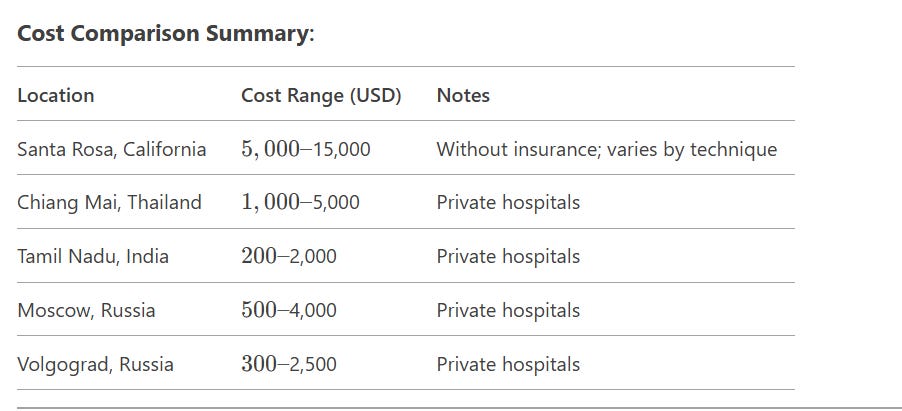
I would be eligible for Medicare, but it doesn’t pay outside the US. So, it looks like the cost with insurance in the US will cost about the same as in Thailand without insurance coverage.
How About Cost of Hernia Surgery in Other Countries?
India is Major Medical Tourism Country
So US corporations win twice. They pay half of what a US trained nurse who joins a union pay. And India picked up the cost of her education. Communism subsidizes capitalism. Here are the costs of treatment in Tamil Nadu, just north of Kerala.
Tamil Nadu, India
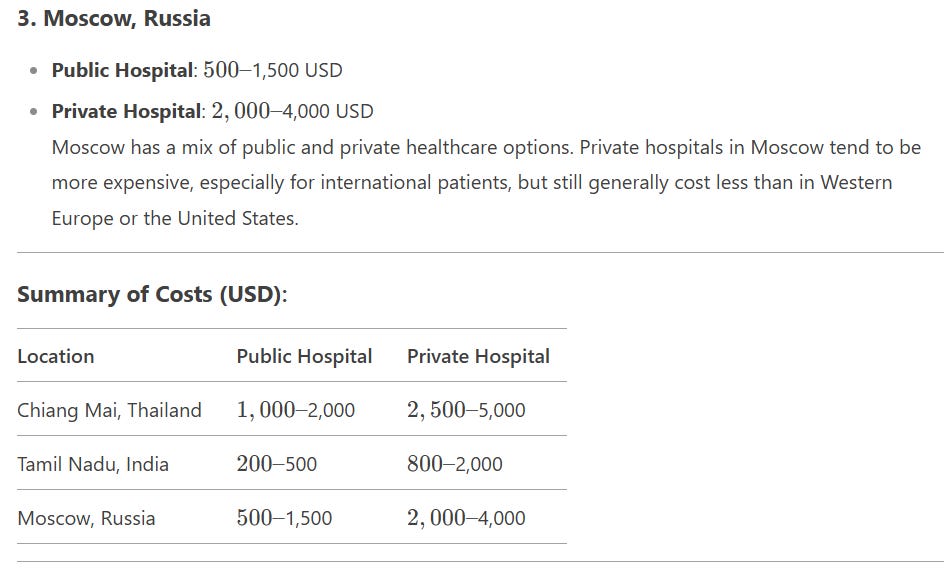
Public Hospital: 200–500 USD
Private Hospital: 800–2,000 USD
India is one of the most cost-effective destinations for medical procedures. Tamil Nadu, in particular, has a robust healthcare system with many well-equipped private hospitals. The cost is significantly lower compared to Western countries, even in private facilities.
How Does Russia, a Key Rival of the US, Stack Up?
3. Moscow, Russia
Public Hospital: 500–1,500 USD
Private Hospital: 2,000–4,000 USD
Moscow has a mix of public and private healthcare options. Private hospitals in Moscow tend to be more expensive, especially for international patients, but still generally cost less than in Western Europe or the United States.
Summary of Costs (USD):
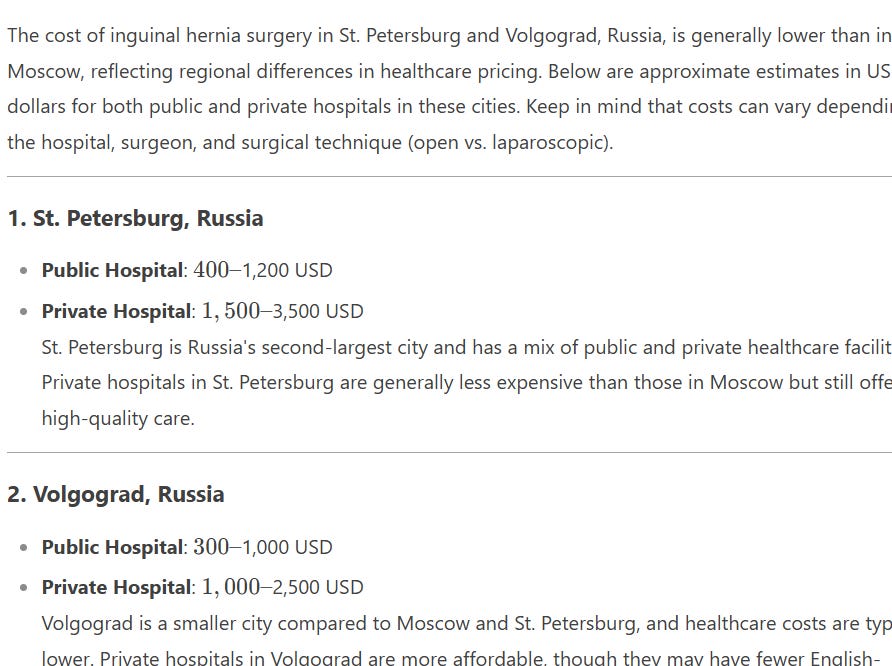
Comparing Cities in Russia: Moscow, St. Petersburg, Volgograd
Bottom Line Comparison of Selected Countries Cost of Surgery for Inguinal Hernia
A Russian Friend Can Help
He told me that such an operation, with a friend of his doing it, might cost as low as $100! Another great friend of mine, Regis Tremblay, who lives in Russia, had successful hip replacement surgery after a fall.
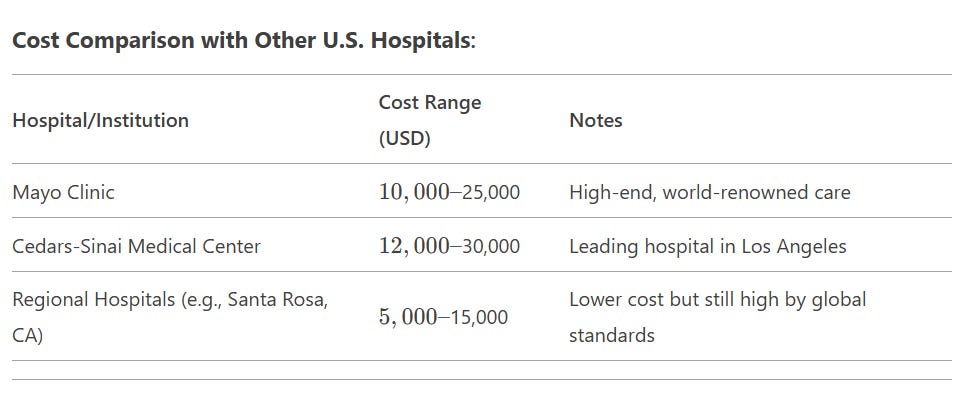
So chances of success are high, at a fraction of the cost of even Thailand, also known for its medical tourism, or especially the cost in a third tier city in the USA. But that nothing compared to the top US hospitals. Take a look:
Costs of Top US Hospitals
Conclusion
He even owns a small sail boat which he sails on the mighty Volga River. He bought it for $5000.
The fact that the US economy is so based on Wall Street and massive national debt as well as personal debts—mortgages, credit cards, auto, and of course medical debt —raise costs and makes the US system fundamentally unworkable over the long or short term. The US national debt is $36 Trillion and rising fast.
Thailand has a basic health plan, where you can see a doctor for a basic appointment for $1 USD as a Thai citizen. My immediate access as a foreigner living here in Thailand to a qualified surgeon cost me $10.
In Russia, most health care is free to Russian citizens, even though Russia is no longer a socialist country. However, unlike the USA, public health is a priority: Organic agriculture is the norm.
A final thought: The US financial system, so dependent on debt and war to keep it going is massively inefficient and unworkable. This case study is just another example and a wakeup call. The problem is not The Democrats or The Republicans. It’s the system run by and for Oligarchy. That’s what we have to deal with.

Geopolitics, history, advancing human consciousness. I talk about the intersection of human consciousness, as informed by my years of experience as a Zen practitioner, along with my study of history, geopolitics and current events.
Print this article [bws_pdfprint display=’print’]
 This work is licensed under a Creative Commons Attribution-NonCommercial 4.0 International License •
ALL CAPTIONS AND PULL QUOTES BY THE EDITORS NOT THE AUTHORS