Print this article [bws_pdfprint display=’print’]
This work is licensed under a Creative Commons Attribution-NonCommercial 4.0 International License •
ALL CAPTIONS AND PULL QUOTES BY THE EDITORS NOT THE AUTHORS
Ben Norton is a journalist and analyst whose work focuses primarily on geopolitics, international political economy, and US foreign policy. Benjamin (Ben) Norton is the founder and editor-in-chief of Geopolitical Economy Report, an independent news website dedicated to publishing original journalism and analysis. Ben has reported from numerous countries, including China, Venezuela, Nicaragua, Bolivia, Ecuador, Honduras, Colombia, and more. His journalistic work has been published in dozens of media outlets, and he has done interviews on the BBC, Sky News, Al Jazeera, Democracy Now, El Financiero Bloomberg, CGTN, TRT World, teleSUR, and more. Ben is now based in Beijing, China.


| Traducir—Translate! | |
| Make fonts bigger>>> | Resize text-+= |
The US government is trying to starve millions of people
Feb 14, 2026
BEFORE you leave, PLEASE pay attention to this alert.
[t4b-ticker id="1"]
This work is licensed under a Creative Commons Attribution-NonCommercial 4.0 International License •
ALL CAPTIONS AND PULL QUOTES BY THE EDITORS NOT THE AUTHORS
Geopolitical Economy Report| Traducir—Translate! | |
| Make fonts bigger>>> | Resize text-+= |
FURTHER CLARIFICATION
Good to see that Ben Norton has done some research into the physical nature of Venezuela’s oil reserves, and instead of simply repeating the idiot mantra “Venezuela has the biggest proven oil reserves in the world” brainlessly spewed out by the LEMSO (Lying Establishment Media Sewer Outlets), Ben stated that most Venezuelan oil today requires imported diluent for extraction and pipeline transport.
Nevertheless there is still a long way to go for GPE to report petroleum matters properly.
Most important is to use PROPER TERMINOLOGY as specifically and precisely defined by the doyens of petroleum geophysics, namely M King Hubbert, Colin Campbell and Jean Laherrère, honest unprostituted SCIENTISTS.
Why? Because using Orwellian doublethink neo-definitions that have been pretzelised by the oil majors and oil PROPAGANDISTS (bullshit terminology and false conflations by the EIA and IEA and especially CERA) simply serve to confuse and promote LIES which then convince sucker investors to part with their money in bullshit oily ventures.
One of the biggest lies is conflating UNCONVENTIONAL shale LTO (also gas condensates* etc) with CONVENTIONAL crude oil output, lumping them together on oil output graphs, which I have explained is a BULLSHIT, in my booklet here:
*Gas condensates are now re-branded by the propagandists as natural gas “LIQUIDS”, which is BULLSHIT because they are in fact GASES at STP. May as well describe IRON as a liquid, because it a liquid at 2000 deg Celsius. Such bullshit.
Other conflations are also highly problematic, eg describing Orinoco oil as “heavy crude”. This confuses people into thinking Orinoco oil is the same as the heavy crude that flows out of conventional oil wells in, say Russia or Saudi Arabia. IT IS NOT.
The proper term for Orinoco basin oil is UNCONVENTIONAL EXTRA-HEAVY crude, which does NOT flow out of wells and through pipes of its own accord.
This is essential to differentiate it from CONVENTIONAL heavy crude which DOES flow out of wells and through pipes of its own accord without needing steam injection or diluent.
The two have VERY VERY VERY different EROEI implications, which thus have HUGE economic and financial implications, which Ben also needs to research and report properly.
Other idiots keep calling shale oil “light sweet crude” because of the Goebbel-esque EIA, IEA and CERA deceitful conflations.
BULLSHIT.
Shale oil is volatile UNCONVENTIONAL LIGHT TIGHT OIL which CANNOT be fractionated into the workhorse fuels of industry and agriculture, diesel and jet fuel.
CONVENTIONAL light sweet crude however is FAR MORE VALUABLE than LTO because the forner CAN AND IS fractionated into the workhorse fuels of industry and agriculture, diesel and jet fuel.
Unless people use the proper terminologies, they will continue to be mindless brain hosts of the oil parasite propagandists who want to keep all of you ignorant and hoodwinked and invested in their SCAMS.
WAKE UP EVERYBODY, IT’S THE OILCONOMY STUPID!!!
—EAB
Topics
0:00 US attack on Venezuela
0:49 (CLIP) Trump: USA will "run the country"
1:31 Two main US demands for Venezuela
2:20 Chavista government is intact
3:21 Oil corporations are skeptical
4:57 Trump's oil deal with Venezuela
7:44 US oil industry benefits rich elites
8:27 China, Russia, Iran, Cuba ties
10:08 USA wants heavy crude
10:46 Economic war
11:53 Marco Rubio targets Cuba
12:24 China and Venezuelan oil
13:02 Pete Hegseth threatens China & Russia
13:44 US seizes Russian-flagged tanker
14:16 Trump wants $1.5 trillion military budget
14:58 Trump bombed 7 countries in 2025
15:20 China's oil imports by country
17:43 Imperialist Monroe/Donroe Doctrine
18:21 Desperation of declining US empire
19:12 International law & UN Charter
20:19 China: South America's top trading partner
PLUS:
BEFORE you leave, PLEASE pay attention to this alert.
[t4b-ticker id="1"]
This work is licensed under a Creative Commons Attribution-NonCommercial 4.0 International License •
ALL CAPTIONS AND PULL QUOTES BY THE EDITORS NOT THE AUTHORS

Geopolitical Economy Report| Traducir—Translate! | |
| Make fonts bigger>>> | Resize text-+= |
![]()
By Ben Norton • 2025-11-13
María Corina Machado is a far-right Venezuelan coup leader who has been funded by the US government since at least 2003.
The Donald Trump administration is waging war on Venezuela, and if it can succeed in overthrowing the leftist government of President Nicolás Maduro, Machado would help to lead the new pro-US regime in Caracas.
Machado won the 2025 Nobel Peace Prize (sic), despite the fact that she openly supports Trump’s war on her country. She has for years called for a US military intervention to violently topple President Maduro.
If Trump and his powerful Secretary of State and National Security Advisor Marco Rubio [a notorious gusano] can manage to put Machado in power, she has pledged to sell off her country’s assets to US corporations.
Machado proudly told a group of US corporate executives in Miami, Florida, that she is planning a “massive privatization program”, offering “a $1.7 trillion opportunity” to exploit Venezuela’s oil, natural gas, infrastructure, gold, and other minerals.
María Corina Machado, the far-right US-backed Venezuelan coup leader who won the Nobel Peace Prize, promised a “massive privatization” if Trump can put her in power.
She vowed to sell off $1.7 TRILLION of Venezuela's oil, gas, gold, infrastructure, etc. to US corporations. pic.twitter.com/jH4AkFbzzk
— Ben Norton (@BenjaminNorton) November 13, 2025
The far-right Venezuelan opposition leader made these remarks in a virtual speech at the America Business Forum on 5 November.
Machado spoke before Donald Trump appeared on stage at the same event. She was interviewed by the Republican mayor of Miami, Florida, Francis Suarez, a loyal right-wing ally of Trump and Rubio. (He is also the son of Xavier Suarez, who previously served as Miami’s mayor.)
The following is a partial transcript of Machado’s comments (all emphasis added):
And this is amazing, super exciting for me: We will open Venezuela for foreign investment.
I am talking about a $1.7 trillion opportunity, not only in oil and gas, which is huge, and you know that there are opportunities, because we will open all, upstream, midstream, downstream, to all companies; but also in mining, in gold, in infrastructure, power.
We have, our grid right now has a 17 gigawatt opportunity of energy potential that needs to be rehabbed, certainly for technology and AI.
And tourism, you know, Venezuela has 2800km of pristine Caribbean coastline ready to be developed.
So this is going to be huge. We will bring rule of law. We will open markets. We will have security for foreign investment, and a transparent, massive privatization program that is waiting for you.
This was not the first time that Machado had made this promise.
Machado also spoke virtually at the Fortune Global Forum in Saudi Arabia in October, where she offered a “business opportunity of more than $1.7 trillion”.
“Venezuela will be the single biggest economic opportunity for decades to come in this region”, vowed the US government-funded Venezuelan coup leader.
Machado presented her ultra-right-wing economic program at an event in June hosted by AS/COA, a corporate lobby group funded by a Who’s Who of large US companies.
In an interview with Donald Trump Jr. in February, Machado again promised to sell off her country’s assets to US corporations.
“We are going to privatize all our industry”, she said, stressing that US companies “are going to make a lot of money”.
These were her comments:
Forget about Saudi Arabia; forget about the Saudis. I mean, we have more oil, I mean, infinite potential.
And we’re going to open markets. We’re going to kick [out] the government from the oil sector. We’re going to privatize all our industry.
Venezuela has huge resources: oil, gas, minerals, land, technology. And, as you said before, we have a strategic location, you know, hours from the United States.
So we’re going to do this right. We know what we have to do.
…
And American companies are in, you know, a super strategic position to invest.
…
This country, Venezuela, is going to be the brightest opportunity for investment of American companies, of good people that are going to make a lot of money.
Nobel Peace Prize winner María Corina Machado, a US-funded far-right coup leader, vowed to privatize Venezuela's oil and give it to US corporations.
"We are going to privatize all our industry", she told Donald Trump Jr.
US companies "are going to make a lot of money", she said pic.twitter.com/NcL6svAeWA
— Ben Norton (@BenjaminNorton) October 14, 2025
María Corina Machado boasts that she is being supported by Marco Rubio and other US government officials
Machado has boasted of the fact that she and her coup-plotting movement in Venezuela are receiving support from numerous US government officials, including Marco Rubio, the second-most powerful person in the administration after Trump himself.
In an interview with Bloomberg reporter Mishal Husain in October, Machado revealed, “I have been in contact not only with several officials in the US government, but also in other countries — in Canada, in Latin America, in the Caribbean, and certainly Europe as well”.
Husain asked if Machado has specifically been in touch with Rubio. The Venezuelan coup leader confirmed that she has.
“I have been in touch with [Rubio], of course, and with his team”, Machado divulged. “And I have to say, even further in Congress, both aisles, you know, in both parties, we have really good friends and champions of our cause”.
In her virtual remarks at the America Business Forum on 5 November, Machado also thanked more US government officials for supporting the coup attempt in Venezuela.
This is what she said:
I’m so grateful to the Secretary of State Marco Rubio, that has been, you know, the champion of the cause of freedom and democracy in the Americas.
I want to thank Governor DeSantis.
I want to thank my friend, Senator Rick Scott, that has always trusted us.
And now Senator Ashley Moody.
And of course, I have to say, and I want to make a special mention to our three amigos, our three friends, [Congress members] María Elvira Salazar, Mario Díaz-Balart, and Carlos Giménez, who have been so, so, so close, and always supporting us.
Machado likewise expressed gratitude to the Miami mayor, Francis Suarez, who was interviewing her at the America Business Forum, just two hours before Trump spoke at the same event.
“You have been a great friend, Francis, of our cause. I am so grateful to you”, she said.
The Miami mayor noted that he and Machado had a friendly conversation before the interview.
“We spoke yesterday on the phone, and you invited me to a free Venezuela, and I look forward to that day, where I can go with my wife, who is in the audience, to visit you in the presidential palace, one day”, Suarez said.
This was a clear sign that US government officials hope to put Machado in power in Caracas. They are confident that the longtime US government-funded coup leader would obediently serve US interests in Latin America.
Machado stressed that, if Trump and Rubio can help her overthrow Maduro, she would cut Venezuela’s ties with China, Russia, and Iran, and their next plan would be to work with Washington to topple the leftist governments in Nicaragua and Cuba.![]()
BEFORE you leave, PLEASE pay attention to this alert.
[t4b-ticker id="1"]
This work is licensed under a Creative Commons Attribution-NonCommercial 4.0 International License •
ALL CAPTIONS AND PULL QUOTES BY THE EDITORS NOT THE AUTHORS

| Traducir—Translate! | |
| Make fonts bigger>>> | Resize text-+= |
US 'neo-imperialist' dollar scheme explained by economist Yanis Varoufakis
Greece’s former Finance Minister Yanis Varoufakis explains the US system of “neo-imperialism” based on the dollar, an “IOU issued by the hegemon”, which finances a huge trade deficit by letting foreign capitalists “extract colossal surplus value from their workers and then stash it away in America’s rentier economy”.
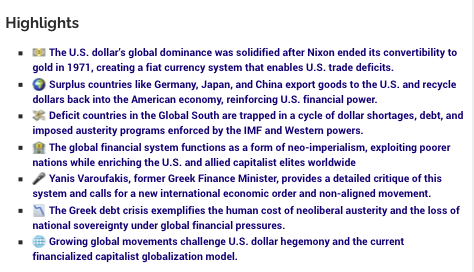
The video explores the dominance of the U.S. dollar in the global financial system and the mechanisms by which the United States has maintained economic hegemony since the early 1970s. Central to this dominance is the 1971 decision by President Richard Nixon to end the dollar’s convertibility to gold, effectively transforming the dollar into a floating fiat currency and an IOU issued by the global hegemon. This shift enabled the U.S. to run massive trade deficits, which acted as a “vacuum cleaner” sucking in net exports from major surplus countries like Germany, Japan, and China. These surplus countries then recycled their dollar earnings back into the U.S. economy by purchasing American government bonds and real estate, reinforcing U.S. financial dominance.
Meanwhile, deficit countries, primarily in the Global South, faced chronic shortages of dollars necessary to pay for vital imports such as energy, medicine, and technology. To obtain dollars, these countries resorted to borrowing on international markets, leading to unsustainable debt burdens. When they defaulted or could no longer service their debts, institutions such as the International Monetary Fund (IMF) intervened, imposing structural adjustment programs that enforced neoliberal austerity measures, privatization of public assets, and severe social cutbacks. This cycle perpetuated the economic subjugation of poorer nations, enabling Western and local oligarchs to extract wealth and repatriate it to the U.S. economy, cementing a system described as “financialized capitalist globalization” or “neo-imperialism.”
The transcript prominently features the economist and former Greek Finance Minister Yanis Varoufakis, who delivered a powerful speech elaborating on these themes. Varoufakis critiques the global capitalist system as exploitative and highlights how the original Non-Aligned Movement fell victim to this form of neo-imperialism because capitalist interests were more adept at internationalism and understanding global finance than the movement’s leaders. The transcript also references economist Michael Hudson, who first exposed the U.S. dollar hegemony scheme in the early 1970s and recently updated his analysis in light of contemporary geopolitical tensions and efforts to de-dollarize.
The discussion extends to political consequences, notably Greece’s 2008 financial crisis and the subsequent austerity policies imposed by the European Troika, which Varoufakis opposes as a “politics of humiliation” and a loss of national sovereignty. Since resigning as Finance Minister, Varoufakis has become an activist advocating for a new international economic order and a non-aligned movement to counterbalance U.S. imperialism and the new Cold War dynamics. The transcript concludes by emphasizing the importance of public intellectuals like Varoufakis speaking openly about imperialism and the need for a fairer global financial system.
The End of Bretton Woods Marked a New Era of Financial Imperialism: When Nixon ended the dollar’s gold convertibility, it effectively transferred massive financial power to the U.S., allowing it to run trade deficits without the usual economic consequences faced by other countries. This decision underpins the modern global financial system and U.S. economic hegemonism, facilitating a unique form of imperialism through finance rather than traditional colonialism.
Trade Deficits as a Vacuum Cleaner for Global Wealth: The U.S. trade deficit is not a sign of economic weakness but a deliberate mechanism that attracts the surplus export earnings of powerhouse economies. Countries like Germany, Japan, and China accumulate dollars through exports, which they then invest back into the U.S., sustaining American spending and financial dominance. This cyclical flow benefits both the U.S. and these capitalist surplus countries, illustrating a symbiotic relationship underpinning dollar hegemony.
Dollar Shortages in the Global South Foster Dependency and Austerity: Poor and deficit countries face chronic dollar shortages needed to pay for critical imports. Unable to generate sufficient dollars through exports, they rely on borrowing. This dependency subjects them to IMF conditionalities that enforce harsh neoliberal policies, which often lead to social devastation. This dynamic is a form of economic coercion that perpetuates inequality and underdevelopment.
️ IMF and Structural Adjustment Programs as Tools of Financial Neo-Imperialism: The IMF’s role in managing debt crises in the Global South often results in the privatization of national assets and austerity policies that benefit international capitalist interests and local oligarchs. This process effectively transfers public wealth to private hands, which then funnel resources back into Western financial markets, sustaining the global economic order in favor of the U.S. and allied elites.
️ Yanis Varoufakis’s Critique Highlights the Political Dimension of Economic Sovereignty: Varoufakis’s experience as Greece’s Finance Minister during the debt crisis illustrates how economic policies imposed by external actors undermine national sovereignty and democracy. His reference to Greece’s austerity as a “new Versailles” underscores the political humiliation and loss of control experienced by debtor nations under neoliberal globalization.
The Original Non-Aligned Movement’s Failure Reflects Capitalist Sophistication: Varoufakis argues that capitalist actors were more effective at international coordination and exploiting the post-Bretton Woods system than the Non-Aligned Movement, which failed to counter this new form of imperialism. This insight suggests that ideological resistance alone is insufficient without a practical understanding of global financial dynamics.
Calls for a New International Economic Order and De-Dollarization Reflect Growing Resistance: The speech and the surrounding discourse underscore the increasing global pushback against U.S. financial hegemony. Movements for de-dollarization, new non-aligned alliances, and alternative economic orders are gaining momentum, signaling a potential shift in the global economic landscape. These developments challenge the unipolar dominance that has characterized the post-World War II era.
The transcript demonstrates how financial globalization has evolved into a sophisticated system of neo-imperial control, where economic instruments and currency dominance replace traditional imperial conquest. It reveals the intertwined interests of U.S. power and global capitalist elites in maintaining this order, while highlighting the urgent need for systemic change advocated by voices like Yanis Varoufakis and Michael Hudson. The discussion also frames the contemporary geopolitical tensions and economic inequalities within this broader historical and structural context.
Sources and more information here: https://geopoliticaleconomy.com/2023/02/03/us-imperialism-dollar-hegemony-yanis-varoufakis
German lawmaker condemns ‘US-led proxy war against Russia’ and EU’s ‘servile vassals’: https://geopoliticaleconomy.com/2023/01/28/german-lawmaker-us-proxy-war-russia-ukraine-eu
Varoufakis' full speech:
|| Geopolitical Economy Report ||
Please consider supporting us at https://GeopoliticalEconomy.com/Support
Patreon: https://Patreon.com/GeopoliticalEconomy
BELOW: The RUMBLE version of the main video, just in case YouTube (Google), notorious for its aggressive censorship on behalf of the globalists' narrative, decides to suddenly "disappear" this video.
HIGHLY RECOMMENDED related post:
IT’S THE OILCONOMY, STUPID: MATERIAL WEALTH and THE US PETRODOLLAR
https://www.greanvillepost.com/2025/10/26/its-the-oilconomy-stupid-material-wealth-and-the-us-petrodollar/
BEFORE you leave, PLEASE pay attention to this alert.
[t4b-ticker id="1"]
This work is licensed under a Creative Commons Attribution-NonCommercial 4.0 International License •
ALL CAPTIONS AND PULL QUOTES BY THE EDITORS NOT THE AUTHORS

| Traducir—Translate! | |
| Make fonts bigger>>> | Resize text-+= |
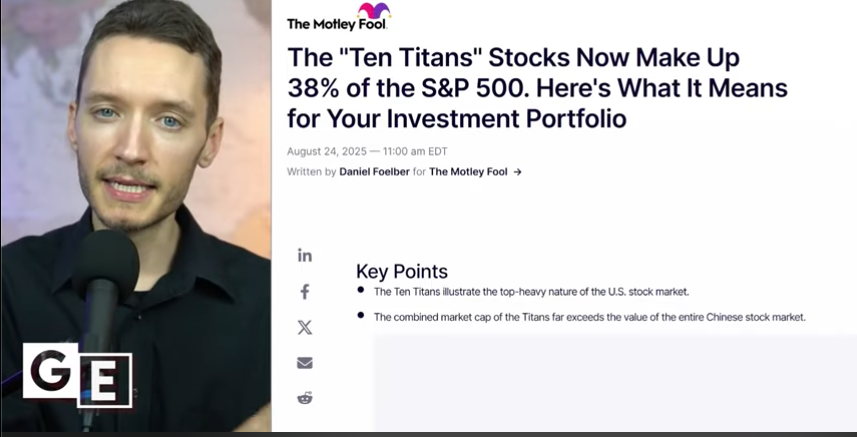
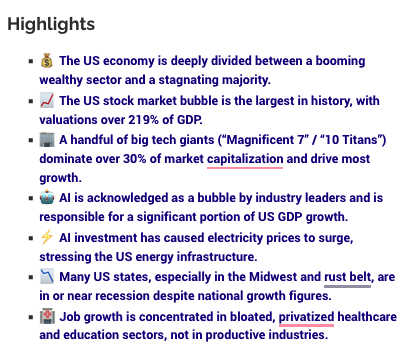
The video provides a comprehensive analysis of the current state of the United States economy, revealing deep structural problems masked by aggregate growth figures. While the headline US GDP and stock market indices suggest economic strength and growth, the reality for most Americans is quite different: a bifurcated economy where the rich—particularly the top 10%—benefit disproportionately, while the majority experience stagnation or recession. The economy of the wealthy is driven by massive financial and tech bubbles, especially in the stock market and artificial intelligence (AI) sectors. These bubbles have reached unprecedented levels, with the stock market’s valuation exceeding 219% of GDP, far surpassing previous historical peaks. The concentration of wealth and stock ownership in a handful of big tech companies—the so-called “Magnificent 7” or “10 Titans”—is extreme, with these few corporations driving most market growth while the rest of the economy remains stagnant.
The AI sector, heavily invested in by these tech giants, is also in a bubble, acknowledged by industry leaders like Sam Altman and Jeff Bezos, though Bezos frames it as a “good” industrial bubble. However, data shows that the majority of AI projects are failing to generate profits, and much of the stock price growth is driven by speculative investment rather than real economic value. This financial bubble is propping up the illusion of growth, while the real economy—especially in regions like the Midwest and Rust Belt—is in decline, with many states already in or at high risk of recession.
The video also highlights how AI investment is disproportionately influencing GDP growth, with some economists estimating that AI-related capital expenditures account for over 90% of US GDP growth in early 2025. This bubble is so large that it has caused electricity prices to soar due to the massive energy demands of AI data centers, compounding economic challenges. Government policies, particularly under the Trump administration, are criticized for favoring fossil fuel interests over renewable energy development, worsening the energy supply problem.
Finally, while sectors like healthcare and education are adding jobs, these are largely due to bloated, privatised, and inefficient industries rather than genuine economic health. The overall message is a warning: the US economy’s apparent strength is an illusion fueled by financial and tech bubbles that will eventually burst, causing severe damage to the broader economy and worsening inequality.
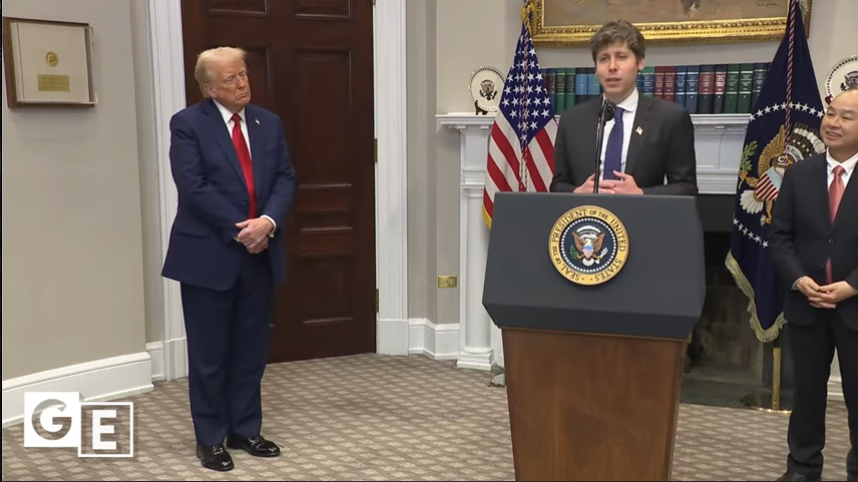
BELOW: Ignoramus Trump listening piously to Sam Altman, OpenAI-ChatGPT
Economic Bifurcation and Inequality: The US economy is split into two distinct realities: a financialized economy benefiting the top 10%, and a stagnant or recessionary economy experienced by the majority. This bifurcation highlights systemic inequality and challenges the narrative of broad-based economic growth. The richest 10% account for nearly half of all consumer spending and a third of GDP, showing how skewed economic benefits have become. This concentration of economic power exacerbates social and economic divides and undermines overall economic resilience.
Unprecedented Stock Market Bubble: The Buffett indicator reveals that the US stock market’s valuation is more than double the size of the economy (219% of GDP), dwarfing previous bubbles like the dot-com and 2007 housing bubbles. This extreme overvaluation signals a highly unstable financial environment, driven more by speculation than fundamentals. The concentration of market cap in a tiny fraction of companies (0.12% of firms holding 30% market cap) further increases systemic risk, as the performance of the entire market hinges on a small number of tech giants.
️ The Tech Bubble and AI Speculation: The “Magnificent 7” (later expanded to 10 Titans) dominate market growth, fueled by massive AI investments. Despite heavy spending, 95% of AI pilot projects fail to generate profits, indicating a disconnect between investor enthusiasm and real economic returns. This speculative behavior, where fund managers collectively acknowledge overvaluation yet continue to invest, mirrors past irrational bubbles and suggests the market is driven by herd mentality rather than sound economics.
⚡ AI Investment’s Impact on the Economy and Energy: AI capital expenditure has become a major driver of GDP growth, possibly accounting for over 90% of growth in early 2025. However, the cost is enormous: AI data centers consume massive amounts of electricity, causing US energy prices to soar amid constrained supply. Government policies that hinder renewable energy development worsen this problem, creating a paradox where AI growth strains the very infrastructure needed to sustain it. This dynamic increases operational costs across the economy and risks undermining long-term economic stability.
Regional Economic Disparities and Recession Risk: Aggregate GDP growth masks significant regional disparities. States in the Midwest and rust belt, often dependent on manufacturing and deindustrialized, face recession or high risk thereof. These areas, representing a third of US GDP, are economically neglected compared to booming states like California and Texas, driven by tech and finance bubbles. This geographic divide has profound social and political implications, as large populations face economic hardship despite national prosperity narratives.
Job Market and Sectoral Imbalances: Job growth is minimal or negative across most sectors, except for healthcare and education, which expand due to demographic trends and inefficient, bloated privatized systems rather than genuine economic vitality. These sectors’ growth reflects systemic inefficiencies and rising costs, burdening average Americans with high expenses and limited benefits. This uneven job market underscores the fragility of the real economy beneath headline growth figures and points to structural weaknesses in labor markets.
⚠️ Systemic Risk of Bubble Bursting: The video warns that the stock market and AI bubbles are unsustainable and will eventually burst, potentially triggering a severe economic downturn affecting the entire country and even global markets. The financialization of the US economy means that a bubble collapse would devastate not only Wall Street elites but also the broader economy that depends on these sectors for growth. Policymakers and investors face profound challenges in managing this risk, as history shows bubbles can inflate well beyond fundamental values before collapsing, causing widespread economic damage.
The video offers a sobering and well-substantiated critique of the US economy’s current condition. Beneath the surface of aggregate growth and stock market highs lies a deeply divided economy where the majority of Americans face stagnation or recession. The enormous stock market and AI bubbles, centered on a handful of tech giants, create an illusion of prosperity that masks systemic inequality and regional economic distress. The overreliance on speculative investment and AI spending to drive growth is unsustainable and poses significant risks to the future stability of the US and global economies. The video calls for greater awareness of these structural problems and cautions that the eventual bursting of these bubbles will have far-reaching consequences.
BEFORE you leave, PLEASE pay attention to this alert.
[t4b-ticker id="1"]
This work is licensed under a Creative Commons Attribution-NonCommercial 4.0 International License •
ALL CAPTIONS AND PULL QUOTES BY THE EDITORS NOT THE AUTHORS