
Karl Sanchez


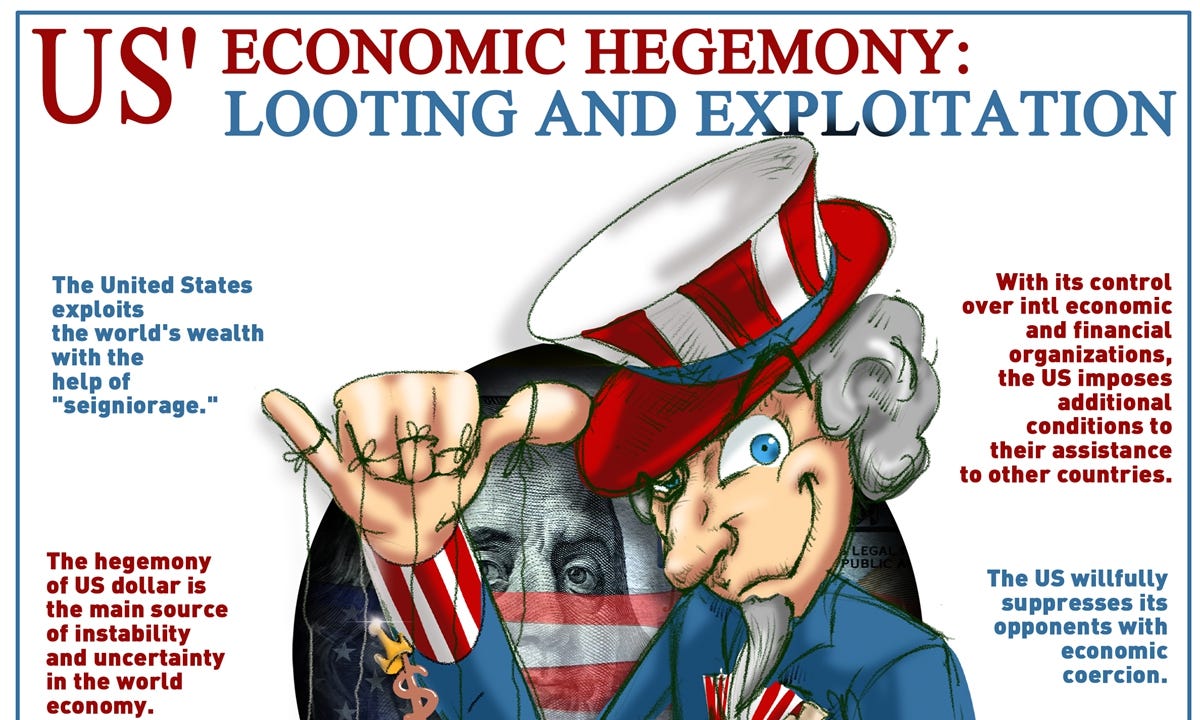
The roots of this problem are over 100 years old with the competition between Imperialist Colonial Empires for mastery of the Global System as it then existed and as it’s evolved due to the effects of three previous and now a fourth global war. Over those years and conflicts, the competition’s been reduced to the remnants of the initial Imperialist Colonial Empires, which are now distilled to the Collective Western Empire led by the Outlaw US Empire, versus three Civilization States—China, Russia and Iran and their allies within the Global Majority. Professor Richard Wolff has dubbed this the Last Great Colonial War. I see it as the War to Eliminate Hegemony.
Resistance to hegemony has existed for centuries but was greatly escalated with the onset of what’s known as the Scramble for Africa that placed all the Colonial/Imperial Empires into direct competition for what remained. One Empire that was placed on the menu was the Ottoman Empire—the Sick Man of Europe as it was then known whose lands were coveted by the other empires. And one Empire hadn’t really arrived on the world stage yet—the US Empire. Just prior to and as the 20th Century began, new views on how to attain systematic hegemonic control of the world were being voiced by the United States and the United Kingdom with Halford Mackinder’s system becoming dominant: control of the Eurasian Heartland via the maritime empires’ control of the oceans which is where most commercial trade took place as overland communication routes were very few at the time. And that doctrine also brought Japan into the mix as it had its eyes on Korea, Manchuria and the rest of East Asia to which it was suggested it control by President Roosevelt after Japan beat Russia in the 1904-5 war—Japan was to be an agent, a proxy of the USA in East Asia, or so it was suggested and interpreted by the Americans and Japanese at the time as I reported in an earlier article. So, naval power served the Imperial need to exert power and control colonies, and great competition ensued that continued after WW1.
The first two world wars, or parts one and two of the first, ruined the European Colonial powers as they devastated each other and the same happened to Japan in the Pacific. The one Empire left standing was the US Empire that became an Outlaw as soon as the UN Charter became the accepted international law by the world’s nations. During the war, US planners schemed to obtain post-war dominance in a way that would allow the Empire to control most of the planet using a method that was called indirect/informal colonialism that used financial fetters instead of occupying armies. Decolonization on a formal basis was slowly and grudgingly allowed at great cost to those nations wanting independence from their broken colonial masters.
Wars were fought by the Outlaw US Empire to ensure those new nations would be controlled by it and not attain complete sovereignty. The key method was to use a tool initiated prior to WW2 that was known as Dollar Diplomacy which was enforced by the US Marines and prompted General Smedly Butler to write his seminal War is a Racket that testified to the Mafiosi methods of extracting money from what were supposedly independent sovereign nations. Those methods were modified and utilized by two new Bretton Woods institutions formulated in 1944—the World Bank and the International Monetary Fund both of which were under the complete control of the Empire. How they worked is well described in Dr. Michael Hudson’s Super Imperialism (1972) and was recently updated (2021) to reflect what had transpired over the intervening fifty years. The key is financial control mainly via dollar denominated loans and an international financial system based on dollars. This control is more powerful than many armies and navies, and as we’ve seen was recently weaponized to use against several nations the Outlaw US Empire has long coveted to control—Russia, Iran, Cuba, Venezuela. When Trump tried to use the dollar against China during his first term, he discovered China was too resilient and was forced to relent, although he tried again during his second term and lost very badly. China had anticipated and prepared. China also understands that for its economic policy goals to attain their objectives—global Win-Win trade via the Global Development Initiative—it will need to eliminate hegemony once and for all, and to accomplish that without entering into a shooting war with the Outlaw US Empire, although China’s military power can defeat the Empire. What China wants to avoid is the vast damage such a war would cause to the planet and Humanity. We’ve seen part of China’s plan with its industrial and technological development. But there’s more to it as was outlined in a 2024 speech made by Xi Jinping that was only publicly released last February and reported on here.
Recently more rumblings about what China’s already emplaced as a foundation for what Xi said in 2024: “Take the road of financial development with Chinese characteristics and build a financial power.” Recently on Dragon TV’s “This is China” program two episodes were aired, “How to Build a Financial Powerhouse,” and “Building a Strong Capital Market Nation,” which featured Professor Zhang Weiwei, Director of the China Research Institute at Fudan University, and Professor Zhang Keliang, a researcher at the National Institute of Financial and Economic Strategy at Central University of Finance and Economics, and moderator He Jie. These two programs give vital background to China’s emerging parallel financial system that is of its own creation and not aimed at displacing or directly competing with the established US Empire system; it’s an alternative. That it will be more modern, less costly for users and without coercive hooks are just matter-of-fact and not aimed at anyone as the Chinese Foreign Ministry likes to say. Of course, the reality is that is a competitor with Win-Win benefits for users.
I pause for an aside. Today’s Wolff/Hudson/Nima discussion looks at the Big Picture as they’ve done often. Hudson in summation might have said Neoliberals are what Rump refers to as Communists, while using the term Neofeudalists instead–since they covet rent and 100% control. Wolff provides an excellent example of how there are two tails wagging the dog–-Zionist and European–-for very similar reasons. Ultimately, the conflict is between the Global Majority and the Outlaw US Empire for the former’s freedom from Colonial Mafia control. Currently, Russia and Iran are the main defenders of the Global Majority and are on the firing line. A significant portion of the Global Majority remains on the fence unable to see the Big Picture with clarity, which is why Hudson and Wolff frame their discussions together and separately as they do. The key is not to get distracted by the daily happenings but to see how they can be combined to provide the overview that’s required, otherwise the main conflict will be obscured as the Empire desires and its narrative insists. Pause over.
The “This is China” programs are aimed at explaining to Chinese how this will be done. That the information is being made public is a sign of China’s high degree of confidence that it will succeed. We now proceed with the transcript of “How to Build a Financial Powerhouse”:
Finance is the lifeblood of the national economy and an important component of a country’s core competitiveness. Building a strong financial nation has also become an essential part of China’s development in the new era. Although China is now a major financial powerhouse, with the largest bank scale and foreign exchange reserves in the world, the second largest bond and stock market scale, and the insurance scale also ranking among the top, overall it is large but not strong. Accelerating the construction of a strong financial nation is an inevitable requirement for fully building a modern socialist country and promoting high-quality development.
As a socialist country, what kind of financial theory should China have, and how should we build a strong socialist financial nation? On March 30th, on Dragon TV’s program “This Is China,” Professor Zhang Weiwei, Director of the China Research Institute at Fudan University, and Professor Zhang Keliang, a researcher at the National Institute of Financial and Economic Strategy at Central University of Finance and Economics, engaged in an in-depth dialogue and discussion on the history and prospects of China’s financial development.
Zhang Keliang:
The third issue of Qiushi magazine, published on February 1, featured General Secretary Xi Jinping’s important article “Following the Path of Financial Development with Chinese Characteristics and Building a Strong Financial Nation.” A new discussion about becoming a financial powerhouse has sparked in both domestic theoretical and practical circles. Today, I would like to share my learning and thoughts on this topic. Now, I will share three viewpoints. [It’s important to note again that the “article” was a speech given in 2024 whose contents were withheld from the public while China’s government began acting of Xi’s suggestions.]
The first viewpoint is that the essence of finance is production relations. Currently, mainstream domestic financial theories all originate from the West. The essence of finance is defined as the cross-time allocation of funds, but I believe the essence of finance is production relations. Let us review the three core elements of production relations: who owns the means of production; relationships between people during production; how the fruits of labor are distributed. In feudal society, land, as the most important means of production, mostly belonged to the landlord class. Tenant farmers rented land from landlords and paid rent to the landlords, suffering oppression from the landlords. In capitalist society, the means of production belong to the capitalists.
Peasants lose their land and become workers, working for capitalists in factories. Workers could only earn wages to make a living, exploited by capitalists. Entering the era of financial capitalism, with monetary capital, one could purchase corresponding physical forms of production at any time. Money has become the main form of production in modern society. Financial institutions effectively control social funds, that is, the right to manage, allocate and use the means of production, as well as the right to distribute profits. It is precisely because banks and other financial institutions control the means of production, that is, capital, that they determine the relationships between people during the labor process. So many entrepreneurs say they are “working for the bank.”
As for how the fruits of labor are distributed, that is even more obvious. In previous years, the salaries of financial professionals were 12 times higher than those in other industries. Even with salary cuts now, it is still higher than most industries. It is evident that the establishment of the financial system determines who owns the means of production, determines people’s status and relationships in the production process, and also determines how labor results are distributed. The socialist financial system is controlled by the state, serving all the people, and its achievements are shared by all. In contrast, the capitalist financial system is controlled by big capitalists, with profits held exclusively by them.
Since the financial system is the relations of production, then the real economy is the productive force. The issue of matching productive forces and production relations translates into the issue of matching the real economy and the financial system. A sound and efficient financial system can promote enterprise development and advance social productivity. Conversely, if the financial system has flaws, it will hinder enterprise development and limit productivity improvement. When we were in school, we all learned that capitalist society has a contradiction between large-scale socialized production and private ownership of the means of production, which inevitably leads to periodic financial crises.
However, in socialist countries, precisely because our financial system is mainly controlled by the state representing the people, it can adapt to large-scale socialized production and has the ability to “smooth out” economic fluctuations and resist various internal and external shocks. So, in just a few decades, we have followed the development path of the West that took hundreds of years, growing from an exploited and oppressed semi-colonial society into the world’s leading manufacturing power. [Dr. Hudson often notes that irony.]
The second viewpoint is that inclusive finance is an important feature of socialist finance. Modern Western financial capital has undergone serious alienation, transforming from serving the real economy into a tool for financial oligarchs to exploit ordinary people internally and to impose neo-colonial rule externally. To build a strong financial nation, we can no longer blindly follow Western leads, following the old Western path. We need to summarize socialist financial theory based on years of financial practice.
The core difference between the two is that Western financial theory and practice have the real economy serving financial capital and labor serving capital. Socialist financial theory and practice should be that the financial system serves the real economy and capital serves labor. Capitalism is a society based on “capital” and employed by “people”; our socialism is a society that is people-oriented and uses resources for us.
The socialist financial system, on one hand, must adapt to large-scale socialized production and promote the development and improvement of productive forces; on the other hand, it must ensure that the fruits of social and economic development are shared by all people to achieve common prosperity. First, we rely on the leadership of the Party; second, we rely on inclusive finance. Inclusive finance, on one hand, should be wide and broad, benefiting more small and medium-sized enterprises and ordinary people. On the other hand, the cost must be low, allowing small and medium-sized enterprises and ordinary people to truly benefit. To achieve the goal of common prosperity, the key is to increase the people’s share in the right to use means of production, that is, in access to financial resources and services. [These points were echoed by Einar Tangen in this podcast and at his substack.]
Capitalism separates workers from the means of production, creating the proletariat. We must organically combine talent and means of production, and harness the enthusiasm and creativity of human capital. The state allocates the means of production—that is, funds—to the broad masses of workers through inclusive finance. Only by allowing workers to own these means of production can they enjoy the fruits of labor, solve the wealth gap, and achieve common prosperity.
Western financial institutions are privately owned by capitalists, only pursuing maximum returns and keeping small accounts. This is why the principle of risk-return matching arises. Small and medium-sized enterprises are risky, so loan interest rates must also be high. In China, financial institutions aim to enhance social productivity and people’s well-being. The state provides loans to support small and medium-sized enterprises through inclusive finance, with interest rates not only low but actually lower than those of large enterprises. Although this may cause financial institutions to lose part of their returns, it creates greater value for society. Socialist finance is not about calculating small accounts for itself, but about the greater accounts of society.
The third viewpoint is that the state controls capital through “capital policy.” Water can nourish all living things and meet people’s needs for agricultural irrigation, but it can also trigger floods and cause massive destruction. What are we supposed to do? We must plan and build water conservancy systems so that they serve our interests, not suffer harm. In the economic sphere, monetary capital is water, and the financial system is the water conservancy system.
We should better build and improve our financial system, so that, just as Yu the Great controlled the floods, we can cultivate, manage, and utilize capital more effectively, so that it can better serve social and economic development. Therefore, I suggest that the country should introduce a “capital policy” based on fiscal and monetary policies. “Capital policy” refers to the strategy for water management, referring to the state’s macro-control policies that regulate the creation, formation, distribution, and use of various types of capital through various means. Only by achieving coordinated measures of fiscal, monetary, and capital can the country’s macro-control measures be complete and more effective.
Western countries do not have a “capital policy” because their financial institutions are mostly controlled by big capitalists, a function controlled by capitalists. Most of our country’s financial institutions are state-owned, and the state can fully control these institutions and implement ‘capital policies’ to manage capital and better serve the people. If money is compared to individual people, capital is the money organized, forming the force that develops combat effectiveness and directly creating value.
The core goal of “capital policy” is to transform dispersed funds into various types of capital capable of creating value, promoting the formation of capital, especially innovative capital. Its essence lies in elevating capital from spontaneous market allocation to national policy guidance, promoting economic growth by restructuring the mechanisms of capital formation, flow, and income distribution. To sum up, recognizing that the essence of finance is production relations, inclusive finance is an important feature of socialist finance, and the state has introduced “capital policies” to control capital in order to better build a strong financial nation. Thank you, everyone.
Roundtable dialogue
He Jie: Just now, Teacher Ke Liang gave a speech explaining his understanding of the socialist financial system from a theoretical perspective. The explanation is quite fast, with many technical terms, so I think our roundtable dialogue section can use numerous examples to explain these systems and help everyone understand better. I would like to first ask Mr. Ke Liang a question: In your speech just now, you mentioned that China’s financial system has helped us grow into the world’s leading industrial power over several decades. Could you give some examples to illustrate how our finance has helped achieve this goal at different stages?
Zhang Keliang: Actually, China’s financial system can be divided into two stages, with 1993 as the boundary. Before 1993, China was basically under a planned economy system, with finance essentially being a subsidiary of fiscal finance and the “cashier” of finance. But even in this case, it still made a very important contribution. After the founding of New China, the country was poor and had no capital. Most of the domestic wealth was taken to Taiwan by Chiang Kai-shek’s faction. What should be done?
So we can only pool the remaining funds and invest them in heavy industry construction, laying the foundation for our industrial base. For example, after the founding of New China, we implemented “156 projects” and 156 major projects, including enterprises like Changchun FAW and Ansteel, known as the “eldest son” of the Republic, pooling all ordinary people’s funds through financial institutions and providing support according to national unified allocation. In the 1960s, when we faced nuclear blackmail from the United States and launched the Third Front construction, financial institutions invested funds into the Southwest region, which not only ensured national security but also adjusted the industrial structure. If there had been no Third Front construction back then, the gap between coastal areas and the central and western regions might have been even greater.
He Jie: In other words, all the cases you just mentioned had socialist finance playing a role. Although at that time, the concept of “finance” was not particularly emphasized.
Zhang Weiwei: Let’s start from the Republic of China period. The problems of the Republic of China were that it was bad at warfare, poor at finance, the financial system collapsed, and banknotes depreciated sharply. Similarly, China was bullied by Western hegemony at the time, such as in the Opium Wars. After Britain defeated China, it demanded war reparations. During the war reparations period, our customs were controlled by the British man Hudd. His approach was simple: first deduct all the war reparations and other payments to be paid, then hand over the remaining funds to the Chinese government. [These are the sort of reparations Trump wants to impose on Iran, although Trump lost the war. Venezuela and Iraq suffer under that formula.]
In other words, Britain defeated China by both military means and financial means. From defeat to control, the Western powers have done exactly this, and the U.S. is still doing it today. After the founding of New China, the military and finance began to “stand up.” Our achievements deserve full recognition, but for quite some time we were still exploring how to use “finance.” As you said, at that time there was only finance, and finance was just “tellers.”
He Jie: The point just added by Mr. Zhang also shows us that when capitalist countries bully the weak, they drain the blood of a nation and undermine its financial system.
Zhang Keliang: After 1993, we carried out reforms. Previously, the only bank in China was the People’s Bank of China. Later, we established three policy banks: the Export-Import Bank of China, the Agricultural Development Bank of China, and the China Development Bank. We have stripped away the policy functions of the four banks—’ICBC, Peasant, China Construction’—this is market-oriented reform. After implementing market-oriented reforms, the financial system entered a stage of market-based allocation. At this stage, what is its contribution to our economy?
First, support for national infrastructure construction. For example, our highway and high-speed rail construction has achieved remarkable results, with ports like Yangshan Port and Zhoushan Port, as well as 5G communication networks, all established. These infrastructure projects require huge sums of money. For example, the total investment for the Beijing-Shanghai High-Speed Railway exceeds 200 billion yuan. We were able to complete it because our banking system provided substantial funds through syndicated loans, ensuring the infrastructure is well built. Once infrastructure is built, it will benefit all our enterprises.
Second, to help our companies go global. In the process of globalization, after joining the WTO, many of our companies have gone global, including acquiring overseas minerals and well-known overseas brands, and helping Asia, Africa, and Latin America build infrastructure through the Belt and Road Initiative. Asia, Africa, and Latin America often face funding shortages, thus opening the door for loans from China’s Export-Import Bank, allowing us to export our production capacity and machinery to the Asian, African, and Latin American regions.
Third, to support our technological innovation, which mainly relies on the capital market.
Another point: I just mentioned “smoothing out” economic fluctuations. We can recall that the West experiences periodic economic crises—the 1997 Asian financial crisis, the 2008 international financial crisis—our country relied on the financial system to get through these crises. Including the 4 trillion yuan loan support introduced during the 2008 financial crisis, minimizing the impact. These are all the important roles finance plays in our economic development.
Zhang Weiwei: Let me add one more thing. We often say that the greatest advantage of China’s system is its concentration of efforts to accomplish major tasks. The underlying logic is finance, allowing funds to be concentrated.
He Jie: We need to concentrate our efforts. What kind of strength is being concentrated? First and foremost, the power of capital is the financial system at play.
Zhang Weiwei: No matter how many shortcomings our current financial system still has, the fact that our financial system has helped us avoid financial and economic crises is itself an extraordinary achievement. I personally experienced the 2008 financial crisis. At that time, I was in Europe, and several major Swiss banks were on the verge of bankruptcy. Like the United States, they were obsessed with financial games and heavily engaged in financial derivatives business. Fortunately, the Swiss government had reserves and injected capital into banks, surviving the crisis. However, many countries went bankrupt as a result, and many others experienced this. The wealth of ordinary Americans has shrunk by a quarter.
He Jie: You just said in your speech that the financial system ultimately determines the ownership of the means of production. In socialist countries, the means of production are in the hands of the people. Capitalist society is different, where the means of production are controlled by big capitalists and big capital consortia. For them, finance is the operation of funds.
Zhang Keliang: Let’s not talk about anything else, let’s talk about the most developed capitalist country, the United States. The high-speed rail mileage in the U.S. is very limited, and the highways were built in the early days. The U.S. State Grid is outdated, and now with AI, the grid can no longer support it. And communication networks—many people who have been to the US say many places have no signal, many places can’t use credit cards, or use mobile payments. Our mobile payments rely on the construction of 5G networks. Why don’t they do it?
First, the government lacks the ability to mobilize funds; all the funds are controlled by capitalists. Why doesn’t the U.S. build high-speed rail? Because building high-speed rail would impact its aviation industry. The American aviation industry is highly developed, and these capitalists do not revolutionize themselves. The U.S. banking and credit card systems are highly developed, so they are reluctant to use payment methods like Alipay. Therefore, only when the financial system is controlled by the state will the state, in the interest of its people, promote self-revolution and self-iteration. If they are in the hands of capitalists, they will never innovate themselves. Even if they know they need to catch up, they won’t do it without interest.
Zhang Weiwei: The reasoning is simple. Privately controlled banks are reluctant to invest because infrastructure investment cycles are long—often 5, 10, or even longer without returns. So they are reluctant to invest. In a socialist market economy and mixed-ownership economy like China’s, taking infrastructure as an example, state-owned enterprises and the government are responsible for construction, with 5G base stations covering all villages. On the other hand, we cannot rely solely on the state; we can achieve “one phone to handle everything,” and the private economy has made great contributions.
He Jie: Nowadays, for tech innovation companies, we always have a slogan: “Invest early, invest small, invest in hard technology.” Much of their capital comes from diverse sources, much of which is social capital. The second point you mentioned in your speech is that one of the most important features of socialist finance is inclusive finance. What role has it played in the development of our small and medium-sized enterprises?
Zhang Keliang: The concept of inclusive finance actually reflects the Party Central Committee’s consistent insistence that financial development must be people-centered. Previously, when we studied financial theory, we all knew that risk and return must be matched. Small and medium-sized enterprises are always risky, and I might not want to do this. If I were to do it, I had to have high enough returns to cover the risks. So you see, the interest rates and costs for financing small and medium-sized enterprises in Western countries are especially high, or basically they can’t get any funding.
Back then, our country actually faced similar situations; every year, the government was working on this work and advancing it. But I think the previous approach was wrong—at least it didn’t address the issue. After the 18th Party Congress, this situation changed. The government said loan interest rates for SMEs should be low, and since they can’t repay, support is needed. But many banks actually resist this because it contradicts the financial theories we learn and is costly.
If I give a large company a loan of 1 billion, it will definitely be able to repay it. Even if the interest rate is a bit lower, I have no risk and can receive these benefits. But if I have to lend 1 billion yuan to small and medium-sized enterprises, I might have to serve 10,000 or even 100,000 SMEs. I might not even be able to lend out this 1 billion, and after the loan is, part of it might not be repaid, so the costs are very high. In fact, banks are unwilling to do this.
He Jie: So from this perspective, the central government has been clearly promoting it, especially after the 18th National Congress of the Communist Party of China, firmly advancing the concept of inclusive finance. For many financial institutions, it is also a form of conceptual reshaping of the concept.
Zhang Weiwei: I personally think the inclusive finance we experience in daily life is a very good case—mobile payments. I think this itself is a form of inclusive finance. You can now handle many services on your phone, including loans. You can approve them in just a few minutes, depending on your conditions, loan type, and credit history. But don’t forget, only China can do “everything with one phone.” One is hardware like digital infrastructure, because wherever you go, you have internet and can make payments, which many other countries can’t do.
He Jie: So now, major banks, including other banks, have become part of their “muscle memory” for inclusive finance.
Zhang Keliang: At first, there may have been boycotts, and people were reluctant to do it, but later the Party Central Committee proposed that finance must be political, people-oriented, and not just about profits. Then, in the assessment of the banking system, inclusive finance ranks first. I previously communicated with the bank, and I asked, ‘Do you now schedule once a month?’ He said we schedule every Monday, always checking the indicators. The head office requires the provincial branch to report, the provincial bank to report to the city branch, and the city branch to report the amount. Each week, the inclusive finance loan amount must be reported.
It only manages two things. First, the volume must increase; the proportion of inclusive finance loans to SMEs must rise within the total proportion. Second, interest rates must decrease. Let me give a simple example: from 2018 to 2023, our inclusive loans grew from 8 trillion to 30 trillion, with an average annual growth rate of about 30%. Loan interest rates have dropped from nearly 8% to just over 4%, and they’re still declining.
Only we in China have now done something that “violates” financial theory. But isn’t this a bad thing? Actually, that’s not the case. It is the big deal. It supports all small and medium-sized enterprises, and SMEs support so many employees and families behind them, greatly reducing social costs.
He Jie: The country is calculating a big account, not a small bank account. So maybe bank staff say, ‘It’s not easy for us, but we have to consider that what you’re doing is contributing to society.’
Zhang Weiwei: There was a famous historian in Britain, Hobsbaum, who lived into his nineties. The last group of Chinese scholars he met before his death were me and Professor Chen Ping. We went to his house, and he was still very talkative. We talked for 40 minutes. When talking about financialization, he said that all Western major powers have been in decline since they adopted financialization. A bank may think a business is profitable, but from a macro perspective, that account may be losing money. After getting addicted to the money-making game, they stopped working in the real economy.
Back then, the Netherlands was like this—highly financialized, lacking a real economy, and eventually collapsed. Britain is doing the same, and the US is exactly the same today, following the same old path. So, from the negative side, it can be proven that while some specific units or banks benefit, the entire country and society are harmed.
He Jie: For China to build its own system of financial and economic knowledge, it really depends on what kind of theories our practice can develop. The third point you just mentioned left a deep impression on me: ‘capital policy,’ right? This is also a relatively new concept. From the perspective of offering advice, what kind of “capital policies” do you think our country can still implement?
Zhang Keliang: As I just mentioned, money is a decentralized entity; capital is organized currency, it is the military. At the time, people said we couldn’t defeat the Eight-Nation Alliance because China was not organized at the time. The Communist Party organized us. Although we were poor and backed in weapons, we still managed to defeat our opponents. Capital is essentially organized currency. Our personal bank deposits are 3000 or 5000 yuan, which is for consumption and cannot bring capital appreciation. But only after gathering them together can you buy factory equipment and turn it into capital.
Previously, our country regulated through monetary policy, and to cope with the financial crisis, we injected 4 trillion yuan. But this money goes from the central bank to commercial banks, which then seek out quality enterprises, take out loans, and then invest in them. When the economy is good, companies are willing to take out loans. But if the economic situation isn’t good, companies may say, ‘I don’t want to take out loans anymore,’ and some may even want to scale back, pay off bank loans, and ease financial pressure. At this point, even if the People’s Bank injects liquidity, no matter how loose monetary policy is, it may not be effective. Monetary policy is like a rope—you can only pull it forward, push it forward, but it won’t work.
A more effective approach is the “capital policy.” Look at the National Development and Reform Commission at the Two Sessions, which said it would establish a 1 trillion yuan venture capital guidance fund. Isn’t the venture capital guidance fund directed capital? After I take this money, whoever wants to start a business, I’ll give you the funds and invest directly in the company. This year, the Two Sessions also said we would set up a 1 trillion yuan M&A fund, which is all “capital policy.” It’s not about issuing base currency and then taking out bank loans to re-export; rather, this is capital—which companies are good and which need it, and I give it directly to you without charging interest. Previously, bank loans required interest payments.
This money doesn’t charge interest; the state pays you directly. This is the “capital policy.” But what is the “capital policy” the country is currently using? First, the Ministry of Finance provides funding; second, special government bonds are issued, and then other large and medium-sized state-owned enterprises are contributed, with local governments providing support. Is it fundraising or raising existing social funds? What I mean is, the central bank can issue base money, and the central bank can directly inject capital into these funds. The issuance of base money no longer goes through the banking system or forms debt capital, but rather equity capital. Equity capital is willing to take risks, so it is willing to invest in innovative companies. [This fact was mentioned by the entrepreneur interviewed in “Another Path to Fusion.”}
Zhang Weiwei: This time, I watched the reports on the Two Sessions, including the “Government Work Report” and expert explanations, which often mentioned various policy combinations. The most frequently mentioned approach was a combination of fiscal, monetary, and industrial policies. The Chinese model is a complete combination of measures, coordinating different policies together.
Indeed, the fiscal and monetary policies you mentioned are mainly borrowed from the West, and we are doing them all now. Industrial policies are mainly our own and centered on us. These policies together form a combination of measures, and this system is our own. When combined, they create a different effect.
He Jie: This is also our innovation in practice. Many of the cases just mentioned are related to larger enterprises and banks. I want to ask some questions that relate to ordinary people and individuals. One of the financial activities we encounter most often is buying and selling stocks. Ordinary people are eager to ask, how is China’s stock market? What kind of confidence can ordinary people have in it?
Zhang Keliang: I work in a securities company and previously served as a branch manager. By the end of September 2024, the situation had changed. But if everyone only knows the market is good, what is the reason for its success? It was because of President Pan Gongsheng’s speech.
President Pan said that the People’s Bank of China wants to support the capital market, and we can provide loans. If listed companies want to repurchase shares, we can use loans to support their stock buybacks. At the same time, securities companies and fund companies can mortgage their stock assets to us, and we will provide you with funds to continue investing in this market. First, provide 500 billion; if the results are good, additional 500 billion can be added later. In other words, the state and central bank stepped in, and the “national team” stepped in to provide a market cushion.
With the “national team” as a backup, the so-called capital giants no longer dare to make money by short-selling. But ordinary people can only make money by going long. In the past, we hoped stocks would rise and then make money, but in reality, institutions can make money by shorting—whether it’s up or down. So while retail investors are losing money during the decline, many institutions are actually making money. This issue must change.
The CSRC actually has no leverage in its hands; just issuing policies is unlikely to be effective. Now the central bank has made its stance clear: if you dare to sell stocks and chips, I’ll buy as much as you sell. Let the ‘national team’ buy in at low prices, and if they want to buy back, they won’t be able to buy it back. In the past, it would crash the stock price,
After the price drops, it buys the stocks held by retail investors, then pushes them up, and after the price rises, they chase after the price and sell to retail investors, making money through these fluctuations. Retail investors can accept a 10% loss, but if it becomes greater than 10%, they might have to cut losses. Now, the government says it wants to stabilize stock market volatility and prevent these institutions from causing the market to fluctuate wildly, with bottoms below and tops above. If the market is too wild, suppress it by selling stocks at the bottom of the “national team”; If it’s too low, just take the hit. This helps the market maintain a steady and upward trend.
He Jie: The stock market case also tells us that in the socialist financial system, including the stock market, the people should have a stand.
Zhang Keliang: In the past, when it came to the stock market, the state couldn’t intervene. That’s the Western approach—once you intervene, it’s no longer a free market—it becomes a plan. Actually, that’s not the logic. Western Wall Street big capital says, ‘The state can’t control me, so I’m making money here.’ Actually, that’s not the logic—socialist finance must be managed. My suggestion is that a very important item in “capital policy” is the establishment of a stabilization fund.
We have reserves of grain and oil; when the harvest is poor, we open the granaries to release grain to stabilize prices. If oil prices rise, we also have reserves. Only with reserves can regulation be maintained and prices remain stable. But our capital market has no reserves or chips; just shouting slogans won’t work. So now the central bank says, ‘Get out,’ using the ‘national team’ to calm the market. We can then have confidence in the capital market.
He Jie: For us young viewers watching the show and at the show, it’s also an encouragement. Looking at the stock market case, we can see our financial attributes clearly. We are now starting a live conversation to see if anyone has questions they want to share.
Live Q&A
Audience: Hello, both teachers, hello to the host. The stabilization fund is an important “capital policy,” which inspired me. Because I usually participate in some financial investments, my biggest worry is that the stock market is too volatile. What role will the Stabilization Fund play in the capital market in the future? Can it change the current ecosystem of China’s stock market?
Zhang Keliang: Western countries also have stabilization funds, but what are they used for? When the stock market crashes, the state steps in to support it. But once the stock market improved, it gradually exited; it was a temporary firefighting tool. During the “3000-point defense battle” after falling below 3000 points, many experts have actually suggested urging the establishment of stabilization funds as soon as possible. But what they call stabilization funds is still like abroad, temporarily rescuing the stock market, which is different from the concept of stabilization funds I mentioned.
The stabilization fund I mentioned is the “national team,” which has existed long-term. Long-term existence is meant to calm market volatility. Central Huijin is actually acting as a quasi-stabilization fund; it’s not yet a standard stabilization fund. I believe it will definitely be launched in the future.
Zhang Weiwei: This point in your proposal is especially valuable—the central bank stepping in. Because the central government of China has a very good reputation. In a socialist country like ours, so many resources are controlled by the state. Whenever the state issues bonds, ordinary people will buy them.
Audience: Hello, teacher, I work in the clothing retail industry. Our country’s current financial scale is actually quite large, but in the general public’s perception, it is still some distance from becoming a financial powerhouse. There are relatively few investment channels, and investment risks are still high. How can ordinary people truly feel the benefits of a financially strong country?
Zhang Keliang: Actually, we are already enjoying the benefits brought by being a financial powerhouse. Finance serves and supports the real economy. Sometimes, it doesn’t directly affect the lives of ordinary people but rather benefits the overall macro development of the country. The financial crises of 1997 and 2008 did not affect us; the economy has been growing rapidly, including the current situation, where we still maintain a growth rate of 4.5% to 5%. Other countries, such as Japan, have seen zero or even negative growth. The better life we live now is all thanks to support from financial institutions.
At that time, President Guo Shuqing said that yields above 8% could mean losing principal. High-interest wealth management—aren’t those all financial scams? The financial cost of society as a whole is there. If the bank offers you a very high risk-free return, and you can earn high interest even by depositing in the bank, prices will definitely rise very high every year.
So for ordinary people, risk-free returns mostly remain in banks, as long as they can outperform inflation. Among them, some people might say, “I want to earn returns higher than the bank rate. What should I do?” We operate in a financial system primarily based on indirect financing. Next, we will revive our capital market, allowing ordinary people to buy public funds or index products.
Audience: Hello, teachers. I myself am also working in the financial industry. Previously, I had been working and studying in the United States. The U.S. often relies on military hegemony to maintain its financial dominance, imposing a series of sanctions on Venezuela and Iran. We are building a financial powerhouse, and some Western economists have been promoting the “China threat theory.” What measures can our country take to address this potential risk?
Zhang Weiwei: Former Greek Finance Minister Yanis Varufakis said that the rise of Chinese financial products and payment channels is already very concerning for the United States. The U.S. still uses the International Clearing System (SWIFT) and frequently kicks other countries out of the system. China has independently built the RMB Cross-Border Payment System (CIPS). The international clearing system is like an old, damaged, and inefficient highway: high fees, slow transfers, still using the most traditional methods, even fax machines for exchanging information, which is indeed very outdated. China’s CIPS system technology is advanced, efficient, and convenient, allowing funds to be transferred quickly.
China is the largest trading partner for more than 140 countries worldwide. If the US wants to kick China out of the international fund clearing system, from that day on, the US dollar’s international status will be severely impacted, and countries will increasingly use RMB to buy Chinese products, including the US. I have advised relevant parties to clearly promote the use of RMB for some goods settlement rather than US dollars, with a clear and proactive attitude. We want to see who truly depends on whom.
Zhang Keliang: Currency—only with goods can there be currency. China is now a manufacturing powerhouse, and countries are willing to have the funds to buy Chinese goods. In the past, it was the petrodollar system, where countries mainly used dollars to purchase oil. Countries like Russia and Venezuela have tried to break away from the dollar system, such as settling in their own currencies, but have been suppressed by the U.S. through hegemonic means. But now, for China, U.S. military hegemony cannot pose a real threat to us. Therefore, while promoting RMB internationalization in China is entirely feasible, we must proceed steadily.
He Jie: From the tech war to trade wars, tariff wars, and finally the financial war. Winning the financial war depends on ourselves: building a strong socialist financial nation and improving the market system. Capital is liquid and will actively flow into higher-quality markets. Many thanks to Teacher Ke Liang for appearing on the program, where he not only explained the socialist financial system but also provided many case studies, helping everyone gain a more intuitive understanding of China’s socialist financial system and the concepts, paths, and practices of building a strong financial nation. You just mentioned that socialist finance must be effectively managed. This also helps everyone understand that our finance must be managed in a standardized manner, serve the people well, and at the same time manage risks well. Many thanks to both teachers, and thanks to the audience present. Goodbye. [My Emphasis]
Part one showed us that China needs to beware the Casino Capitalist Trap which resides in stock markets. Loaning money to firms for stock buybacks is a horrible waste of capital that ought to be used for productive purposes. Otherwise, the theoretical basis for China’s financial system is sound. The Q&A brought forth one of the tools China will employ to eliminate the Mafia Empire’s hegemony. As I observed elsewhere: Buying Chinese and paying in Chinese currency is pragmatic and is naturally competitive since the buyer opted to buy Chinese, not American, European or Asian that provides the assumption that the Chinese product was superior in some manner and thus more competitive. As China's product quality increases, its market share and revenues will increase thus expanding and strengthening China's financial system. China holds it economic destiny in its own hands and will prosper as long as it abides by law and refuses to rig the system like the Outlaw US Empire did, which is one main reason why the dollar system is failing, its lack of quality products being another.
Well noted also is China’s dedication to People Centered Development and ensuring equity within the overall economy which leads to social stability. A massive number of flowering plants are blooming that the financial system keeps irrigated and tight regulation keeps the weeds out. The primary element to China’s rise is its making finance a public utility and only allowing private finance limited niches well after China’s public finance was established and deeply imbedded. Part Two of this discussion occurred on 29 June and its translation will soon appear at the Gym. The new narrative that appearing is being called The China Threat, positing that China will become a hegemon just like the Outlaw Mafia US Empire, but there’s one major problem with that—it’s false—as it implies that Mafia hegemony will be judged to be nicer. China’s firmly against any form of hegemony as noted in its White Paper about the Global Governance Initiative and in Xi Jinping’s speech announcing China’s Global Security Initiative: “The Cold War mentality, unilateralism, bloc confrontation and hegemonism contradict the spirit of the UN Charter and must be resisted and rejected,” which formed the basis for China’s 2023 “US Hegemony and its Perils” essay. [My Emphasis] As Xi noted, hegemony is illegal under international law and must be eliminated. IMO, 99.9999% of Humanity will agree.
*
Like what you’ve been reading at Karlof1’s Substack? Then please consider subscribing and choosing to make a monthly/yearly pledge to enable my efforts in this challenging realm. Thank You!