Be sure to share these materials with friends, kin, and workmates.
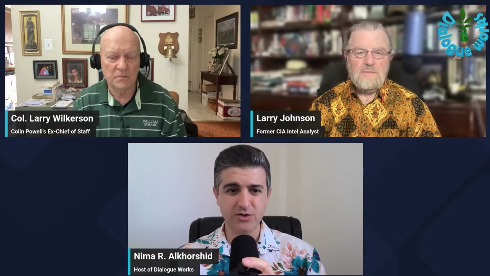
Dialogue Works' Nima Alkhorshid chats with Col. (Ret/) Larry Wilkerson
Col. Larry Wilkerson: Iran ROCKS Two U.S. Destroyers – 30 Refueling Jets Airborne! WAR IS HERE
Dialogue Works
Chapter: Navigating the Strait of Hormuz and the Geopolitical Turmoil of 2026
Introduction: The Strategic Significance of the Strait of Hormuz and Operation Freedom
- [00:08] This chapter delves into the escalating tensions in the Strait of Hormuz, a critical maritime chokepoint for global oil transportation, against the backdrop of the 2026 geopolitical conflict involving the United States, Iran, and their respective allies. The discussion centers around Operation Freedom, an initiative announced by then-President Donald Trump aiming to secure freedom of navigation through the Strait amid Iranian claims of control.
- The Strait of Hormuz is described as a narrow and complex maritime passage, fraught with navigational and military challenges, making any military or escort operation highly difficult. Key vocabulary terms include freedom of navigation, blockade, escort operations, ballistic missiles, sanctions, and state-sponsored terrorism.
- This strategic environment is compounded by broader geopolitical dynamics involving the Gulf Cooperation Council (GCC), Israel, Russia, China, and the shifting global balance of power, particularly the rise of China and its push to supplant the U.S. dollar with the renminbi (RMB) as the world’s dominant currency.
- The significance of this content lies in understanding the complex military, economic, and diplomatic maneuvers around the Strait, which serve as a microcosm of wider global power struggles and the looming risks of wider conflict.
Section 1: Military Challenges in Escorting Commercial Ships through the Strait of Hormuz
- [00:46 → 06:39] The claim that American and allied ships have safely transited the Strait under Operation Freedom is scrutinized. Experts emphasize the geographical constraints of the Strait—narrow channels, dense traffic, and limited maneuvering space—which make escort operations highly challenging.
- The U.S. Navy’s current fleet composition is inadequate for the scale of the operation. For instance, the ship Camber, classified as a Littoral Combat Ship (LCS), is primarily a converted mine-clearance vessel rather than an escort warship, thus unsuitable for high-threat escort missions.
- There are approximately 2,000 commercial ships waiting to transit, making a one-by-one escort logistically impossible. Effective protection would entail convoy-style movements requiring 30 to 40 warships, roughly the entire current naval force available, including aircraft carriers.
- Historical parallels are drawn to Operation Earnest Will (1988-89) during the Iran-Iraq war, when fewer ships and greater U.S. naval capability allowed for limited escort operations. The current situation, with more ships and less military advantage, is described as “logistically crazy.”
- Important military incidents include Iran striking three commercial vessels and launching two ballistic missiles at the Camber, which retreated without engaging.
- The speaker critiques Pentagon and White House narratives as overly optimistic or misleading, suggesting internal skepticism within the administration, notably from figures like JD Vance, regarding the feasibility and wisdom of the operation.
Key Points:
- The Strait’s geography severely limits naval escort operations.
- The U.S. fleet is under-equipped for large-scale escort missions.
- Current operations risk escalating tensions without guaranteeing safety.
- Historical precedent shows limited success with far fewer ships and less complex logistics.
Section 2: The Political and Military Dynamics in the Gulf Region
- [09:39 → 15:40] The broader Gulf region is marked by escalating attacks, such as the assault on the UAE’s Fger oil zone, highlighting the fragile security situation.
- The UAE’s rhetoric is described as aggressive but lacking military follow-through, with warnings of retaliation likened to an “empty threat.”
- Israel’s military and political situation is strained, with conflicts on multiple fronts—Gaza, the West Bank, East Jerusalem, and Lebanon. The speaker portrays Israeli leadership as aggressive, pursuing policies with little regard for humanitarian consequences.
- The terminology used by the Trump administration—such as “blockade”—is criticized for being inaccurate or misunderstood. A blockade implies preventing ships from passing, whereas the official stance is escorting ships through the Strait, which are fundamentally different military actions.
- The ceasefire in the region is characterized as ineffective or non-existent, with ongoing hostilities and conflicting interpretations by U.S. and Israeli leaders.
Key Points:
- Regional attacks continue, exacerbating tensions.
- UAE’s military posture is challenged by reality versus rhetoric.
- Israeli military leadership is seen as pursuing harsh measures with little international accountability.
- Political language from the U.S. administration is inconsistent and confusing.
- The ceasefire is fragile and possibly a pretext for continued aggression.
Section 3: Broader Geopolitical Implications – The Rise of China and Russia’s Role
- [21:44 → 27:20] The conflict in the Gulf is embedded within a larger global power shift. Russia is a staunch ally of Iran, providing diplomatic and possibly military support, while China is actively moving to undermine U.S. economic dominance.
- China’s support includes instructing its refineries to ignore U.S. sanctions on Iran, signaling defiance of American economic pressure.
- The renminbi is positioned as the future global reserve currency, aiming to replace the U.S. dollar in international trade, especially in energy markets. This shift threatens U.S. financial primacy.
- The speaker highlights the inevitability of this transition, noting that China and Russia are working in tandem to create alternatives to the SWIFT banking system and the dollar-based oil consortium.
- This economic realignment is accelerating the decline of American global influence, exacerbated by massive U.S. national debt nearing $40 trillion and the decreasing willingness of other nations to hold U.S. debt or operate in dollars.
Key Points:
- Russia and China are strategically supporting Iran to counter U.S. influence.
- China is advancing the renminbi as a global currency, challenging dollar supremacy.
- U.S. economic sanctions are losing effectiveness in the face of coordinated international resistance.
- The shift threatens U.S. financial stability and global power status.
Section 4: The Human Cost and Regional Instability
- [33:21 → 37:41] The war’s toll on Iran and the region is devastating, including thousands of casualties, destruction of cultural and medical facilities, and widespread suffering.
- Iran’s new policy, including the Persian Gulf Trade Authority, mandates that all ships passing through the Strait must register and pay tolls, reflecting Iran’s assertion of sovereignty and control.
- The conflict exacerbates divisions within the GCC and weakens U.S. alliances.
- The speaker foresees no clear winner in the war, suggesting a Pyrrhic victory for Iran if it simply avoids defeat, but at enormous cost.
- There is also concern about leadership crises both in Iran and in the U.S., with calls for younger, more democratic leadership in Iran being seen as a potential positive development.
- The humanitarian catastrophe in Gaza is highlighted, with an estimated 200,000 civilians trapped beneath rubble in the “New Gaza” reconstruction plans, which the speaker condemns as a cover-up of mass atrocities.
Key Points:
- The war inflicts severe human and infrastructural damage on Iran and the region.
- Iran asserts control over maritime traffic, complicating international navigation.
- The conflict deepens regional fractures and undermines alliances.
- Leadership crises exacerbate instability on both sides.
- Humanitarian disasters, especially in Gaza, remain largely unaddressed internationally.
Section 5: The Role of Propaganda, Misinformation, and War Crimes
- [38:14 → 51:59] Misinformation plays a significant role in shaping public perception, exemplified by absurd claims like the use of “kamikaze dolphins” as weapons, which were debunked and ridiculed.
- The speaker condemns the use of animals in warfare as a profound moral failing and highlights the cynical propaganda efforts by military spokespeople.
- Israeli policies toward Palestinians are described as codifying war crimes, including laws mandating the death penalty exclusively for Palestinians, and are likened to historical genocidal regimes.
- International institutions and governments largely fail to hold Israel accountable, with political systems silencing dissent and protests, as seen in the British Parliament’s suppression of criticism against Israeli policies.
- The U.S. is portrayed as complicit, acting as “the expediter” and “provider of the bullets,” with American taxpayers funding violence abroad.
Key Points:
- Propaganda and misinformation distort public understanding of the conflict.
- Ethical violations in warfare, including animal exploitation, highlight moral degradation.
- Israeli policies are criticized as institutionalized war crimes against Palestinians.
- Global political systems suppress dissent and accountability.
- U.S. involvement is direct and financially supportive of ongoing violence.
Section 6: Prospects for Peace and the Future of Global Power
- [52:44 → 58:09] The speakers express pessimism about immediate peace prospects, noting entrenched positions on both sides that are incompatible with compromise.
- The deepening divide within GCC countries and the broader Middle East complicates any diplomatic solution.
- The decline of U.S. global primacy and the rise of China and Russia create a multipolar world where traditional Western dominance is waning.
- There is a call for international cooperation on critical issues like nuclear disarmament and climate change, recognizing that ongoing conflicts undermine global efforts to address existential threats.
- The discussion closes with a somber reflection on the human cost of war and a hope for sanity to return to decision-makers, quoting Matthew Arnold’s line about “ignorant armies clash[ing] by night” to symbolize the chaos and futility of current conflicts.
Key Points:
- Peace prospects are dim due to uncompromising demands.
- Regional and global power shifts complicate conflict resolution.
- International cooperation is essential for addressing broader existential risks.
- The human toll of conflict demands urgent reconsideration of current policies.
- Hope persists for reason and sanity to guide future decisions.
Conclusion: Lessons and Implications from the Strait of Hormuz Crisis and Regional Conflict
- The ongoing crisis in the Strait of Hormuz underscores the profound challenges of ensuring freedom of navigation in a geopolitically volatile, geographically constrained region.
- Military operations like Operation Freedom face severe logistical, strategic, and political hurdles, with risks of escalation and unintended consequences.
- The conflict is not isolated but deeply intertwined with the global power realignment, especially the ascent of China and Russia, challenging U.S. dominance economically and militarily.
- The humanitarian cost, including war crimes and the suffering of civilians in Gaza and Iran, highlights the urgent need for international attention and accountability.
- Propaganda and misinformation distort realities, impeding constructive dialogue and understanding.
- The future demands new leadership, regional cooperation, and global collaboration to address the overlapping crises of war, economic instability, and climate change.
- Ultimately, the situation reflects a world at a crossroads, where failure to act wisely risks further destruction, but hope remains that reason and diplomacy can prevail.