


By Hakim
Reagan's presidency was the triumph of extreme right-wing demagogy.

This video critically examines the legacy of Ronald Reagan, focusing on the detrimental social, economic, and political effects of the policies introduced during his presidency from 1981 to 1989. Reagan’s administration marked a decisive shift toward neoliberalism—a market-centric ideology grounded in deregulation, privatization, tax cuts for the wealthy, and reductions in social spending—which reshaped the American government and society with lasting consequences.
The video argues that Reagan’s approach deliberately engineered economic hardship for working-class Americans, exemplified by recessions, soaring unemployment, and massive deficits created through the Economic Recovery Tax Act of 1981. This act slashed government revenue by $264 billion, justifying cuts to social programs and pushing public services toward privatization. Privatization, championed by ideologues like Emanuel Savos and organizations such as the Reason Foundation and ALEC, transferred previously public goods—water, education, social security, postal services—to corporate control, leading in many cases to higher costs and deteriorated service quality. This transformed citizens from democratic partners into mere taxpayers dependent on "handouts," undermining collective civic responsibility.

Reagan participated in many campaigns to demonize state-funded universal healthcare.
The video further highlights the engineered decoupling of worker compensation from productivity growth—where wages stagnated while productivity rose—driven by policy decisions favoring capital over labor, including union busting (exemplified by Reagan’s 1981 firing of striking air traffic controllers), increased use of non-compete clauses, and precarious employment arrangements. This led to a significant decline in labor share of income and a class-wide pay cut of nearly 10% from 2000 to 2016.
The resultant wage stagnation forced many Americans to rely on credit to maintain a basic standard of living. This gave rise to a debt-dependent economy, fueled by innovations like mortgage-backed securities and the rise of student debt. Reagan’s defunding of public higher education transformed college from a near-right into a privatized commodity heavily reliant on high-interest loans, saddling generations of students with debilitating debt virtually impossible to discharge.
Racially charged rhetoric and policies under Reagan exacerbated social divisions and systemic racism. The welfare queen myth demonized minority welfare recipients while masking the true economic issues. The Anti-Drug Abuse Act of 1986 imposed harsher penalties on crack cocaine offenses, disproportionately impacting Black communities. Reagan’s administration also ignored the AIDS crisis initially due to the affected populations’ marginalized status.
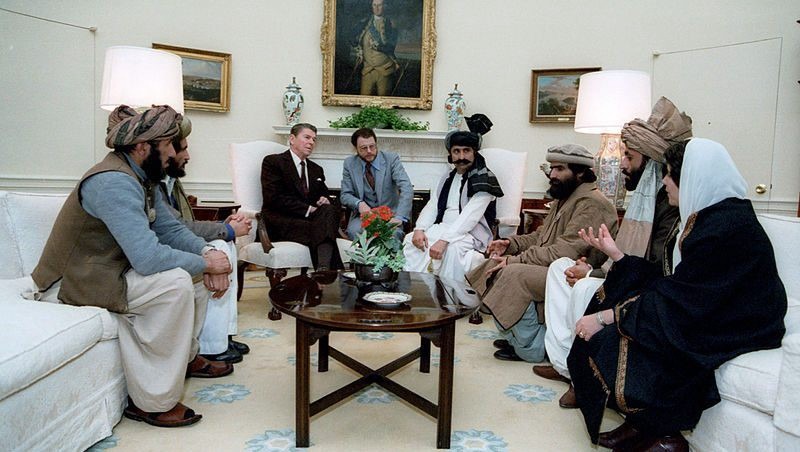
US-supported Jihadists visting Reagan at the White House. The idea of giving the Soviet Union its own "Vietnam" was incubated by National Security Advisor Zbigniew Brzeziński, and first implemented by Jimmy Carter.
Corruption and regulatory capture flourished under Reagan, with agencies like the EPA deliberately weakened, enabling polluters and corporations to operate with minimal oversight. Federal funds were redirected toward insiders and political allies, illustrating a pattern of crony capitalism.
Internationally, Reagan’s foreign policy supported repressive regimes and undermined liberation movements under the guise of anti-communism. The U.S. backed death squads in Guatemala, funded the Nicaraguan Contras (despite international legal condemnations), and covertly collaborated with apartheid South Africa, placing economic and geopolitical interests above human rights.
Through these wide-ranging policies and actions, Reagan accelerated the neoliberal agenda—enriching the wealthy, shrinking public welfare, privatizing communal resources, suppressing labor power, and fostering a debt-dependent economy. The video concludes that these outcomes are not accidental but the logical consequence of capitalism’s inherent dynamics—a system forever seeking endless growth at the expense of public good—while asserting that a better, more equitable world remains possible.
Highlights
- [00:29] ⚖️ Reagan's policies engineered a recession with unemployment over 10%, benefiting the wealthiest.
- [01:30] 🏛️ The President’s Commission on Privatization aimed to sell off essential public goods like water, air traffic control, and social security.
- [06:30] 💼 After Reagan, worker productivity grew by 60%, but wages only increased by 14%, widening income inequality dramatically.
- [09:03] 🎓 Reagan shifted higher education funding from public support to high-interest loans, creating the modern student debt crisis.
- [11:28] 🚔 The welfare queen myth and policies like the Anti-Drug Abuse Act fueled racialized stereotypes and harsher penalties disproportionately targeting minorities.
- [14:52] 🌍 Regulatory capture under Reagan gutted EPA enforcement, slashing budgets and inspections, worsening environmental protections.
- [16:50] ⚔️ Reagan supported deadly dictatorships, death squads, and apartheid-era South Africa while discrediting legitimate liberation movements like the ANC.
Key Insights
- [00:29] ⚖️ Engineered Recession as a Wealth Transfer Mechanism: Reagan’s economic strategy intentionally induced a recession with unemployment rates exceeding 10%, reminiscent of the Great Depression’s worst levels. This recession disproportionately harmed working and middle-class Americans, while wealth and income were concentrated among the richest, creating the foundation of neoliberalism’s wealth-first ideology. The forced economic contraction justified cuts and deregulation, presenting economic pain as a necessary sacrifice for “free market” recovery.
- [01:30] 🏛️ Privatization as a Societal and Ideological Shift: By rebranding the selloff of public goods as “free enterprise,” Reagan dismantled the conceptual framework of public services as collective societal investments. This shifted citizens’ identities from empowered democratic participants to individual taxpayers, promoting privatization not as a choice but an inevitable solution to engineered public sector failures. This redefinition weakened social solidarity and paved the way for corporate dominance of essential services with detrimental outcomes for quality and affordability.
- [06:30] 💼 Divergence of Productivity and Wages Signals Class War Victory: The sharp decoupling between productivity growth and stagnant wages post-Reagan signals the erosion of labor’s bargaining power. Policy choices such as union busting, weakening overtime protections, imposing non-competes, and proliferating contract work effectively suppressed wages. This nearly 10% drop in labor’s share of income is a structural transfer of wealth to capital owners rather than market-driven inevitability, illustrating how political decisions can forcibly reshape economic distributions.
- [09:03] 🎓 Transformation of Higher Education Financing into Debt Trap: Reagan’s defunding of public universities and reduction of federal grants forced states to raise tuition and shift aid toward high-interest federal loans. This marked the commodification of higher education and the creation of a massive student debt bubble, which now entraps two-thirds of students and disproportionately delays economic and social milestones, such as home ownership. Student debt, unlike secured loans, is anchored solely on the borrower’s future labor and identity, making it uniquely burdensome and nearly impossible to discharge, with broad intergenerational economic ramifications.
- [11:28] 🚔 Racialized Narratives Used to Undermine Welfare and Criminalize Communities: Reagan popularized the “welfare queen” myth, exploiting racial stereotypes to blame marginalized groups for structural poverty. This myth obscured the reality that welfare recipients, mostly white, were not living in luxury and instead barely survived. Meanwhile, harsh policies like the Anti-Drug Abuse Act of 1986 disproportionately targeted Black communities, creating mass incarceration as a racially coded tool of social control while the cocaine epidemic in wealthier white neighborhoods faced lighter repercussions.
- [14:52] 🌍 Regulatory Capture as Institutionalized Corruption: Reagan’s appointments deliberately weakened regulatory agencies, notably the EPA, slashing budgets, inspections, and enforcement. This form of regulatory capture meant agencies designed to protect public health instead advanced corporate interests, undermining environmental protections and public safety. This reversal of regulatory purpose exemplifies the fusion of government and private sector interests characteristic of neoliberal governance.
- [16:50] ⚔️ Foreign Policy Prioritized Cold War Interests Over Human Rights: Reagan’s administration supported brutal regimes, death squads, and apartheid South Africa, endorsing systematic abuses and genocide to suppress socialist and liberation movements. The labeling of figures like Nelson Mandela as terrorists reflected a geopolitical priority to maintain capitalist-aligned regimes and resources rather than advancing justice or democracy. The U.S.’s blatant disregard for international law in Nicaragua underscores the administration’s commitment to Cold War realpolitik over lawful norms and human rights, prolonging violence and oppression globally.

Special Feature
Former Socialism's Faults
By Hakim
First published Jul 3, 2023