
 Judge Napolitano
| Traducir—Translate! | |
| Make fonts bigger>>> | Resize text-+= |
Prof. Jeffrey Sachs : Trump’s attempt at Venezuelan regime-change and his Gaza Illusions
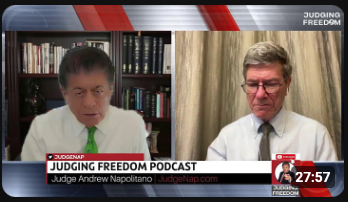
 Judge Napolitano - Judging Freedom
Streamed live on Oct 27, 2025 • Prof. Jeffrey Sachs : Gangster assault on Venezuela • Trump's Gaza Illusions.
Summary
The conversation then shifts to the ongoing violence and occupation in Gaza and the West Bank. Sachs condemns Israeli policies of annexation, settler violence, and blockade, labelling them as illegal under international law and de facto apartheid. He criticises the U.S. government’s unwavering support for these policies and its obstruction of peace efforts, despite widespread international consensus on a two-state solution. Sachs emphasises the dissonance between American public opinion, which largely sympathises with Palestinians, and official U.S. policy, which enables continued repression and violence.
Throughout the dialogue, Sachs paints a picture of a U.S. foreign policy apparatus that prioritizes geopolitical dominance and resource control over human rights, international law, and peace. He calls for greater accountability and awareness within the U.S. media, government, and public to challenge this narrative and demand a more ethical and lawful approach to global affairs.
 Key Insights

⚖️ U.S. Disregard for International Law: Professor Sachs provides an in-depth analysis of how the U.S. uniquely disregards international legal standards, regularly engaging in covert coups and military interventions with no legitimate legal mandate. This pattern reflects a broader imperialist mindset that prioritizes power projection and resource control over adherence to global norms, undermining international stability and the rule of law.
Sanctions as a Weapon of War: The use of economic sanctions against Venezuela is framed not as a diplomatic tool but as an act of economic warfare designed to destabilize a sovereign nation. These sanctions exacerbate humanitarian crises by crippling the economy, healthcare, and basic living conditions, which Sachs argues is a deliberate strategy to induce regime collapse rather than protect human rights.
️♂️ Covert Regime Change as U.S. Foreign Policy Mainstay: Drawing on historical examples and recent events, Sachs highlights that covert regime change has been a consistent U.S. strategy for over 70 years. The extensive documentation of 64 regime change operations since 1947 reveals a systemic pattern of interventionism that has repeatedly led to violence, instability, and failure to achieve declared objectives.
Hypocrisy in U.S. Rhetoric: The U.S. government’s public justification for intervention—such as combating narcotics trafficking or defending democracy—is exposed as a façade. Sachs emphasizes that these narratives obscure the underlying motive of economic and geopolitical control, specifically targeting resource-rich countries like Venezuela.
Erosion of Constitutional and Ethical Norms: The transcript underscores the erosion of constitutional checks and balances within the U.S., exemplified by a president openly stating a willingness to kill without congressional approval or legal oversight. This cavalier attitude towards use of force within and beyond U.S. borders signals a dangerous normalization of extrajudicial violence and executive overreach.
U.S. Enabling of Israeli Occupation and Repression: Sachs provides a thorough critique of Israeli policies in Palestinian territories, highlighting their illegality under international law and the complicity of the U.S. government in supporting these actions. This support includes blocking UN initiatives and endorsing policies that perpetuate apartheid-like conditions, undermining any genuine prospects for peace.
Media Complicity and Silence: The transcript reveals that U.S. media often neglects or actively suppresses coverage of covert interventions and illegal military actions. Sachs recounts firsthand experiences of media editors refusing to report on coups, reflecting a broader systemic failure to hold the government accountable or inform the public adequately.
Conclusion
The conversation between Judge Napolitano and Professor Sachs presents a sobering critique of U.S. foreign policy, exposing a pattern of illegal, violent, and self-serving interventions masked by manufactured narratives of national security and moral responsibility. Through detailed examples involving Venezuela and Israel-Palestine, Sachs calls attention to the destructive consequences of these policies for global peace, sovereignty, and human rights. The discussion challenges viewers to question official narratives, demand greater transparency, and advocate for adherence to international law and ethical governance in U.S. foreign affairs.
 BEFORE you leave, PLEASE pay attention to this alert.
[t4b-ticker id="1"]
Print this article [bws_pdfprint display=’print’]
 This work is licensed under a Creative Commons Attribution-NonCommercial 4.0 International License •
ALL CAPTIONS AND PULL QUOTES BY THE EDITORS NOT THE AUTHORS