Friday, July 3 2026 - Welcome • Bienvenidos • Bienvenu
Europe Continues Self-Harming
Why the US Lost More Than a War Against Iran | Radhika...
IMPERIALISM: DECADENT & DOOMED W/JOTI BRAR EP 58 – EU GOVERNMENTS FIGHT...
The REAL reason the US fears China
Alexander Mercouris: A New Putin? From Diplomacy to War
PATRIOT MISSILES FAIL MISERABLY, Here’s the Video Evidence /MIT Prof Ted Postol
Class War Is Bipartisan
Trump Turns from TACO to TITS
The Horrors of Early Dickensian Capitalism
End of Empire: A Report to America
  • HOME
  • ESSENTIAL
  • MYTH-FREE HISTORY WITH JACQUES PAUWELS
  • MUST VIDEO
  • BLOWBACK
  • NATURE
The Greanville Post
Money for Crimes? Oh. YEA. Money for the people? Hell NO. That's American democracy for you.
  • HOME
  • ESSENTIAL
  • MYTH-FREE HISTORY WITH JACQUES PAUWELS
  • MUST VIDEO
  • BLOWBACK
  • NATURE
Home Author
Author

Roger Boyd

  • Author Profile
  • Posts by the Author
  • Europe Continues Self-Harming
  • The New Scramble for Africa: Setting the Stage
  • How The Western Financial System Got Here
  • The US A.I. Bubble Rendezvous With Reality
  • A Personal Journey Through Neoliberalism
  • Oligarch Wealth Depends Upon Growth
roger boyd
Roger Boyd

Roger Boyd is a graduate of the Global Governance PhD program at the Balsillie School. His research is focused on the joint transitions of global power politics and the global energy system to low carbon sources, with specific focus on the interactions and dependencies of the two. He is working with a major academic publisher with respect to a book form of his PhD dissertation.Prior to beginning his doctoral studies he spent 25 years as an executive in the financial industry, and authored a book exploring the links between the energy and financial systems.

The US Retreats While Attempting to Increase Its Grip on its “Backyard”

by Roger Boyd Published: March 15, 2025
written by Roger Boyd 62 Mins • Watch / read
Please make sure these dispatches reach as many readers as possible. Share with kin, friends and workmates and ask them to do likewise.

Roger Boyd
Geopolitics And Climate Change
Roger Boyd

<• Choose your  language • Elija su idioma
Resize text-+=
 

The US Retreats While Attempting to Increase Its Grip on its "Backyard"
 

Why is the US bullying Panama, Canada and Mexico so outrageously? It’s an attempt by the new administration to reinstate its dominance over the American Hemisphere; ousting Chinese influence under a reinforced Monroe Doctrine (the statement of US dominance in the hemisphere in the 1800s). As it retreats from Europe and cuts other parts of its global dominance complex, while refocusing its efforts on China, it must make sure that its backyard is secure. As I have reported elsewhere, two and a half decades of debt-funded war making, oligarch bailouts, and tax cuts for the rich have placed the US government into a fiscal straight-jacket. At the same time, the oligarch extractive neoliberalism has socio-economically weakened the homeland by immiserating much of the US population and destroying much of the productive capacity of the nation. The answer is a retrenchment internationally, with Europe given a much bigger responsibility for managing its hemisphere to allow the concentration of US forces against China. At home, a move away from the inverted totalitarianism that has produced a political somnolence among the general population to a more overt fascistic orientation utilizing Christian Nationalism and Zionism to motivate the population to a greater readiness for war.

The most important nations are the neighbours of the US, Canada and Mexico. That is why Trump has focused his tariff threats and aggressive statements towards them early on; the Boss wanting to cow his vassals even more while forcing a chunk of their productive forces to move to the US. As noted by this article:

Second, and more importantly, Trump is trying to impose a Monroe Doctrine redux, where he can bully Mexico and, by extension, the rest of Latin America, into compliance with his new era of gunboat diplomacy without fear of retaliation.

These are dangerous times for Mexico and Latin America. The signs of a strategic and military buildup are clear: the renaming of the Gulf of Mexico to “the Gulf of America”, the labelling of eight Mexican cartels as terrorist organisations, the stepping up of CIA secret drone missions deep inside Mexican territory, the deployment of a Stryker Brigade combat team to the border, and Defense Secretary Pete Hegseth’s declaration that “all options are on the table”.

The deployment of troops and the escalating rhetoric are creating the conditions for a US military incursion into Mexico. If one does take place, it would fit neatly into the long history of US aggression against its southern neighbour and Latin America as a whole, which began 200 years ago with the so-called Monroe Doctrine.

In 1823, then-President James Monroe put forward a policy, which under the guise of opposing European colonialism in the Western Hemisphere, sought to solidify US supremacy over the region.

With respect to Canada, China sees what is happening and has decided to intensify the economic pressure upon a nation that placed 100% tariffs on Chinese EVs and kidnapped the CFO of Huawei on the orders of Trump’s previous administration. Why help Canada when its’ ruling class has been such an obedient tool of the US Empire? Better to weaken it even more unless it embraces relations with China.


Next in importance is Central America, with the Hong Kong owners of the Panamanian ports already being forced to sell out to the US oligarchy (Blackrock). We can expect a more aggressive approach toward Cuba and Nicaragua. Also high on the list is a Venezuela that has suffered under US aggression for more than two decades. At last subjugating that nation will send a very chilling message to the rest of Latin America. Already, Trump is turning the screw by cancelling the permission of Chevron to produce oil in Venezuela while considering ordering more US companies to cease their operations there.

Milei of Argentina is of course more than happy to become a fully compliant and kowtowing US vassal, but even then his nation was not exempted from the US tariffs on imported steel; the need for the US to steal the productive forces of its vassals cannot be offset by any level of subservience. We can expect aggressive moves against such things as the Chinese port that just opened in Peru. The problem is that it makes economic sense for Latin America to trade more with the nation that has the greatest productive forces and appetite for the continent’s natural resource exports; greater than the de-industrialized US. Especially when China funds the building of infrastructure compared to the US bullying and attempts to steal what remains of Latin America’s productive assets; with US investors only wanting easy outsized profits.


The independent and more socialist Bolivia will experience even greater attempts at regime change. But the pressure from the US will be somewhat independent of the political stripes of the national ruling coalitions, as it is aimed at subjugation, obedience and openness to US extractive profiteering and theft of productive assets. Brazil, with easily the largest population and economy in Latin America, will come under extensive pressure to reduce its deepening economic cooperation with China. The reality is, all that the US has to offer is blackmail through its ability to use its currency as a weapon (which risks destroying the US$ reserve currency status), tariffs and internal political interference and military threats. The best way to tell if a nation is truly resisting US pressure will be if we see such things as US NGOs and media organizations being restricted, US embassies forcibly downsized, and entry restrictions on US operatives.

The oligarchs of Latin America are now faced with a very hard choice: accept increased US domination and economic stagnation or fight their previous Boss and ask for help from a new, perhaps nicer, Boss. They will of course try mightily to find a middle way but that will be increasingly closed by a US that becomes more and more desperate to protect its “backyard” as its inability to hold back the rise of China becomes too brutally obvious to remain blind to.

If “personnel is policy” then Trump has made his policies towards Latin America very evident by making “Little Narco” Rubio, a product of the reactionary Latino oligarch retreat Miami, the Secretary of State. This is him 7 years ago calling for a greater US focus on the “Western” Hemisphere.


Here he is a month ago bullying Central American nations to bow to US power and reduce their dalliances with China.


At his Senate hearing he pushed the “China bad” message hard, after quickly forgetting his previous full on support for the Ukraine War.


And just like the fake warrior Hegseth, he pushes his Christian (Catholic) bona fides very publicly. All the better to push the fear mongering of “godless communists”. Laughably, he pushes the Uighur Moslem genocide lies while forgetting the murder of millions of Moslems by the US and the ongoing Zionist genocide of the majority-Moslem Palestinians. Rubio started lying at an early stage of his political career, claiming his family fled Castro when they actually fled the dictator Batista and claiming that he saw nothing while living at his brother’s house that was a centre of Miami cocaine dealing. Here he is wearing the Ash Wednesday “Ash of Crosses”, looking more like a Bond villain than one who truly follows the teachings of Christ, while doing nothing about the mass murders of Shia Muslims, Alawites (whose beliefs draw from both Shia Islam and Christianity) and Christians in Syria by the dominant HTS forces that the West supports. Forces that were previously implicated in the widespread kidnapping, rape and murder of Syrian Christians.


He is the perfect individual to drive the super-charged US policy of aggression against any nation in the Americas that dares not to say “uncle”.


Subscribe to Geopolitics And Climate Change
By Roger Boyd · Launched 3 years ago
Geopolitics And Climate Change: A Holistic And Joined Up View


Print this article [bws_pdfprint display=’print’]

The views expressed herein are solely those of the author and may or may not reflect those of The Greanville Post, although, if we publish them, we obviously find them noteworthy and valuable. 

Creative Commons LicenseThis work is licensed under a Creative Commons Attribution-NonCommercial 4.0 International License • 
ALL CAPTIONS AND PULL QUOTES BY THE EDITORS NOT THE AUTHORS

Published: March 15, 2025 0 comments
0 FacebookTwitterPinterestEmail

The US Mafia Boss Lashes Out At His Made Men

by Roger Boyd Published: February 6, 2025
written by Roger Boyd 7 minutes read
Please make sure these dispatches reach as many readers as possible. Share with kin, friends and workmates and ask them to do likewise.

Roger Boyd
Geopolitics And Climate Change

<• Choose your  language • Elija su idioma
Resize text-+=


The beginning of the end of any mafia boss is when his made men start to question his power, and when he starts to distrust and lash out against those made men. He thinks that he is disciplining those made men and keeping them in line, but he has crossed a line into insulting them and making them question his temperament and decision-making. That’s when the made men start looking to make alternative arrangements, while they carefully back away from the mafia boss. One day he finds that he has a lot fewer made men on his side than he thought he had.

The Decline of the West has moved into a new stage, where the imperial core starts to trigger the collapse of its empire through its own selfish and short-sighted actions. But that is all it can do when it is now fully dominated by a profiteering, rentier, short-sighted, delusional and ever-greedy oligarchy.

The US in its relative decline had a number of paths to take (i) retrenchment and national renewal (ii) retrenchment and controlled decline (iii) extract value from the vassals to try to renew the imperial heartland (iv) attempt to undermine the development of China and defeat Russia (v) some version of WW3.

  1. The profiteering, rentier and extractive US oligarchy that is the product of five decades of neoliberalism utterly blocks a national renewal that would require them to give up so much of their power and profit. The same with a general retrenchment.

  2. Retrenchment would negatively affect both the security state and the ability of the US oligarchy to profiteer and exploit across the world. It would also directly clash with the US oligarchy+courtier class view of themselves as the elite of a civilizational-supremacist project; as would a consciously controlled decline.

  3. This is the path chosen by the Trump administration

  4. This was the previous path chosen by the US oligarchy and it has failed spectacularly. Russia is stronger after three years of war, and has already taken over half of the vast resources of Ukraine to add to its own vast resources. It will take much more. China is overtaking the West across the technological board, and is only accelerating away with its vastly superior political-economic development model. The allied combination of Russia and China is greater than the sum of their parts. ASEAN, India etc. refuse to take sides and are happy to enjoy the growth and development that trade with Russia and China brings. Iran and North Korea find themselves more and more aligned with Russia and China.

  5. With nuclear weapons, wars will only ever be of a limited nature and through the use of third parties, unless an utter madman inhabits the White House.

It is hard at the best of times to trigger a truly nationalistic response within the Canadian populace, but what I observe as Trump tariffs and insults Canada is a wave of nationalism across this nation. This wave may also very well destroy the political hopes of Canada’s Trump, Pierre Polievre, as the Liberals jettison the past-his-sell-by-date Trudeau and quite possibly select the central banker Carney. The same nationalist wave is certainly also evident within the Mexican leadership. There will be no quick rollover as with Colombia and Panama, and the relationship between the US and its two neighbouring nations is being damaged for good. And Europe stands by knowing that they are next. Trump has even attacked a UK that runs a trade deficit with the US, but facts do not seem to be a major input to Trump’s decision-making nor his ridiculous public statements.


All major politicians in the US rely on the billionaire class for support, but. Trump, as usual, is among the most blatant. One of his mega donors was the late ultra-Zionist casino operator Sheldon Adelson. His influence now exerted through his widow, Miriam. Incidentally, it was Miriam, an Israeli, who made Sheldon into a rabid Zionist.


To add to the foreign picture of the US as descending into banana-republic levels of oligarchic dominance, corruption and incompetence we have the lunatic Musk and his little band of helpers causing utter chaos within the core of the US state apparatus. We may celebrate the neutering of the regime-change agent USAID, [actually, they are merely camouflaging their regime-change ops, to make them harder to spot.—Ed] but this is just a drive-by impact of chaos within the US state apparatus. This is utter music to the ears of the Russian and Chinese leadership, as the rest of the world comes to grips with a US that has become an utterly abusive narcissist both through its policies and the actual personage of the US President. To simply appear as sane, reasonable and agreement-capable is to shine like a bright light against the darkness, corruption and sheer unpredictability of US foreign policy. With a US soft power that was already deeply undermined by the unconditional support of the Zionist genocide now being thoroughly torn asunder. Any manager of US brands abroad can only be in anguish as the US President destroys what is left of brand USA. Tesla already had a huge target on its back after the Musk Nazi Brand Suicide, and Musk’s close alignment with the new bully Trump can only further turn the Tesla brand into a negative.

The Imperial Mafia Boss is now displaying its weakness to the made men, and to the members of the other gangs who can see the internal chaos within the Westerns. The other gangs will be watching for those Westerns gang members who are looking to hedge their bets and will be welcoming to their approaches. The Decline of the West has moved into a new stage, where the imperial core starts to trigger the collapse of its empire through its own selfish and short-sighted actions. But that is all it can do when it is now fully dominated by a profiteering, rentier, short-sighted, delusional and ever-greedy oligarchy.

With his delay of the Mexican sanctions for a month in response to a purely public affairs response by Mexico, Trump has shown even greater unpredictability and weakness. His use of the “nuclear-option” of tariffs for such a small gain shows a very bad card player. Now what can he do with a Canada that is in no way a major source of fentanyl or illegal immigrants, and has been a very loyal vassal for years? And what about even his domestic credibility? Flailing around needlessly is not an effective imperial management strategy. And now Canada has offered a few extra promises and got a one-month delay. What a joke.


SELECT COMMENTARY
CityguyUSA
What we need is our Putin. Putin came in and told the Russian oligarchs that things were going to change and he made them sign agreements to that end. We're still not accepting the reality of what the US has become and while we want to believe Trump is strong, he has no morality. He stands on nothing and might well contradict what he says now in a few hours.


Print this article [bws_pdfprint display=’print’]

The views expressed herein are solely those of the author and may or may not reflect those of The Greanville Post, although, if we publish them, we obviously find them noteworthy and valuable. 

Creative Commons LicenseThis work is licensed under a Creative Commons Attribution-NonCommercial 4.0 International License • 
ALL CAPTIONS AND PULL QUOTES BY THE EDITORS NOT THE AUTHORS

Published: February 6, 2025 0 comments
0 FacebookTwitterPinterestEmail

The Ongoing Collapse of the Western Car Industry: Q1 2025, Part 1

by Roger Boyd Published: January 9, 2025
written by Roger Boyd 200+ Mins. Must Watch read
Chinese cars
Please make sure these dispatches reach as many readers as possible. Share with kin, friends and workmates and ask them to do likewise.

Roger Boyd

<• Choose your  language • Elija su idioma
Resize text-+=
 

GEOPOLITICS AND CLIMATE CHANGE

The Ongoing Collapse of the Western Car Industry: Q1 2025, Part 1
 
ROGER BOYD
JAN 07, 2025

This piece became a bit of a sprawling lengthy one so I decided to split it up into three pieces, to aid both my editing and your reading. Part 1 covers the global level introduction, and then the Asian and Australasian region. Part 2 covers the North American region and Part 3 Europe.

Global Overview


What happens in Asia+Australasia will decide the fate of the major car manufacturers. In 2024, the Chinese EV market represented more than two thirds of the global EV market, as EVs took a more than 50% share of the largest car market in the world (25 million yearly sales). VW and Toyota managed to limit their drop in sales to about 10% by taking a bigger share of the shrinking Chinese internal combustion engine vehicle (ICEV) segment, while General Motors and Honda sales collapsed by around 25%, Nissan by 15%, BMW and Audi (part of the VW group) by nearly 20%. With the ICEV segment shrinking again in 2025, to possibly only 30% of the Chinese car market, VW and Toyota will not be able to repeat that performance. And the pain will be even worse in 2026; VW and Toyota may be the only sizeable foreign brands left in the ICEV segment, but that segment will be much smaller by the end of 2026. At the same time, the fight for that shrinking segment will intensify - driving out any profitability.

ASEAN markets such as Indonesia and Thailand are also rapidly growing (and the Western car brands are also being pushed out of there by the Chinese), and India (currently dominated by Suzuki, Hyundai, Tata and Mahindra) has a huge potential for cheaper mass market models. It will be interesting to see if the thaw in China-India relations stretches to the significant entry of Chinese car manufacturers into India, something India desperately needs to help develop its automobile manufacturing supply chain; especially for EVs. Without a presence in the Asia+Australasia market, manufacturers will become regional at best players without the scale and ecosystem efficiencies of those that do have such a presence. Without a presence in China they will be continuously left behind by the rapid changes in a market that represents the leading edge, and two thirds, of the global EV market.

The South Korean and Japanese markets are protected by many “non-tariff” barriers, with the former at 1.7 million sales and the latter at less than 5 million sales. The EV share of both markets is extremely low. Although this may change as the Chinese brands are starting to sell EVs in both South Korea and Japan; creating disruption for the South Korean and Japanese manufacturers even in their home markets. Both countries are already high income nations with rapidly ageing and diminishing populations with the future reality of stagnation at best. Both are dominated by the national car makers, Hyundai-Kia in South Korea and Toyota, Honda, Nissan, Subaru, Mitsubishi etc. in Japan. These car makers are dependent upon much larger overseas sales to maintain financial viability.

The US market of just under 16 million sales is dominated by trucks and SUVs, and together with the distances driven (public transport is nearly non-existent) this places a significant limitation on the speed of EV adoption. Even with significant federal and state fiscal support the US BEV market only grew by 10%, to reach a share of 8.5%, in 2024. With the prospect of the Trump administration removing all federal fiscal support, combined with the Biden-administration imposed 100% anti-China EV tariff, the prospects for the EV market in the US are dim. The US is in danger of turning into an ICEV island left behind by the rest of the world, with a relatively stagnant level of sales.

The European car market at 13 million sales is also stagnant, with the move to EVs losing most of the state fiscal support that it previously had; EV sales in Europe actually fell in 2024 with an EV market share of 23%. The incremental upward ratchet yearly change in the UK mandated EV market share, together with the new 2025 EV mandate in the EU, will drive an increase in EV sales in 2025. However, without the previous state fiscal support that growth may be profitless at best for the car manufacturers. The EU has moved to protect its domestic manufacturers through anti-China EV tariffs, but this is only a stop gap as Chinese manufacturers increasingly open production plants in the EU. In addition, the prospect of Chinese retaliation against the EV tariffs may result in a reduction of those tariffs. The high cost of electricity in Europe also negatively affects the cost/benefit of EV vs. ICEV.

This infographic from the web site “Visual Capitalist” shows the regional distribution of sales of the major global manufacturers, although there is an error for VW - its 2023 China sales were 33% of its global sales not 45%. Some of the other numbers are also off a bit, but not meaningfully so. Even with these errors though, it provides a good visual display of the regional sales structure of each major manufacturer.


GM and Ford have already pretty much retreated to North America, the German big three are all Europe+China plus a lesser amount in North America, the Japanese more evenly split between China, Japan (the majority of Rest of Asia), and North America, and the South Koreans (Hyundia-Kia) heavily dependent upon their home market (the majority of their Rest of Asia), then North America, then Europe. The rapid drop in foreign car sales in China will change the above significantly. The 2024 global sales numbers for the largest car manufacturers, with an estimate for December sales in some cases:

  1. Toyota: 11.1 million (1.5 million sales in China)

  2. VW: 9.2 million (3 million sales in China)

  3. Hyundai-Kia: 7.3 million (445,000 sales in China)

  4. Stellantis: 5 million

    1. 1.5 million in North America

    2. 1 million in South America; Fiat-Peugeot-Citroen 750,000 and Stellantis-NA sales of 250,000, the vast majority locally produced

    3. 2.3 million in Europe-Middle East North Africa (MENA)

  1. General Motors: 4.4 million (673,000 sales in China)

    1. excludes SAIC-GM-Wuling sales as GM has a minority stake

  2. Ford: 4.4 million (211,000 sales in China)

  3. BYD: 4.27 million

  4. SAIC: 4.1 million

    1. includes SAIC-GM-Wuling sales of 1.34 million

    2. has foreign JV brand sales of 1.81 million; VW (1.14MM) & GM (673M)

    3. SAIC-Motor (MG) sales of 707,000 are overwhelmingly foreign

  5. Honda: 3.8 million (820,000 sales in China)

  6. Geely: 3.4 million

  7. Nissan: 3.3 million (600,000 sales in China)

  8. Suzuki: 3.2 million

  9. Changan: 2.7 milllion

    1. has foreign JV sales of 260,000; Ford & Mazda

  10. Chery: 2.6 million

  11. Dongfeng: 2.5 million

    1. has foreign JV sales of 1.2 million; Honda, Nissan & Peuguot-Citroen


Not in the top 15 but with a market capitalization greater than all of the other car makers due to the bubble in its stock price, Tesla with 1.79 million sales in 2024; a fall of 1% vs. 2023 (662,000 sales in China, 623,000 sales in the US, 327,000 sales in Europe)

With the rapidly falling sales of the foreign manufacturers in China the list of truly global players could shrink fast in 2025 and 2026; with the added challenge of the rapid expansion of Chinese brands across Asia, Australasia, MENA, South Africa and South America. Toyota’s China sales in 2024 were about 1.5 million, while VW’s were about 3 million, Honda’s were 820,000, Nissan’s about 600,000; 13.5% of Toyota’s global sales, one third of VW’s, 21.5% of Honda’s and 18% of Nissan’s.

Already, Honda has announced a merger with Nissan and Mitsubishi; creating another “combination of failures” to add to that of Stellantis. The latter is really two (or even perhaps three) completely separate car companies, and from January onwards I will treat it as such; Stellnatis North America and Stellantis Europe-MENA, and also perhaps Stellantis-South America. Below is what I see as the regional trends between 2024 and 2026 for the top manufacturers.

2024 Global: Toyota, Honda-Nissan-Mitsubishi, VW, Hyundai-Kia, BMW, Mercedes, Geely, Chery, Tesla, SAIC.

  • 2026: Hyundai-Kia, Geely, Chery, SAIC, Dongfeng, Changan, and Tesla are global (although Tesla may be only a niche player outside North America and Europe)

  • 2026: Toyota and Honda-Nissan-Mitsubishi become global minus China

  • 2026: VW, BMW, Mercedes become Europe plus an offshoot in North America

2026: BYD will still be a China/Asia-focused company, with relatively small foreign sales. Set to change in 2027 as BYD has to look to foreign sales for growth outside the EV-saturated Chinese market.

2026: The North American players of GM, Ford and Stellantis NA will remain so

2026: Stellantis Europe-MENA and Renault remain Europe plus MENA, but Stellantis-South America is also becoming an independent and successful entity (a bright spot among so much Stellantis failure).

  • With collapsing sales in Europe, and growing sales of locally produced models in South America, Fiat has become a predominantly South America company. Peugeot and Citroen have also been growing their South American production and sales. Stellantis has a thriving Fiat-Peugeot-Citroen locally produced business with 750,000 sales in 2024. A separate Stellantis-South America?

  • Stellantis brands Peugeot-Citroen and Vauxhall-Opel remain predominantly Europe-MENA

2026: Suzuki remains as India plus Japan plus Europe

By the end of 2026 foreign brands will have been decimated in the Chinese market, with EV sales at saturation levels, and the Chinese brands also dominant across Asia and Australasia (minus South Korea and Japan). Going into 2027 the Chinese manufacturers will have also ramped up their local manufacturing in Europe and South America while also targeting non-EU European markets (e.g. UK and Norway) and South America for a big export push. A large question will be whether or not the Trump administration will allow for domestic Chinese production plants (in addition to the grandfathered GM-Volvo plant); if so, this could spell disaster for the NA-only and Japanese and South Korean brands in the medium term. Such Chinese plants would also be aided if the Trump administration removes all EV state fiscal support, as that would level the playing field between Chinese and non-Chinese US manufacturing plants.

There is also the possibility of further brand mergers, as has recently taken place with the Honda-Nissan-Mitsubishi merger, which was really the weakening Honda rescuing Nissan from bankruptcy; a merger of failures just like Stellantis. Nissan had previously stated that it had about 14 months to find an outside investor to bail it out. Honda will rue the day that it took on the failing Nissan, when it needed to focus all its efforts on saving itself.


What will be a shock to many is how fast the profitability of markets collapse, as the players fight over a shrinking ICEV space (especially in China) while having to produce an increasing number of EVs (especially in Europe) without the benefit of the Chinese EV supply chain that has been developed over two decades. The Chinese brands have already collapsed the profitability of the foreign brands in China, badly impacting groups such as VW that relied on China profits to subsidize others parts of the group (e.g. manufacturing in Germany). As North America becomes more and more important to the Japanese manufacturers that are seeing their sales collapse in China, we may see much greater price competition; quite different to the price gouging of the COVID years. Very bad news for a Tesla that made the US its overwhelming source of profits during the price gouging years. The same for Europe with respect to the German manufacturers that are watching their China sales collapse. As stated below, the legacy car manufacturers are dying and tariffs wont save them.

Below is a former GM executive who warns that the Chinese EV wave is unstoppable, although he incorrectly counts Tesla as being in the same position as the Chinese brands when in fact Tesla’s market share in the US has been falling y-o-y at a rate of about 7%; to less than 50% in 2024. Tesla’s sales fell in 2024 compared to 2023, while BYD left it in the dust in BEVs and much, much more in overall EV sales (BEVs and PHEVs). BYD outsells Tesla in China nearly six to one and makes money doing it.


GM’s China sales are currently being destroyed by the Chinese brands, and GM already exited the European market. The ex-GM executive deeply misunderstands the highly competitive nature of the Chinese social market economy, the lack of the sate “picking favourites”, and the current low level of Chinese state support - especially for private companies such as BYD. And the US state subsidy trough that Tesla has been feasting at for well over a decade, plus the help it also gets from selling EV credits and benefitting from European EV sales incentives. Of course, given his previous position and current consulting relationships he may find it hard to blame the gross incompetence and profiteering collusion of the Western car manufacturers. He “gets it” but doesn’t really “get it”.


Asia


China

The Chinese market for electric vehicles (EVs) has continued to grow at an exponential rate, aided by brutal competition that reduced prices while increasing functionality, and government subsidies that supported the replacement of older cars with new ones. The overall EV market grew more than 35% when compared to 2023, taking nearly 50% of the overall light vehicle market, but the benefits of this growth were very unevenly spread between winners and losers. The sales numbers for December show the fundamental problem for the foreign manufacturers, an inability to gain momentum in the rapidly growing EV segment. The December share of EVs as a percentage of sales:
  • China brands: 71.3%

  • Foreign Brands: 4.8%

This problem does not just affect the foreign manufacturers, but the state-owned car manufacturers that have large joint ventures with those foreign manufacturers. Such as SAIC, GAC, Dongfeng and Changan, all of which have a huge challenge to replace those predominantly JV ICEVs with their own brand EVs. Many of their own brand sales are also ICEVs. Quite the opposite of a BYD that has no JVs and stopped producing ICEVs years ago.

BYD was a big winner, growing at a slightly faster rate (42%) than the overall Chinese EV market, although its China sales growth seemed to flatten out in the fourth quarter; with Chinese sales actually falling in December vs. November. Maintaining more than a one third share of a market growing so rapidly, and with such brutal competition, would tax any organization. It will be interesting to see if BYD can maintain the same sales growth momentum in 2025; notably it started cutting prices toward the end of December, perhaps the start of a new brutal price war? In early January BYD started pre-sales for its Seal 05 Dm-i PHEV sedan, starting at the equivalent of US$12,250 and will be shortly introducing its luxury Xia PHEV MPV for the equivalent of US$40,000, producing more pain for the purveyors of equivalent ICE and non-plug in hybrid (HEV) vehicles that are at the same price point.

BYD’s focus on its domestic market share in such a fast growing market has significantly limited BYD’s exports, which represent less than 10% of its overall sales. Including exports of 417,200, BYD delivered 4.27 million cars in 2024. Only when the Chinese market is saturated may BYD become an export powerhouse. In the interim its factories in Brazil, Thailand, Turkey and Hungary will be driving foreign sales as much as exports as they come on line.

Geely was the biggest winner in 2024 with its domestic EV sales growing much faster than the overall EV market, while its overseas sales also saw success. It has been releasing one winning product after another, across its Geely, Galaxy, Zeekr, Volvo, Radar and other brands. Geely Auto which includes the Geely, Galaxy, Zeekr and Radar brands (but not Geely-Volvo) sold 893,000 EVs in 2024; an increase of 83% over the previous year. Zeekr (the premium EV subsidiary) had a fourth record delivery month in a row in December, selling 27,000 vehicles for the month and 222,000 for the year (up 87%); with sales momentum building into the new year. Total 2024 Geely Auto sales were 2.22 million, growing over 25% y-o-y, of which 410,000 were exported; the growth in EV sales more than offsetting a drop in ICEV sales. Geely Holdings (which includes Geely-Volvo) sold 3.4 million vehicles in 2024, a growth of 20% y-o-y (Volvo sales grew 9% y-o-y, with half being EVs). Proton of Malaysia, in which Geely holds a 49.9% stake, saw its sales grow by 20% and retained its place as the second best selling brand in Malaysia.

Unlike BYD, Geely has sales momentum heading into 2025. Geely also both exports vehicles and produces vehicles at its Geely-Volvo plants in Europe and the US. This has allowed it to somewhat sidestep the anti-China EV tariffs by moving production for sales in Europe and North America to its non-Chinese plants; which did produce some delays, as with the EX30. Some of Geely’s recent new products below; a US$12,000 super-mini, a US$14,000 pickup, a US$17,000 Galaxy E5 compact SUV that bests the BYD Yuan Plus, a US$28,000 Lynk & Co. Z10 sporty sedan, the revolutionary Zeekr Mix people carrier for US$40,000, and the Zeeky 7X Model Y competitor for US$32,000. US and European consumers can only dream of such price/functionality combinations.


The state-owned manufacturers, which produce significant volumes of ICEVs both for their own brands and the JV brands they have with foreign manufacturers, are struggling to replace declining ICEV sales (both from their own and JV brands) with increasing EV sales. SAIC was hit by the collapse in sales of its joint venture with GM, a fall in the sales of SAIC own and SAIC-GM-Wuling (small EVs) brand cars, and the lesser fall in sales of its joint venture with VW, together with the extra hefty anti-China EV tariffs placed on its exports (under the MG brand) by the EU.

In 2024 SAIC’s overall sales went down by 20%, to just over 4 million; with SAIC-VW sales down to 1.148 million (from 1.215 million), SAIC-GM sales down to 673,000 (from 895,000), SAIC Motor (MG) sales down to 707,000 (from 986,000), and SAIC-GM-Wuling sales down to 1.34 million (from 1.4 million). The sales fall was limited by the much lesser falls in SAIC-VW and SAIC-GM-Wuling sales, but the former may decline much more in 2025 as the ICEV segment continues to shrink. SGMW (which SAIC owns 50.1% of) had a bad start to 2024 but recovered somewhat later in the year and has sales momentum going into 2025. Exports and sales of EVs were were flat year over year. One bright spot was the performance of the IM brand, in which SAIC owns a majority stake; it saw annual sales rise of 71% to 65,500. Overall, SAIC faces an extremely challenging 2025 where its increased EV sales will most probably not offset the fall in ICEV sales.

A possibility is that SAIC buys GM out of its 44% share of SGMW, as SGMW becomes more and more important to SAIC due to continued falls in its own and JV brands; with the fall in SAIC-GM sales, GM may be more open to selling its SGMW stake (it has already exited the European market). The vast majority of SAIC Motor sales are overseas sales of MG (Chinese sales of the MG brand have collapsed); outside of the foreign JVs and SGMW, SAIC has a very small footprint in China. It needs to rapidly arrest the fall in MG sales due to its punitive treatment by the EU with respect to the anti-China EV tariffs. By the end of 2026 SAIC may be predominantly SGMW, MG and IM. The irrelevance of an “affordable Tesla Model 2” to the Chinese market is shown by SGMW; from which you can already buy a Wuling Mini EV 4 door for the equivalent of US$6,800, or a slightly larger Wuling Binguo for US$8,000. China is already flooded with affordable, and even ridiculously cheap, EV models.

Dongfeng sold 2.42 million vehicles in 2023, including 780,000 Nissans and 594,000 Hondas (and 78,000 Peugeot-Citroen), and has therefore been very badly hit by the significant drop in sales at its joint ventures (Honda down nearly 30% and Nissan down 13%). However, this drop has been met with a surge in Dongfeng’s own brand sales (1.37 million, up 37% y-o-y) and EV sales (860,000 up 70% y-o-y) with overall sales growing slightly to 2.5 million in 2024; with a target of 3 million for 2025. A company successfully transitioning from ICEV to EV, and foreign-brand to own-brand. Dongfeng owns the Voyah EV brand.

GAC has seen its sales in 2024 fall as the sales of its GAC Aion EV subsidiary saw a 14% drop in sales in 2024 to 413,000, together with the sales of its joint venture with Honda crashing by 35% (from 640,000 in 2023), and its JV with Toyota also seeing a sales fall of 15% (from 950,000 in 2023), and even its own brand ICEV sales falling significantly. After selling 2.5 million vehicles in 2023, GAC sold only 1.92 million in 2024 (of which 1.2 million were JV sales and 300,000 its own brand ICEV). With the lack of a breakthrough in the Aion brand, and probable further significant falls in the JV sales, GAC will most probably see a further sales decline in 2025 and 2026. It could end up as a takeover or bankruptcy candidate if it does not find a way of sparking major growth in its Aion EV brand.

The state owned Changan is a standout as it is having increasing success selling its EVs (from 470,000 in 2023 to over 700,000 in 2024) with its successful Deepal and Avatr (in conjunction with Huawei) EV brands, and it benefits from the small scale of the sales of its joint ventures with Mazda and Ford. In 2023 Changan sold 2.55 million vehicles (including 89,000 Mazdas and 233,000 Fords). In 2024 the company sold 2.68 million vehicles, with sales momentum increasing toward the end of the year and a 2025 target of 3 million; showing a successful transition from ICEV to EV sales.

Chery, owned by the Chinese Wuhu municipal government, is absolutely flourishing in both the domestic and export markets. Its positioning as a provider of low price / high functionality cars is paying off in the ICEV segment, and now increasingly in the EV segment. With models like this:

In 2023 Chery sold 1.88 million vehicles, over 50% higher than the previous year. That momentum continued in 2024, with sales up nearly 40% to 2.6 million; with sales of EVs growing by over 250% to 78,000 in the month of November 2024 alone. Chery is heavily export focused, but most of its growth in 2024 was due to the domestic Chinese market.

Great Wall Motors has been struggling to maintain sales in 2024; while top-level sales have remained about the same as the 1.23 million in 2023, there has been a huge amount of change within individual brands. The Haval brand that is focused on mainstream cross-overs and SUVs and represents just over half of all sales stagnated in 2024, while the second biggest brand Great Wall pickup sales fell by about 10% and the Ora EV brand sales collapsed by about 40%. Those falls were offset by a 20% jump in the Wey brand (focused on premium versions of Haval models) and a 40% jump in sales of the Tank brand which is focused on off-road SUVs. Nearly 40% of sales were exports (not exposed to the rapid Chinese move to EVs) and over a quarter were EVs. GWM Tank seems to be in the same space as Chery, offering very high spec vehicles for very affordable prices. It is becoming increasingly threatened by the success of the BYD Fang Cheng Bao off-road EV brand though, and has recently released the Tank 500 Hi4-Z hybrid off-road SUV in response.

The startups of Xpeng, Nio and Leap are finding some success but they are still relatively small scale players. Xpeng sales had stumbled badly at the start of 2024, but gained momentum that accelerated into the end of 2024 with new and improved models; it could more than double sales to 400,000 in 2025.

Nio’s year was a mirror image of Xpeng’s, and it could also see sales nearly double to 400,000 in 2025 through its successful new and updated models. This includes two new cheaper brands, the Onvo and the upcoming Firefly super mini.

Leap Motor stood out as it doubled sales from 2023, to nearly 300,000 in 2024. Its accelerating end of 2024 momentum could take sales as high as 600,000 in 2025; challenging Tesla.

Neta is in serious trouble with sales stagnating and then collapsing in fourth quarter, it may never recover. Li Auto grew sales by about a third in 2024 to 500,000, and has regained some of the momentum it lost early in the year. It could see sales grow further in 2025, perhaps to 700,000 (challenging Tesla), but is seeing increasing competition in the market segment that it had carved out for itself, with such rivals as the BYD Xia MPV and the Lynk & Co. 900. Any successful new Chinese segment will find many rivals leaping into the space very quickly, no company can remain both complacent and successful in China.

Huawei has been successful with its Aito JV (with Seres), and somewhat successful with its Luxeed JV (with Chery) and Avatr JV (with Changan). Xiaomi has found great success with its SU7, growing sales very rapidly and outdoing its increased sales target of 130,000 in 2024. With the introduction of the Model Y competitor XU7 in mid-2025 it may have a shot at half a million sales in 2025 (it has officially targeted 300,000 sales in 2025); the main limitation being production capacity. This would still though put it in a relatively niche position in the market until it adds a number of extra models.

Here is a good review of the Chinese product and brand highlights of 2024.

Below the outlook for major new Chinese EV models in 2025 is detailed, an intensifying nightmare for the Western manufacturers.

Excluding Tesla, the Western manufacturers still do not have a competitive EV in China (none ranked in the top 20 sellers) while the Chinese are about to up their game even more. With the ICEV segment falling below 50% market share in 2024, it may very well fall below 30% by the end of 2025 and perhaps as low as 10% by the end of 2026. VW and Toyota did manage in 2024 to limit their sales fall to about 10% by taking a bigger share of the shrinking ICEV China segment, but the rapid collapse of that segment will not facilitate such a strategy in the next couple of years. With so many domestic and foreign manufacturers fighting over the shrinking ICEV segment, it will also increasingly become a profitless and in many cases loss-making one. Tesla will see its market share shrink even more into niche territory, even with the face lifted Model Y and huge sales incentives (e.g. no money down 5-year financing at 0% interest), perhaps its sales will even decline y-o-y as the EV segment continues to boom but its competitors proliferate while it struggles to bring new models to the market?

Tesla struggled mightily as its refreshed Model 3 was beset with local competitors, most especially the Xiaomi SU7. At the same time more and more Model Y competitors also entered the market. Tesla sales were falling early in the year until it cut prices and offered 5 year 0% financing in the second quarter of 2024. Overall, Tesla sales were up only 8.3% in 2024 which was far behind the 35% growth in the overall market; resulting in a large fall in Chinese EV market share from 7.5% in 2023 to 6% in 2024 (5.2% in Q4 2024). As sales in the US fell by 5%, and in Europe by 10.5%, in 2024, China became the biggest selling market for Tesla and its only source of sales growth; a market where it breaks even at best. The early 2025 bounce from the face lifted Model Y may be very sort-lived as Xiaomi has announced its Model Y competitor XU7 for 2025. And other models such as the 2025 Nio Onvo L60 and 2025 Xpeng G6 are becoming increasingly available as production ramps up.

The focus on BEV-only models has also greatly impacted Tesla, as the PHEV segment has grown significantly faster than the BEV sector. Tesla’s pain seems small though compared to that of the other foreign manufacturers who suffered from falling sales as the ICEV segment shrank and they continued to have no meaningful position in the EV segment. In 2024, the share of foreign manufacturers in the Chinese car market will have fallen to only about 30%, compared to 53% only two years earlier; and that includes Tesla! That share will fall further in 2024 and 2025, perhaps to single digits.

Volkeswagen (VW) was the dominant player in the Chinese market not so long ago, but has seen its sales go into a continuous decline. A decline that looks set to continue as it still has no meaningful position in the growing EV segment. In 2017 nearly half of VW’s global sales of 10 million were in China, in 2023 its China sales were 3.2 million. In 2024 Chinese sales fell by a further 10% to around 3 million (out of 9 million global sales), a fall limited by VW taking a bigger share of the shrinking ICEV segment. VW, as a purveyor of more low gas consumption cars, also benefitted from the Chinese government incentives to scrap older gas guzzlers brought in toward the end of the year (as also did Toyota). The sales fall will accelerate as that segment collapses at an increasing rate.

Toyota sold 1.7 million cars in China in 2023, just over 10% less than in 2019. In 2024 sales fell about 10%, as like VW, Toyota took a bigger share of the contracting ICEV segment. With Toyota having even less competitiveness than VW in the Chinese EV market, its sales fall acceleration may be somewhat greater than VW’s as the ICEV segment utterly collapses in the next two years. It simply waited far too long to embrace EVs, while it wasted many billions on hydrogen fuelled vehicle development.

BMW has had a terrible 2024, with sales falling to about 675,000 from 825,000 in 2023 (out of 2.56 million global 2023 sales, including the Mini brand). BMW’s attempted first half sales drive through massive discounting cheapened the brand and destroyed profit margins more than boosted sales. It rescinded those discounts, with sales responding with a 30% y-o-y slump in the third quarter of 2024 (partially due to deliveries being delayed due to a fault in the braking system). A good insight into the problems of BMW in China is given by this review of the Huawei M9, which outsells the X5 three to one.

Mercedes had a terrible time with its EQE EV sedan, which sold hardly any units toward the end of the year even after 50% discounts! It sold 737,200 vehicles in China in 2023, but by the third quarter of 2024 sales were down 13% y-o-y. With falls in sales of EVs, and a sales mix moving away from the more expensive vehicles such as the S-Class, things do not look auspicious for Mercedes-Benz in China in 2025.

The impacts on BMW and Mercedes (and VW owned Audi) will intensify in 2025 as multiple Chinese brands move up market to directly target their more expensive models; with industry leading price/functionality combinations such as the Denza Z9, Zeekr 009, Nio ET7 and ET9, Denza N9 and Yangwang U7. This year may be the major turning point in the end of the German luxury brands in China, and Asia as a whole. In December, the luxury segment had only a 33.9% EV share, so it is ripe for a Chinese EV brand invasion.

The ET9 will start deliveries in March 2025, with a base price of 788,000 RMB (US$108,000), with the limited edition (priced at RMB 818,000) sold out on day one of the ability to order. These prices are well below comparable German luxury models, such as the Porsche Panamera (from RMB 1,138,000 for ICE), Mercedes S-Class, and BMW 7-Series (from RMB 828,000 for ICE, RMB 1,459,000 for the electric i7). The Denza N9 and Yangwang U7 reviews below start at 12.35.

And for the more mass market mid-range Mercedes, BMW and Audi SUVs, there is competition from the likes of the Avatr 07, priced between US$30,000 and US$40,000; offering much better price/functionality combinations.

One very big problem for the German manufacturers is that they are very weak in the area of technology within the cars, an area the Chinese manufacturers excel in and one that is very important to Chinese car buyers.

Here is Merceds-Benz attempting to blame a “weakening Chinese car market” (that market actually grew 4% y-o-y in the first 11 months), and a Chinese turn away form luxury cars when in fact they are turning away from German luxury brands.

With Mercedes being especially behind on EV models (including their disastrous EQE and EQS models) they may be the most heavily impacted in the next 2 years of the move to EV market saturation. The German manufacturers also tend to import their most expensive ICE vehicles, which leaves them open to Chinese retaliation against the European anti-China EV tariffs; the Chinese could simply put a tax on big ICE engines for environmental reasons!

General Motors has also had a bad 2024, with SAIC-GM sales falling to 673,000 (excluding SAIC-GM-Wuling in which GM does not have a controlling stake), from nearly 900,000 in 2023 (out of 4.8 million globally). In December of 2024 GM took a US$5 billion write down on its joint venture with SAIC.

Honda (GAC-Honda and Dongfeng-Honda) has had a disastrous 2024, with sales falling by nearly 30%, from 1.23 million in 2023 (out of 3.7 million globally), with it quite possibly destined to exit the Chinese market in the next couple of years. Nissan sales in China (Dongfeng-Nissan) have been falling since 2018, when its sales peaked at nearly 1.6 million (out of 5.8 million global sales). By 2023 they had halved to 794,000 (out of 3.44 million global sales), and in 2024 they fell again by nearly 15%; on the same trajectory as Honda. Soon to be merged into the same company!

Ford’s China fell slightly (Changan-Ford) to about 211,000, while its CEO sang the praises of the Xiaomi SU7, and Mazda’s sales are also at a very low level. The latter may follow Mitsubishi (soon to be part of the merged Honda-Nissan-Mitsubishi) who in November announced that they are pulling out of China.

Hyundai-Kia China sales peaked in 2014 at nearly 1.5 million, and had fallen to around 445,000 (Hyundai 245,000 and Kia 200,000) in 2023. In 2024 the two brands diverged markedly with Hyundai sales down 40% while Kia sales are up 60%; with the two nearly offsetting each other. The firm needs to be successful in China, to maintain a presence in the largest and fastest growing EV market in the world; and it is investing heavily in its Chinese presence.

The foreign manufacturers inhabit the shrinking ICEV island while having little or no position in the expanding EV sea. As the island gets smaller, its percentage rate of shrinkage accelerates. In 2023 ICEVs had 63% of the Chinese market, but in 2024 only 50% (a drop of 21% in ICEV sales assuming a stable overall market). Even if EV sales growth slows to 30% in 2025, that means that the ICEV share will fall to only 35% of the overall car market which will mean a drop of 30% in ICEV sales (assuming a stable overall market). That’s an average, some manufacturers will do much worse and some better; and there are also Chinese manufacturers selling ICEV cars. Foreign car market share was only 30% in 2024.

With a further 30% growth of Chinese EV sales in 2026, the ICEV share will fall to only 15%, that’s a 57% drop in ICEV sales (assuming a stable overall car market). The foreign manufacturers only have until the end of 2025 to establish themselves in the Chinese EV space, otherwise they will to all intents and purposes be annihilated in 2026. Mitsubishi announced its exit from China in November 2024, and at current trends Nissan, Ford, GM, Mazda and Honda may not be viable by the end of 2025.

South East Asia & Australasia

At the same time, the Chinese manufacturers are making increasing inroads across South East Asia and in Australia and New Zealand. Pushing out the Western manufacturers and even a Tesla whose “Rest of the World” (with Australia being the largest RoW market for Tesla) sales have stagnated.

In Australia specifically, where EVs represent 10% of the market, Tesla’s sales were down by about 35% y-o-y in the fourth quarter of 2024 as competition has greatly intensified. Mitsubishi is very exposed to such a trend as more than half of its sales are in ASEAN and Australasia (e.g. 275,000 in Thailand, 154,000 in Indonesia and 64,000 in Australia out of 1MM global sales); it already announced its exit from the China market. Here are all of the announced new EV models (68 of them) hitting the Australian market in 2025, including the entry of a number of additional Chinese brands; a market which shows what will happen to other Western car markets in the future.

In Indonesia just over one million light vehicles were sold in 2023, but these sales fell about 15% in 2024. Sales in Thailand are also falling, by 25% to 560,000 in 2024. In contrast Malaysia light vehicle sales were stable in 2024 at about 800,000 vehicles. The Chinese brands are bucking these falling and stable sales trends with increasing sales in the region. For example with BYD in Thailand, which grew sales by 7.6% in the first 10 months, claiming the #4 market share slot (passing Mitsubishi) behind Honda (sales down 19%), Isuzu (sales down 46%) and the number one Toyota (sales down 17%). Four out of five EVs sold in Indonesia are from Chinese brands. Geely also own a 49.9% stake in Proton, the second biggest car brand in Malaysia.

This reinforces the trend of the Japanese manufacturers becoming predominantly US+Japan, the South Koreans becoming US+South Korea, the German manufacturers becoming Europe+US and the US manufacturers being US+little else; excluded from the fastest growing car markets in the world. A trend exacerbated by the Chinese sales successes in Latin America, MENA and South Africa (e.g. Chery).

And in parallel those foreign manufacturers are increasingly using China as a low cost base with which to supply the markets outside of the US and EU tariff walls, reinforcing the Chinese manufacturing eco-system. The home factories will predominantly supply their local countries (Japan, South Korea, US) or regions (Europe) which are much slower growing or even stagnant, while the faster growing markets will be supplied from their Chinese factories. With only the US market currently protected from Chinese exports and/or local factory production.

Japan and South Korea


Both markets are stagnant to shrinking given the increasingly bad demographics of both nations. With North American sales being predominantly met with local production, and other export avenues shrinking, this can only mean a long term decline in the local car manufacturing production levels. The Chinese manufacturers are also making efforts to enter both of these markets with their EVs, which can only exacerbate the local production crisis for the Japanese and South Korean car producers.

Among the Japanese producers, only Toyota can be said to still be a global car company. But with the probable collapse of even its Chinese sales (falling 8% in the first 11 months of 2024 y-o-y) as the EV market share climbs upwards, Toyota will become predominantly North America and Japan focused with a European wing. The other Japanese manufacturers will be much more North America plus Japan focused, with the only exception being Suzuki with its 2 million sales in India. The collapse in Honda and Nissan’s Chinese sales is already having consequences, with the merger of Honda-Nissan-Mitsubishi; a merger of failures akin to Stellantis.

Hyundai-Kia is more geographically dispersed in its sales than even Toyota, but it is imperative that it becomes more competitive in the Chinese market where it has been in long-term decline. In 2024 it has held its own, but with greatly diverging fortunes of Hyundai (sales down 40%) and Kia (sales up 60%), and with no EV model in the top 20 selling list. The transformation of the Chinese car market, the largest in the world, into one saturated with EVs over the next two years will produce a number of super competitive manufacturers that can leverage their scale and product advantages across the global car market. H-K’s geographical diversification may protect it somewhat against this wave of Chinese brand competition, but it may also just delay an inevitable decline.

The same goes for the South Korean and Japanese EV battery manufacturers who have a tiny (LG is the only South Korean or Japanese manufacturer below) share of the Chinese EV battery market.


Leading them to lag further and further behind the Chinese at the global level. CATL, BYD, CALB, Gotion High-tech, Eve Energy and Sunwoda are all Chinese EV battery manufacturers, as are the majority of those in the “Others” category below. LG’s share fell from 13.9% in the first 11 months of 2023 to 11.6% in the first eleven months of 2024. The only other non-Chinese manufacturers below are SK On, Panasonic and Samsung SDI.


The decline of the Japanese, and perhaps somewhat slower decline of the South Korean, car manufacturing and related industries (e.g. batteries, electronics, robotics, advanced manufacturing) will have large geopolitical implications given the importance of both nations as US vassals in West Asia. This will produce much weaker vassals and also perhaps a move within the two nations to reconcile with China in an attempt to ameliorate the economic decline. One of course added to by the very negative demographics of both nations, a decline which will not significantly hit the Chinese working population for more than a decade.


Subscribe to Geopolitics And Climate Change

By Roger Boyd · Launched 3 years ago •. Geopolitics And Climate Change: A Holistic And Joined Up View

Print this article [bws_pdfprint display=’print’]

The views expressed herein are solely those of the author and may or may not reflect those of The Greanville Post, although, if we publish them, we obviously find them noteworthy and valuable. 

Creative Commons LicenseThis work is licensed under a Creative Commons Attribution-NonCommercial 4.0 International License • 
ALL CAPTIONS AND PULL QUOTES BY THE EDITORS NOT THE AUTHORS
Published: January 9, 2025 0 comments
0 FacebookTwitterPinterestEmail

Israeli Newspaper Admits Israeli Holigans Started Amsterdam Riot

by Roger Boyd Published: November 13, 2024
written by Roger Boyd 3 minutes read
Israeli hooligans in Amsterdam
Please make sure these dispatches reach as many readers as possible. Share with kin, friends and workmates and ask them to do likewise.

Roger Boyd
&
INDIE NILE • MEHDI HASSAN • NOVARA MEDIA • KRYSTAL & SAAGAR


Resize text-+=

If you did not already accept the 1984-level of propagandist lying and fabrication by the Western mainstream media in support of the Zionist genocidal regime, the reporting of the violence in Amsterdam in The Netherlands should remove all doubt. https://www.youtube.com/watch?v=-eD-eEibXpg

- Roger Boyd

Read on Substack


Other correspondents and alt commentators file similar reports


By Novara Media:


The Media Lied About These Attacks

Novara Media

Nov 11, 2024
Novara Live broadcasts every weekday from 6PM on YouTube and Twitch. Episodes of Downstream are released Sundays at 3PM on YouTube.
Support our journalism by buying Novara Media merch:
https://shop.novaramedia.com


Go to top
By Zeteo / Mehdi Hassan 


Israeli Soccer Attacks: Amsterdam Photographer on What Really Happened

Zeteo

 
NOTE: We don't trust Mehdi Hassan intrinsically, as the man cut his career on mainstream media by sucking up to Western lies. That said, when it comes to the Middle East he seems to be a lot more reliable, as this report confirms, even if he still tilts the narrative toward the "bothsidism" mould.

“They told the opposite of what happened in that footage.” Photographer Annet de Graaf captured the Israeli Maccabi soccer fan violence in Amsterdam. In her first interview with US media, she tells Mehdi that outlets like Sky News, the New York Times, BBC, and CNN misused her footage and twisted the narrative to frame the Maccabi fans as victims of antisemitic attacks and overlook the anti-Arab racism that fueled the clash.

Read more: https://zeteo.com/p/amsterdam-violenc...
Subscribe to Zeteo for unfiltered journalism:
https://zeteo.com/subscribe

Find Zeteo: Twitter:   / zeteo_news  
Instagram:
  / zeteonews  
TikTok:
  / zeteonews  


Go to top

By Krystal and Saagar


DEBUNKED: Media Claims Amsterdam Soccer 'Pogrom'

Breaking Points

Nov 11, 2024 #politics #news #youtube
Krystal and Saagar discuss the media claiming there was a pogrom in Amsterdam after clashes between soccer fans and residents. Krystal and Saagar is essentially an establishment program catering to younger, "alt-oriented fare", so you can observe the truth is presented with a generous dollop of "bothsidism". Still, it manages to debunk the shameless narrative of an Amsterdam "pogrom" of helpless victimised Jews pushed by the BBC, the New York Times, CNN, MSNBC, and the usual suspects we always find on mainstream media.


AND...BY INDIE NILE


Amsterdam Gets Front-Row Seat to Israeli Propaganda

Indie Nile
Nov 11, 2024 #maccabi #israel #propaganda


[DISPLAY_ULTIMATE_SOCIAL_ICONS]


Print this article [bws_pdfprint display=’print’]

The views expressed herein are solely those of the author and may or may not reflect those of The Greanville Post.

Creative Commons LicenseThis work is licensed under a Creative Commons Attribution-NonCommercial 4.0 International License • 
ALL CAPTIONS AND PULL QUOTES BY THE EDITORS NOT THE AUTHORS

Published: November 13, 2024 0 comments
0 FacebookTwitterPinterestEmail

Non-Vassal Elite Competence Exhibit 1: Claudia Sheinbaum

by Roger Boyd Published: November 7, 2024
written by Roger Boyd 7 minutes read
Please make sure these dispatches reach as many readers as possible. Share with kin, friends and workmates and ask them to do likewise.

Roger Boyd


Resize text-+=

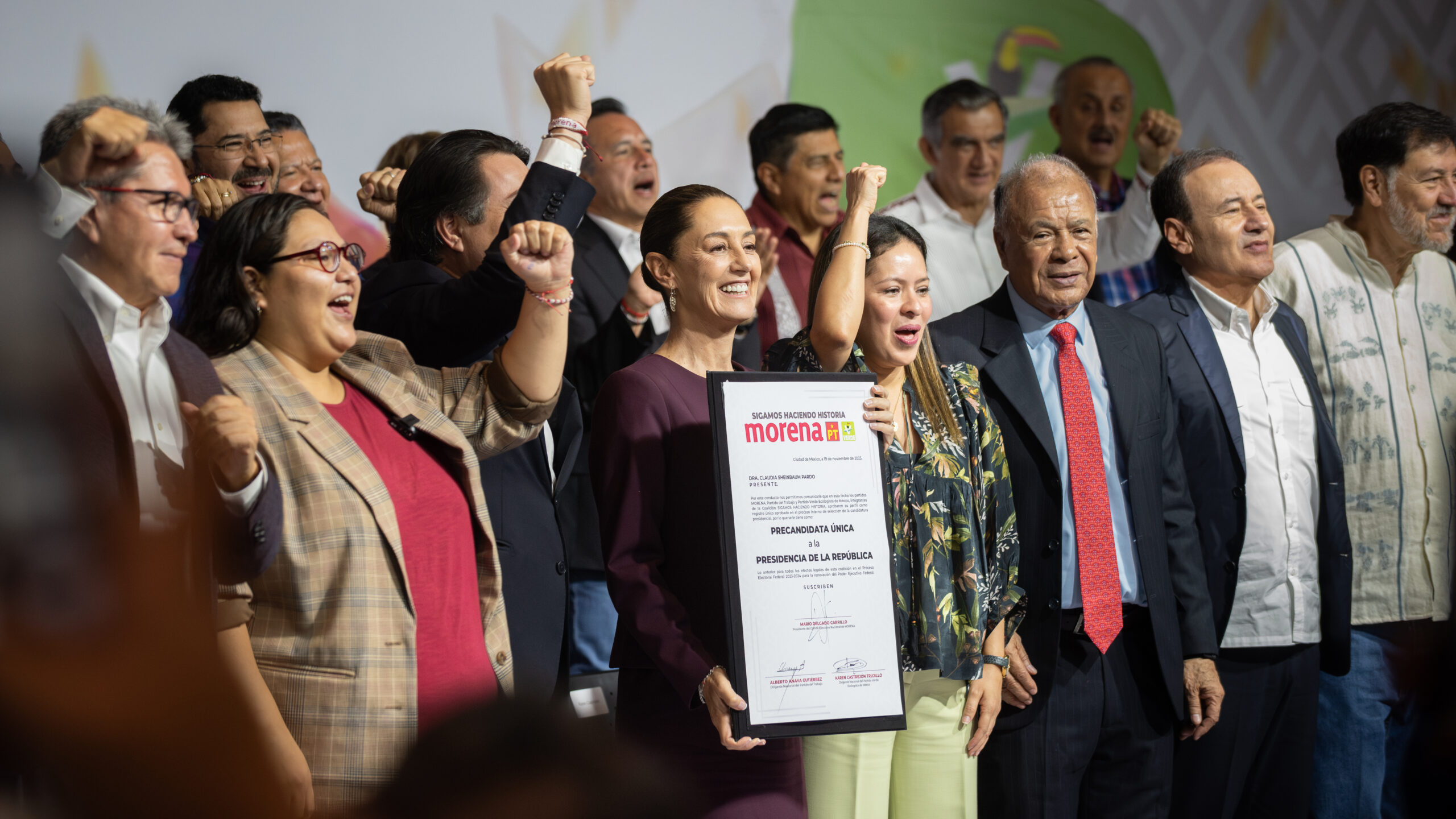
Sheinbaum acepting official nomination for her party, Morena.


There is a saying that soft times produce soft leaders and that hard times produce strong leaders. In the West, the soft times for the oligarchs from the 1980s onwards have produced many incompetent leaders as I am detailing in my series on them. In this series of articles I detail how the hard times have produced very strong leaders in nations outside the West. The first example is Claudia Sheinbaum, the President of Mexico.

She was born in 1962 to Sephardic Jewish biologist and chemical engineering parents, who raised her in a secular household. Sheinbaum has undergraduate and graduate degrees in physics and a PhD in energy engineering. From 1995 to 2000 she was a researcher at the National Autonomous University of Mexico (UNAM). She had been active in politics since her student days and was a member of the student group that founded the Party of the Democratic Revolution (PRD). In 2000 she became the Secretary of the Environment of Mexico City, within the city administration of Lopez Obrador, a position she held until 2006. After which she returned to UNAM, and was a contributing author on the UN IPCC Fourth Assessment Report mitigation section (2007), and a lead author of the same section in the IPCC Fifth Assessment Report (2013). She has also authored over 100 scientific journal articles and two books.

In 2014, Sheinbaum joined Obrador in splitting away from the PRD to form a new party, Moreno. From 2014 to 2017 she was Mayor of Tlalpan, a borough of Mexico City. In 2018 she was elected to the position of the Head of Government of Mexico City, which she held until 2023; the city has a population of approximately 10 million. During her period in office, the city homicide rate was reduced from 17.9 to 8.6 per 100,000 population, far below the national rate and about the same as the US national murder rate; on par with Los Angeles and very significantly lower than Phoenix (12.3), Houston (15.1), Chicago (22.5), Philadelphia (23.9) and Washington D.C. (39.7). The homicide rate in the Mexican capital became about one quarter that of the US capital; perhaps Mexico City should be sending their police force into US cities to aid their local police forces? Sheinbaum also oversaw a significant expansion and modernization of the city’s public transport infrastructure, as well as managing the city’s response to the COVID 19 pandemic.

This year, Sheinbaum was elected as the President of Mexico with 60% of the vote! The attack of the bought and paid for Western mainstream media upon the democratically elected president was nearly immediate . The Atlantic Monthly chimed out “Women Can Be Autocrats Too, Mexico’s new president follows her predecessor’s authoritarian path” authored by the dependable US oligarch propagandist tool David Frum. In US mainstream media Newspeak, the word “authoritarian” means any foreign leader that is not a vassal to the US; irrespective of the nature of the government involved. “Democratic” or “Popular” tends to mean any leader who is a US vassal; irrespective of the nature of the government involved. In this Newspeak, Sheinbaum is authoritarian while the unelected Zelensky who has banned the opposition parties, media and even religious orders while depending on the support of a bunch of fascist thugs is defined as “democratic”. As is the Zionist apartheid state, whose genocidal and ethnic cleansing policies Sheinbaum opposes.

Sheinbaum is not just resistant to becoming a vassal, but is also extremely intelligent and experienced in political and governmental affairs while being very popular among the citizenry; the worst possible combination for the US oligarchy as the head of state of a bordering nation. Contrast the two interviews below with any Harris, Trump, Blinken (US Secretary of State), Sullivan (US National Security Advisor), JD Vance (Trump VP running mate) or Tim Waltz (Harris VP running mate) interviews.


The kind of first woman president that many Americans would be happy with, but someone they will never be allowed to have an accurate representation of by the US oligarchic state and media organs. Especially when US corporations see her as a threat who is focused on the welfare of the Mexican citizenry rather than corporate welfare. Her party also now governs 24 of the 32 Mexican states, and has a two thirds majority in both houses of the senate, putting her in a significantly stronger position than her predecessor Obrador.

The last bastion of oligarchical elite power within the state, the judiciary, is directly threatened by the judicial reform passed under Obrador which will have the 7,000 strong state and federal judiciary elected rather than selected by an elite-serving and corrupt establishment. Across Latin America, the judiciary has acted as a bulwark against any democracy that threatens the oligarchical vassal elite. The first election of the judiciary will take place in 2025, and the balance of the positions elected in 2027. We can expect an escalating level of Western media propaganda, overt pressure, and covert political interference attempting to forestall these changes. Full of hypocrisy and irony of course, as the judiciary is generally elected in the US; with the US Supreme Court judges having to be approved by Congress. Sheinbaum has six years to make a real impact, both in Mexico and regionally, and make sure that the democratization and social development of Mexico continues with her successor.


This article from The American Conservative is much more open about why the US oligarchy hates Sheinbaum and will do anything to take her down.

I hate to break the news to my bullish Texas friends reading this, but Claudia Sheinbaum spent three years at the California Lawrence Berkeley National Laboratory completing a PhD thesis in energy engineering. Her speech reflected an appreciation for market-oriented renewable investment, but contained a pledge to cap fossil fuel consumption at a daily 1.8 million barrels …

Her environmental proposals, coupled with judicial reform and broadly left-wing rhetoric …

Sheinbaum plans to continue AMLO’s failed "hugs not bullets" approach to narco-terrorism …

Sheinbaum’s only substantive mention of migration was her reference to the “heroes and heroines” living in the United States, sending “help” back to communities in Mexico

AMLO (Obrador) was hemmed in by the vassal Mexican oligarchy, but through his own colossal popularity, reforms and the democratization of the judiciary, has provided a base from which Sheinbaum can truly start to challenge that vassal oligarchy. That she will embrace the need for action on climate change and environmental destruction (as against the Democratic cos-playing in this area), implement the judicial reform, continue to oppose the utterly failed US anti-drug policies (designed at least as much to discipline the masses as actually reduce the drug trade), and also refuse to be beholden to US domestic considerations, is anathema to the US oligarchy. For the record, when AMLO came to power in 2018 the Mexican murder rate was 29 per 100,000, dropped to 25 in 2022, and fell again in 2023 by 6.7%. With the majority of the illegal weapons in Mexico smuggled in from the US, sometimes even aided by the US state, a focus on stopping this trade rather than the drugs trade may better help reduce the Mexican murder rate.

One hopes that she has support within the military, as once she takes out the courts as a vassalized institution, the US oligarchs may attempt to use their standby option of a military coup. In these days when the US oligarchs are openly supporting an ongoing genocide, I put nothing past them - especially in a nation so vital to US oligarchic core interests.


Recommend Geopolitics And Climate Change to your readers

Geopolitics And Climate Change: A Holistic And Joined Up View


[t4b-ticker id=”6″]


[DISPLAY_ULTIMATE_SOCIAL_ICONS]


Print this article [bws_pdfprint display=’print’]

The views expressed herein are solely those of the author and may or may not reflect those of The Greanville Post.

Creative Commons LicenseThis work is licensed under a Creative Commons Attribution-NonCommercial 4.0 International License • 
ALL CAPTIONS AND PULL QUOTES BY THE EDITORS NOT THE AUTHORS

Published: November 7, 2024 1 comment
0 FacebookTwitterPinterestEmail
  • 1
  • …
  • 4
  • 5
  • 6
  • 7
  • 8

Choose your language

Recent Posts

  • Europe Continues Self-Harming

    Published: July 2, 2026
  • Why the US Lost More Than a War Against Iran | Radhika Desai

    Published: July 2, 2026
  • IMPERIALISM: DECADENT & DOOMED W/JOTI BRAR EP 58 – EU GOVERNMENTS FIGHT THE PEOPLE WHO OPPOSE WAR

    Published: July 1, 2026
  • The REAL reason the US fears China

    Published: July 1, 2026
  • Alexander Mercouris: A New Putin? From Diplomacy to War

    Published: June 30, 2026

Search

Speaking for the suppressed is our mission

IF YOU THINK THE WARMONGERING MEDIA ARE A DISGRACE AND A HUGE OBSTACLE TO REAL CHANGE IN AMERICA…
why haven’t you sent at least a few dollars to The Greanville Post (or a similar anti-imperialist citizen’s media)?. Think about it.  Without educating and organizing our ranks our cause is DOA. That’s why our citizens’ media need your support.  
Click anywhere on the image.

Gateway

  • Log in
  • Entries feed
  • Comments feed
  • WordPress.org

Most Important Info Sources


Most Trusted:
Andrei Martyanov
Black Agenda Report
Caitlin Johnstone
Caleb Maupin
China Rising/Jeff J. Brown
Consortium News
Danny Haiphong
Don Hank
Free PalestineTV–Laith Marouf

Garland Nixon
George Galloway
George Hazim
Gilbert Doctorow —Armageddon
Glenn Greenwald
Godfree Roberts / Here Comes China
Information Clearinghouse
In Defense of Communism
Jim Kavanagh/The Polemicist
Jonathan Cook Blog
Julian Macfarlane
Michael Roberts
Mondoweiss
Moon of Alabama
Multipolarista
Oliver Boyd-Barrett
Orinoco Tribune
Revolutionary Blackout Network/ Nick Cruse
Richard Medhurst
Roger Boyd
Sabby Sabs
Scott Ritter/AskThe Inspector
Seek Truth From Fact Foundation (STFF)
Simplicius the Thinker
Sonar21/Larry C Johnson
The Cradle
The Electronic Intifada
The Grayzone
The Jimmy Dore Show
The New Atlas/ Brian Berletic
The Vineyard of the Saker
Thomas Fazi Dispatches
Voltairenet.org
William Schryver / imetatronink

DONATE to The Greanville Post! It’s your media.


“Nothin’ tougher than cat herding!”

NOW IN THE TOP 1% OF AMAZON’S ASIA TITLES. WITH A SPECIAL FOREWORD BY PEPE ESCOBAR. 568 PP, ILLUSTRATED.

About Us

Kitty studious philosopherTHE GREANVILLE POST (TGP) is an antidote to and refuge from the ubiquitous brainwash long afflicting most people in the United States and the rest of the collective West. TGP is an independent, (barely) reader-supported, non-dogmatic publication dedicated to seeking the truth wherever it may be found. Thus, we publish voices from any point in the political spectrum, left, right, up, down, except shitlibs, professional disinformers, media whores, and demagogues of the extreme right. TGP is already heavily shadowbanned; it could be gone tomorrow. That’s the lousy, uber-hypocritical times we inhabit, so read it while you can, and do pass its carefully selected articles to others: friends, kin and workmates. Incidentally, if you can send a donation, do so. For obvious reasons, we do not operate behind a paywall. Defeating the Big Lie is too important and urgent to subject the truth to the test of wallet power.

He does not believe in Western “objectivity”.

bandido no stinking badge

Legalities: Disclaimer, etc.


Disclaimer Notice
  • Facebook
  • Twitter

@2021 - All Right Reserved. Designed and Developed by PenciDesign


Back To Top
The Greanville Post
  • HOME
  • ESSENTIAL
  • MYTH-FREE HISTORY WITH JACQUES PAUWELS
  • MUST VIDEO
  • BLOWBACK
  • NATURE