

Overall a somewhat disappointing book. So much more space could have been spent on some really deep analysis of “Party Life”. I have covered the sections below, apart from chapters 8 and 9 because they are just so pointless to analyze. In “A Bad Beginning” I spend quite some time providing not just a critique but also some contradictory details of the period covered. Chapters 5, 6, 7 and 10 are the real meat that tends to match the book title.
A Bad Beginning
The prologue and the second chapter suffer greatly from the lack of a historical materialist analysis in their coverage of the period leading up to the 1990s and a decidedly liberal propagandist interpretation of the West, late Mao years and the fall of the Soviet Union. The capitalist oligarch dominance and largely performative “democracies” in the West is nowhere to be found, as is the significant continuity between Mao and Deng together with the great advantages that Deng enjoyed (much of them due to Mao’s efforts) and Deng’s near-miss Gorbachev-like catastrophe in the late 1980s. The typification of the post-Stalin Soviet Union is so deeply flawed as to be a near caricature of Western propaganda. This even flows into the beginning of chapter 3 when it is stated that Deng rejected political reform when in fact he came close to utterly disastrous political and economic reforms before stepping back from the brink.
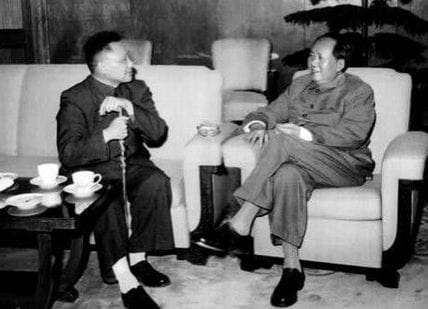
Deng with Mao: Two visionary giants.
The 1980s greatly benefitted from better relations and free trade with the West (instigated by Mao), a massive currency depreciation in the late 1980s/early 1990s (a blunt instrument to boost exports), the great increases in rural literacy and numeracy during the Cultural Revolution, and the mechanization of agriculture carried out during those years. China in 1979 was hardly in a disastrous state and typifications of the economy as being at the level of sub-Saharan Africa are utterly ridiculous. During the period between 1949 and 1979, the Chinese economy grew at an average rate of 6.7% over three decades; whilst subject to a Western trade embargo and contributing heavily to both the North Korean and Vietnamese war efforts. During the years of the Cultural Revolution (1966 to 1976), the Chinese economy grew at the three decadal average of 6.7% - hardly the disaster that the author identifies it as. In 1977 GDP grew by 7.6%, the next year by 11.7% and the year after by 7.6%; an average of 9% per annum. In January 1979, China gain Most Favoured Nation trade status (reviewed annually) with the US, a huge change which would have been expected to drive more rapid growth.
In March 1978, Deng inherited an economic launchpad while certainly not borrowing “just about everything from the more advanced West” as the author asserts, added to by the opening up of free trade. In the first five years of the 1980s (1980 to 1984), GNP grew by an average of 8.6%, only 1.9% higher than in the previous three decades. In the next four years (1985 to 1988) GNP growth accelerated to an average of 10.6%, but at the same time inflation started to accelerate; with the disastrous “big bang” price reforms of 1988 spiking it to 18.8%. In parallel with the political openings supported by the Zhao Ziyang (the General Secretary of the Communist Party who was linked to Soros and the Open Society Foundation regime change organization), and increasing levels of state corruption at all levels, the high inflation (still 18% in 1989) helped trigger the civil strife known as “Tiananmen” in 1989. It was only in 1988 and 1989 that the “big bang” price changes were significantly reversed and the political openings shut down (including Zhao Ziyang’s house arrest), together with Deng’s power being significantly weakened (he formally stepped down from the position of supreme leader in 1989). What followed were a few years of economic and financial consolidation to bring inflation back under control and a cleansing of the more radical elements from the senior ranks of the Party. In 1989 the economy grew by 4.1% and then 3.9% the following year. Overall in the 1980s, GDP had grown by 9.3% per year, 2.6% higher than the previous three decade average.
The author also misses the very significant Yuan devaluation between 1989 and 1994, from 376.5 to the US$ to 861.9 to the US$, which greatly aided exports and helped kick start growth. With capital controls, foreign investment significantly segmented into the delineated free trade zones, and state trade controls, the impact on the domestic-oriented economy was limited while exports and foreign investment greatly benefitted. A significant driver of the 10.3% annual growth of the 1990s, in addition to the economic liberalizations after Deng’s “Southern Tour” of 1992 that helped restore the strength of the “reform and opening up” movement; by 1994 he was seriously ill and his influence waned. Deng was certainly “crossing the river by feeling the stones beneath” with quite a few slips and one near-disastrous lurch toward the water. The growth rate of the 1980s could perhaps have been expected given the freeing up of trade and the previous three-decade growth rate. The 1980s had been a very rough ride, with many party officials at all levels filling their pockets through corruption. The most consequential changes made by Deng may have been the restarting of the official college entrance exams after an 11-year hiatus and the re-professionalization of the Party-state. Together with his focus on increasing state capacity and strengthening the power of the Party within the state apparatus.
The author seems to think that the “Deng era” came to a close with the appointment of Xi Jinping as the new leader, but that is both ridiculous and severely downplays the very significant contributions of Jiang Zemin (1989 to 2002) and Hu Jintao (2002 to 2012). This simplistic Deng worship is tiresome and lacks academic rigour, mirroring somewhat the ridiculous Western worship of Gorbachev; it would be better to talk also about the “Zemin-era” and the “Jintao era”. It was under Zemin that the State Owned Enterprises (SOEs) were massively restructured, that private business people were allowed to join the Party, that World Trade Order accession was gained, Hong Kong and Macau returned to China, and the military significantly modernized. It was under Jintao that the Party-state focus shifted from purely growth to more quality growth and measures to address the massive income and wealth divides that had opened up. Deng may have stumbled across the river feeling the stones, but it was Zemin and Jintao that built the concrete road and rail bridges across the river.
It is the maintenance of a strong state and the post-Tiananmen full rejection of the liberal political system that has allowed China to maintain its sovereignty, driving its own industrialization within its own terms and forestalling a dominance of foreign (and domestic) capital. This aspect is not properly covered in the book, along with the Chinese “privilege of historical backwardness”, first with respect to the Soviet Union under Mao and then with respect to the West.
An annoying habit of the author, utilized by many Western commentators, is to misrepresent GDP comparisons by using market exchange rates. For example, at PPP the Chinese economy was 18.8% the size of the US economy in 1990; not the 6.1% stated by the author on page 91. Another is his use of the Western “CCP” when it is correctly the CPC (Communist Party of China).
A Somewhat Better Coverage of the Party-state
China’s success to data is a result of taking a path that worked with its history, tradition, values, and present circumstances. These are distinctly different from the liberal vision propagated by America. And China’s choices and experience are becoming increasingly relevant today as a large number of developing countries are seeking new paths for their futures.
Li draws the distinction between Modernization (i.e. industrial development) and a universal Modernity stemming from the West’s specific historical development path. He localizes the latter as specific to the West and considers Modernization to be the universal phenomena. As he puts it, quite accurately, “all these religious, cultural, and political ideas developed over centuries in the corner of a small peninsula called Western Europe”. In contrast to these political traditions:
In today’s China, political power is not divided between centres of power but is centralized under a single political authority. Meanwhile, the individual remains part of the collective. He or she is by no means the independent and basic unit of society. To be sure, ordinary Chinese enjoy as wide a range of personal liberties as in the Western world. Both those with political aspirations contrary to the state and society’s collective objectives are severely constrained, even repressed.
With respect to the market economy, China is a socialist one not a capitalist one:
A market economy … efficiently allocates resources and returns high rates of growth, lifting hundreds of millions out of poverty. Yet, it is pointedly not capitalism - for two reasons: First, the Chinese state maintains a strong determinant role in overall economic strategy, in the design of developmental frameworks, and in the regulation of enterprises. Second, unlike in the West, in China, capital does not have inherent rights that invest it with power beyond or even above political authority. Beijing’s authority to redistribute wealth is theoretically unconstrained, and it can prevent capital from entering the socially destructive cycle of infinite accumulation.
Li points out the importance of the founding of the KMT by Sun Yat-sen in 1912, with the overthrow of the Qin Dynasty installing Sun as president of the Republic of China, and its establishment of a Party-state with the aid of the Soviet Union. Of course, in 1927 the then leader of the KMT Chiang Kai-shek tried to destroy its CPC ally. Resulting in the Long March and the CPC revolutionary force based among the peasantry, in contrast to an increasingly corrupt KMT aligned with the warlords and mafia elements. Li correctly draws the continuity between the historical Emperor and Mandarin system and the modern Party Secretary and Cadre system. With both the mandarins and cadres based upon meritocratic selection, as is the same with the Party Secretary. With government service as the highest calling for the nation’s intellectual elites and the values of Marxism very much in synch with Confucian traditions; and Leninism mirroring the strong central state of Chinese history.
Then Li cannot stop himself falling back into the Western academic habit of “making false truth from misrepresentation”, by stating correctly that agricultural yields fell by 15% in 1959 but without ever mentioning that the year was marked by a devastating combination of drought, floods and other extreme events; followed by worse in 1960. This is unconscionable from an academic that will have easy access to sources of climatic date for the period. From such manipulations and misrepresentations, Li attempts to build a view of Mao that is utterly a straw-man and even states that by 1976 “state building had come to a complete halt”. This is utter baloney. There were significant disruptions within the cities in the first two years of the Cultural Revolution, but these were rapidly brought under control; also only 12.2% of the Chinese population lived in the cities at the time. The rural population, the vast majority of the Chinese population at the time, greatly benefitted from the Cultural Revolution. That included a major, and very successful, state drive to mechanize agriculture. Hardly what would be expected from a period when “state building had come to a complete halt”. The Mao straw man is the contrasted with the “heroic” Deng, with the false narrative of Deng being a fundamental break with Mao being sold, when in fact there was a great deal of continuity.
Li does properly identify the accession of Xi to the leadership in 2012 as a “New Era”. His main competitor had been Bo Xilai, who was brought down by the Wang Lijun incident, stripped of his Party positions, found guilty of bribery, abuse of power and corruption, had all his property confiscated and jailed for life.
At the time, the Wall Street Journal predicted that the scandal would bring down the Party, a prediction that has aged like milk; as with so many of such Western predictions. Instead of being severely damaged by this scandal, the Party has gone from strength to strength in the new era of Xi Jinping.
Xi started out by establishing six leading groups and committees directly overseen by the Politburo, with the power to derive and implement national policies. Xi personally heads a number of these policymaking bodies, which bring bring a greater level of strategic coordination. The Central Disciplinary Inspection Commission was also centralized and fused with state law and order apparatus; facilitating Xi’s widespread crackdown on Party-state corruption. In addition, there has been a major refocusing toward common prosperity (reducing wealth and income inequalities) and high quality development (technology upgrading and the development of Chinese technology leading corporations).
Some Real Details Of The Party-State At Last!
With chapter 6, starting at page 168, we at last get some of what the book’s title promised; some details of how the Party-state actually works. Li starts by showing the huge difference between the Chinese leadership members that have spent many decades of meritocratic competition moving up the Party ladder while they take on increasing amounts of responsibility, and their Western counterparts. By the time they reach the upper levels of the Party-state, they are very fully-rounded and competent technocrats. In contrast to Western leaders who in many cases may have had no relevant experience before being appointed to their positions.
Also, the centrality of the Central Operational Department, which “carries out an elaborate process of bureaucratic selection, evaluation, and promotion that would be the envy of even the most successful corporations”. As he notes, “patronage continues to be a problem for the system, but by and large, merit remains the main driving force”. In the Party-state there are “900,000 officials at the [junior] levels, 600,000 at the [mid] levels, and 40,000 at the [more senior] levels. After a few more promotions, an individual may become one of the 300 Central Committee members. Above that are the 25 politburo members, seventeen of which “had managed provinces larger than most countries in the world and budgets larger than the average nation’s” as have six out of the seven members of the Politburo standing committee. On his way to becoming a member of the Politburo, Xi “managed areas with a total population of over 150 million and combined GDPs of more than US$1.5 trillion”. As Li brutally points out “a person with Obama’s pre-presidential experience would never have become a small county manager in China’s system, let alone come anywhere near the Politburo”.
Li also details the amount of experimentation carried out by the Party-state with respect to governance, facilitated by the nation’s size and devolved governance structures; e.g. the provinces, cities and towns that vary so greatly in scale, economics and geography. With the Party-state very much being the entrepreneurial one envisaged by Mazzucato. He then covers the quality of strategic governance through the example of the national rail system. In the early 2000s, a long term plan was put in place for 16,000km of high speed rail track that would cover 90% of China’s population and be completed by 2020. At the time, China had no high speed rail and the plan would require it to build more high speed rail than the rest of the world combined. Financing was arranged (50% central / 50% local), and the sheer scale of the opportunity facilitated foreign technology transfer and large scale efficient domestic production. By 2017, China had already far exceeded the plan with 25,000km of high speed network; by 2022 it had 42,000km, today 54,000km and it will have 60,000km by 2030. With China now building high speed rail in other nations and integrating an increasing number of other nations with its domestic network.
The development of the five year plans, which integrate longer term plans such as that for high speed rail, is an exemplar of the Chinese capacity for strategic planning. Following a four-stage process of (i) investigation and research, (ii) broad consultation, (iii) public participation and (iv) democratic centralization. The third step involves an extensive process of direct consultations between the Party-state and the general population; a very real direct involvement of the population in the planning process. The Party-state can both maintain its autonomy in the planning process while also being highly responsive to the general public.
A Report Card on Xi Jinping
Li details the successes of Xi, such as the anti-corruption drive, the reduction in environmental pollution, and reductions in economic inequality. He also covers the reining in of the power of concentrated private wealth; such as the defenestration of Jack Ma and a series of anti-trust actions. Also, the redirection of capital from the housing sector to the productive forces for the technology upgrading of the economy; moving up the value chain. The latter part is a little dated, as China has so rapidly leapt up the value chain in so many industries.
Very importantly, Li notes that in the period of rapid economic growth before the leadership of Xi:
[an] ideological vacuum in Chinese society also led to moral decay as manifested in official corruption, wealth worship, and disregard for the poor, as well as destruction of the environment for short-term gains at the expense of future generations. In those four decades, nearly two generations of Chinese grew up knowing only the market. Western liberal and neoliberal ideas infested Chinese society.
With Xi there is a “resolute no to the West’s liberalism” and a turn back both to the Party-state and ideology. This is not a return to the past, but a much needed cultural resetting. The public sector will not overwhelm the private sector, but it will firmly remain as the boss; “it is also clear that in a socialist China, capital can only achieve legitimate returns under the framework of the public realm”. Xi is also placing Chinese traditional culture, a Sinicization of Marxism, in a central place in the Party’s platform.
