SIMPLICIUS

Originally run on JUL 15, 2026
China has mastered the art of the silent observer. Legions of commentators spent years criticizing China for not being more active and involved in the global geopolitical theaters, such as the Russia-Ukraine war, particularly when tilting those conflicts in its own favor would have greatly benefited China.
But now portions of China’s strategy are finally coming to light, and revealing the country’s uniquely furtive approach to maintaining a semblance of balance while in actuality making unprecedented hidden preparations for the worst case scenarios.
This description summarizes the developments best:
Russian analysis: China has accelerated construction of a comprehensive national-resilience system intended to withstand sanctions, blockade, supply-chain collapse, natural disasters and potentially major war.
This refers to the recent report from Russia’s Global Affairs defense journal called, “The New Great Wall: The Logic of China’s Foreign Policy Behavior”:

The report opens with this blockbuster revelation:
In the early 2020s, China commenced a series of mobilization measures that, in consistency and scale, have no precedent since the early 1970s, and in some ways since the Soviet Union’s preparations for World War II. In Chinese literature, they are explicitly compared with major mobilization programs undertaken when China was preparing for a war with the USSR in the 1960s and 1970s, specifically with Third Front Construction.
The fact that this report is from a Russian patriotic journal, rather than a pro-Western one with an obvious anti-Chinese bias, means that the revelations herein are particularly noteworthy.
They admit that these massive measures are done under the surface, which we can only assume is a deliberate choice to conceal China’s true posture of formidable national restructuring toward hybrid-war impregnability:
These measures are not noticeable but are an important component of the general trend towards total securitization of all aspects of Chinese policy (even, e.g., culture and ecology) per Xi Jinping’s Holistic Security Concept.
The authors note that this policy flies in the face of China’s “outward” facade of optimism for humanity, showing that at their core, Chinese leadership are pragmatic adherents of realpolitik:
The measures’ extreme cost indicates that, although the Chinese leadership advances optimistic conceptions like the Community of Common Destiny for Mankind and a “universally beneficial, inclusive economic globalization,” the leadership actually adheres to an extremely bleak outlook for the world in the 21st century.
The Russian authors believe the measures indicate China is internally preparing for worst-case scenario outcomes:
It is preparing—at the very least—for a severe military and political crisis, including the disruption of all normal economic ties and a slide to the brink of war. At worst, it is preparing for even more nightmarish scenarios.
In effect, what is happening is that China is quietly watching and learning from the mistakes of all its counterparts, particularly Russia and Iran, and is restructuring its own internal policies and protective apparatuses toward avoiding the exact kind of traps that Russia had fallen into in Ukraine.
What “trap”, precisely, do we mean? One word suffices—it is the trap of vulnerability.
China appears to be keenly reassembling its infrastructure in order to be as least exposed as possible to any of the multifarious Western hybrid-war vectors in existence, from kinetic to economic.
How is China going about this?
By relocating strategic industries farther inland to the “rear”, to avoid precisely the type of things being seen in Russia now; strengthening its national energy grid, again to avoid the weaknesses seen both in the Russian and Iranian theaters; and much more.
The report summarizes:
Such conclusions are prompted by various documented actions of the Chinese government, including:
a program for relocating strategic industry inland to create a ‘strategic hinterland’ there;
major civil defense and urban infrastructure resilience projects, including on the basis of lessons from Russia’s Special Military Operation;
measures to strengthen the resilience of the national energy system;
improvement of national legislation to clarify the terms of military service and provide timely support for families of fallen soldiers and law enforcement officers;
the urgent build-up of food and raw material reserves.
They go into further detail, listing concrete steps the Chinese authorities have taken since the start of the Russian SMO. For instance, an accelerated buildup of hardened command posts, purges of the armed forces, particularly after inspections which found logistical conditions lacking:
China’s measures do not necessarily indicate an intention to initiate a large-scale military conflict, but they certainly indicate that the Chinese leadership considers such a conflict very likely and perhaps unavoidable, sometime in the late 2020s or early 2030s. It would seem that the scenarios under consideration range from severe sanctions and naval blockade to a major war with missile strikes on Chinese cities.
Preparations for such an extreme scenario seem central to China’s planning of military—as well as foreign and domestic—policy. And these preparations are taking place alongside an accelerated buildup of strategic nuclear forces and hardened command posts.
Simultaneously, in 2023, China conducted purges of its armed forces, foreign policy staff, and mobilization structures: the Ministry of Emergency Management, the State Grain Reserve Bureau, the China Grain Reserves Corporation (now China Grain Reserves Group), etc.
Some of these moves followed inspections of the inventory and condition of mobilization infrastructure. For instance, senior officials of the Chinese Grain Reserves Corporation were prosecuted.
One of the key mentioned aspects is the relocation of important enterprises and industries to the “strategic hinterland”, which the article notes has been a newly-coined term utilized by President Xi in the post-SMO period:
The term ‘strategic hinterland’ (战略腹地) was brought into official use by President Xi Jinping during an inspection trip to Sichuan Province in July 2023. Xi noted that the province is a “strategic hinterland,” as it has a “unique and important position in national development and in the Great Western Development Strategy.” This status imposes a whole range of obligations on the province, such as ensuring production, supply-chain, energy, and food security (Xinhua, 2023a). The Sichuan and Chongqing regions have essentially been tasked with building a national strategic reserve of resources and industry.
Sichuan and Chongqing can be seen below, nearly 1,000km from the coast—not much shorter a distance than the 1,200km separating Russia’s strategic Ural zone (where critical enterprises like Uralvagonzavod are stashed away) from Ukraine:
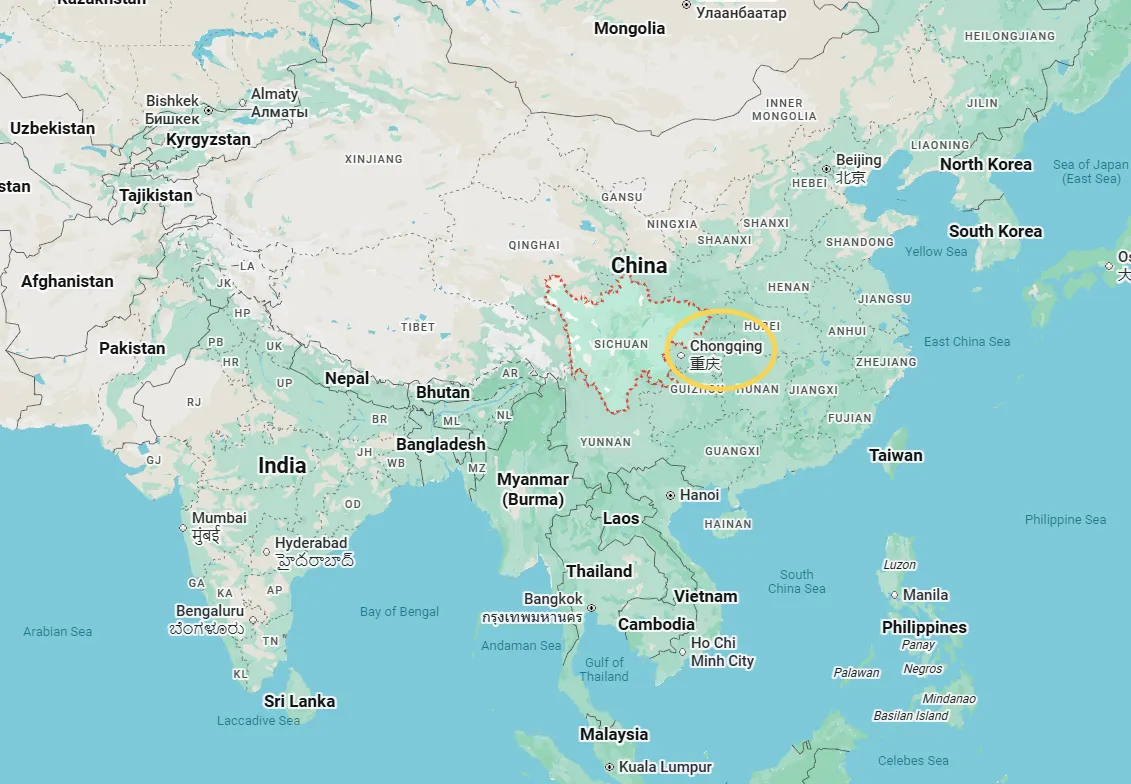

But one of the main changes marking Xi’s vision, is the linking of the ‘strategic hinterland’ with a dual-use civilian development concept for the chosen regions. The entire initiative has been likened to China’s famed “Third Front” project of the 1960s which likewise sought to develop industrial capacity in the country’s “interior”, which “followed the guiding principle "Close to mountains, dispersed, hidden".
But the Third Front project was said to have been hurriedly and more haphazardly carried out, leading to great inefficiencies and untenable integration. Xi’s new reimagining of it appears to be grander in design: the development of these “hinterland” regions into both strategic rears and “high quality” development for civilian economic purposes:
The modern strategy is seen as departing from the solely defensive Third Line, in that it seeks to integrate security with high-quality development. Reserves should be “living” and serve as centers of growth for “new quality productive forces.” In peacetime, they are to generate innovations and fully participate in market competition.
At the plenary session held in July 2024, China’s CPC again emphasized the initiative, naming key industries earmarked for this rear parallelization:
…which for the first time mentioned the need to “build a national strategic hinterland and backup capacity for key industries” (Xinhua, 2024b). This phrase, which has become a fixed expression, meant enhancing the security of production and distribution chains, creating a risk-assessment and -prevention system, transferring key industry deep inside the country to ensure its resilience, and developing national resource reserves. Key industries include integrated circuits, medical equipment, industrial equipment and machine tools, basic and industrial software, and advanced materials (Ibid).
The Third Plenary Session’s resolution also spurred discussion in the Chinese academic community about the meaning of ‘strategic hinterland.’ Interestingly, it focused on comparisons with the Third Line construction program of the 1960s-1970s—a large-scale inland relocation of defense and other industries.
Despite the focus on economic redundancy in the rear, the report states that Chinese made it clear that the military purpose was paramount:
Nevertheless, despite the emphasis on economic efficiency, the academic discussion of the ‘strategic hinterland’ clearly reveals its role as a rear area in the military sense. Sichuan is described as a “deep strategic rear area for national security” (国家战略安全大后方)
The rest of this post can only be read on its original site for paid readers: https://simplicius76.substack.com/p/the-new-third-front-china-quietly?r=2nwdrk&utm_campaign=post&utm_medium=web