
Michael Mezz
CHATS WITH
JASON HICKEL
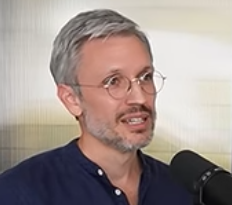
We're still trying to decide how much of a socialist Prof. Jason Hickel is. At times he sounds like a regular social democrat. Other times he professes allegiance to the workers' co-op model (i.e., Mondragon, etc.), which historically has never come close to challenging, let alone neutralizing capitalism, and which has roots in "anarcho-syndicalism", ultimately a romantic idealist bourgeois fantasy. In this post we present additional materials to clarify these questions.
How to Overcome Capitalism | Jason Hickel on Socialism, China, and the West

00:00 What capitalism really is 01:09 Introducing Jason Hickel 02:20 Capitalist imperialism in action: Venezuela, Iran, Lebanon 05:27 Why the US supports Israel 08:45 Capitalism, coups & the war on sovereignty 22:13 How capitalism creates poverty 25:25 Socialism as a solution 31:41 Why solving the climate crisis means overcoming capitalism 36:09 Economic democracy in practice 48:09 Elections vs. revolution: building a mass movement 57:01 The immiseration of the Western working class 59:28 Socialism is our best alternative to fascism 1:06:31 The limits of identity politics 1:13:52 Why the West fears China’s rise 1:20:16 How China builds what the West won’t 1:32:54 Delinking from the capitalist law of value 1:38:02 Hope for a better future 1:46:51 Conclusion Host/Creator: Michael Mezzatesta Guest: Jason Hickel Editor: Nuria Salgado Designer: Amea Wadsworth Producer: Jade Risser
II. ADDITIONAL MATERIALS
Hickel is clearly cogent and persuasive. But he offers some contradictions. Although he is officially not a social democrat, he talks about social democrat Bernie Sanders as possibly offering a solution, which, despite all the noise can never amount to any real solution, since his views remain strictly those of a bourgeois reformer. Not to mention Bernie's proven record of sheep dogging.
He supports: Democratic Eco-Socialism: He advocates for systemic post-capitalist transformation; Economic Democracy: He supports public ownership, democratized control over finance and production, and universal public goods; Degrowth: He links ecological stability with scaling down unnecessary aggregate output rather than relying on green growth under capitalism. [1, 2, 3, 4, 5, 6]. Some of these positions are implicit in any authentic socialist government, starting with democracy itself, which would likely veto production for unnecessary and "luxury" goods.

Social democracy is not a viable alternative to capitalism. It is a tempting prospect, but ultimately suffers from violent contradictions that cannot be sustained. Social democracy tries to establish a compromise between (a) capitalism, and (b) socialist demands for fair wages, good public services, and environmental protections. But the latter represents a real problem for capital. It increases input prices, and increases workers’ bargaining power, and makes capital accumulation very difficult to achieve. One way to resolve this tension is to abandon capital accumulation and transition to a post-capitalist economy where production is democratically organized around human well-being and ecology (in other words, socialism). But social democracy, which is ultimately committed to capitalism, takes a different approach. It resolves the tension through imperialism. Social democratic states appropriate cheap labour and nature from the global South, from an external “outside”, thus allowing them to offer good wages and public services at home while also maintaining the conditions for capital accumulation. Even states that may seem neutral or benevolent, like some of the Scandinavian countries, benefit from a massive net-appropriation of labour and resources from the global South through dynamics of unequal exchange, which enables them to sustain the social democratic compromise.
CRITIQUE BY THE FINNISH BOLSHEVIK
Fact Checking Liberals On Finnish Social-Democracy

First streamed Sep 22, 2019
Social-Democracy doesn't fix capitalism, it just perpetuates it.
@UmQasaann3 years ago
(The above comment has been edited for space. The fact that Scandinavian countries, including Finland, implemented social democracy to keep an all-out revolution from bursting out due to the example being set by the Soviet Union, practically next door, is also mentioned by The Finnish Communist in one of his videos. Logically, and as some astute observers warned, as soon as the Soviet Union imploded, the capitalists started to roll back the once generous safety net. —PG).
IV. CODA
And this is what the US imperialist AI has to say in reference to this topic. Keep in mind it is written from a deliberate pro-capitalist standpoint:
AI Overview
The classic Nordic social democratic model underwent severe strain in the late 20th century. High public spending and heavy taxation led to economic crises in the early 1990s. This forced Scandinavian nations to adopt market reforms, privatize public services, and lower corporate taxes while maintaining broad-based welfare funding.The Midcentury Peak and Crisis
Massive expansion: During the post-war decades, countries like Sweden pushed public spending past 50% of GDP, creating vast universal welfare systems.
Economic overload: High taxes, rigid labor market rules, and ballooning public sectors eventually strained economic growth and competitiveness.The 1990s crunch: Sweden and its neighbors suffered severe financial and currency crises, proving that extreme redistribution models needed structural correction.
Shifts Toward the Market
Reforms: Governments rolled back parts of the traditional cradle-to-grave state. They introduced choice in schools, healthcare competition, and reduced top tax rates.
Capitalist reality: Nordic leaders frequently clarify that they run competitive, free-market capitalist economies, not socialist systems.Funding the model: Present-day welfare relies heavily on broad consumption and middle-class income taxes rather than just soaking the rich.Current Challenges
Inequality growth: While still egalitarian compared to the U.S., income gaps in Scandinavia have grown faster than before.
Immigration strain: Integrating large numbers of newcomers into high-cost labor markets has tested the limits of public welfare systems.
Political shifts: Traditional Social Democratic parties have lost their historic dominance, sharing power or losing ground to center-right and nationalist political movements.
V. When capitalism takes over,
all bets are off.
I found this article, by a Swedish political scientist, compelling. Obviously the nation has gone from a sober, quasi-exemplar of civic virtue, to an almost gangster state. No wonder Sweden had no trouble backing NATO and supporting the US in its devious moves to destroy Russia.
How Sweden’s Welfare Experiment Became a Warning to Europe
Sweden pioneered welfare privatisation, and its controversial model is now being exported across the continent.
7th May 2025
The Swedish Economic Crime Authority recently reported that a number of healthcare centres, vaccination services, schools, pre-schools and pharmacies have been taken over by organised crime. It was a disturbing reminder that outsourcing and privatisation have transformed the Swedish welfare state beyond recognition – a fate that other welfare states in Europe could now be facing.
Outsourcing, privatisation and the introduction of voucher systems since the 1990s have marketised welfare services to a greater extent in Sweden than in any other European country. This has transformed the nation: what was once often portrayed as a social democratic ideal is now seen more as a neoliberal showcase. It has also created a number of very wealthy welfare corporations, which are now accelerating their expansion into other European countries.
In “Don’t Try This at Home“, a report recently published by the Friedrich-Ebert-Stiftung, Mia Laurén and I examine the consequences of this development and how Swedish for-profit welfare companies are now seeking to expand their businesses and business models abroad.
In the 1990s, Sweden opened up its tax-funded welfare services to private actors in what the scholars Jenny Andersson and Chris Howell term a “profound process of neoliberalisation”, a “reordering of welfare societies around the market form”, in their recently released anthology “Nordic Neoliberalisms“.
Did you know that now even Sweden's postal service has been privatized?
The idea was that competition between a diversity of actors would both increase efficiency and give the users of services (pupils, patients, etc.) “freedom of choice”. Rather than privatising through public procurement, where services bought from private providers are defined in contracts and limited in time, Sweden chose a Milton Friedman-inspired, voucher-style privatisation in areas such as employment services, healthcare, schools and pre-schools. Though the alleged aim of the reforms was to increase freedom of choice, the Swedish public has become increasingly aware that the reforms have, more than anything, led to a proliferation of private providers who compromise quality in order to maximise profits.
Education was the first subject of the Swedish privatisation of fully tax-funded welfare services. Voucher-based funding of Swedish public schools was introduced in 1991. The idea was that pupils and their families should be able to choose how to spend resources allocated for schooling, meaning whether to attend a publicly run school or take the voucher to a private school. Inevitably, though, it is mostly privileged families who are able to exercise their “freedom of choice”. While profitable pupils are picked by private schools, socially disadvantaged pupils are often left in the public schools. In addition to increasing socio-economic and ethnic segregation, the reform of the Swedish schooling system has been detrimental to the quality of education. No other country has experienced such a rapid fall in performance in the OECD’s Programme for International Student Assessment (PISA) rankings as Sweden.
Even so, Swedish school corporations are now expanding to other European countries. Recently, AcadeMedia, with 107 pre-schools in Sweden, bought 113 pre-schools in Finland in one go and is expanding rapidly on the German market: it already owns 98 pre-school units in six different Bundesländer.
In 2010, a voucher system was also made compulsory in Swedish tax-funded primary care. As with the school system, the aim of the healthcare reform was to increase patients’ “freedom of choice”. When the Swedish National Audit Office performed the first thorough evaluation, in 2014, it concluded that the voucher system had contributed to higher consumption of care, but also to more unequal care, where patients with less care needs and higher socio-economic status have been favoured.
Digital care has proved to be particularly profitable for private providers, and Sweden has seen a virtual explosion of digital healthcare services. As with other forms of for-profit care, it is geared towards people with milder symptoms such as acne or common colds. These are quick and inexpensive for companies to treat, yet they burden regional budgets and lead to funds being redirected towards relatively healthy people with small needs, and away from people with larger medical needs. Kry, Sweden’s largest private company in the digital healthcare sector, has now established itself in Norway, France, the UK and, more recently, Germany.
Swedish for-profit elderly care companies are also rapidly expanding abroad. The two largest, Attendo and Ambea, both have operations in Norway and Denmark, and Ambea recently bought the Finnish company Validia Oy. What is being exported from Sweden are companies notorious for their exploitation of temporary employment contracts and part-time employment. The pandemic highlighted the consequences of this policy of precarity: a research study commissioned by the Swedish state inquiry commission into the consequences of the Covid-19 pandemic concluded that higher staff turnover led to higher death rates.
The problems with Swedish privatisation do not end there. The raids of two tax-funded and privately run healthcare centres in the Swedish city of Göteborg in March 2025 is the latest development in an allegedly accelerating trend of criminal infiltration in Swedish tax-funded welfare services. The privatisation of tax-funded welfare services has thus allegedly contributed to Sweden’s escalating problems with criminal gangs.
Sweden’s large-scale privatisations have enabled companies to develop profitable business models and have led to very wealthy private welfare providers, often owned by multinational companies and venture capital firms. These companies and venture capital firms are now ready to expand abroad across various welfare sectors.
If not contained, these companies risk outcompeting local providers of welfare services, strengthening the lobby for increased marketisation and diverting tax funds intended for the delivery of welfare in several European countries, just as they have in Sweden.
It is important to highlight an additional “risk factor”: the somewhat romantic view of the Swedish welfare state, which has persisted ever since Sweden was described as an archetypical social democratic welfare state.
This romantic view can be exploited by Swedish welfare corporations when they market themselves in other countries. For instance, when exporting childcare services to Germany, Swedish companies try to invoke a certain imagery – with blonde children playing in Astrid Lindgren-style meadows and birch groves – which serves to conceal the for-profit nature of their operations.
There is a risk that Swedish welfare companies – equipped with international venture capital – will now play a destructive role in other European countries. These companies have nothing in common with the Swedish welfare state that was once portrayed as a progressive model for other countries to follow. Now the message must be: don’t try this at home.
AUTHOR PROFILE




@maxmeggeneder8935