
3

Be sure to share these materials with friends, kin, and workmates.
PROF. GLENN DIESEN CHATS W. PROF. SEYED MARANDI
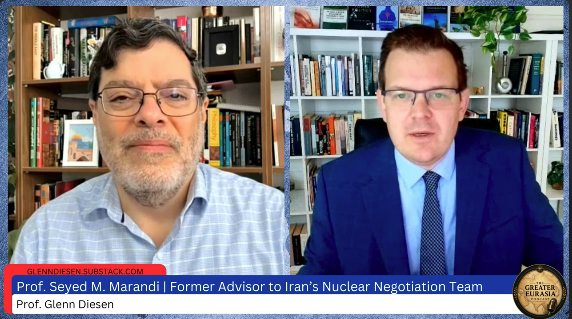
Seyed M. Marandi: If Saudi Arabia Collapses, the Entire Region Will Transform

In this discussion, Prof. Seyed Mohammad Marandi provides an analysis of the escalating conflict in the Middle East, focusing on the tensions between Yemen, Saudi Arabia, and the role of the United States and Israel.
Key takeaways from the discussion:
- The Yemen Conflict: Prof. Marandi details the ongoing conflict in Yemen, arguing that the Saudi-led military campaign has failed and that the Houthi (Ansar Allah) forces have gained the upper hand, partially due to developing their own military capabilities and receiving external support (1:16-5:00).
- US Regional Decline: The guest characterizes the recent withdrawal of US forces from Iraq as a significant milestone reflecting a relative decline in American influence in the region (14:30-17:35).
- Predictability of War: Citing the book Going to Tehran, Prof. Marandi explains that the current state of conflict was predictable if the United States failed to engage with Iran realistically and instead prioritized hostile policies shaped by Zionist influence (39:27-42:00).
- Potential for Escalation: The guest expresses concern that the situation may continue to deteriorate into a major conflict or global economic instability if diplomatic solutions—such as fulfilling the memorandum of understanding (MOU)—are not pursued.
Prof Marandi suggests that the United States was effectively pushed out of Iraq rather than leaving voluntarily. This withdrawal is linked to both Iranian strikes on their positions during hostilities and the efforts of the Iraqi resistance. Specifically, the Iraqi resistance (larger than Hezbollah) warned the United States that it would attack American assets if they did not leave the country by the end of September.

