Jyotishman
— INDIA & GLOBAL LEFT —
 Interviews Profs. David Guignion, Gabriel Rockhill
WITH SUMMATIONS BY PATRICE GREANVILLE

This video features a debate (0:01:33-1:22:22) between Professor Gabriel Rockhill, a Marxist philosopher, and Assistant Professor David Guignion, a philosopher sympathetic to post-structuralism and postmodernism. The discussion, moderated by the India and Global Left platform, centers on the strengths and weaknesses of Marxism compared to the "French theory" tradition.
Key themes and arguments discussed:
- The Nature of Theory and Praxis: The speakers debate whether the "French theory industry" (encompassing thinkers like Foucault, Derrida, and Deleuze, all "post-modernists") contributes to revolutionary change or serves as a reactionary, capitalist-accommodating framework (0:07:06-0:11:32).
- Marxism as a Collective Tradition: Professor Rockhill argues that Marxism should be viewed as a collective, internationalist scientific tradition—a process of learning focused on material reality and anti-imperialist struggle—rather than a dogmatic text-based philosophy (0:21:06-0:24:25).
- The Role of Academics: The debate touches on whether academic work is inherently detached from real-world class struggles, with Guignion questioning the practical role of intellectuals and advocating for a more bottom-up approach that integrates diverse theoretical insights (0:12:50-0:14:00).
- Compatibility vs. Incompatibility: A significant portion of the conversation revolves around whether Marxism can or should be combined with other theoretical frameworks. Professor Rockhill criticizes this as "bourgeois intellectual eclecticism," while Guignion argues that including more perspectives (such as insights on power, gender, or race) enriches the revolutionary movement (1:07:00-1:11:48).
Editor's Addendum / Proto-Summation
Overall, there is little question that "post-modernism" is an affectation of petit-bourgeois intellectuals wishing to appear as "thought lions" without paying the price of holding truly radical critiques of the the existing imperialist order. Post-modernists, especially in cultures like the French and German, easily exploit the belief that complicated,often "insolent" theories and positions, imply philosophical profundity. Intellectual poseurs, like Bernard-Henri Levy (BHL) have made an industry of this. The AI engine seems to agree with me. When I asked for notable "poseurs" in contemporary France, it quicky came up with this:
By AI—In contemporary French cultural discourse, the critique of the "intellectual poseur"—often lampooned as a “turbo-intellectual” or media-driven performance artist—is a major theme. Critics from both the left and right, alongside international observers like Noam Chomsky, have long argued that the classic French tradition of the universal moral guide (exemplified by Voltaire or Zola) has devolved into a culture of superficial, attention-seeking media stars who prioritize "exciting" or provocative statements over rigorous truth. [1, 2, 3]
While "poseur" is an inherently subjective label, a few prominent public figures are routinely singled out by critics, satirists, and peers as the biggest intellectual lightweight performance artists in France today:1. Bernard-Henri Lévy (BHL)- The Critique: Critics accuse Lévy of practicing "parachute philosophy"—flying into international conflict zones with unbuttoned white shirts and film crews to strike heroic poses, while offering shallow, moralizing commentary.
- Famous Blunders: His intellectual credibility suffered a catastrophic blow when he published a serious philosophical critique of Immanuel Kant based entirely on the theories of a "Jean-Baptiste Botul." Botul was later revealed to be a completely fictional character invented by a French satirical journalist to parody academic pomposity.
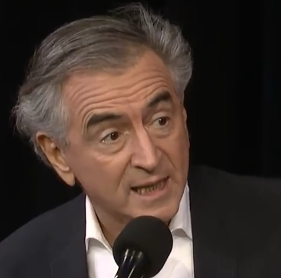
Below, in this clip, BHL, whose fame and success have always depended on his servile willingness to defend the US, Israel, and imperialism at any cost, is seen happily slandering the leaders of the only powers standing up to Washington's ghastly criminality to the acclaim of his host and befogged audience. The video (on WNYC, a NY city channel), is ludicrously titled,
A French Philosopher's Take on America's Role in the World
BHL, wastes no time in singling out today's "Five Kings of Hate".
 See what he came up with.
 Alignment with Bourgeois Liberal Pluralism
Though postmodernism presented itself as subversive, its core tenets aligned comfortably with the bureaucratic needs of the expanding neo-liberal university.- Defanged Radicalism: Because thinkers like Foucault and Derrida argued that power was decentralized, diffuse, and embedded in language rather than concentrated in the ownership of capital, their theories posed zero threat to the university's financial endowments or corporate structure.
- Consumer-Friendly Pluralism: Postmodernism's emphasis on infinite subjectivity and diverse perspectives was easily co-opted by the university administration to rebrand higher education as a consumer marketplace of identities. It substituted structural demands for economic redistribution with demands for institutional recognition and linguistic inclusivity—a trade-off the corporate university administration was happy to accept.
David Guignon (Podcaster / Content Creator): He is the host of the popular critical theory and philosophy podcast Theory & Philosophy, where he produces accessible overviews of complex philosophical texts, concepts, and thinkers (such as Michel Foucault and Judith Butler). He maintains a substantial library of over 250 educational episodes broadcast across YouTube and other streaming platforms.