2.2K

Please make sure these dispatches reach as many readers as possible. Share with kin, friends and workmates and ask them to do likewise.

 Nima R. Alkhorshid
DIALOGUE WORKS
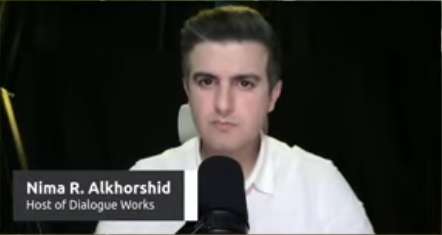
Nima chats with
Profs. Michael Hudson & Richard D. Wolff
| Traducir—Translate! | |
| Make fonts bigger>>> | Resize text-+= |

Dialogue Works
Streamed live on Jan 22, 2026
Streamed live on Jan 22, 2026
Summary
The conversation between Richard Wolff and Michael Hudson on the 2026 Davos forum centers on the evolving global geopolitical and economic landscape, highlighting a profound shift in international power dynamics. The discussion frames Davos not just as an economic forum but as a platform where a new global order, led by the United States, is being asserted through military and economic strategies aimed at maintaining U.S. dominance. Central to this is the U.S. effort to militarize and control strategic regions like Greenland and Iceland to dominate the Arctic and North Atlantic, countering China’s Belt and Road Initiative and Eurasian economic integration.
They critique Donald Trump’s vision of “peace,” which, according to them, is effectively a continuation of conflict through the establishment of rival military blocs under U.S. dominance, contrary to genuine peace. This new “rules-based order” undermines long-standing international law and national sovereignty, harking back to historical hegemonies where financial and military power dictated global relations. Europe’s response is uncertain and fragmented, with some political factions acquiescing to U.S. demands while others remain silent or resist, exposing fractures in the transatlantic alliance.
The broader context is described as a contest between two models of capitalism: the U.S.-led neoliberal privatization approach versus China’s hybrid state-capitalist model, which has successfully driven faster economic growth. This economic shift undermines U.S. hegemony and intensifies geopolitical tensions. The speakers also delve into the historical and contemporary struggles of labor movements, particularly in the U.S. and Europe, illustrating how political and economic elites have co-opted or suppressed genuine labor activism, further deepening social inequalities.
The discussion concludes with a cautious optimism that despite the current dominance of neoliberal finance capital and U.S. military power, the rising awareness and resistance within labor movements and the global population could challenge and eventually reshape the emerging global order.
Highlights
[02:12] 🌍 U.S. strategic control over Greenland and Iceland aims to militarize the Arctic and block China’s economic routes.
[04:42] ⚖️ The “rules-based order” promoted by the U.S. undermines national sovereignty and international law rooted in the 1648 Treaty of Westphalia.
[07:41] 🛑 Europe’s potential surrender of Greenland risks forfeiting control over Iceland and ceding strategic dominance to the U.S.
[14:19] 💰 The U.S. national security strategy focuses on military spending to maintain unipolar dominance against Russia and China.[23:16] 🔄 The global geopolitical disruption stems not from Trump but from capitalism’s evolution, especially China’s hybrid private-state economic model.
[37:37] ✊ Minneapolis’ general strike signals renewed labor resistance amid political and social divisions in the U.S.
[41:47] 🚗 U.S. tariffs on Chinese electric vehicles reflect protectionism amid losing competitive ground to China’s industrial growth.
Key Insights
[02:39] 🧊 The Military Significance of Greenland and Iceland: Control of Greenland and Iceland is less about resource extraction under the ice and more about establishing a strategic sea control line from Canada through the Arctic. This “seaborne Maginot Line” is crucial for the U.S. to block China’s and Russia’s access to Arctic shipping routes, highlighting how military strategy is deeply intertwined with economic dominance in the 21st century.
[04:15] ⚔️ Trump’s “Board of Peace” as a New Cold War Construct: The purported “peace” initiative is actually a strategy of imposing U.S. terms globally, where dissenters are labeled enemies to be defeated militarily or economically. This echoes the Cold War binary but with far-reaching implications, including the displacement of the United Nations and traditional bodies of international law. The attempt to rewrite international norms signals a radical shift toward unipolar U.S. hegemony.
[11:33] ⛓️ Historical Parallels to European Hegemony and Financial Control: The discussion draws parallels between the current U.S. efforts to dominate global finance and military power with the Catholic Church’s medieval political control via financial mechanisms and land ownership. This comparison underscores the cyclical nature of hegemonic power—where economic control translates into political subjugation—and warns of the consequences for European sovereignty.
[16:28] 🛑 Europe’s Dilemma and U.S. Subordination: The U.S. is gambling on subordinating Europe to its will, turning historic allies into satellites or “slaves” to its military and economic agenda. The internal divisions within Europe, especially the pro-American stances of influential families and political elites, weaken Europe’s ability to resist U.S. dominance and preserve its autonomy, risking loss of control over critical territories and resources.
[22:17] 🔥 Limits of Colonial-Style Big Power Politics Today: Attempts to exercise classical colonial or imperial control, such as in Greenland or Latin America, are increasingly untenable due to global anti-colonial sentiment and the evolving international order. This shift challenges U.S. strategies based on military intervention and economic coercion, suggesting that such tactics are outdated and will face growing resistance and failure.
[31:35] 💸 The Financialized U.S. Model vs. Social State Models: The U.S. model prioritizes financial interests and military spending at the expense of social welfare and industrial production, contrasting with Russia and China’s approach of maintaining industrial capacity and social spending. This divergence fuels geopolitical competition and exposes contradictions in neoliberal capitalism that undermine the U.S.’ long-term position.
[44:31] ⚙️ Labor Movements as a Potential Force for Change: Despite widespread political co-optation and fragmentation, the labor movement remains a critical arena for contesting the current order. Historical examples, like the Minneapolis general strikes, illustrate that organized labor can mobilize significant resistance. The growing disillusionment with mainstream political parties and economic inequality could catalyze renewed labor activism with transformative potential globally.
This analysis paints a complex picture of a world in flux, where economic, military, and ideological battles intersect. The U.S. is aggressively trying to maintain its dominance through a combination of military posturing, economic coercion, and narrative control, but faces fundamental challenges from China’s rise, European ambivalence, and internal social tensions. The eventual shape of the global order will depend heavily on whether emerging social forces can disrupt entrenched power structures and offer alternative visions of economic and political sovereignty.
 BEFORE you leave, PLEASE pay attention to this alert.
[t4b-ticker id="1"]
Print this article [bws_pdfprint display=’print’]
The views expressed herein are solely those of the author and may or may not reflect those of The Greanville Post, although, if we publish them, we obviously find them noteworthy and valuable.
 This work is licensed under a Creative Commons Attribution-NonCommercial 4.0 International License •
ALL CAPTIONS AND PULL QUOTES BY THE EDITORS NOT THE AUTHORS