Saturday, July 4 2026 - Welcome • Bienvenidos • Bienvenu
The Wake
Scott Ritter: Iran SMASHES Trump’s Bluff, Putin’s New War SHOCKS NATO
Amb. Chas Freeman: Hezbollah Responds Hard to Israel – IDF NOW Prepares...
Prof. Ted Postol: “It’s Over”: Israel Faces Total Collapse if War Escalates
Europe Continues Self-Harming
Why the US Lost More Than a War Against Iran | Radhika...
IMPERIALISM: DECADENT & DOOMED W/JOTI BRAR EP 58 – EU GOVERNMENTS FIGHT...
The REAL reason the US fears China
Alexander Mercouris: A New Putin? From Diplomacy to War
PATRIOT MISSILES FAIL MISERABLY, Here’s the Video Evidence /MIT Prof Ted Postol
  • HOME
  • ESSENTIAL
  • MYTH-FREE HISTORY WITH JACQUES PAUWELS
  • MUST VIDEO
  • BLOWBACK
  • NATURE
The Greanville Post
Money for Crimes? Oh. YEA. Money for the people? Hell NO. That's American democracy for you.
  • HOME
  • ESSENTIAL
  • MYTH-FREE HISTORY WITH JACQUES PAUWELS
  • MUST VIDEO
  • BLOWBACK
  • NATURE
Home Tags Posts tagged with "ukraine war"
Tag:

ukraine war

Ukraine: Fighting to the Conclusion

by Bergeracpas Published: March 28, 2025
written by Bergeracpas 38 minutes read
Be sure to share these materials with friends, kin, and workmates.

Big Serge
BIG SERGE THOUGHT
Traducir—Translate!
Make fonts bigger>>>
Resize text-+=

Ukraine: Fighting to the Conclusion
Russo-Ukrainian War, Spring 2025
BIG SERGE • MAR 28, 2025

Frontline battery


The Russo-Ukrainian War is now three years old, and the third Z-Day, on February 24, 2025, was marked by a substantively different tone than prior iterations. On the battlefield, Russian forces stand significantly closer to victory than they have at any point since the opening weeks of the war. After reversals early in the war as Ukraine took advantage of Russian miscalculations and insufficient force generation, the Russian army surged in 2024, collapsing Ukraine’s front in southern Donetsk and pushing the front forward towards the remaining citadels of the Donbas.

At the same time, 2025’s Z-Day was the first under the new American administration, and hopes were high in some quarters that President Trump could bring about a negotiated settlement and end the war prematurely. The new tenor seemed to be made abundantly clear in an explosive February 28 Oval Office meeting between Trump, Vice President Vance, and Zelensky, which ended in the Ukrainian president being ignominiously shouted down and evicted from the White House. This followed an abrupt announcement that Ukraine was to be cut off from American ISR (Intelligence, Surveillance, and Reconnaissance) until Zelensky apologized for his conduct.

In an information sphere rife with rumors, inscrutable diplomatic maneuvering, and heavy handed posturing (clouded further by the distinctive style and personality of Trump himself), it is very hard to figure out what might actually matter. We’re left with a bizarre juxtaposition: based on the explosive vignettes of Trump and Zelensky, many might hope for an abrupt course change on the war, or at least a revision of the American position. On the ground, however, things continue much as they have, with the Russians grinding forward along a sprawling front. The infantryman entrenched near Pokrovsk, listening for the whirring of drones overhead, could be forgiven for not feeling that much has changed at all.

I have never made any bones about my belief that the war in Ukraine will be resolved militarily: that is, it will be fought to its conclusion and end in the defeat of Ukraine in the east, Russian control of vast swathes of the country, and the subordination of a rump Ukraine to Russian interests. Trump’s self-concept is greatly tied up in his image as a “dealmaker”, and his view of foreign affairs as fundamentally transactional in nature. As the American president, he has the power to force this framing on Ukraine, but not on Russia. There remain intractable gulfs between Russia’s war aims and what Kiev is willing to discuss, and it is doubtful that Trump will be able to reconcile these differences. Russia, however, does not need to accept a partial victory simply in the name of goodwill and negotiation. Moscow has recourse to a more primal form of power. The sword predates and transcends the pen. Negotiation, as such, must bow to the reality of the battlefield, and no amount of sharp deal making can transcend the more ancient law of blood.

The Great Misadventure: Front Collapse in Kursk


When the history of this war is laid out retrospectively, no shortage of ink will be lavished on Ukraine’s eight month operation in Kursk. From the broader perspective of the wartime narrative, Ukraine’s initial incursion into Russia filled a variety of needs, with the AFU “taking the fight” to Russia and seizing the initiative, albeit on a limited front, after months of continuous Russian advances in the Donbas.

Notwithstanding the immense hyperbole that followed the launch of Ukraine’s Kursk Operation (which I facetiously nicknamed “Krepost”, in an homage to the 1943 German plan for its own Battle of Kursk), in the months that followed this was undoubtedly a sector of great significance, and not only because it brought the distinctive of Ukraine holding territory within the prewar Russian Federation. Based on a perusal of the Order of Battle, Kursk was clearly one of the two axes of primary effort for the AFU, along with the defense of Pokrovsk. Dozens of brigades were involved in the operation, including a significant portion of Ukraine’s premier assets (mechanized, air assault, and marine infantry brigades). Perhaps more importantly, Kursk is the only axis where Ukraine has made a serious effort to gain initiative and go on the offensive in the last year, and the first Ukrainian operational level offensive (as opposed to local counterattacks) since their assault on the Russian Zaporizhia line in 2023.

With all that being said, March brought about the culmination of a serious Ukrainian defeat, with Russian forces recapturing the town of Sudzha (which formed the central anchor of Ukraine’s position in Kursk) on March 13. Although Ukrainian forces still have a presence on the border, Russian forces have crossed the Kursk-Sumy border into Ukraine in other places. The AFU has been functionally ejected from Kursk, and all dreams of some breakout into Russia have faded. At this point, the Russians now hold more territory in Sumy than the Ukrainians do in Kursk.

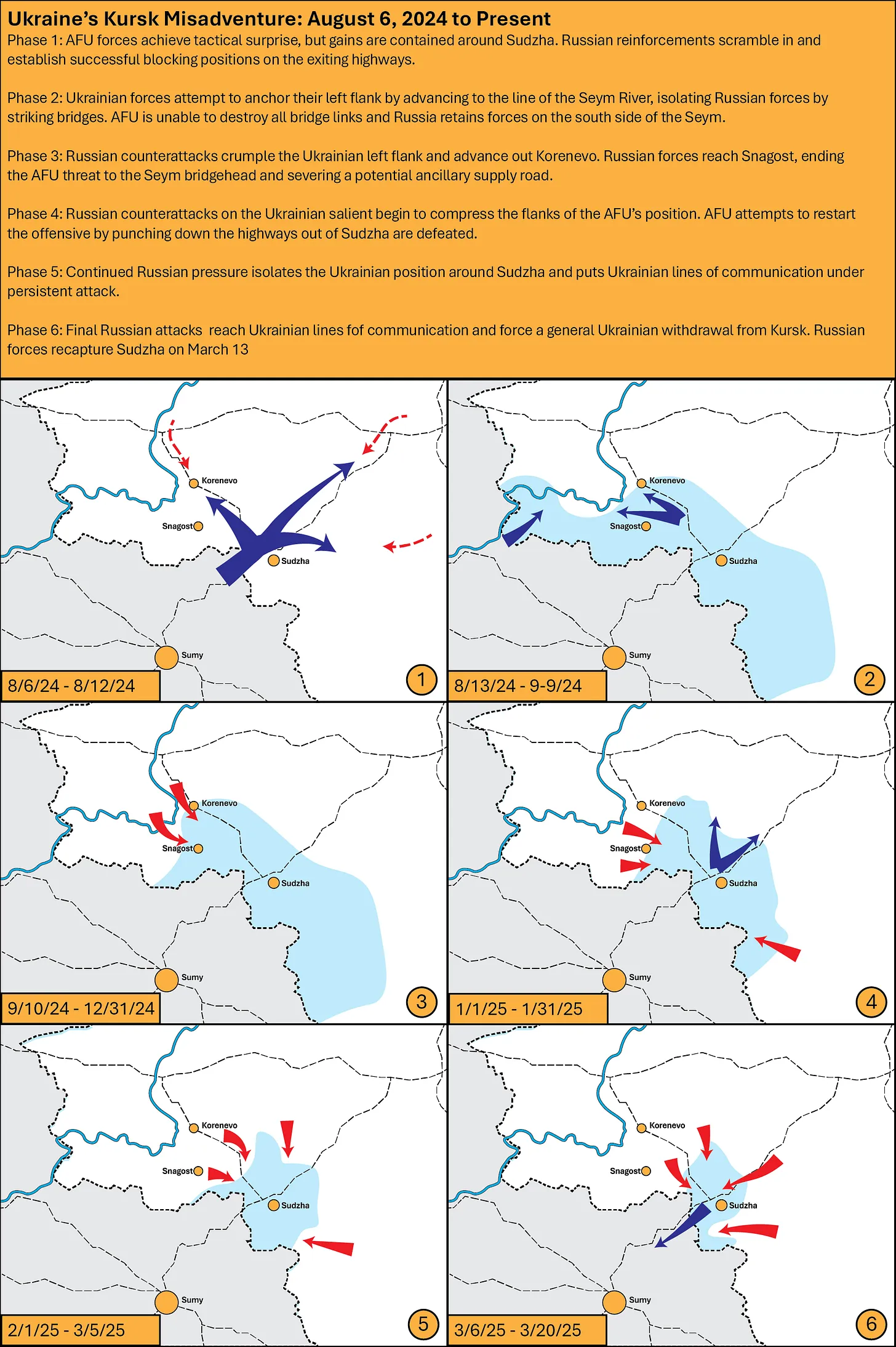
This would seem, then, to be a good time to conduct an autopsy on the Kursk Operation. Ukrainian forces achieved the basic prerequisite for success in August: they managed to stage a suitable mechanized package - notably, the forest canopy around Sumy allowed them to assemble assets in relative secrecy, in contrast to the open steppe in the south - and achieve tactical surprise, overrunning Russian border guards at the outset. Despite their tactical surprise and the early capture of Sudzha, the AFU was never able to parlay this into a meaningful penetration or exploitation in Kursk. Why?

The answer seems to be a nexus of operational and technical problems which became mutually reinforcing - in some respects these problems are general to this war and well understood, while in some ways they are unique to Kursk, or at least, Kursk provided a potent demonstration of them. More specifically, we can enumerate three problems that doomed the Ukrainian invasion of Kursk:

  1. The failure of the AFU to widen their penetration adequately.

  2. The road-poor connectivity of the Ukrainian hub in Sudzha to their bases of support around Sumy.

  3. Persistent Russian ISR-strike overwatch on Ukrainian lines of communication and supply.

We can see, almost naturally, how these elements can feed into each other - the Ukrainians were unable to create a wide penetration into Russia (for the most part, the “opening” of their salient was less than 30 miles wide), which greatly reduced the number of roads available to them for supply and reinforcement. The narrow penetration and poor road access in turn allowed the Russians to concentrate strike systems on the few available lines of communication, to the effect that the Ukrainians struggled to either supply or reinforce the grouping based around Sudzha - this low logistical and reinforcement connectivity in turn made it impossible for the Ukrainians to stage additional forces to try and expand the salient. This created a positive feedback loop of confinement and isolation for the Ukrainian grouping which made their defeat more or less inevitable.

We can, however, go a little deeper in our postmortem and see how this happened. In the opening weeks of the operation, Ukraine’s prospects became severely untracked by two critical tactical failures which threatened from the outset to spiral into an operational catastrophe.

The first critical moment came in the days from August 10-13; after initial successes and tactical surprise, Ukrainian progress stalled as they attempted to advance up the highway from Sudzha to Korenevo. Several clashes took place throughout this period, but solid Russian blocking positions were held as reinforcements scrambled into the theater. Korenevo always promised to be a critical position, as the Russian breakwater on the main road leading northwest out of Sudzha: so long as the Russians held it, the Ukrainians would be unable to widen their penetration in this direction.

With the Russian defenses jamming up the Ukrainian columns at Korenevo, the Ukrainian position was already pregnant with a basic operational crisis: the penetration was narrow, and thus threatened to become a severe and untenable salient. At the risk of making a perilous historical analogy, the operational form was very similar to the famous 1944 Battle of the Bulge: taken by surprise by a German counteroffensive, Dwight Eisenhower prioritized limiting the width, rather than the depth of the German penetration, moving reinforcements to defend the “shoulders” of the salient.

Blocked at Korenevo, the Ukrainians shifted their approach and made a renewed effort to solidify the western shoulder of their position (their left flank). This attempt aimed to leverage the Seym River, which runs a winding course about twelve miles behind the state border. By striking bridges over the Seym and launching a ground attack towards the river, the Ukrainians hoped to isolate Russian forces on the south bank and either destroy them or force a withdrawal over the river. If they had succeeded, the Seym would have become an anchoring defensive feature protecting the western flank of the Ukrainian position.


The Battle of Kursk

The Ukrainian attempt to leverage the Seym and create a defensive anchor on their flank was well conceived in the abstract, but ultimately it failed. By this time, the effects of Ukraine’s tactical surprise had dissipated and there were strong Russian units present in the field. In particular, the Russian 155th Naval Infantry Brigade held its position on the south bank of the Seym, maintained its links to neighboring units, and led a series of counterattacks: by September 13, Russian forces had recaptured the critical town of Snagost, which lies in the inner bend of the Seym.

The recapture of Snagost (and the linkup with Russian forces advancing out Korenevo) not only ended the threat to the Russian positions on the south bank of the Seym, but more or less sterilized the entire Ukrainian operation by confining them to a narrow salient around Sudzha and constricting their ability to supply the grouping at the front.

It’s rather natural that road connectivity is poorer across the state boundary than it is within Ukraine itself, and this is especially true for Sudzha. Once Snagost was recaptured by Russian forces, the Ukrainian grouping around Sudzha had just two roads connecting it to the base of support around Sumy: the main supply route (MSR in the technical parlance) ran along the R200 highway, and was supplemented by a single road some 3 miles to the southeast. The loss of Snagost condemned the AFU to resupply and reinforce a large multi-brigade grouping with just two roads, both of which were well within reach of Russian strike systems.

This poor road connectivity allowed the Russians to persistently surveil and strike Ukrainian supplies and reinforcements making the run into Sudzha, particularly after Russian forces began the widespread use of fiber optic FPV drones, which are immune to jamming. One other advantage of the fiber optic drones, which is not as widely discussed, is that they maintain their signal during final approach to the target (as opposed to wirelessly controlled models, which lose signal strength as they drop to low altitude on attack). The stable signal strength of fiber optic units is a great boon to accuracy, as it allows controllers to control the drone until impact. They also provide a higher resolution video feed which makes it easier to spot and target concealed enemy vehicles and positions.

Operationally, the main distinctive of the fighting in Kursk is the orthogonal orientation of effort by the combatants. By this, we mean that Russian counteroffensives were directed at the flanks of the salient, steadily compressing the Ukrainians into a more narrow position (by the end of 2024, the Ukrainians had lost half of the territory they once held), while Ukrainian efforts to restart their progress were aimed at moving deeper into Russia.

In January, the Ukrainians launched a fresh attack out of Sudzha, but rather than attempting to widen and solidify their flanks, this attack once again aimed to punch down the highway towards Bolshoye Soldatskoye. The attack was repulsed on its own terms, with Ukrainian columns advancing a few miles down the road before collapsing with heavy losses, but even if it had succeeded it would not have fixed the fundamental problem, which was the narrowness of the salient and the limited road connectivity for supply and reinforcement.

By February, the Ukrainian grouping in Kursk was clearly exhausted and their supply linkages were under permanent surveillance and attack by Russian drones. It was perhaps predictable, then, that the Russians would close up the salient quickly once they made a determined push. The actual endgame took, at most, a week of good fighting. On March 6, Russian forces broke through Ukrainian defenses around Kurilovka, to the south of Sudzha, and threatened to overrun the secondary supply road. By the 10th, the Ukrainians were withdrawing from Sudzha proper, with the town falling back under full Russian control by the 13th.

It was during this brief period of climactic action that the sensational story of the Russian assault through the pipeline emerged. This became a totem anecdote, with Ukrainian sources claiming that the emerging Russian troops were ambushed and massacred, and Russian sources acclaiming it as a tremendous success. I think this rather misses the point. The pipeline assault was innovative and high risk, and it certainly involved tremendous grit on the part of the Russian troops who had to crawl through miles of cramped pipeline, but ultimately I do not think it mattered much in the operational sense.

On a schematic level, the Ukrainian position in Kursk was doomed by mid-September when Russian troops recaptured Snagost. If the Ukrainians had successfully isolated the south bank of the Seym, they would have had the river as a valuable defensive barrier protecting their left flank as well as access to valuable space and additional supply roads. As it happened, the Ukrainian flank was crumpled early in the operation by the Russian victories at Korenevo and Snagost, which left Ukraine trying to fight its way out of a very compressed and road-poor salient. The (correct) Russian decision to concentrate its counterattacks on the flanks further compressed the space and left the Ukrainians with inadequate supply linkages subject to persistent Russian drone strikes. One recent Ukrainian publication claims that by the end of the year, Ukrainian reinforcements had to move to the frontline on foot, carrying all their equipment and supplies, due to the persistent threat to vehicles.

Fighting in a severe salient is almost always a bad proposition, and is something of a geometrical motif of warfare going back millennia. In the current operating environment, however, it is particularly dangerous, given the potential of FPV drones to saturate supply lines with high explosives. In this case, the effect was particularly synergistic: the cramped salient amplified the effect of Russian strike systems, and this in turn, prevented the Ukrainians from assembling and sustaining the force needed to expand the salient and create more space. Confinement bred strangulation, and strangulation bred confinement. Fighting with a caved-in flank for months, the Ukrainian grouping was doomed to operational sterility and eventual defeat almost at the outset.


The world is still adjusting to the new kinetic logic of the powerful ISR-Strike nexus which now rules the battlefield. What Kursk demonstrates, however, is that conventional sensibilities about operations are hardly obsolete: if anything, they have become even more important in the age of the FPV drone. Ukraine’s defeat in Kursk ultimately reduces to well-established rules about lines of communication and flank security. Their early defeats in Korenevo and Snagost left their western flank permanently crumpled and thrust them back on a thin logistical chain which was easy for Russian forces to surveil and strike. In a sense, drones have made it possible to vertically envelop enemy forces, isolating frontline groupings with persistent overwatch on supply roads. This was a feature that was largely missing in Bakhmut, where Russian forces were still preferentially using tube artillery rather, but it seems to be a permanent feature of the battlefield going forward, making seemingly antiquated concerns like “lines of communication” more important than ever. Drones matter, but the spatial position of forces matter too.

So where does this leave Ukraine? They’ve now blown a pair of carefully husbanded mechanized packages: one in Zaporizhia in 2023, and now a second in Kursk. In both cases, they were unable to cope with the capability of Russian strike systems to isolate their groupings on the frontline, and with Russian surveillance and strikes on rear assembly areas and bases of support. Their position in Kursk is gone, and they have nothing to show for their efforts.

All theories as to why Ukraine went into Kursk are now a quaint point of speculation. Whether or not they intended to hold some token slice of Russian territory as a bargaining chip is irrelevant, as the slice is gone. More importantly, the theory that Kursk could force a major redeployment of Russian forces has gone awry and now threatens to boomerang on the Ukrainians. Most of the Russian forces in Kursk were redeployed from their grouping in Belgorod, rather than the critical theater in the Donbas (as we noted earlier, while the AFU was running its “diversion” in Kursk, the Russians completely collapsed the southern Donetsk front and pushed up the Dnipro Oblast border).

What’s important to note, however, is that the Kursk front is not going to be scratched off simply because the Russians have ejected Ukraine across the border. In his surprise appearance at the Kursk theater headquarters, Putin noted to need to create a “security zone” around Kursk. This is the Russian parlance for continuing the offensive across the Ukrainian border (and in fact, Russian forces have crossed into Sumy Oblast in several places) to create a buffer zone. This will have the dual purpose of both keeping the front active, preventing Ukraine from redeploying forces back to the Donbas, and preempting any attempt by the AFU to stage forces for a second crack at Kursk. Most likely the Russians will attempt to capture the heights along the border line and position themselves uphill from the Ukrainians, replicating the situation around Kharkov.

In short, having opened a new front in Kursk, the Ukrainians cannot now easily close it. For a force facing severe personnel shortages (read my previous analysis on the parlous state of Ukrainian mobilization if you’d like a refresher), Ukraine’s inability to shorten their frontline creates unwelcome additional stresses. With Russian pressure continuing unabated in the Donbas, we are left wondering whether a doomed 9 month battle for Sudzha was really the best use of Ukraine’s dwindling resources.

A Brief Tour of the Front


The Kursk salient is the second front to be fully collapsed by the Russian Army in the past three months. The first was the southern Donetsk front, which was completely caved in over the course of December and then rolled up in the opening weeks of the year, which had the effect of not only knocking the AFU out of longstanding strongholds like Ugledar and Kurakhove, but also safeguarding the flank of the Russian advance towards Pokrovsk.

At the moment, there are several axes of Russian progress which we’ll examine in more detail momentarily. More broadly, as Russia scratches off secondary axes like South Donetsk and Kursk, the general trajectory of the front is becoming more focused, as the arrows converge on the Slovyansk-Kramatorsk agglomeration. Eyes on the prize. Russia currently controls roughly 99% of Lugansk Oblast and 70% of Donetsk.


The Donbas: March Situation

We’ll take a brief tour of these axes of combat. One of the motifs which will immediately stand out is that in multiple critical sectors, Russian forces currently occupy operationally potent positions that give them powerful launchpads for further advances in 2025. In particular, the Russians currently hold multiple bridgeheads across river lines, putting them in position to outflank Ukrainian defensive lines, and they have consolidated control of dominating heights in places like Chasiv Yar.

We can begin at the northernmost end of the line, at Kupyansk. Kupyansk is a modestly sized town (prewar population of perhaps 26,000 people) located at a strategic crossroads on the Oskil River, which is the largest tributary of the Donets. More specifically, Kupyansk is at the intersection of the main east-west highway out of Kharkov and the Oskil highway corridor which runs south to Izym, and it is also the most important transit hub for crossing the Oskil in its northern course. The city was captured early in the war by Russian forces and served as an important plug to prevent the movement of Ukrainian reserves into northern Lugansk Oblast, and was later recaptured during Ukraine’s late-2022 counteroffensive, which saw them push the front away from Kharkov and across the Oskil.

Today, Kupyansk serves as the vital transit hub, base of support, and crossing point that supports a Ukrainian grouping fighting on the east bank of the Oskil. As the battlefield is currently shaped here, however, Russian forces have a tantalizing opportunity to collapse the Ukrainian position altogether. The critical feature here is the consolidation of a sizeable Russian bridgehead north of Kupyansk on the west bank of the Oskil (that is, the Ukrainian side), with Russian forces already positioned on the north-south highway. Although this northern front has been a decidedly de-prioritized theater in recent months, as the Russians scratched off the Kursk and South Donetsk fronts, the placement of Russian forces west of the Oskil creates serious problems for the AFU in Kupyansk.


An advance to the south and west out of the Oskil bridgehead would flank Kupyansk and, in combination with advances from the southeast, threaten to collapse Ukraine’s salient across the Oskil altogether. Depending on how much combat power Russia commits to this axis, we could see a similar situation to the one we saw in Kursk, with multiple brigades (currently fighting east of the Oskil) forced to attempt an ad-hoc evacuation across the river as the salient collapses, with their ability to extract heavy equipment potentially compromised by the complication of the river crossing.

Further south on this front, we see a similar situation on the Donets axis. The operational geography here is a bit complicated, so we will indulge in a bit of an elaboration.

The northern Donetsk theater (with its ultimate prize in the Kramatorsk-Slovyansk agglomeration) is dominated by two important terrain features. The first is the fact that the urban corridor (which runs from Kostyantynivka northward to Slovyansk) lies at low elevation along the course of the Kryvyi Torets River - while the river itself is not an important feature, the low elevation of its basin is. This means that the cities themselves are dominated by heights to the east, with Chasiv Yar forming an important hub and stronghold at a commanding elevation.

 
Northern Donetsk Elevation Map

The second important terrain feature is the Donets River - unlike the diminutive Kryvyi Torets, this is an imposing barrier which bisects the Donbas and forms the northern shield for Slovyansk and Kramatorsk. Russian control of the Donets from the north bank (either at Lyman or, ideally, Izyum further to the west) unlocks the potential to outflank Slovyansk and Kramatorsk from the west and interdict road traffic.

In short, although Kramatorsk and Slovyansk together form an imposing urban agglomeration, their defense is intimately connected with the battle for both the heights to the east and the struggle for control of the Donets. At the current moment, however, Russian forces hold valuable positions which provide a launching pad to unlock this front.

When we zoom in more closely, we see that the Ukrainian defenses around the Donets have benefited from the terrain. On the north bank of the Donets, Russian forces must also contend with an ancillary waterway in the Zherebets River, which flows south towards the Donets and feeds several reservoirs which form formidable defense barriers. The gap between the Zherebets and the Donets is roughly five miles, forming a natural defensive bottleneck, and most of that gap is covered by the town of Tors’ke (now heavily fortified) and a dense plantation forest. For most of the past eighteen months, this section of front has been largely static, with Russian forces failing to make significant headway fighting into this bottleneck.

One way for Russia to undermine this strong defensive position might have been to advance along the south bank of the Donets, reaching the crossing near Yampil and outflanking the Tors’ke line from the southeast. This would have isolated the Ukrainian forces fighting in the forestry plantation and allowed the Russians to advance through the bottleneck. Ultimately, this did not materialize due to the low material priority placed on this front in addition to a very well-managed defense of the Siversk salient by Ukrainian forces. Siversk has been strongly held, and serves as the shield for the Ukrainian right flank.

What is different now, however, is that Russian forces have consolidated a bridgehead over the Zherebets River, which will allow them to outflank Tors’ke and reach Lyman - not from the south, but from the north. Recent weeks have seen the Russians moving into the small villages around the periphery of their bridgehead (names like Kolodyazi and Myrne), creating the space to move additional units over the Zherebets. Much like at Kupyansk, the bridgehead offers the launching point for a sweeping hook into the rear of the Ukrainian defenses.

 
Northern Donbas: General Situation

What stands out about the Russian bridgehead here is that it is not only over the Zherebets (that is, Russian forces are firmly on the western bank of the river while the Ukrainians further south are still defending far to the east of it), but that it is also past most of the Ukrainian field fortifications in the area. Borrowing from the Military Summary Map, which conveniently includes fortifications and earthworks, we can see that there is very little built up in the space between the Zherebets and Lyman. Russian forces breaking out of this bridgehead are entering mostly open space, with only a few roadblocks in place.


If Russia can parlay the Zherebets bridgehead into an advance to Lyman, they can collapse much of the Ukrainian defense on both sides of the river. Not only would they outflank the defensive line at Tors’ke and roll up the northern bank of the Donets, but doing so would also precipitate the fall of the Siversk salient. Siversk has been well defended by the AFU to this point, but it is already firmly in a salient, and the capture of Yampil would put Russian forces firmly in Siversk’s rear and physically sever the main line of communication.

Further south still, the front is similarly well shaped for Russian advances in the coming months. The signature developments here have been the capture of Chasiv Yar and Toretsk, and Russia’s victory on the South Donetsk front. The latter is particularly important as it safeguards Russia’s flank to the south of Pokrovsk - rather than a Russian pincer flaring out into space to encircle Pokrovsk to the west, the entire frontline is now to the west of Pokrovsk.

Toretsk has been something of a sticky wicket. Russia made great progress throughout the winter advancing through this heavily fortified urban buildup, and in early February the Russian MoD announced the capture of the city. In the weeks since then, however, fighting has continued in the outer limits - at first, this was styled as Ukrainian infiltration back into the city, but it spiraled into rumors of a full fledged Ukrainian counteroffensive, with sensational claims that Russian forces were encircled or destroyed in Toretsk. The situation was strongly reminiscent of the late stages of Bakhmut, when Ukrainian phantom counterattacks were reported frequently.

It appears that what actually happened was rather that the Russian MoD announced the capture of the city while its extremities were still contested. Russian forces remain in control of the bulk of the city, but Ukrainian units remain dug at the periphery and fighting has continued in the “grey zone.” DeepState (a Ukrainian mapping project) confirmed that there was no general Ukrainian counterattack - rather, the fighting was simply part of a continuous struggle for the western periphery of the city.

Fighting a delaying action in Toretsk is inarguably the correct choice of action for the AFU. The reason that Toretsk and Chasiv Yar were so hotly contested is fairly simple: both occupy the high ground and will allow Russian forces to attack downhill, wrapping up large salients sitting on the floor of the battlespace. Pincers from Chasiv Yar and Toretsk will work concentrically towards Kostyantynivka, collapsing the strongly held Ukrainian line along the canal west of Bakhmut. Similarly, forces blooming west out of Toretsk and Niu York will link up with the Pokrovsk front and push the frontline well to the north of the city.

 
Central Donetsk Front: Pokrovsk and Toretsk

That is quite a bit to chew on, and I sometimes question the value of such analysis. For those who have been dutifully following this war from the beginning, this is all fairly elementary. For others with less investment in the front, it’s possible that the status of these settlements is not very interesting and devolves into esoteric minutia.

Broadly, however, the arrows are pointing up for Russia in the Donbas for the following reasons:

  1. The collapse of the Southern Donetsk front for Ukraine secures the flank of Russia’s advances towards Pokrovsk and allows the front to be pushed far to the west of the city.

  2. Russian bridgeheads over the Zherebets and Oskil rivers create opportunities to outflank and collapse Ukrainian positions around Kupyansk, Lyman, and Siversk.

  3. The capture of Chasiv Yar and Toretsk, both of which lie on elevated ridges, provides the launching point for strong thrusts towards Kostyantynivka, collapsing multiple Ukrainian salients in the process.

All in all, this portends continued Russian advances in the next stage of the offensive. Pokrovsk is already a frontline city, and Kostyantynivka will become one very soon. The Russians have scratched off two important fronts in the last three months - collapsing first the South Donetsk axis, and then eradicating the Ukrainian position in Kursk. The next phase will see breakthroughs in the Central Donbas, as the Russians move through the next belt of cities and approach the final objectives in Kramatorsk and Slovyansk.


None of this is predetermined, of course. Both armies face continual force allocation problems, and at the moment large groupings are fighting around both Pokrovsk and Toretsk. But the simple fact is that the Russians have claimed victory on two strategic axes and have defeated a large and determined AFU grouping in Kursk. The captures of Toresk and Chasiv Yar are of great strategic importance, and the front is well shaped for further Russian gains. Russian forces are significantly closer to victory in the Donbas than they were a year ago, when the front was still mired in places like Ugledar and Avdiivka. The Ukrainian forces are still upright, fighting bravely, but the front is bleeding from an ever increasing number of wounds.

The Art of the Deal

Any discussion of the diplomatic sphere and the prospects for a negotiation peace must begin by noting the guiding animus of the American stance: namely, that President Trump is a practitioner of personal politics, with a fundamentally transactional view of the world. By “personal politics”, we mean that he places great emphasis on his own interpersonal dynamics and his self-conception as a dealmaker who can maneuver people into agreement, provided he can just get them to the table.

Trump is hardly alone in this; to take one example, we could look at his long-dead predecessor, Franklin Roosevelt. FDR, much like Trump, took great pride in the idea that he was exceptionally skilled at managing, soothing, and charming people. A guiding principle of American policy during the Second World War was FDR’s sense that he could “manage” Stalin in face to face interactions. In one infamous letter to Churchill, FDR told the British Prime Minister:

I know you will not mind my being brutally frank when I tell you that I think I can personally handle Stalin better than either your Foreign Office or my State Department. Stalin hates the guts of all your top people. He thinks he likes me better, and I hope he will continue to do so.

Trump shares a similar sensibility, which postulates personality and transactional acumen as a driving force of world affairs. To be perfectly fair to President Trump, this has largely worked for him both in business and domestic politics, but it may not port over so well to foreign affairs. Nevertheless, this is how he thinks. He expressed it succinctly in his explosive February 28th meeting with Zelensky:

Biden, they didn’t respect him. They didn’t respect Obama. They respect me… He might have broken deals with Obama and Bush, and he might have broken them with Biden. He did, maybe. Maybe he did. I don’t know what happened, but he didn’t break them with me. He wants to make a deal.

Whether or not this is true, it is an important bedrock in the framing of the situation to remember that this is how Trump sees himself and the world: politics is a transactional domain mediated by personalities. With that in mind, there are two different issues to consider, namely the mineral deal between Ukraine and the United States, and the prospects for a negotiated ceasefire between Ukraine and Russia.

The mineral deal is somewhat easier to parse, and the central motif that emerges is just how badly Zelensky bungled his meetings with Trump. It’s helpful first to examine the actual contents of the mineral deal - notwithstanding the enormous $500 billion price tag, it is actually a very scant agreement. The agreement, as it currently stands, seems to essentially give American companies the right of first refusal on the exploitation of Ukrainian mineral resources, with 50% of the proceeds from state owned resources going to an “investment fund” for the reconstruction of Ukraine under joint US-Ukrainian management.

The mineral deal ought to be understood as a manifestation of Trump’s immense aversion to acting at economic disadvantage. He is a fundamentally transactional man who complained at great length about the costs of American support for Kiev, and mineral rights are the easiest way for him to extract promises of “repayment” from a Ukrainian government that cannot actually afford to repay anything in the near term.

For Ukraine, entangling America in Ukrainian mineral wealth might seem like an opportunity to ensure ongoing American support, as it would potentially create direct stakes for American companies. It’s important to note, however, that the mineral deal does not contain any security guarantees for Ukraine, and is in fact explicitly tied to *past* support, rather than future aid. In other words, Trump wants to present the mineral deal as a way for Ukraine to repay the last three years of American assistance, and not as a deal guaranteeing American support in the future.


Given this, it ought to be obvious that Zelensky badly fumbled his encounter with Trump. The optimal strategy for Ukraine was to draw as close to the Trump administration as possible - sign the mineral deal, say thank you, wear a suit, and commend Trump’s efforts to negotiate an end to the war. Trump’s negotiations were guaranteed to run into a wall once the Russians themselves were brought into the discussion, but in this scenario (one where Zelensky came across as supportive and compliant towards Trump), Trump’s personal ire would be directed at Moscow, rather than Kiev. This might have enabled Zelensky to play Trump and Putin off of each other, parlaying the situation into more American support once Trump became frustrated at Russia’s unwillingness to quickly negotiate a ceasefire.

The operating principle is that Trump is a mercurial, personal politician who places primacy on the deal. Inability to solidify the deal breeds irritation, and Zelensky’s best play was to do everything possible to ensure that it was Russia that became the irritant in Trump’s attempted deal making. Unfortunately for Ukraine, a valuable opportunity was wasted by Zelensky’s inability to read the room. Instead, Ukraine was put in an ISR timeout and Zelensky had to come crawling back with an apology to sign the mineral deal.

This parlayed directly into tenuous diplomatic feelers, including a long phone conversation between Trump and Putin and a diplomatic roundtable in Riyadh attended by American, Russian, and Ukrainian delegations.

Thus far, the only outcome from these discussions has been the sketch for a climbdown in the Black Sea, which in its essence would end attacks on commercial shipping (presumably including Russian attacks on Ukrainian port infrastructure in Odessa) in exchange for American moves to rehabilitate Russian agricultural exports by reconnecting Russia to shipping insurance, foreign ports, and payment systems.

For those that have been following along, this is more or less a revival of the defunct Turkish-negotiated grain deal, which collapsed in 2023. There are still sticking points here: Ukraine is bristling at the promise to loosen sanctions on Russian agricultural exports, and Russia will want a robust inspection regime to ensure that the Black Sea ceasefire does not provide cover for weapons to be shipped into Odessa, but things appear on the whole to be returning roughly to the lines of the 2022 grain deal. Whether the rerun will last remains to be seen.

All of this is preliminary and perhaps even irrelevant to the main question, which is whether it is possible to negotiate a meaningful peace in Ukraine at this time, or even a temporary ceasefire. This, however, is a much larger hurdle to climb. As I see it, there are four structural obstacles to a negotiated peace which Trump has little or leverage to overcome:

  1. Russian disillusionment with negotiation and the credibility of western promises

  2. Climbing Russian confidence that they are on track to win a decisive victory on the battlefield

  3. Mutual unwillingness between Moscow and the extant Kiev regime to engage in direct negotiations with each other

  4. The status of Russian-claimed territories in the Donbas which are still under Ukrainian control

Many of these issues dovetail, and are ultimately linked to the trajectory of the battlefield where the Russian Army continues to advance. So long as Russian leadership believes they are on pace to capture the entirety of the Donbas (and beyond), Putin’s team is highly unlikely to accept a truncated victory at the negotiating table - the only way out would be for Kiev to cede objectives like Kramatorsk and Slovyansk. In many ways, Ukraine’s current possession of these cities are its best cards in any negotiation, but for cards to be useful they must be played, and it’s difficult to imagine Zelensky’s regime simply giving up cities that it has fought for years to defend.

Furthermore, Putin has made it extremely clear that he does not consider Zelensky to be either a legitimate or credible figure at all, arguing that because Zelensky has suspended elections under the pretext of martial law, there is in fact no legitimate government in Kiev. This is obfuscation by the Kremlin, of course: Zelensky is the President of Ukraine, and within the parameters of Ukraine’s laws, conditions of martial law do allow him to stay in office. But this is rather beside the point: what matters is that the Kremlin has more or less categorically ruled out negotiating with the current government in Kiev, and has even suggested an internationally supervised provisional government as a replacement.

A generous assessment is that, for there to be reasonable prospects for a negotiated settlement from the Russian perspective, at least four conditions have to be satisfied:

  1. Regime change in Kiev to bring in a government more acquiescent to Russian interests.

  2. Russian control of all annexed territories (either through the actions of the Russian Army on the ground or by Kiev withdrawing from them)

  3. Broad sanctions relief for Russia

  4. Credible pledges that Western troops will not be stationed in Ukraine as “peacekeepers” - since, after all, one critical strategic objective for Russia was to prevent the consolidation of NATO on its flank, they will hardly accept a peace that features the deployment of NATO troops into Ukraine.

So long as Russia continues to advance on the battlefield, they have no incentive to (as they would see it) rob themselves of a full victory by accepting a truncated and premature settlement. Putin expressed this view very cogently and explicitly on March 27:

We are gradually, not as quickly as some would like, but nevertheless persistently and confidently moving towards achieving all the goals declared at the beginning of this operation. Along the entire line of combat contact, our troops have the strategic initiative. I said just recently: We will finish them off. There is reason to believe that we will finish them off.

Fair enough. Ultimately, Trumps’ transactional view of politics runs into the more grounded reality of what negotiations actually mean in wartime. The battlefield has a reality of its own that is existentially prior to negotiations. Diplomacy in this context does not serve to transact a “fair” or “balanced” peace, but rather to codify the reality of the military calculus. If Russia believes it is on a trajectory to achieve the total defeat of Ukraine, then the only acceptable sort of peace would be one that expresses such a defeat through the fall of the Ukrainian government and a Ukrainian withdrawal from the east. Russia’s blood is up, and Putin seems to be in no mood to accept a partial victory when the full measure is within reach.

The problem for Ukraine, if history is any guide, is that it is not actually very easy to surrender. In the First World War, Germany surrendered while its army was still in the field, fighting in good order far from the German heartland. This was an anticipatory surrender, born of a realistic assessment of the battlefield which indicated that German defeat was an inevitability. Berlin therefore opted to bow out prematurely, saving the lives of its young men once the struggle had become hopeless. This decision, of course, was poorly received, and was widely denounced as betrayal and cowardice. It became a politically scarring watershed moment that shaped German sensibilities and revanchist drives for decades to come.

So long as Zelensky’s government continues to receive western support and the AFU remains in the field - even if it is being steadily rolled back and chewed up all along the front - it is difficult to imagine Kiev acceding to an anticipatory surrender. Ukraine must choose between doing this the easy way and the hard way, as the parlance goes, but this is not really a choice at all, particularly given the Kremlin’s insistence that a change of government in Kiev is a prerequisite to peace as such. Any successful path to a negotiated piece runs through the ruins of Zelensky’s government, and is therefore largely precluded at the moment.

Russian forces today stand significantly closer to victory in the Donbas than they did one year ago, and the AFU has been decisively defeated in Kursk. They are poised to make further progress towards the limits of the Donbas in 2025, with an increasingly threadbare AFU straining to stay in the field. This is what Ukraine asked for, when they willingly eschewed the opportunity to negotiate in 2022. So for all the diplomatic cinema, the brute reality of the battlefield remains the same. The battlefield is the first principle, and the ultimate repository of political power. The diplomat is a servant of the warrior, and Russia takes recourse to the fist and the boot and the bullet.


ABOUT THE AUTHOR
Big Serge is a semi-anonymous geopolitical and military analyst of Slavonic origin. He may be Russian, Yugoslavian of any other Slavonic origin.


Print this article [bws_pdfprint display=’print’]

The views expressed herein are solely those of the author and may or may not reflect those of The Greanville Post, although, if we publish them, we obviously find them noteworthy and valuable. 

Creative Commons LicenseThis work is licensed under a Creative Commons Attribution-NonCommercial 4.0 International License • 
ALL CAPTIONS AND PULL QUOTES BY THE EDITORS NOT THE AUTHORS

Published: March 28, 2025 0 comments
0 FacebookTwitterPinterestEmail

Is There a Real US-EU Split? Or Simply “Division Of Labor” for US Primacy?

by Brian Berletic Published: February 23, 2025
written by Brian Berletic 1 hr 30 mins • Must watch! read
Please make sure these dispatches reach as many readers as possible. Share with kin, friends and workmates and ask them to do likewise.

The New Atlas
Brian Berletic • Angelo Giuliano
WITH
Special Editorial Commentary by Billy Bob

<• Choose your  language • Elija su idioma
Resize text-+=
 

Berletic • Giuliano


Is There a Real US-EU Split? Or Simply "Division Of Labor" for US Primacy?

The New Atlas
Streamed live on Feb 22, 2025
Geopolitical analysts Berletic and Giuliano warn about taking Trump's drastic policy shifts at face value. The West may be playing an elaborate game of deception, with the aim of outwitting and eventually dominating its Eurasian rivals. Meantime, the US empire is apparently cannibalising its own vassal states in Europe, Asia and other points, causing severe political fractures and fragility in the targeted nations. 

As usual, it would be inane, stupid and even traitorous for Russia's leaders to accept US offers of peace at face value. The US represents a political culture completely incapable of peaceful coexistence, honesty, and genuine multipolarism. 

Editorial Commentary by Billy Bob
Brian Berletic concisely describes what the war in Ukraine was always about, a brazen proxy war designed to exploit a situation to maximize benefit for the Western oligarchy at the expense of those who are easiest to manipulate and exploit.

First, they spent generations using their soft power to proselytise the country before they initiated the strategy to weaponise the divisive narrative that they worked so long to manufacture.

In Ukraine, they weaponized hatred of Russia and they managed to put into positions of power those cretins who most fully absorbed and internalized this holistic belief system.

By propping up the cretinous fools who are the truest believers in the Russia-hating cult, the West pretends that their effort to sacrifice Ukraine to weaken and destroy Russia, is "altruistic".  Meanwhile, Western media continues to endorse and proliferate hatred of Russia and the altruistic nature of Western "help" while they censor and marginalize any dissenting voices and opinions.

So, the manipulation and proliferation of anti-Russian sentiment is followed by a cynical exploitation of Ukrainian blood and sacrifice, in a genuine *but futile* effort to attack, weaken, and destroy Russia.  This effort spanned decades and was finally launched despite the fact that in reality, the West knew very well that *there was never any chance that Ukraine could win*.

The reprehensible and malign nature of the Western oligarchic system is shielded by their pretense to democracy.  The politicians that represent the oligarchs change every few years and this is the key to maintaining their malign and murderous strategies without any accountability whatsoever.

The new figurehead, in this case Trump, comes along and demands that the "foolish" Western "altruism" that was provided in the form of weapons, intelligence, constant political support, and praise for the Ukrainian puppet government, be repaid with tangible assets such as Ukraine's mineral wealth and resources.  The Ukrainian nation is hung out to dry, and after sacrificing a million lives they are now asked to fork over their resource wealth as well.

Perhaps what is most striking about the above situation is how no one in the establishment press is able to put the pieces of the puzzle together and present them to the people in the obvious way that the facts demand.  The explanation for this apparent journalistic incompetence is that the media is not incompetent and that they are instead performing their role on behalf of the oligarchy exactly as intended.

Oligarchy is a totalitarian system where the billionaire class effectively owns not just both political parties, but all the platforms of mass communication, the courts, the FED, the "intelligence community", and is really as Ray McGovern describes, MICIMATT: The "Military-Industrial-Congressional-Intelligence-Media-Academia-Think-Tank" complex.

The oligarchs' class rules today in a way that is very similar to how the hereditary monarchies ruled the West for millennia. The divine right of kings and the authority of the church was the dual hierarchical system that subjugated humanity for nearly two thousand years.  This same paradigm exists today but instead of one monolithic narrative that no one is allowed to question or dissent from, there are innumerable narratives which come and go with the ever-changing interests of the oligarchs.  This is possible thanks to technological advancement that is harnessed to further ruling class narratives, the think tanks that come up with the strategies, the politicians that implement these strategies, and the media that sells these strategies to the people.

What people need to really consider is their emotional attachment to the narratives they embrace, and that they need to look objectively at how these narratives are weaponized to further the interests of the wealthy and powerful while doing so much harm to humanity and the planet.

In feudal times, it was as impossible for most people to question the divine right of kings and the absolute authority of the church, as it is for many in the West today, to question the [putative] evil of Russia and its government (to name just one of many liberal dogmas).  In reality, both of these belief systems are manufactured out of whole cloth.  They were and are designed specifically with the intention to allow the ruling class to maintain its position of power and to pursue its interests with impunity, while it callously disregards the oppositional interests of humanity.

Here's Brian Berletic:

Ukrainian Government Finally Realizes the Truth

▪️President Zelensky and his government spent at least 3 years convinced they were special, the center of the world, indispensable, promised all of the collective West's might to secure victory against Russia;

▪️In reality the plan was ALWAYS to burn Ukraine to the ground and fight Russia to the last Ukrainian;

▪️It was not a secret plan, RAND Corporation wrote a whole paper about "Extending Russia" and provoking a war with Russia by "providing lethal aid" to Ukraine;

▪️The same paper admitted Ukraine would likely lose and pay a steep price;

▪️This price now comes in the form of Ukraine's robbery (mineral "deal") following arson (its destruction amid the proxy war);

As Zelensky resorts to futile bargaining, he appears to finally realize trusting the US is hazardous to a nation's existence.

As Kissinger himself put it,

Henry Kissinger

“It may be dangerous to be America's enemy, but to be America's friend is fatal.”

Billy Bob is The Greanville Post's Editor at Large. 


US is Reorganizing/Outsourcing Empire + Freezing not Ending Ukraine War

The New Atlas

Feb 18, 2025
The US under a new administration is attempting to convince many Americans that it seeks the end of the conflict in Ukraine. However all talk has centered on continued pressure on Russia, additional arms for Ukraine, and simply the outsourcing of a Syria-style conflict freeze to Europe instead of an actual enduring peace. At the same time, the US has repeatedly pointed out that it is prioritizing confrontation with China in the Asia-Pacific region and simply doesn't have enough resources to fight both wars at the same time, needing Europe to "double down" vis-a-vis Russia.


References:
US DoD - Hegseth Calls on NATO Allies to Lead Europe's Security, Rules Out Support for Ukraine Membership (Feb. 12, 2025):
https://www.defense.gov/News/News-Sto...
Guardian (VIDEO) - US no longer ‘primarily focused’ on Europe’s security, says Pete Hegseth (Feb 12, 2025):
   • US no longer ‘primarily focused’ on E...  
US DoD - Secretary of Defense Pete Hegseth Press Conference Following NATO Ministers of Defense Meeting in Brussels, Belgium (Feb. 13, 2025):
https://www.defense.gov/News/Transcri... State Department - US Relations with Taiwan (2022): https://web.archive.org/web/202402070... State Department - US Relations with Taiwan (2024): https://www.state.gov/u-s-relations-w...


Print this article [bws_pdfprint display=’print’]

Creative Commons LicenseThis work is licensed under a Creative Commons Attribution-NonCommercial 4.0 International License • 
ALL CAPTIONS AND PULL QUOTES BY THE EDITORS NOT THE AUTHORS

Published: February 23, 2025 0 comments
0 FacebookTwitterPinterestEmail

The Chosen Fronts of World War Three

by Oliver Boyd-Barrett Published: January 23, 2025
written by Oliver Boyd-Barrett 20 minutes read
Please make sure these dispatches reach as many readers as possible. Share with kin, friends and workmates and ask them to do likewise.

Oliver Boyd-Barrett

<• Choose your  language • Elija su idioma
Resize text-+=
 

The Chosen Fronts of World War Three
Trump
 

The Trump era basically starts off in continuation from the Biden era: Trump is the electorally chosen leader of a besieged, formerly unipolar superpower and its European vassals, with the further cooption of some important but generally ambivalent powers in the Global South. For “Global South” we should say, the “Global Majority” since even if we limit the term only to those that are full or partner members of the BRICS, we are talking about well over half of the global population. I believe that Trump, like Biden, will continue the hegemon’s desperate fight to postpone its expiry date along any front of its choosing.

NATO Proxy War with Russia over Ukraine

The US chose the proxy NATO war with Russia over China. Actually, it would be more accurate to say that it manufactured the war. A recent article in TIME, discussed below, confirms the projection of the 1999 RAND report on Extending Russia. The purpose was not even to win the war, merely to “extend” Russia. We shall see if Trump is successful in bringing this conflict to an end. I am skeptical that his neocon supporters will allow such an outcome or that, should he be sincere in his claims that he wants to end the conflict, he will be allowed to articulate the only terms that would be necessary to close on the deal, since these terms have to do less with Ukraine and much more about a reformulation of the global security architecture, something that either Trump himself, or his base, or both, will find unpalatable.

Trump’s silly statement (so many more of these to come!) that Putin is “destroying Russia,” does not help build confidence in his ability to foster good relations with his opposite number. According to The Hill today, Trump has threatened that if there was not a ceasefire deal soon, he would “have no other choice” but to impose tariffs, taxes and sanctions on “anything being sold by Russia to the United States, and various other participating countries.” This is a continuation of the Biden “escalate to de-escalate” foreign policy which we can be absolutely sure will not work on Russia and will guarantee a continuation of the war until the ultimate defeat of either the collective West or of Russia and its allies in the BRICS. And I am not holding my breath as to who the winner is most likely to be, assuming (big assumption, see the Hartung reference below) there is a planet left at the end of it.

Monitoring Russian television, Gilbert Doctorow reports that Russia’s Sixty Minutesprogram discussed what Trump has in store for Russia if Russians fail to “behave.”

“They laughed aloud at the idea of raising tariffs on Russian goods sold in the United States, since the total volume of Russian exports to the USA in 2024 was 350 million dollars, and much of that was for uranium which US power stations badly needed to stay operating. They also ridiculed Trump for some foolish and ignorant statements that he made to journalists this morning: that he didn’t want to hurt the Russian people, since ‘Russia had helped us to win WWII,’ and that Russia had lost 60 million of its citizens in that war. For Russians, the question of who helped whom to win WWII is precisely the inverse, and their war dead, bad as they were, amounted to 26 million”.

Today’s war has greatly diminished the Ukrainian population through flight, emigration and a collapse of the birth rate and, of course, it has led to a large number of deaths - far higher than the casualties suffered by Russia. In an assessment by Michel Vhahoss published in Landmarks: A Journal of International Dialogue we learn that if we talk in terms of “irrecoverable” losses,” then Ukraine has lost not less than 920,000 men. In addition, Eurostat reports that 650,000 men of fighting age have fled Ukraine, and desertions were reportedly over 200,000 in 2024.

“Moreover, actual irrecoverable losses, across the board, are almost certainly understated. For example, many platoon and company commanders simply do not report desertions, for fear of punishment by their field grade superiors. Likewise, the number of missing KIA is massive, given the sheer number of Ukrainian corpses left on the battlefields. A recent composite of casualty estimates puts the KIA total at 780,000. Adding in the severely wounded, total irrecoverable Ukrainian battle losses could be as high as 1.2 million, after 1000 days of war.”

Manufacturing the “Extending Russia” war.

An article by Simon Shuster for TIME magazine (Shuster), and which is commented on by Kit Klarenberg in his Substack column, Global Delinquents (Klarenberg), claims that the US always intended to abandon Ukraine after setting up the country for proxy war with Russia, and never had any desire or intention to assist Kiev in defeating Moscow in the conflict. Ukraine’s victory was never among Biden’s objectives. Supporting Kiev “for as long as it takes”, was never meant to be taken literally. The US “deliberately…made no promise” to President Volodymyr Zelensky to “recover all of the land Russia had occupied.” One objective was “avoiding direct conflict between Russia and NATO” and this has been achieved, more or less. The objective that Ukraine should survive as a sovereign, democratic country free to pursue integration with the West has not been achieved. Kiev is wholly dependent on Washington.


Cold Imperialism

For the World Socialist Web Site, E.P. Milligan (Milligan) writes that the emergence of the Arctic as a major site of geostrategic conflict has been growing over the course of the past two decades but is only now bursting into the open, fueled by climate change. The region is energy-rich and offers access to substantially shorter trade routes.

As noted here several times in recent posts, these are the prizes that explain Trump’s recent aggressive statements on China and Greenland, and the recent visit by his son, Donald Trump Jr. to Nuuk, Greenland’s capital, and the unveiling of a recent bill legitimizing the annexation of Greenland that allows the President to seek to enter into negotiations with the Kingdom of Denmark to secure the acquisition of Greenland by the United States. Europe and, in particular, Greenland’s current owner, Denmark, will not be sanguine. The US tried but failed to purchase Greenland from Denmark in 1946.

Russia has recently invested considerable sums in developing its onshore and offshore Arctic territories from an economic standpoint, and in developing its military capabilities in the region. China has declared itself a “Near Arctic Power,” and plans considerable investments in scientific research, as well as mineral and oil and gas extraction.

“The Arctic…is a region rich in key raw materials, including oil and gas, and rare-earth minerals (and fresh water! - OBB). The outcome of rival territorial claims to offshore Artic Ocean land-ridges will be decisive in determining which powers can lay claim to these natural resources. Secondly, the Northwest Passage on Canada’s northern coast and the Northern Sea Route along Russia’s Arctic coast are quickly becoming viable trade routes that would massively reduce freight transport times and costs between Europe and Asia. Thirdly, control over the Arctic and its approaches would offer crucial military advantages during a third world war. Missiles fired by North America’s imperialist powers against Russia and China could swiftly reach their targets by traversing the Arctic (and vice versa).

Underneath Greenland’s ice cap is “rock flour,” ground into nanoparticles of dust by the crushing weight of the ice. Scientists have found that this glacial flour contains a particular nutrient composition that could regenerate depleted soils, vastly improving agricultural yields. One study in the use of rock flour on corn fields in Ghana, for example, produced a 30 to 50 percent increase in crop yields. The melting of Greenland’s ice cap uncovers an estimated one billion tons of glacial flour per year. In total, there is enough rock flour in Greenland to cover every acre of agricultural land in the world. Thus, whoever controls Greenland’s ice cap would have a considerable advantage in terms of future food security and access to clean water.

Finally, the Arctic holds vast potential for oil and gas reserves. There are 19 geological basins in the Arctic, each of which has the potential to bear oil and/or natural gas reserves. While some basins have been explored, such as the Alaska North Slope in Prudhoe Bay, only half the basins have been explored. A United States Geological Survey report published in 2008 estimated that areas north of the Arctic Circle may contain as much as 90 billion barrels of oil and 44 billion barrels of natural gas when liquefied—13 percent of undiscovered oil in the world. Of particular interest are three geologic provinces: Arctic Alaska, the Amerasian Basin, and the East Greenland Rift Basin. The annexation of Greenland would give US imperialism unfettered access to the entire East Greenland Rift Basin in particular”.

The Coming War with Iran

The US backed the formation of the nation of Israel (on others people’s land) and then, more aggressively, switched its dependence on Iran as US policeman for the Middle East in the period 1953 to 1979, to Israel. Thence forward it chose to support this relatively small nation (even now barely 10 million), allowing it, in effect, to steal and illegally develop a nuclear weapons capability, which would ensure its safety against rival behemoths (principally Iran, but Turkiye increasingly, while Egypt still simmers under what is essentially a coopted military regime). The US has now not simply allowed but encouraged, funded and weaponized Israel’s genocide of Palestinians in Gaza and the West Bank.

Even in the earliest days of the supposed “ceasefire” in Gaza - which is unlikely even to reach its second phase, Israel’s army has invaded Jenin and its surrounding Palestinian villages in the West Bank. The army of the Palestinian Authority, a bankrupt Israeli patsi regime, pulled out even before Israeli tanks moved in. In southern Lebanon, where there is supposed to be a ceasefire prior to Israel’s withdrawal in a few days’ time, the IDF continues to attack villages, to kill and maim.

Most commentators seem to agree that there continues to be a high likelihood of an Israeli attack on Iran, although last week’s signing of the strategic partnership agreement between Iran and Russia, if not as militarily focused as some had expected, and although it has been judged to foreclose on the possibility that Iran would acquire a nuclear missile any time soon, is certainly a source of greater confidence, support and strength for Iran.

Perhaps as a salutary reminder of Iran’s considerable military strength, an Iranian news agency today reports that On January 18, 2025, Channel 2 (Iran) the existence of an IRGC underground naval base containing a "vessel city" where numerous naval combat vessels are stored in a "labyrinth of tunnels, one next to the other."

These vessels include "Red Hornet" speedboats reportedly equipped with a "huge" number of cruise missiles, Zolfaghar boats that have been recently updated with weapon systems and high-explosive cruise missiles that can "destroy" an American aircraft carrier on their own, and Taregh stealth-capable speedboats that have a carbon fiber fuselage – supposedly causing them to appear on enemy radars as a fishing boat – and can fire "smart" cruise missiles even when traveling at speeds exceeding 180kph. The base was also visited by IRGC Navy Commander General Alireza Tangsiri, and the IRGC Commander-in-Chief has said that the IRGC Navy "is now capable of dealing with threats even beyond the Persian Gulf."

Another report from Iran describes the Iranian Army's recent receipt of 1,000 new drones, both combat drones and "destroyer" drones, including Moharram, Kaman-99, and Arash-2 stealth-capable UAVs. Kaman-99 drones have a range of 2,000 kilometers. Arash-2 drones have an AI-based navigation system that makes it highly resistant to electronic warfare. “Loitering drones of the IRGC's ground forces are said to monitor "terrorists" inside and outside of Iran.

The Forever Non-Existent Iranian Nuclear Threat in Context

Inevitably, the US under Trump and with shrill reinforcement from Tel Aviv will continue to try to give propaganda substance to the lie that Iran is a “nuclear threat.” Even as in the US a powerful lobby is anxious for ever more intensification of the nuclear threat that the US has itself posed to the world.

For Consortium News, William Hartung (Hartung) reports on the nuclear hawks who want to build more kinds of nuclear weapons and ever more of them in addition to the Pentagon’s current plans for spending up to $2 trillion over the next three decades to create a whole new generation of nuclear weapons, stoking a dangerous new nuclear arms race. Northrop Grumman is the largest beneficiary of the Pentagon’s nuclear weapons spending binge, as the lead contractor on both the future B-21 nuclear bomber and Sentinel intercontinental ballistic missile (ICBM).

The Sentinel program drew widespread attention recently when it was revealed that, in just a few years, its estimated cost had jumped by an astonishing 81 percent, pushing the price for building those future missiles to more than $140 billion (with tens of billions more needed to operate them in their years of “service” to come)

October 7th Lies

Jean Shaoul, for World Socialist Web Site (Shaoul), reports the statement of Israeli prosecutor Moran Gaz to the effect that her department has no evidence of any rapes or sexual assaults and is not filing any such cases for prosecution against the Palestinian attackers held in Israeli jails. Shaoul comments:

“Once again, Israel’s propaganda about Hamas savagery, rape, mutilations and beheaded babies that it put out to justify the slaughter and maiming of tens of thousands of innocent Palestinians has been revealed as a tissue of lies. But there has been little or no mention of Gaz’s admission in the mainstream media”...

This confirms the conclusion of a UN panel that looked into the rape allegations last March that stated explicitly that as far as the first day of the raid was concerned (the raid and the Israeli response lasted from early Saturday morning till Monday evening), they had been unable to verify any sexual violence.

“Three of Israel’s claims were positively disproved and the rest were unverified, with many based on the “inaccurate” and “unreliable” claims of a group of people who didn’t know what they were talking about. Furthermore, without forensic evidence and survivor testimony, it was impossible to determine the scope and veracity of other claims of sexual violence.

“It is telling that just last week Israel blocked a request from the UN panel to carry out a further probe of the October 7 rape allegations, reportedly to avoid any scrutiny of rape and other abuse committed by Israeli forces against Palestinians languishing in Israeli jails, typically without charge. It prompted Israeli women’s rights groups to warn that this could lead to Israel, instead of Hamas, being added to the UN’s sexual violence blacklist…

“The report by the Israeli human rights group B’Tselem, “Welcome to Hell”: The Israeli Prison System as a Network of Torture Camps, has documented in great detail Israel’s systemic policy of abusing and torturing thousands of Palestinians in its custody...

“Israel’s entire narrative surrounding the events of October 7 has been shown to be a pack of lies. First of all, far from being unprovoked and “coming out of the blue”, the attack by Hamas militants was itself the product of countless deliberate provocations aimed at inciting retaliation, as then occurred on October 7. Al-Aqsa Flood provided the casus belli for a pre-planned campaign of mass murder and ethnic cleansing of the Palestinians beginning with Gaza and then moving on to the West Bank and including Israel’s two million Arab citizens.

“Secondly, there is mounting evidence that Netanyahu’s government and Israel’s army and security services knew a military incursion was about to happen—Egypt and Israeli soldiers have stated so quite explicitly—and that these warnings were ignored and the security forces stood down.

“Once the attack took place, large numbers of Israeli casualties—at least 360—resulted from a massive military operation carried out by the IDF that lasted several days, using its infamous and secretive Hannibal Directive. But the exact number can only be confirmed by releasing the results of autopsies that would show the type of bullets used...

“Another lie, soon exposed, was that Hamas had planned to attack the Nova music festival, where the largest number of deaths occurred—364 people, including 17 police officers—and where 40 people were taken hostage. This was impossible as the festival organisers switched sites just two days earlier after the original location fell through. Palestinian fighters only found out about it by accident after the festival was then extended by a day at short notice, even though Israel had received warnings that an attack was imminent”.

China and Taiwan

Again, the US chose to pretend that Taiwan is independent of China (though it isn’t, as Nixon and Kissinger acknowledged back in 1972) and should therefore be “protected,” - or should we say, in the light of the experience of Ukraine - simply exploited for propaganda purposes in another unsuccessful attempt to “extend,” contain and fragment China.

International agreements in 1943 and 1945 acknowledged that Taiwan (which had been seized and occupied by Japan from the 1890s) should be returned to China. This was prior to the end of the civil war (1927-1949) in China. On the victory over Chiang Kai-shek’s Kuomintang government by Mao Zedong in 1949, the Kuomintang forces retreated to Taipei. The indigenous people of Taiwan had little say in the matter. Many of them were ancient Austronesian tribes although these had been joined and outnumbered by waves of Chinese migrants from the sixteenth century onwards.

The logic of Trumpian foreign policy as it was initially suspected of being - the replacement of unipolar hegemony with a multimodal balance-of-power - seems now to be undermined by Trump’s attacks on his main allies and regional partners including Canada and Mexico (on trade with which he will impose 25% tariffs), and Europe (tariffs of at least 10% expected) as well as competitors such as China (whom he threatens with tariffs of at least 10%, although in the recent past far high percentages have been mentioned).

Amelioration of these penal measures seem to be conditional on “better behavior” such as more control by these countries over fentanyl exports to the US, or of migration to the US, or on suppression of drug cartels. We should certainly consider why the hell can’t the US control these things by its own means? And then to contemplate the obvious problems and limitations with Trump’s approach. The imposition of tariffs is unilateral. They are not the product in any way of careful consultation with the victims. They reek of imperial “bullying” and a sense of entitlement. They may be intended, as noted, to extract “concessions,” even if, at the end of everything, there were still be higher prices that Americans will have to pay for what they buy in the US, and there will be additional costs that must be bourne by US allies who, in the case of Canada, Mexico and many countries of Europe, previously thought they were privileged members of "a free trading” system. Meanwhile, the Pentagon is sending up to 1,500 troops to help “secure” the southern border.

Trump’s behavior, in short, is not the most likely to win friends; on the contrary, it is likely to convert friends into former friends who will be strongly motivated to look elsewhere for allies and trading partners. Trump’s approach is likely to sow division within and break up the USA’s own “sphere of interest.” It is likely to provoke former trading partners into imposing tariffs of their own or engaging in manifestations of other aggressions that are not favorable to American interests.

There is more than a tinge of insanity behind a revolution that does not dare to clarify what exactly it is revolutionizing, or why, and in whose interests, and which seems, in practically every way, to augur very bad news for ordinary people in the USA and around the world. But the immediate victims, Americans, have been brainwashed too long into somnambulance as to where their real interests actually lie.

America’s oligarchs, so feted on the day of the inauguration, so repulsive (as in Elon Musk’s fascist salutes), so derisive, so incipiently cruel (e.g. depriving the children of undocumented immigrants of their birthright citizenship), are laughing at America. Note that Musk in the same week as his black suited, fascistic display, is pressuring California to launch one hundred more Starlink satellites a year from Vandenburg Air Base in Lompoc. These shake the houses and terrorize the residents of California for up to a hundred miles all around.

The New York Times notes some, but only some, of the extent of the damage that Trump is about to inflict:

“Mexico, China and Canada account for more than a third of the goods and services that are imported to or bought from the United States, supporting tens of millions of American jobs. Together, the countries purchased more than $1 trillion of U.S. exports and provided nearly $1.5 trillion of goods and services to the United States in 2023, the last year government data is available”.

Trumpian politics is politics for billionaires and billionaires will be his most grateful beneficiaries. An Oxfam report (Takers Not Makers) reports that in 2024, the number of billionaires rose to 2,769, up from 2,565 in 2023. Their combined wealth surged from $13 trillion to $15 trillion in just 12 months. This is the second largest annual increase in billionaire wealth since records began, according to Oxfam. The wealth of the world’s ten richest men grew on average by almost $100 million a day —even if they lost 99 percent of their wealth overnight, they would remain billionaires.

Empire, Communication and NATO Wars is a reader-supported publication. To receive new posts, access the archives and support my work, please consider upgrading to a paid subscription if you have not already done so. Thank you!

 
© 2025 Oliver Boyd-Barrett
Privacy ∙ Terms ∙ Collection notice
Start WritingGet the appSubstack is the home for great culture


Print this article [bws_pdfprint display=’print’]

The views expressed herein are solely those of the author and may or may not reflect those of The Greanville Post, although, if we publish them, we obviously find them noteworthy and valuable. 

Creative Commons LicenseThis work is licensed under a Creative Commons Attribution-NonCommercial 4.0 International License • 
ALL CAPTIONS AND PULL QUOTES BY THE EDITORS NOT THE AUTHORS

Published: January 23, 2025 0 comments
0 FacebookTwitterPinterestEmail

The cancellation of Western mainstream debate on what’s happening in Ukraine

by Ian Proud Published: January 21, 2025
written by Ian Proud 10 minutes read
Bandera monument
Please make sure these dispatches reach as many readers as possible. Share with kin, friends and workmates and ask them to do likewise.

Ian Proud

<• Choose your  language • Elija su idioma
Resize text-+=
 

Bandera monument

Bandera monument in Lvov. Lvov in Western Ukraine is one of the most pro-Neonazi regions. (wikimapia.org)

There has been an enormous cancellation of debate on Ukraine in the mainstream Western media. Google does its part too, making it very difficult in the West to search for and find genuinely independent reporting on what is happening. When you search for key issues, such as Ukrainian casualty rates, ultra-nationalism in Ukraine, presidential elections or the state of Ukraine’s economy, the computer will normally say no.

Let’s look at those areas where independent information and analysis is actively withheld from Western citizens.

The number of Ukrainian casualties

In a war that has killed or injured, by most accounts, over a million people, the issue of which side has suffered most may appear academic. Why can’t we stop the killing, would be my first question?

But the Western media often claims that Russia has suffered far greater casualties than Ukraine. They do this to maintain the argument that, even though Ukraine is losing on the battlefield, it could still win the war. This is completely false.

The go-to figure used by Western journalists is that 1,500 Russian troops are being lost on the front line every day. This number has no basis in analysis but is rather plucked from a Ukrainian military intelligence report of early November. Recognising that it is in the interests of both sides in a conflict to embellish the other side’s casualty figures, western officials and journalists nevertheless take numbers from the Ukrainian Defence Ministry as truer than the Gospel.

What the Ukrainian side almost never does is to admit the shocking number of Ukrainian casualties so far. In a rare announcement on the subject, Zelensky suggested in December 2004 that 43,000 Ukrainian troops had died. No serious analysts believe that figure. I have seen estimates of upwards of 700,000 Ukrainian dead or injured. Looking at the six separate exchanges of dead bodies between the Russian and Ukrainian side during 2024 which have been reported in the press, six times more bodies were returned to Ukraine (1611) compared to Russia (273). That doesn’t mean that Ukraine has suffered six times as many deaths, as Russia has been advancing and Ukraine retreating. But few serious analysts really believe that Russia is suffering a higher rate of casualties than Ukraine, quite the opposite.

Yet talking about Ukrainian casualties in the Western media would reaffirm the assessment many realists have made, that Ukraine is losing on the battlefield, suffering greater casualties than Russia, and urgently needs to sue for peace.

The ‘Russia is suffering more’ narrative is merely a PR tool to bolster Zelensky’s never-ending quest to keep fighting and to receive additional billions in support from the West in a battle he can’t win.

Ultra-nationalism in Ukraine

I have never believed that most Ukrainians are Nazis, but there is a huge body of evidence to suggest that Nazi-sympathising groups have a disproportionate influence on state policy in Ukraine. Western media seldom discusses this.

A recent ultra-nationalist torch parade in Lviv to commemorate the birthdate of the Nazi collaborator Stepan Bandera received no western coverage, for example. Nor the extinguishing of a Jewish menora statue. Any suggestion that there is a deeply unpleasant ultra-nationalist core at the heart of decision making in Kiev is written off as pro-Russian propaganda.

It didn’t used to be like this. In the run-up to the Polish and Ukrainian hosting of the Euro 2012 Football championship, there was widespread reporting in UK media about the risk of anti-Semitism among Polish and Ukrainian football fans. The Kyiv Post reported on Svoboda’s anti-Semitic and racist tendencies when, in 2012, the marginal ultra-nationalist party from western Ukraine gained seats in the Verkhovna Rada. In the aftermath of the 2014 coup to remove Viktor Yanukovych, the Western press cautiously reported on the prevalence of ultranationalists like Right Sector in the Maidan protests; they instead minimise their role, particularly in the killing of 100 protestors by snipers, despite evidence suggesting their possible involvement or complicity. In 2015, politico was still describing Svoboda, Patriot of Ukraine and the Social-Nationalist Assembly as neo-Nazi organisations. A 2019 photo essay in the Guardian newspaper suggested the Azov battalion was also neo-Nazi and had propagated white supremacist views. Yet this same group was welcomed with open arms into the Reform Club in London by Boris Johnson in the spring of 2024, who greeted them as ‘heroes’.

It is now entirely commonplace to see black and red flags of the neo-Nazi Ukraine Insurgent Army displayed at Ukrainian military ceremonies, even at the passing out parade of the Anna of Kyiv Battalion that was trained in France. A cross-chest fascist salute is commonplace in photographs of Ukrainian army formations. The term ‘Slava Ukraini’ slips off the tongues of Western political leaders more easily than ‘Heil Hitler’, as they don’t obviously seem to appreciate its neo-Nazi associations.

The most corrosive aspect of Ukrainian ultra-nationalism has been the relentless quest since 2014 for Ukrainian to be the sole and only language spoken in Ukraine. This first manifested itself in the declaration of the Verkhovna Rada on 24 February 2014, two days after Yanukovych’s ouster, to cancel the Kolesnichenko language law which allowed for Russian to be considered on of Ukraine’s state languages, among others. Perhaps more than other reckless moves by the Ukrainian side, attempting to deny the Russian language to a significant proportion of Ukraine’s population that speaks Russian as a first language, was the act that provoked Russian intervention.

By refusing to talk about the challenge of ultra-nationalism in Ukraine, western commentators are potentially contributing to its growth and for the maintenance of a war posture in Kiev. It is also holding back prospects for Ukraine to emerge from war and continue on its road to potential future EU membership.

The absence of democratic elections

The issue of ultra-nationalism is perhaps not seen as a pressing challenge right now, as Ukraine itself is going through a markedly undemocratic phase, given the constraints of war. Because Western commentators also seldom talk about the pause in presidential elections in Ukraine.

These elections in Ukraine should have taken place in Ukraine in March 2024, but were postponed sine die because the country is under martial law. This is not necessarily an illegitimate move. Elections didn’t take place in the United Kingdom for ten years between 1935 and 1945 because of the intervention of World War II. However, in the United Kingdom, the government was comprised of a coalition representing the two main political parties, the Conservatives and Labour. This was despite the Conservative party having a very large majority in Parliament. During the war, political power in Britain was shared in the interests of the nation.

However, in Ukraine, no such division of power exists. Zelensky has centralised all power into the office of President. By edict, he can rule on any topic, for example, making it illegal for any official to hold talks with Russia about peace. For now, any decision to negotiate with Russia an end of the war appears entirely to be in his power.

Ukraine, though, has found itself in the perfect storm of losing the war slowly yet continuing to receive billions of dollars’ worth of aid and loans each year. If Ukraine was losing in a more dramatic way on the battlefield, there would be more internal pressure for Zelensky to sue for peace. But, for now, western sponsors appear happy to keep paying for slow defeat. Western leaders treat Zelensky like a superhero when he visits, yet Ukrainian opinion polls suggest that he would lose a Presidential election to Zaluzhny and that many Ukrainians believe Zelensky shouldn’t even stand for office again. Zelensky has now started using excuses such as that it would be impossible to hold elections with so many Ukrainians living outside the country; although that didn’t seem to be a problem in the recent elections in Moldova, where diaspora voters tipped the vote in favour of Maia Sandu. The real issue here, I suggest, is that with over one million Ukrainians having moved to Russia, that Zelensky would not wish for them to vote.

Zelensky has fallen into the same trap that many dictators fall into, in believing that he is the state, and therefore indispensable. So, it is not in Zelensky’s interests to negotiate an end to the war, as that would almost certainly mean an end to his political career.

Even Trump’s pick for Director of National Intelligence – Tulsi Gabbard – has described Zelensky as an unelected dictator. But you will never hear the western media talk about that. They have spent three years lionising Zelensky and it would be damaging to their credibility to suggest that, rather then being part of the solution, he may be part of the problem.

The state of Ukraine’s economy

As war grinds on, there is considerable western reporting of the state of Russia’s economy. Despite Russia forecast to grow by over 3% in 2024, when final figures are released, western journalists portray an imminent meltdown on the back of admittedly high inflation and interest rates caused by the massive fiscal stimulus of war spending. However, Russia’s foundations remain strong with state debt at only 14% and international reserves topping $620bn (including that part which is currently frozen by sanctions). There’s no evidence to suggest Russia will be unable to continue to prosecute a war for the foreseeable future.

On the other hand, Ukraine’s economy is entirely dependent on foreign handouts. Of the $93bn budget that was set for 2024, almost fifty percent of that cost was to be met by lending, either from western donors or domestic bonds to Ukrainian citizens. Another $12.5bn would be provided in the form of free handouts from the west, the biggest donor being the U.S. So, Ukraine racked up over $44bn in new debt in 2024 – or almost one-quarter of GDP – and will do the same in 2025. The economic cost of the war is completely unsustainable for Ukraine with debt soaring above 100% of GDP and no plan to repay it. Indeed, it is far from clear that any donor government will receive back the money they have lent to Ukraine. And the worst part is, there is no plan to keep paying the bills in Ukraine after 2026. So, in the entirely plausible – though hopefully unlikely – eventually that western leaders are persuaded by Zelensky to keep fighting into 2026, they may be shocked to discover that they will need to pay for it.

If this was covered in the Western media, there would be far more pressure among Western voters to bring the war to its resolution, because Ukraine isn’t winning but Zelensky is still writing cheques at our expense.


Print this article [bws_pdfprint display=’print’]

The views expressed herein are solely those of the author and may or may not reflect those of The Greanville Post, although, if we publish them, we obviously find them noteworthy and valuable. 

Creative Commons LicenseThis work is licensed under a Creative Commons Attribution-NonCommercial 4.0 International License • 
ALL CAPTIONS AND PULL QUOTES BY THE EDITORS NOT THE AUTHORS

Published: January 21, 2025 0 comments
0 FacebookTwitterPinterestEmail

Jeffrey Sachs: The Inevitable War With Iran, and Biden’s Attempts to Sabotage Trump

by Jeffrey Sachs Published: December 19, 2024
written by Jeffrey Sachs 120 Mins / Must watch read
Please make sure these dispatches reach as many readers as possible. Share with kin, friends and workmates and ask them to do likewise.

Tucker Carlson
CHATS WITH
Jeffrey Sachs

<• Choose your  language • Elija su idioma
Resize text-+=


Jeffrey Sachs: The Inevitable War With Iran, and Biden’s Attempts to Sabotage Trump

Tucker Carlson

Premiered Dec 16, 2024 The Tucker Carlson Show
Jeffrey Sachs on how Joe Biden has been the most destructive president in American history, and how Donald Trump can repair the damage.  A must-watch video, considering that this transition period may be the most dangerous weeks humanity has faced in its entire history. Follow Tucker on X: https://x.com/TuckerCarlson


Print this article [bws_pdfprint display=’print’]

The views expressed herein are solely those of the author and may or may not reflect those of The Greanville Post, although, if we publish them, we obviously find them noteworthy and valuable. 

Creative Commons LicenseThis work is licensed under a Creative Commons Attribution-NonCommercial 4.0 International License • 
ALL CAPTIONS AND PULL QUOTES BY THE EDITORS NOT THE AUTHORS

Published: December 19, 2024 0 comments
1 FacebookTwitterPinterestEmail

Choose your language

Recent Posts

  • The Wake

    Published: July 4, 2026
  • Scott Ritter: Iran SMASHES Trump’s Bluff, Putin’s New War SHOCKS NATO

    Published: July 3, 2026
  • Amb. Chas Freeman: Hezbollah Responds Hard to Israel – IDF NOW Prepares for War with Turkey

    Published: July 3, 2026
  • Prof. Ted Postol: “It’s Over”: Israel Faces Total Collapse if War Escalates

    Published: July 3, 2026
  • Europe Continues Self-Harming

    Published: July 2, 2026

Search

Speaking for the suppressed is our mission

IF YOU THINK THE WARMONGERING MEDIA ARE A DISGRACE AND A HUGE OBSTACLE TO REAL CHANGE IN AMERICA…
why haven’t you sent at least a few dollars to The Greanville Post (or a similar anti-imperialist citizen’s media)?. Think about it.  Without educating and organizing our ranks our cause is DOA. That’s why our citizens’ media need your support.  
Click anywhere on the image.

Gateway

  • Log in
  • Entries feed
  • Comments feed
  • WordPress.org

Most Important Info Sources


Most Trusted:
Andrei Martyanov
Black Agenda Report
Caitlin Johnstone
Caleb Maupin
China Rising/Jeff J. Brown
Consortium News
Danny Haiphong
Don Hank
Free PalestineTV–Laith Marouf

Garland Nixon
George Galloway
George Hazim
Gilbert Doctorow —Armageddon
Glenn Greenwald
Godfree Roberts / Here Comes China
Information Clearinghouse
In Defense of Communism
Jim Kavanagh/The Polemicist
Jonathan Cook Blog
Julian Macfarlane
Michael Roberts
Mondoweiss
Moon of Alabama
Multipolarista
Oliver Boyd-Barrett
Orinoco Tribune
Revolutionary Blackout Network/ Nick Cruse
Richard Medhurst
Roger Boyd
Sabby Sabs
Scott Ritter/AskThe Inspector
Seek Truth From Fact Foundation (STFF)
Simplicius the Thinker
Sonar21/Larry C Johnson
The Cradle
The Electronic Intifada
The Grayzone
The Jimmy Dore Show
The New Atlas/ Brian Berletic
The Vineyard of the Saker
Thomas Fazi Dispatches
Voltairenet.org
William Schryver / imetatronink

DONATE to The Greanville Post! It’s your media.


“Nothin’ tougher than cat herding!”

NOW IN THE TOP 1% OF AMAZON’S ASIA TITLES. WITH A SPECIAL FOREWORD BY PEPE ESCOBAR. 568 PP, ILLUSTRATED.

About Us

Kitty studious philosopherTHE GREANVILLE POST (TGP) is an antidote to and refuge from the ubiquitous brainwash long afflicting most people in the United States and the rest of the collective West. TGP is an independent, (barely) reader-supported, non-dogmatic publication dedicated to seeking the truth wherever it may be found. Thus, we publish voices from any point in the political spectrum, left, right, up, down, except shitlibs, professional disinformers, media whores, and demagogues of the extreme right. TGP is already heavily shadowbanned; it could be gone tomorrow. That’s the lousy, uber-hypocritical times we inhabit, so read it while you can, and do pass its carefully selected articles to others: friends, kin and workmates. Incidentally, if you can send a donation, do so. For obvious reasons, we do not operate behind a paywall. Defeating the Big Lie is too important and urgent to subject the truth to the test of wallet power.

He does not believe in Western “objectivity”.

bandido no stinking badge

Legalities: Disclaimer, etc.


Disclaimer Notice
  • Facebook
  • Twitter

@2021 - All Right Reserved. Designed and Developed by PenciDesign


Back To Top
The Greanville Post
  • HOME
  • ESSENTIAL
  • MYTH-FREE HISTORY WITH JACQUES PAUWELS
  • MUST VIDEO
  • BLOWBACK
  • NATURE