kristalparks.com
We are pleased to distribute this alert received from our associate Valerie Traina. As usual it seems as if it’s mostly women who man (sic) the front-line trenches. See if you can help, and always remember that passivity and indifference cost lives. Eventually our own.—PG
From: Valerie Traina
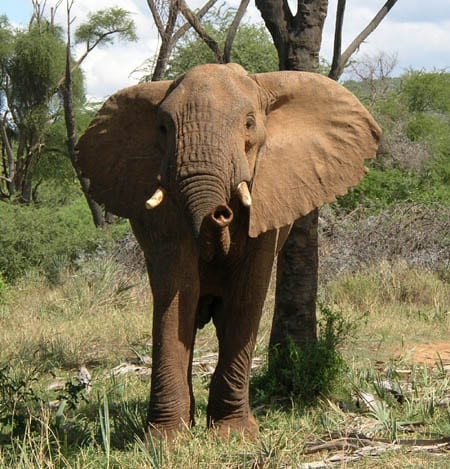
Please read this IMPORTANT message below from Kristal Parks, founder of Pachyderm Power! She is doing a powerful demonstration in front of the Chinese embassy in Washington, DC. from 19-28 June, in order to drive home the message that the Chinese lust for ivory is decimating elephant populations. Please support her in any way you can. Start by spreading this message far and wide.
Make sure you tell everyone you know that ivory is an unnecessary item, but one that causes the painful deaths of thousands of elephants – leaving their babies orphaned. Tell them that Tagua Nut, from a tree, is also carvable and makes for beautiful trinkets.
Thanks,
Val
Val Traina
vtraina2002@yahoo.com
“Only when the last tree has died, the last river has been poisoned and the last fish has been caught, will we realize that we cannot eat money.” Cree Indian Proverb

June 19-28, 2013
Dear Elephant Friend,
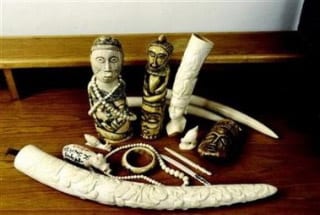
Elephants are killed for the ivory to make the carvings as shown below, sold openly in the United States. Which brings this thought to mind: Why the hell is the US allowing the importation of these items? We may not be able to tell the Chinese what to do but we can certainly do something right here at home.—The Editors
Thank you for caring about elephants!
I want to let you know that I will be doing a water only Hunger Strike in front of the Chinese Embassy in Washington DC from June 19 to the 28th. Here is the information and reasons for it…
Hunger Strike to Save Elephants
Chinese Embassy, Washington DC, June 19-28, 2013
When you love something with all your heart, you will do anything and everything in your power to protect and save it.
That is how I feel about the magnificent, incredible, noble Elephant.
The wise, indigenous tribes I work with in Kenya, tell me that if elephants go extinct, we humans will lose our souls and go crazy. I can not bear the thought of a world without the majestic Elephant… so much like us in their emotional and family lives: loving and caring of each other; mourning the death of a friend; celebrating, with loud trumpeting, the birth of a 200 pound baby.
When you want something with all your heart, you will do whatever it takes to get it… sell your house, quit your job, move to far away places. In my case, it means taking on the personal suffering of a water only Hunger Strike to get the world’s attention.
WAKE UP WORLD!!! Elephants are now tumbling over the cliff into the abyss of extinction. Soon to be gone forever. Forever.
Why? For trinkets. Those things that collect dust on a table. Or, which are used to hold a cigarette! OMG, we have indeed gone crazy, killing about 100 elephants a day for greed and status. The African continent is now a bloody killing field of elephants to supply the Chinese market for ivory. We humans must rise above such blasphemy.
So… I will be present in front of the Chinese Embassy in Washington DC for 10 days where I will undergo a water only Hunger Strike. Additionally, I will hand deliver petitions to the Chinese ambassador (or his representative) and do a powerful ritual with ivory trinkets that people have sent me to use for this purpose.
I hope, with all my heart, that you will use my Hunger Strike to educate all your friends about the plight of elephants. Don’t let me go hungry for nothing! 🙂
I know that Love is stronger than the dark forces of hate, ignorance and destruction. We triumph in our efforts to save the Elephant Nation when we align ourselves with this power of Love. Won’t you join us?!
To get the latest news about the Hunger Strike: “Like Us” on Face Book at: https://www.facebook.com/PachydermPower
This Campaign is Expensive! We’d love your financial support, which you can give by:
1. Support us on line by clicking: HERE
2. If you don’t like doing it on line, you can call us with your credit card information: 1-303-571-0801
3. Send a check, payable to Kristal Parks (preferred) or Pachyderm Power! to:
Pachyderm Power!
% Kristal Parks
1620 Utica St.
Denver, CO 80204
Note: I take no salary from your financial support, so every penny goes to the work!
THANK YOU!!!
Email us at: KristalParks2@gmail.com
Kristal Parks, M.A.
KristalParks@earthlink.net
303-571-0801
____________
ABOUT KRISTAL PARKS
Kristal Parks is an activist — of a different order. She has shared life and struggles with Mayan Indians in Guatemala, Hmong refugees in Thailand and women in American prisons. She resisted nuclear weapons proliferation for 10 years, was arrested often and imprisoned in solitary confinement.
Now she also has the challenging adventure of being an advocate for her disabled brother.
But her deepest passion is as a voice for animals, especially elephants. She aspires to live a cruelty free lifestyle as a vegan.
From The Washington Park Profile, a monthly newspaper:
As Activist Or Clown, She Carries a Message of Hope
by Susan Dugan
 Long-time Denver activist Kristal Parks sits down and points to a photograph of a young Guatemalan girl. “My activism has always had a child component to it,” she explains. Take for example this child, Alejandra. Besides actions that included 10 years resisting nuclear weapons production at Rocky Flats, Parks spent time in Guatemala in the 1980s providing 24-hour protection for the girl and her activist mother to help stem the tide of “disappearing” Guatemalan citizens.
“They had a civil war for a very long time, and people were just disappearing off the street,” she says. “So the local people founded an organization to try to deal with the problem, but it’s against the law to organize like that. So the leaders of the organization (people like Alejandra’s mother) were in really great danger of losing their lives.”
Parks and other Peace Brigade International volunteers intervened by creating a visible international presence. “My job was to walk on the side of the sidewalk next to the street because when you disappear, somebody just comes around a corner and grabs you.” To protect her charges she’d sit on the outside at restaurant tables and behind them in movie theatres. Each day she’d accompany Alejandra to school and wait for her at the front gate.
Did she fear for her life? “Yes,” she says. “But my feeling was if anybody tried to harm her, they were going to have to kill me. Because it wasn’t right. And it was an incredible opportunity to use my class, my education, my nationality, my American looks to save another person’s life.”
The daughter of an American diplomat, Parks, who moved to Mexico at seven and to Spain at 12, considers herself culturally bilingual. “When I went back to Guatemala, it was like going home because the cultures are so similar,” she says. She also credits her early experience in Mexico with igniting her revolutionary spirit.”I became very aware of poverty and prejudice and injustice at a young age, she says. “My family lived in a nice big house, and we had servants, and there was a vacant lot next to me with people living in cardboard houses, and I began to ask questions. I have always felt responsible to act on what I know.”
By the time she graduated from California State LA with a degree in pre-med, that sense of responsibility began to take a strong spiritual and social turn. Her husband at the time had begun to get involved with the anti-nuclear movement in California. She had met Phil and Dan Berrigan, radical Jesuit priests at the forefront of the 1960s peace movement, and was also studying with Black Nationalist Ron Karenga, co-founder of Kwanzaa. “I remember him saying what Martin Luther King taught us is that love and non-violence do not work,” she says. “So I had him offering that on one hand, and people like Dan Berrigan on the other, and I was really asking myself where does my truth lie? I felt that nuclear weapons were really threatening the future of our children, and all life on earth. So I decided to throw myself in with the non-violent camp.”
 She soon put her truth to the test by participating in a series of non-violent “witnesses” at the Lockheed Missile and Space Corporation. “Instead of recognizing your opposition as the enemy, it meant trying to transform the violence within us by witnessing to another way of dealing with problems besides bombing them,” she says.
Her actions carried grave consequences, and she soon found herself facing a possible eight-year jail sentence for trespassing and other more serious charges. Still, she and her co-defendants refused legal counsel because they chose to defend themselves on moral rather than legal grounds. ” I had a lawyer friend who volunteered to defend me and said I could get eight years,” she recalls. “I went to meet with her in jail, and there was a newspaper sitting out there with a picture of two swans swimming on the front page. I asked myself if those swans were worth eight yeas of my life, and I decided they were.”
She defended herself and ended up with only a 60 day sentence. “I wanted to speak profoundly and not have a lawyer get me off on a technicality,” she says. “That was freedom. They told me the judge had tears in his eyes.”
By the time Parks came to Rocky Flats as part of the non-violent resistance movement in December 1981, she had further honed her moral and spiritual beliefs. “We went in on Christmas day in a witness of prayer,” she says. “For me it is important where you pray. Praying at facilities of war gives your prayer a different kind of power and climbing over the fence in order to pray is saying I don’t accept this boundary to my conscience.”
The law, of course, has a different viewpoint. Parks found herself again jailed and eventually ended up spending 4½ months in solitary confinement. “I refused to cooperate because if I’m resisting that which is the cause of suffering outside the jail, I’m going to continue to resist it inside,” she says. “I felt they could break me physically and emotionally, but my soul was the one thing they could not touch. So I followed my conscience and accepted the consequences. I have claustrophobia, so it was really psychological torture to be in a five-by-eight cell.”
How did she survive it? She credits her spiritual training that draws on “the wisdom traditions, East and West. I’m most drawn to the contemplative Christian tradition and Zen Buddhism.”
 She spent time meditating at St. Benedict’s monastery in Snowmass before and after every action. And she studied extensively with exiled Vietnamese Zen Master Thich Nhat Hanh. “I used to say for however much time you spend in jail, you should spend an equal amount of time in a monastery, purifying your motives, taking down barriers that separate you from others.”
These days she’s still helping tear down barriers. Motivated by difficulties she’s experienced helping her recently disabled brother receive entitled benefits, she’s become a champion for the disabled. And she’s transformed herself again, this time into a children’s entertainer, playing characters, including a fairy, an angel, a magician, and a clown. “And I thought if I could be clear, centered and motivated by love, I could be a benefit to children.”
She performs at street fairs, in venues such as the Children’s Museum, and at private birthday parties. “I wanted to invite all of us to care for the earth, so I developed my one-woman show called The Enchanting Wonders of Nature. It uses humor, comedy and fantasy to educate. A caterpillar turns into a butterfly. It’s a metaphor for all our lives. No matter how much we’re crawling on the ground there is the hope of wings.”
A VOICE FOR ANIMALS
Gandhi said: “There is no beauty in a garment that causes suffering”. The fur industry tortures and kills 4 million animals a year for vanity and greed. Kristal reminds people of this atrocity once a week at a fur store where she hands out leaflets and holds a protest sign.

 BE AN ANGEL: DON’T WEAR FUR PROTEST
“Re-Enchanting the World” is dedicated to preserving elephants and to protect them from the abuse and cruelty of circuses, other forms of entertainment and poaching.


4 comments
The Chinese consume more than ivory… China is the only nation on earth where live roasted dog meat is a gourmet food; where 16 million dogs a year are killed for their flesh in legal slaughter facilities, where live bears are kept in cages so small, they can only stand so that bile may be drained from the bodies several times a day: a procedure so painful they scream; where live monkeys have their skulls bashed in so that their brain meat is fresh, where dogs are skinned alive for their fur to be used as trim, where 50,000 dogs were electrocuted and beaten to death in one week during one of the many culls.
A number of years ago, while I was working on the dog meat issue in east asian countries, with korea, vietnam and china the worst offenders, a letter from a woman in belgium noted that the chinese are a greater more deranged and a greater threat than alqaeda. She had a point. As brutal as it is alquaeda is a political organization fighting a perceived injustice. In China the systematic sadism towards animals is culturally endorsed and approved in China, often in the effort to produce the tastiest meat possible.
As western humane organizations attempt to infiltrate china, the culls are less noisy, the lessons of dominion have been introduced. It is now possible to kill 50,000 dogs a week silently, behind closed doors, as is the method preferred by judeo.christian nations. As western organizations encourage the release of the ‘bile bears’ to sanctuaries, the chinese have learned the lessons of saving face. An antiquated bile bear farm was closed and the bears sent to a face saving sanctuary. Most of the bears were so depleted from their ordeal, they died on route. True to the code of greed and sadism, another larger more ‘modern’ bear bile farm, far more efficient as torture was opened. With the illusion of a sanctuary, the number of bears in this gruesome trade increased. Such is the nature of keeping up appearances with even greater profit as bear bile is canned and shipped throughout asia
It will take a thorough and large scale boycott to end chinese pathology… Each one of us must begin now. Every item purchased that is not made in china (and korea or vietnam) is a step towards ending the most vicious sadism on earth. Pet products would be the first item on any boycott list, as china earns billions from this lucrative business, as it viciously kills the domestic animals we cherish: the dog and cat. If you must buy something made in china be sure it is from a second hand store, so that there are no profits to china from the purchase.
China and western nations, steeped in the rhetoric of dominion, would do well to learn from India, where it is always against the law to kill a healthy or treatable dog, for any reason, where ALL the ‘dancing bears’ have been released from servitude and sent to true sanctuaries created for the benefit of the bears, not as a means of creating an illusion of compassion.
In India animals have a chance of surviving the wrath of cultural and religious ignorance and cruelty so prevalent in china and western nations.
In India the elephant is a sacred animal, where there are many laws and traditions in place for protecting them. In western nations elephants remain legally imprisoned in zoos and are forced to perform unnatural acts in circuses. China, where no animal except for the panda is sacred, sends out its poacher hit men in the never ending quest for ivory. If there were no multimillion dollar contracts for renting pandas to foreign zoos, panda bear rugs would soon be flooding the market.
The following is a sampling of the care, protection and respect for elephants in India.:
A number of laws have recently been passed in India to protect elephants:
The most significant and broadsweeping of these laws benefitting elephants frees ALL elephants them from their bondage in circuses and zoos: “All elephants living in Indian zoos and circuses will be moved to wildlife parks and game sanctuaries where the animals can graze more freely, officials at Indian’s Central Zoo Authority announced earlier this month.” November 2009 (see website: http://www.ohmidog.com/2009/11/25/india-to-free-zoo-and-circus-elephants/)
Another provision to protect elephants grants them the status of a ‘national heritage animal’. This provides a high level of awareness to insure their safety: “Indian authorities have now decided to declare the elephant its “national heritage animal” and to afford it the same level of protection as bestowed upon the mighty tiger. “We need to give the same degree of importance to the elephant as is given to the tiger in order to protect the big animal,” said the Environment minister, Jairam Ramesh.” Independent, UK see: http://www.independent.co.uk/environment/nature/indias-elephants-finally-given-same-protection-as-tigers-2068106.html
Yet another measure to protects elephants, this one, from illness, was enacted in Tamil Nadu. Though the measure will result in less income for human beneficiaries, the health of the elephants was valued above the right of those who would exploit them: “Forest officials in the southern Indian state of Tamil Nadu have asked temple custodians to stop their elephants from blessing Hindu pilgrims. Their concern is that the practice could be damaging the more than 50 elephants kept in Hindu temples. The elephants are routinely forced to touch the heads of pilgrims with their trunks as a form of blessing. But officials say the practice could be putting the animals at risk of tuberculosis.” BBC News: http://www.bbc.co.uk/news/world-south-asia-10861832
mahoots: a tradition of cooperation:
In addition to effective legislation, there is an indian tradition which respects the human-elephant bond. In this tradition a person, called a mahoot, works and lives with an elephant on a one to one basis. Often they bond for life. Their relationship is based on mutual trust and respect. If the bond is broken it can be devastating for both. Though there may be some mahoots who violate this trust, this does not negate the value of this institution as a valid and humane way of working with elephants. For the majority this relationship is, based on mutual respect. not domination. As such it is a profound reflection of ahimsa:
“Elephants have been domesticated in the N.E. India since time immemorial and both the elephant and the mahout have become a part of the folklore and the folksongs. Stories of brave and expert phandis (noosers) and mahouts are passed on from generation to generation. In the rural Assam mahouts are looked upon with awe and admiration. Once a captive elephant is weaned at the about the age of three, it begins life as a domesticated elephant under the care of its keeper or mahout. Other than its mother, the mahout is the next most important influence in the elephant’s life. A mahout traditionally is a highly experienced and knowledgeable individual with excellent elephant rearing skills. A mahout must have an intimate understanding of his particular elephant and develop a bond of trust and affection that allows him to control the animal with simple verbal commands and touch. A family that has kept elephants for generations passes the critical knowledge and skills needed from one generation to the next. An elephants is treated as part of the family. Just as children are born into a family, so too are elephants. A young boy will grow up with a baby elephant and together they will develop a lifetime bond based on trust and affection. Elephants are very loyal to their mahouts and they are often associated with supernatural powers because they control such a big animal. Ideally, this relationship will not end until either the elephant is sold or the mahout dies. Many mahouts will spend up to 26 days out of the month with their elephant and the remainder with his family.” (see: http://www.honoluluzoo.org/indian_elephant.htm)
kunkis
Rather than kill rogue elephants, who number in the thousands and have destroyed villages and human lives, a method has been developed which uses tame elephants to intercept their rogue cousins. Because there is a foundation and a precedent for cooperation with elelphants in India, this new technique for controlling free roaming rogue elephants has been implemented. They are not shot or incarcerated and disciplined with bull hooks or electric shock. It is understood that the elephant is an intelligent being who communicates with others of his/her kind. Based on this understanding they have enlisted domesticated, tame elephants (kunkis) to coach their rogue cousins on how to behave more responsibly: http://news.bbc.co.uk/2/hi/south_asia/4201642.stm
villagers
The following is an example of poor Indian villagers rescuing an elephant from a well: http://news.bbc.co.uk/cbbcnews/hi/newsid_4510000/newsid_4511700/4511795.stm
Villagers have battled to save a baby elephant which fell down a well.
The baby had slipped off soaked fields in the small Indian village of Illithodu, and fell down a 10-metre deep well and couldn’t get out.
Locals heard its mother running around at night, frantically calling for other elephants to help her. Many animals did come but they couldn’t rescue it.
Villagers eventually saved the little beast by digging a slope into the well and helping the baby walk out.
A Parable for Our Times…
A long time ago a young man set out to find the truth…after walking for several days he met someone who might know the answer. He asked ‘where can I find the truth?” He was told ‘truth lives on the mountain that you can see’ So he set out to find the truth…He reached the mountain and found a beautiful woman sitting there peacefully. “Ah,” he said, “so you must be the truth” She replied that she was not, but that he had to go to a higher more distant mountain. So he walked on for weeks. Finally he reached this destination and found a another even more beautiful woman…Now he was certain that he had found truth…He asked if she was truth. She replied that she was not and that he must travel even further to a higher and more distant mountain. After months of travel and a very difficult and dangerous climb to the top he found a wizened old woman. He was confused, but he asked anyway. “Are you truth” She replied, “yes, I am, but dont tell anyone”.
“In times of universal deceit, telling the truth becomes a revolutionary act.” – George Orwell, 1984
In times of universal deceit some truths are still taboo.
“It is the essential characteristic of a wise person that he/she does not kill any living being.
One should know that non-killing and equality of all living beings are the main principles of religion”
Jain sutra
“I have always felt responsible to act on what I know.” Kristal Parks
Dear Kristal,
It was noted in the Greanville Post in this article that:
‘She [Kristal] credits her spiritual training that draws on “the wisdom traditions, East and West. I’m most drawn to the contemplative Christian tradition and Zen Buddhism.”
She spent time meditating at St. Benedict’s monastery in Snowmass before and after every action. And she studied extensively with exiled Vietnamese Zen Master Thich Nhat Hanh. “I used to say for however much time you spend in jail, you should spend an equal amount of time in a monastery, purifying your motives, taking down barriers that separate you from others.’
https://www.greanvillepost.com/2013/06/15/alert-hunger-strike-to-protest-chinese-consumption-of-ivory/
There is no doubt that you are a remarkable, courageous person, capable of understanding the implications of violence in its various forms to animals and humans. This is exactly why I was concerned to learn that you credit your spiritual training to “the wisdom traditions, East and West. I’m most drawn to the contemplative Christian tradition and Zen Buddhism.”
Given that you understand that the suffering of animals is no different than the suffering of humans, how is it possible for you to reconcile your values with the belief system of the semitic religions: judaism, christianity and islam? Dominion, the very foundation of this tradition is based on a hierarchy that subjugates animals to slaughter and exploitation in the name of human supremacy. This premise is endorsed by the St Benedictine Monastery, where you sought spiritual healing from exposure to the brutality of prison. The accepted diet for a St Benedictine Monastery includes:
FOOD AND DRINK AT A BENEDICTINE MONASTERY
Though the Rule of St. Benedict proscribes the eating of meat, fish is eaten at all Benedictine houses, and some inmates partake of lard and the flesh of birds as well. Child novices may be allowed the full range of meat dishes, and the head of a house may well have the flesh of pigs, deer, or other animals at his or her table. Obedientiaries frequently eat whatever they wish while travelling, and even when they are within the conventual walls, they may take their meals with the guests of the house and indulge in foods not found in the refectory [70]. Though their diets are more restricted, cloistered monks and nuns also enjoy a variety of dishes in many Benedictine communities. Quantities are often generous, and pittances are common additions to the daily meals. Feast days feature elaborate banquets, with ten or more courses served in the refectories of the wealthiest houses on important holidays. Ale is the usual beverage, or wine if the community can afford it. Mead may be served on special occasions [71]. The customary drink in the refectory in the afternoon during the summer and in the evening in winter sometimes includes light bread or cakes [72].http://www.aedificium.org/MonasticLife/BenedictineOrder.html
In other words, the higher one is in the religious hierarchy, the more likely one is to consume the flesh of many animals. While A Benedictine Monastery is likely in a scenic location, since most of the best land was appropriated from the peasantry, it is hardly a suitable venue for contemplating compassion, peace and justice for all.
Are you familiar with the Jain tradition of India. It is a religiously based community that has embraced the tenets of non-violence, known as ahimsa, for thousands of years by prohibiting meat, leather, fur and silk. Though a small percent of the population, jains have had significant influence on implementing compassion for animals. Jains were historically the first to set up shelters, where injured animals were treated and released, as confining animals violates their right to freedom. To this very day, Jains exert their influence on Indian animal law, which is broad-based, comprehensive and compassionate. If you are familiar with the writings and work of Mahatma Gandhi, then you have an idea of the influence of ahimsa on politics. Prior to embarking on the campaign to liberate India from british occupation, Gandhiji conferred with Jain scholar, Shrimad Rajchandra, to better understand jain doctrine as a basis for protest.
To better understand jain doctrine as a basis for animal compassion consider the following sutras:
“All things breathing, all things existing, all living beings whatever, whould not be slain or treated with violence, or insulted, or tortured or drven away. This is the pure unchanging eternal law, which the wise ones who know the world have proclaimed…” Jain Acharanga Sutra
“If thinking to gain praise, honor or respect,…a man who sins against earth or causes or permits others to do so…he will not gain joy or wisdom…tyrany to the earth is like striking , cutting or maiming a blind man…Knowing this a man should not sin agaonst earth or cause or permit others to do so. He who understands the nature of sin against earth is called a Sage.” Jain Acharanga Sutra
“All beings with two, three, four or five senses in fact, all creation know individually pleasure and displeasure, pain, terror and sorrow. ALL are full of fears which come from all directions. And yet there exist people who would cause greater pain to them…Some kill animals for sacrifice, some for their skin, flesh, blood, feathers, teeth or tusks;…Some kill them intentionally and some unintentionally. Some kill because they have been previously injured by them…and some because they expect to be injured. He who harms animals has not understood or renounced deeds of sin…He who understands the nature of sin against animals is called a Sage.” Jain Acharanga Sutra
If these sutras are consistent with your beliefs, then is it possible to state that the mandate of genesis is similar in intention? As you are well aware the ravages to animals seen daily in judeo.christian nations are a direct result of religious doctrine that excuses animal abuse as a right granted to man as follows:
“Genesis 9:1-3 is the most significant Biblical text supporting the Christian tradition of eating meat: “God blessed Noah and his sons, and said to them: ‘Be fruitful and multiply and fill the earth. The fear and dread of you shall rest on every animal of the earth, and on every bird of the air, on everything that creeps on the ground, and on all the fish in the sea; into your hand they are delivered. Every moving thing that lives shall be food for you; and just as I gave you the green plants, I give you everything.’ ”
Having been born into one of the semtic religions, based on what I know of the cruelty of that tradition, I opted out of dominon. All faiths are not equal.Acting on what I know I left my birth religion of judaism to free myself from the brutality of dominonist doctrine. If I were christian I would do the same. Compassion for animals is not possible in a tradition that sanctifies their subjugation to man.
Living in a dominion rooted culture takes its toll on one’s spirit. In an effort to undo this harm and heal from it, I have found spiritual peace as part of a Jain community, where I attend pujas and other observances, away from the violence of the semitic religious tradition. To the best of my knowledge Jainism is the only religion that has maintained a successful effort to live free from violence to both animals and humans.
While it is not necessary to be a Jain to live by ahimsa, it is impossible to remain in or praise a semitic religion then expect compassion for animals.
Respectfully,
Ruth Eisenbud