
NOTE: THIS IS AS REPORTED BY THE NEW YORK TIMES, THE PAPER OF RECORD FOR THE US POWER ELITES.
For that reason, we reproduce the document in its entirety. As noted below, it is however packaged in the way The Greanville Post readers are accustomed to.

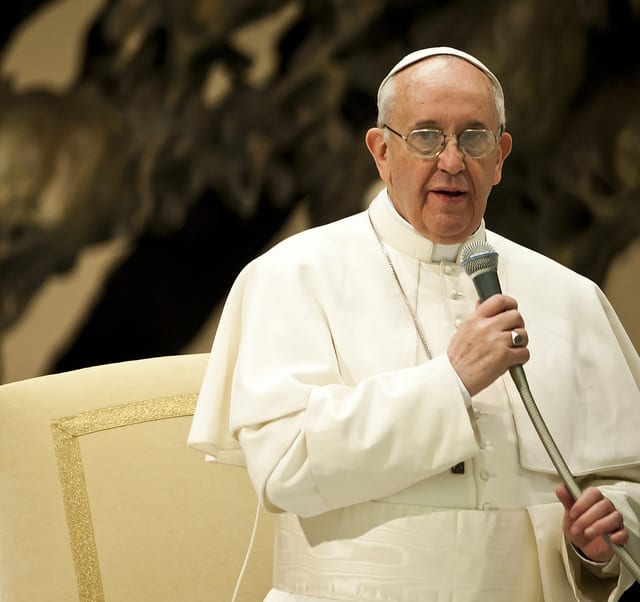
Pope Francis was greeted by crowds at St. Peter’s Square this week. CreditFilippo Monteforte/Agence France-Presse — Getty Images
VATICAN CITY —
[dropcap]P[/dropcap]ope Francis on Thursday called for a radical transformation of politics, economics and individual lifestyles to confront environmental degradation and climate change, as his much-awaited papal encyclical blended a biting critique of consumerism and irresponsible development with a plea for swift and unified global action.
The vision that Francis outlined in the 184-page encyclical is sweeping in ambition and scope: He described a relentless exploitation and destruction of the environment, for which he blamed apathy, the reckless pursuit of profits, excessive faith in technology and political shortsightedness. The most vulnerable victims are the world’s poorest people, he declared, who are being dislocated and disregarded.
The first pope from the developing world, Francis, an Argentine, used the encyclical — titled “Laudato Si’,” or “Praise Be to You” — to highlight the crisis posed by climate change. He placed most of the blame on fossil fuels and human activity while warning of an “unprecedented destruction of ecosystems, with serious consequence for all of us” if swift action is not taken. Developed, industrialized countries were mostly responsible, he said, and were obligated to help poorer nations confront the crisis.
“Climate change is a global problem with grave implications: environmental, social, economic, political and for the distribution of goods,” he wrote. “It represents one of the principal challenges facing humanity in our day.”
The Vatican released the encyclical at noon on Thursday, following a heavily attended news conference and amid widespread global interest. Vatican officials were infuriated after an Italian magazine on Monday posted a leaked draft of the encyclical online — one that almost exactly matched the final document. The breach led to speculation that opponents of Francis inside the Vatican wanted to embarrass him by undermining the planned rollout.
But on Thursday, religious figures, environmentalists, scientists, elected officials and corporate executives around the world were awaiting the official release of the encyclical, with many of them scheduling later news conferences or preparing statements to discuss it. Media interest was enormous, partly because of Francis’ global popularity, but also because this was the first time that a pope had written an encyclical about environmental damage — and because of the intriguing coalition he is proposing between faith and science.
“Humanity is faced with a crucial challenge that requires the development of adequate policies, which, moreover, are currently being discussed on the global agenda,” Cardinal Peter Turkson said during the morning news conference at the Vatican. “Certainly, Laudato Si’ can and must have an impact on important and urgent decisions to be made in this area.”
In the news conference, Cardinal Turkson said that Francis had already noted that humanity had played a role in climate change. He said that there was “heated debate” on the topic and that Francis was not trying to intervene in that.
Francis has made clear that he hopes the encyclical will influence energy and economic policy and stir a global movement. He calls on ordinary people to pressure politicians for change. Bishops and priests around the world are expected to lead discussions on the encyclical in services on Sunday. But Francis is also reaching for a wider audience when in the first pages of the document he asks “to address every person living on this planet.”
Metropolitan John Zizioulas of Pergamon says that the environmental crisis is a “spiritual problem,” during a news conference on Thursday about Pope Francis’ encyclical on climate change. (By Reuters on Publish Date June 18, 2015. )
Even before the release, Francis’ unflinching stance against environmental destruction, and his demand for global action, had already thrilled many scientists. In recent weeks, advocates of policies to combat climate change have expressed hope that Francis could lend a “moral dimension” to the debate, because winning scientific arguments was different from moving people to action.
“Within the scientific community, there is almost a code of honor that you will never transgress the red line between pure analysis and moral issues,” said Hans Joachim Schellnhuber, founder and chairman of the Potsdam Institute for Climate Impact Research and a leading European climate scientist. “But we are now in a situation where we have to think about the consequences of our insight for society.”
Yet Francis has also been sharply criticized by those who question or deny the established science of human-caused climate change and also by some conservative Roman Catholics, who have interpreted the document as an attack on capitalism and as unwanted political meddling at a moment when climate change is high on the global agenda.
Governments are now crafting domestic climate change plans before December’s United Nations summit meeting on climate change in Paris. The goal of the meeting is to achieve the first sweeping global accord in which every nation on earth would commit to enacting new policies to limit greenhouse gas emissions. Many governments have yet to present plans, including major emitters like Brazil, which also has a large Catholic population. The encyclical is seen as an unsubtle nudge for action, even as it provides support for leaders faced with tough choices in countries with large numbers of Catholics.
“It gives a lot of cover to political and economic leaders in those countries, as they make decisions on climate change policy,” said Timothy Wirth, vice chairman of the United Nations Foundation.
Catholic theologians say the overarching theme of the encyclical is “integral ecology,” which links care for the environment with a notion already well developed in Catholic teaching — that economic development, to be morally good and just, must take into account the need of human beings for things such as freedom, education and meaningful work.

[learn_more]
On Planet in Distress, a Papal Call to Action
By LAURIE GOODSTEIN and JUSTIN GILLIS JUNE 18, 2015
 Pope Francis has written the first papal encyclical focused solely on the environment, attempting to reframe care of the earth as a moral and spiritual concern, and not just a matter of politics, science and economics. In the document, “Laudato Si: On Care for Our Common Home,” he argues that the environment is in crisis – cities to oceans, forests to farmland. He emphasizes that the poor are most affected by damage from what he describes as economic systems that favor the wealthy, and political systems that lack the courage to look beyond short-term rewards. But the encyclical is addressed to everyone on the planet. Its 184 pages are an urgent, accessible call to action, making a case that all is interconnected, including the solutions to the grave environmental crisis. Pope Francis’ Encyclical “Laudato Si”
PARAGRAPH 3
“More than fifty years ago, with the world teetering on the brink of nuclear crisis, Pope Saint John XXIII wrote an Encyclical which not only rejected war but offered a proposal for peace. He addressed his message Pacem in Terris to the entire ‘Catholic world’ and indeed ‘to all men and women of good will.’ Now, faced as we are with global environmental deterioration, I wish to address every person living on this planet.”
LAURIE GOODSTEIN, RELIGION REPORTER: By invoking “Pacem in Terris,” or “Peace on Earth,” one of the most famous encyclicals ever issued and one addressed to the world, Pope Francis is making it clear he wants his document to be a historic watershed.
PARAGRAPH 6
“My predecessor Benedict XVI likewise proposed ‘eliminating the structural causes of the dysfunctions of the world economy and correcting models of growth which have proved incapable of ensuring respect for the environment.’ ”
LAURIE GOODSTEIN: Francis repeatedly relies on the words of his predecessors, Benedict XVI and John Paul II, now Saint John Paul, to establish that he is hardly the first pope to be critical of economic systems that exacerbate inequality, or of the unchecked extraction of natural resources.
PARAGRAPH 14
“Young people demand change. They wonder how anyone can claim to be building a better future without thinking of the environmental crisis and the sufferings of the excluded.”
JUSTIN GILLIS, SCIENCE REPORTER: Here Pope Francis acknowledges the sharp divide on environmental issues between young people and their elders, with the most urgent demands for change coming from college students and other young people. It is, of course, young people who have the most at stake, since they will inherit a world of intensifying environmental problems. This is also an early nod to a theme he will develop later in the document: the connections between environmental destruction and poverty.
PARAGRAPH 21
“The earth, our home, is beginning to look more and more like an immense pile of filth. In many parts of the planet, the elderly lament that once beautiful landscapes are now covered with rubbish. Industrial waste and chemical products utilized in cities and agricultural areas can lead to bioaccumulation in the organisms of the local population, even when levels of toxins in those places are low. Frequently no measures are taken until after people’s health has been irreversibly affected.”
JUSTIN GILLIS: Here Francis begins to spell out a litany of specific environmental issues that concern him. One remarkable aspect of the encyclical is that it focuses broadly on what he calls “the ecological crisis,” and not just on a single aspect like pollution or global warming. The pope is concerned about all the ways humanity is damaging the planet, and how that environmental assault is returning like a boomerang to harm humanity itself.
PARAGRAPH 22
“But our industrial system, at the end of its cycle of production and consumption, has not developed the capacity to absorb and reuse waste and by-products. We have not yet managed to adopt a circular model of production capable of preserving resources for present and future generations, while limiting as much as possible the use of non-renewable resources, moderating their consumption, maximizing their efficient use, reusing and recycling them.”
JUSTIN GILLIS: Francis is alluding here to what many experts believe will be the great economic challenge of the 21st century: improved efficiency in using resources. Whole books have been devoted in recent years to the need to reduce waste and produce more with less, and doing so has become an increasing focus for many of the world’s leading businesses.
PARAGRAPH 23
“A very solid scientific consensus indicates that we are presently witnessing a disturbing warming of the climatic system. In recent decades this warming has been accompanied by a constant rise in the sea level and, it would appear, by an increase of extreme weather events, even if a scientifically determinable cause cannot be assigned to each particular phenomenon. Humanity is called to recognize the need for changes of lifestyle, production and consumption, in order to combat this warming or at least the human causes which produce or aggravate it. It is true that there are other factors (such as volcanic activity, variations in the earth’s orbit and axis, the solar cycle), yet a number of scientific studies indicate that most global warming in recent decades is due to the great concentration of greenhouse gases (carbon dioxide, methane, nitrogen oxides and others) released mainly as a result of human activity.”
LAURIE GOODSTEIN: Much of the controversy preceding the encyclical in the United States has been focused on this point: Would Francis take a position on whether climate change is human-induced. Any suspense is now over: He has, citing scientific studies. PARAGRAPH 24 “If present trends continue, this century may well witness extraordinary climate change and an unprecedented destruction of ecosystems, with serious consequences for all of us. A rise in the sea level, for example, can create extremely serious situations, if we consider that a quarter of the world’s population lives on the coast or nearby, and that the majority of our megacities are situated in coastal areas.”
JUSTIN GILLIS: As he does at several other points in his document, Pope Francis here puts himself firmly on the side of mainstream climate science and its analysis of the risks of global warming. “May” is a crucial word; scientists are not certain these things will happen, but they believe the possibility is too high to discount or ignore, and that the only way to reduce the risk is to reduce emissions of greenhouse gases. In this passage, Francis cites one of the gravest risks, an accelerating rise in sea levels that could ultimately inundate many of the world’s great cities, though scientists say the worst effects might not occur until the 22nd or 23rd centuries.
PARAGRAPH 44
“Nowadays, for example, we are conscious of the disproportionate and unruly growth of many cities, which have become unhealthy to live in, not only because of pollution caused by toxic emissions but also as a result of urban chaos, poor transportation, and visual pollution and noise. Many cities are huge, inefficient structures, excessively wasteful of energy and water. Neighbourhoods, even those recently built, are congested, chaotic and lacking in sufficient green space. We were not meant to be inundated by cement, asphalt, glass and metal, and deprived of physical contact with nature.”
JUSTIN GILLIS: This is an odd passage that is likely to provoke argument from many urban thinkers. Here the pope assails cities as wasteful and inefficient. Perhaps he has in mind some of the chaotic cities of the developing world, with their great slums and other problems. Yet well-designed and well-run cities are often seen as one of the major answers to environmental problems, with city dwellers often having less of a carbon footprint than the residents of suburbs or rural areas, thanks in part to the availability of public transport. At several later points in the encyclical, the pope does seem to acknowledge this, citing various ways that cities can be improved and can contribute to solving the ecological crisis.
PARAGRAPH 50
“Instead of resolving the problems of the poor and thinking of how the world can be different, some can only propose a reduction in the birth rate. At times, developing countries face forms of international pressure which make economic assistance contingent on certain policies of ‘reproductive health.’ Yet ‘while it is true that an unequal distribution of the population and of available resources creates obstacles to development and a sustainable use of the environment, it must nonetheless be recognized that demographic growth is fully compatible with an integral and shared development.’ To blame population growth instead of extreme and selective consumerism on the part of some, is one way of refusing to face the issues.”
JUSTIN GILLIS: Some demographers will undoubtedly argue that in this passage, it is the pope who is refusing to face the issues. Many experts regard rapid population growth as damaging to the local environment and to the lives of people in poor countries. It is also true, however, that the linkage between high population growth and global warming is often overstated. The two areas of the world that continue to have high growth, sub-Saharan Africa and southern Asia, are also impoverished areas with low emissions of greenhouse gases.
LAURIE GOODSTEIN: The church teaches that according to what is known as “natural law,” sex must be open to procreation and artificial contraception is a sin. Francis has certainly reinforced that doctrine here. Despite his off-the-cuff comment this year that Catholics must not feel compelled to breed “like rabbits,” he is rejecting birth control and the notion that population growth is a major contributor to environmental problems. Catholic traditionalists had warned that Francis was forming dangerous alliances with environmentalists who promote population control; it will be interesting to see if this passage addresses their concerns.
PARAGRAPH 67
“We are not God. The earth was here before us and it has been given to us. This allows us to respond to the charge that Judaeo-Christian thinking, on the basis of the Genesis account which grants man ‘dominion’ over the earth (cf. Gen 1:28), has encouraged the unbridled exploitation of nature by painting him as domineering and destructive by nature. This is not a correct interpretation of the Bible as understood by the Church. Although it is true that we Christians have at times incorrectly interpreted the Scriptures, nowadays we must forcefully reject the notion that our being created in God’s image and given dominion over the earth justifies absolute domination over other creatures. The biblical texts are to be read in their context, with an appropriate hermeneutic, recognizing that they tell us to ‘till and keep’ the garden of the world (cf. Gen 2:15). ‘Tilling’ refers to cultivating, ploughing or working, while ‘keeping’ means caring, protecting, overseeing and preserving. This implies a relationship of mutual responsibility between human beings and nature.”
LAURIE GOODSTEIN: Francis here is taking to task those Christians and churches that interpret the reference in Genesis to humans taking “dominion” over the earth as a license to exploit and deplete natural resources. He is trying to substitute a different notion of the relationship between humans and creation: that of “tilling” and “keeping.”
PARAGRAPH 168
“Among positive experiences in this regard, we might mention, for example, the Basel Convention on hazardous wastes, with its system of reporting, standards and controls. There is also the binding Convention on international trade in endangered species of wild fauna and flora, which includes on-site visits for verifying effective compliance. Thanks to the Vienna Convention for the protection of the ozone layer and its implementation through the Montreal Protocol and amendments, the problem of the layer’s thinning seems to have entered a phase of resolution.”
JUSTIN GILLIS: In a document that laments the overall lack of progress, the pope is taking pains here to point out some cases that prove that nations can cooperate for the common good. He is citing three of the world’s most successful environmental treaties, including one that limited output of gases that were destroying the ozone layer, which shields the planet from damaging radiation.
PARAGRAPH 171
“The strategy of buying and selling ‘carbon credits’ can lead to a new form of speculation which would not help reduce the emission of polluting gases worldwide. This system seems to provide a quick and easy solution under the guise of a certain commitment to the environment, but in no way does it allow for the radical change which present circumstances require. Rather, it may simply become a ploy which permits maintaining the excessive consumption of some countries and sectors.”
JUSTIN GILLIS: This could be the oddest single passage in the entire encyclical, and it is certain to provoke sharp criticism. In a document that is mostly broad and general, Pope Francis goes out of his way here to condemn a system called cap-and-trade, in which governments limit heat-trapping emissions from businesses, issue permits up to the limit and allow companies to buy and sell those permits, which are sometimes called carbon credits. The system effectively puts a price on pollution from greenhouse gases. If designed properly, this type of system, according to environmental economists, can be one of the best ways to get control of emissions. It is true that Europe, which operates the planet’s largest cap-and-trade system, ran into early problems with loose rules and market manipulation, and has struggled to make repairs. But this type of system is operating effectively in California, the Northeastern United States and some other areas, which had the benefit of studying Europe’s mistakes and avoiding them. Environmental economists are likely to give the pope a serious argument about this passage.
EDITOR’S NOTE: HERE THE NEW YORK TIMES SHOWS ITS DISPLEASURE WITH THE POPE’S INTRANSIGENT DISLIKE OF CAPITALIST SOLUTIONS TO CAPITALISM’S MEGA PROBLEMS. CAPITALISM’S WOUNDS TO THE BIOSPHERE CAN’T BE CURED BY OBSERVING THE SAME BANKRUPT VALUE SYSTEM, THE SAME PLAYBOOK, THAT CREATES SUCH CRISES. BUT THAT IS PRECISELY WHAT THESE CARBON CREDITS ARE ALL ABOUT. A HALF-WAY MEASURE THE CAPITALISTS CAN LIVE WITH, BUT NOT NATURE. AND SOMETHING THE CAPITALIST MEDIA IS MORE THAN WILLING TO ENDORSE AND SELL TO A CONFUSED PUBLIC.
PARAGRAPH 178
“A politics concerned with immediate results, supported by consumerist sectors of the population, is driven to produce short-term growth. In response to electoral interests, governments are reluctant to upset the public with measures which could affect the level of consumption or create risks for foreign investment. The myopia of power politics delays the inclusion of a far-sighted environmental agenda within the overall agenda of governments.”
LAURIE GOODSTEIN: Francis calls on local and national governments to look toward the long term and the common good. He goes on to say that individually and in groups, people can make an impact by organizing and pressuring governments to reorder their priorities. This is an example of Francis aiming to inspire citizens everywhere, and not just Catholics, to take action in their communities. As he says later in the the encyclical, “Unless citizens control political power – national, regional and municipal – it will not be possible to control damage to the environment.” [/learn_more]
Graphic: On Planet in Distress, a Papal Call to Action
“The basic idea is, in order to love God, you have to love your fellow human beings, and you have to love and care for the rest of creation,” said Vincent Miller, who holds a chair in Catholic theology and culture at the University of Dayton, a Catholic college in Ohio. “It gives Francis a very traditional basis to argue for the inclusion of environmental concern at the center of Christian faith.”
He added: “Critics will say the church can’t teach policy, the church can’t teach politics. And Francis is saying, ‘No, these things are at the core of the church’s teaching.’”
Francis has drawn from a wide variety of sources, partly to buttress his arguments, partly to underscore the universality of his message. He regularly cites passages from his two predecessors, Pope John Paul II and Pope Benedict XVI, even as he also draws prominently from his religious ally, Patriarch Bartholomew I of Constantinople, leader of the world’s Eastern Orthodox Christians. He also cites a Sufi Muslim mystic, Ali al-Khawas.
Francis begins the encyclical with a hymn written by St. Francis of Assisi, the 13th-century friar who is the patron saint of animals and the environment. Francis cites the Bible’s book of Genesis to underpin his theological argument, though in a passage certain to rankle some Christians, he chastises those who cite Genesis as evidence that man has “dominion” over earth and therefore an unlimited right to its resources. Some believers have used this biblical understanding of “dominion” to justify practices such as mountaintop mining or fishing with gill nets.
“This is not a correct interpretation of the Bible as understood by the Church,” Francis wrote. The Bible teaches human beings to “till and keep” the garden of the world, he said: “‘Tilling’ refers to cultivating, plowing or working, while ‘keeping’ means caring, protecting, overseeing and preserving.”
His most stinging rebuke is a broad economic and political critique of profit-seeking and the undue influence of technology on society. He praised the progress achieved by economic growth and technology, singling out achievements in medicine, science and engineering. But, he added, “Our immense technological development has not been accompanied by a development in human responsibility, values and conscience.”
Central to Francis’ theme is the linkage between the poor and the fragility of the planet. He rejects the belief that technology and “current economics” will solve environmental problems or “that the problems of global hunger and poverty will be resolved simply by market growth.” He cites finance as having a distorting influence on politics and calls for government action, international regulation and a spiritual and cultural awakening to “recover depth in life.”
Amid the broad themes, Francis also touches on a wide range of specific topics, from urban planning (calling for better neighborhoods for the poor) and agricultural economics (warning against the reach of huge agribusinesses that push family farmers off their land) to conservation and biodiversity (with calls to protect the Amazon and Congo basins), and even offers up small passages of media and architecture criticism.
“A huge indictment I see in this encyclical is that people have lost their sense of ultimate and proper goals of technology and economics,” said Christiana Z. Peppard, an assistant professor of theology, science and ethics at Fordham University in New York. “We are focused on short-term, consumerist patterns, and have allowed technological and economic paradigms to tell us what our values ought to be. ”Encyclicals are letters to clergy members and laity of the church that are considered authoritative papal teaching documents. Catholics are expected to try to sincerely embrace the teaching and moral judgments within. But while broad moral principles are widely considered to be binding, more specific assertions can be categorized as “prudential judgments” — a phrase some critics have invoked to reject Francis’ positions on hot-button issues like climate change or economic inequality.
Many conservatives will be pleased, however, because Francis also included a strong criticism of abortion while also belittling the argument that population control represented a solution to limited resources and poverty. However, he sharply criticized carbon credits — the financial instruments now central to the European Union’s current climate change policy — as a tool that “may simply become a ploy which permits maintaining the excessive consumption of some countries and sectors.”
Above all, Francis has framed the encyclical as a call to action, imbuing environmental protection with a theological and spiritual foundation. He praises the younger generations for being ready for change and said “enforceable international agreements are urgently needed.” He cited Benedict in saying that advanced societies “must be prepared to encourage more sober lifestyles, while reducing their energy consumption and improving its efficiency.”
“All is not lost,” he wrote. “Human beings, while capable of the worst, are also capable of rising above themselves, choosing again what is good, and making a new start.”
[printfriendly]
Remember: All captions and pullquotes are furnished by the editors, NOT the author(s).

