

DISPATCHES FROM STEPHEN LENDMAN

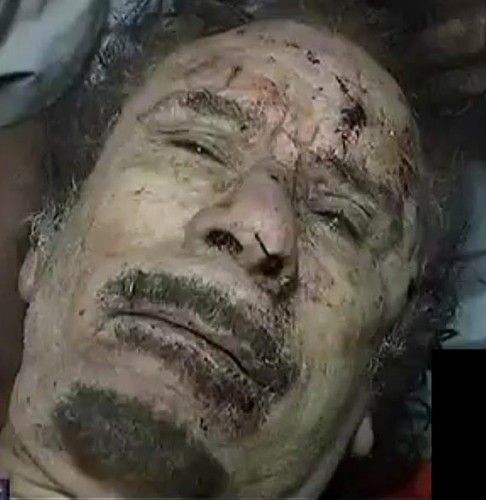
Plain and simply, Gaddafi was murdered like a victim of a mafia hit, all masterminded with the collaboration of Hillary Clinton and the top echelons of the US government.
Her orchestrated naked aggression on Libya had everything to do with “money, banking and preventing African economic sovereignty,” Brown explained. More was involved, discussed in my own articles in October 2011 and February 2016 (drawing on the earlier one), including replacing the Socialist People’s Libyan Arab Jamahiriya (a “state of masses,” sharing the nation’s oil wealth with the people by providing extraordinary social benefits) with Western controlled tyranny.
Brown’s article is important reading, providing more insight into arguably the most unacceptably dangerous presidential aspirant in US history – likely to succeed Obama, given bipartisan efforts to undermine Trump by any means necessary. As secretary of state, Clinton also orchestrated war on Syria, nothing civil about it, one of the many Big Lies about the conflict – naked US aggression by any standard, using ISIS and other terrorist fighters (imported mercenaries from scores of countries) as imperial foot soldiers.
“With Assad gone,” she said, “and Iran no longer able to threaten Israel through its proxies, it is possible that the United States and Israel can agree on red lines for when Iran’s program has crossed an unacceptable threshold.” Naked aggression was her strategy of choice. She called raping Syria, massacring its people and ousting Assad “the right thing” to do. “Washington should start by expressing its willingness to work with regional allies like Turkey, Saudi Arabia, and Qatar to organize, train and arm Syrian rebel forces.”
“The fall of the House of Assad could well ignite a sectarian war between the Shiites and the majority Sunnis of the region drawing in Iran, which, in the view of Israeli commanders would not be a bad thing for Israel and its Western allies…(S)enior Israeli intelligence analysts believe that this turn of events may even prove to be a factor in the eventual fall of the current government of Iran.”
She believed threatening Assad and his family with violent overthrow and death was effective strategy, repeating the scenario leading to Gaddafi’s ouster and sodomized murder. “We came. We saw. He died” in response to his death remains a testimony to her ruthless imperial arrogance, a threat to world peace and security. Her plotting and influence as secretary of state reveals pure evil. Imagine the threat with her as president, her finger on the nuclear trigger. She miscalculated believing Russia wouldn’t intervene in Syria. Her entire scheme proved misguided.
[su_box title=”ABOUT STEPHEN LENDMAN” style=”glass” box_color=”#f3efdf” title_color=”#c40606″]  STEPHEN LENDMAN lives in Chicago. He can be reached at lendmanstephen@sbcglobal.net. His new book as editor and contributor is titled “Flashpoint in Ukraine: US Drive for Hegemony Risks WW III.” ( http://www.claritypress.com/LendmanIII.html ) Visit his blog site at sjlendman.blogspot.com.
Ellen Hodgson Brown is an American author, political candidate, attorney, public speaker, and advocate of alternative medicine and financial reform, most prominently public banking. Brown is the founder and president of the Public Banking Institute, a nonpartisan think tank devoted to the creation of publicly run banks. She is also the president of Third Millennium Press, and is the author of twelve books, including Web of Debt and The Public Bank Solution, as well as over 200 published articles. She has appeared on cable and network television, radio, and internet podcasts, including a discussion on the Fox Business Network concerning student loan debt with the Cato Institute’s Neil McCluskey, a feature story on derivatives and debt on the Russian network RT, and the Thom Hartmann Show’s “Conversations with Great Minds.” Ellen Brown ran for California Treasurer in the California June 2014 Statewide Primary election. Her 300+ blog articles are at EllenBrown.com. Listen to “It’s Our Money with Ellen Brown” on PRN.FM.
[/su_box]
SIDEBAR/ Blog in Blog Special
The Ellen Brown paper. Exposing the Libyan Agenda through Hillary Clinton’s Private Communications. Just click on the bar below.
[su_spoiler title=”Just Click Here for Clinton’s Libyan Agenda: A Closer Look at Hillary’s Emails.” style=”fancy” icon=”arrow-circle-1″]
Posted on March 13, 2016 by Ellen Brown
Critics have long questioned why violent intervention was necessary in Libya. Hillary Clinton’s recently published emails confirm that it was less about protecting the people from a dictator than about money, banking, and preventing African economic sovereignty.
The brief visit of then-Secretary of State Hillary Clinton to Libya in October 2011 was referred to by the media as a “victory lap.” “We came, we saw, he died!” she crowed in a CBS video interview on hearing of the capture and brutal murder of Libyan leader Muammar el-Qaddafi. But the victory lap, write Scott Shane and Jo Becker in the New York Times, was premature. Libya was relegated to the back burner by the State Department, “as the country dissolved into chaos, leading to a civil war that would destabilize the region, fueling the refugee crisis in Europe and allowing the Islamic State to establish a Libyan haven that the United States is now desperately trying to contain.” [The NYTimes itself is lying here, too, of course, as the US has never been “desperately trying to contain ISIS, a monster it created and continues to use cynically to this day.—Eds.]
US-NATO intervention was allegedly undertaken on humanitarian grounds, after reports of mass atrocities; but human rights organizations questioned the claims after finding a lack of evidence. Today, however, verifiable atrocities are occurring. As Dan Kovalik wrote in the Huffington Post, “the human rights situation in Libya is a disaster, as ‘thousands of detainees [including children] languish in prisons without proper judicial review,’ and ‘kidnappings and targeted killings are rampant’.”
Before 2011, Libya had achieved economic independence, with its own water, its own food, its own oil, its own money, and its own state-owned bank. It had arisen under Qaddafi from one of the poorest of countries to the richest in Africa. Education and medical treatment were free; having a home was considered a human right; and Libyans participated in an original system of local democracy. The country boasted the world’s largest irrigation system, the Great Man-made River project, which brought water from the desert to the cities and coastal areas; and Qaddafi was embarking on a program to spread this model throughout Africa.
But that was before US-NATO forces bombed the irrigation system and wreaked havoc on the country. Today the situation is so dire that President Obama has asked his advisors to draw up options including a new military front in Libya, and the Defense Department is reportedly standing ready with “the full spectrum of military operations required.” The Secretary of State’s victory lap was indeed premature, if what we’re talking about is the officially stated goal of humanitarian intervention. But her newly-released emails reveal another agenda behind the Libyan war; and this one, it seems, was achieved.
Mission Accomplished? Of the 3,000 emails released from Hillary Clinton’s private email server in late December 2015, nearly a third were from her close confidante Sidney Blumenthal, the Clinton aide who gained notoriety when he testified against Monica Lewinsky. One of these emails, dated April 2, 2011, reads in part:
Qaddafi’s government holds 143 tons of gold, and a similar amount in silver . . . . This gold was accumulated prior to the current rebellion and was intended to be used to establish a pan-African currency based on the Libyan golden Dinar. This plan was designed to provide the Francophone African Countries with an alternative to the French franc (CFA).
In a “source comment,” the original declassified email adds:
According to knowledgeable individuals this quantity of gold and silver is valued at more than $7 billion. French intelligence officers discovered this plan shortly after the current rebellion began, and this was one of the factors that influenced President Nicolas Sarkozy’s decision to commit France to the attack on Libya. According to these individuals Sarkozy’s plans are driven by the following issues:
•A desire to gain a greater share of Libya oil production,
•Increase French influence in North Africa,
•Improve his internal political situation in France,
•Provide the French military with an opportunity to reassert its position in the world,
•Address the concern of his advisors over Qaddafi’s long term plans to supplant France as the dominant power in Francophone Africa
[What is this if not cold-blooded colonialist theft and plunder?—eds.]
Conspicuously absent is any mention of humanitarian concerns. The objectives are money, power and oil. Other explosive confirmations in the newly-published emails are detailed by investigative journalist Robert Parry. They include admissions of rebel war crimes, of special ops trainers inside Libya from nearly the start of protests, and of Al Qaeda embedded in the US-backed opposition. Key propaganda themes for violent intervention are acknowledged to be mere rumors. Parry suggests they may have originated with Blumenthal himself. They include the bizarre claim that Qaddafi had a “rape policy” involving passing Viagra out to his troops, a charge later raised by UN Ambassador Susan Rice in a UN presentation. Parry asks rhetorically:
So do you think it would it be easier for the Obama administration to rally American support behind this “regime change” by explaining how the French wanted to steal Libya’s wealth and maintain French neocolonial influence over Africa – or would Americans respond better to propaganda themes about Gaddafi passing out Viagra to his troops so they could rape more women while his snipers targeted innocent children? Bingo!
Toppling the Global Financial Scheme
Qaddafi’s threatened attempt to establish an independent African currency was not taken lightly by Western interests. In 2011, Sarkozy reportedly called the Libyan leader a threat to the financial security of the world. How could this tiny country of six million people pose such a threat?
First some background. It is banks, not governments, that create most of the money in Western economies, as the Bank of England recently acknowledged. This has been going on for centuries, through the process called “fractional reserve” lending. Originally, the reserves were in gold. In 1933, President Franklin Roosevelt replaced gold domestically with central bank-created reserves, but gold remained the reserve currency internationally.
In 1944, the International Monetary Fund and the World Bank were created in Bretton Woods, New Hampshire, to unify this bank-created money system globally. An IMF ruling said that no paper money could have gold backing. A money supply created privately as debt at interest requires a continual supply of debtors; and over the next half century, most developing countries wound up in debt to the IMF. The loans came with strings attached, including “structural adjustment” policies involving austerity measures and privatization of public assets.
After 1944, the US dollar traded interchangeably with gold as global reserve currency. When the US was no longer able to maintain the dollar’s gold backing, in the 1970s it made a deal with OPEC to “back” the dollar with oil, creating the “petro-dollar.” Oil would be sold only in US dollars, which would be deposited in Wall Street and other international banks. In 2001, dissatisfied with the shrinking value of the dollars that OPEC was getting for its oil, Iraq’s Saddam Hussein broke the pact and sold oil in euros. Regime change swiftly followed, accompanied by widespread destruction of the country.
In Libya, Qaddafi also broke the pact; but he did more than just sell his oil in another currency. As these developments are detailed by blogger Denise Rhyne:
For decades, Libya and other African countries had been attempting to create a pan-African gold standard. Libya’s al-Qadhafi and other heads of African States had wanted an independent, pan-African, “hard currency.” Under al-Qadhafi’s leadership, African nations had convened at least twice for monetary unification. The countries discussed the possibility of using the Libyan dinar and the silver dirham as the only possible money to buy African oil. Until the recent US/NATO invasion, the gold dinar was issued by the Central Bank of Libya (CBL). The Libyan bank was 100% state owned and independent. Foreigners had to go through the CBL to do business with Libya. The Central Bank of Libya issued the dinar, using the country’s 143.8 tons of gold. Libya’s Qadhafi (African Union 2009 Chair) conceived and financed a plan to unify the sovereign States of Africa with one gold currency (United States of Africa). In 2004, a pan-African Parliament (53 nations) laid plans for the African Economic Community – with a single gold currency by 2023. African oil-producing nations were planning to abandon the petro-dollar, and demand gold payment for oil/gas.
Showing What Is Possible
Qaddafi had done more than organize an African monetary coup. He had demonstrated that financial independence could be achieved. His greatest infrastructure project, the Great Man-made River, was turning arid regions into a breadbasket for Libya; and the $33 billion project was being funded interest-free without foreign debt, through Libya’s own state-owned bank.
That could explain why this critical piece of infrastructure was destroyed in 2011. NATO not only bombed the pipeline but finished off the project by bombing the factory producing the pipes necessary to repair it. Crippling a civilian irrigation system serving up to 70% of the population hardly looks like humanitarian intervention. Rather, as Canadian Professor Maximilian Forte put it in his heavily researched book Slouching Towards Sirte: NATO’s War on Libya and Africa:
[T]he goal of US military intervention was to disrupt an emerging pattern of independence and a network of collaboration within Africa that would facilitate increased African self-reliance. This is at odds with the geostrategic and political economic ambitions of extra-continental European powers, namely the US.
Mystery Solved
Hilary Clinton’s emails shed light on another enigma remarked on by early commentators. Why, within weeks of initiating fighting, did the rebels set up their own central bank? Robert Wenzel wrote in The Economic Policy Journal in 2011:
This suggests we have a bit more than a rag tag bunch of rebels running around and that there are some pretty sophisticated influences. I have never before heard of a central bank being created in just a matter of weeks out of a popular uprising.
It was all highly suspicious, but as Alex Newman concluded in a November 2011 article: Whether salvaging central banking and the corrupt global monetary system were truly among the reasons for Gadhafi’s overthrow . . . may never be known for certain – at least not publicly. There the matter would have remained – suspicious but unverified like so many stories of fraud and corruption – but for the publication of Hillary Clinton’s emails after an FBI probe. They add substantial weight to Newman’s suspicions: violent intervention was not chiefly about the security of the people. It was about the security of global banking, money and oil.
Errata: Sidney Blumenthal is not an attorney, as originally stated in this article. When he earned notoriety as Bill Clinton’s defender against Monica Lewinsky, it was as special adviser for the Clintons.[/su_spoiler]
=SUBSCRIBE TODAY! NOTHING TO LOSE, EVERYTHING TO GAIN.=
free • safe • invaluable
[su_panel background=”#f6f7f7″ color=”#261402″ border=”8px solid #cccccc” shadow=”5px 1px 2px #eeeeee” radius=”2″]If you appreciate our articles, do the right thing and let us know by subscribing. It’s free and it implies no obligation to you—ever. We just want to have a way to reach our most loyal readers on important occasions when their input is necessary. In return you get our email newsletter compiling the best of The Greanville Post several times a week. [/su_panel]
[email-subscribers namefield=”YES” desc=”” group=”Public”]


2 comments
The enemy of your enemy is not your friend. The deification of such as Gaddafi, Hussein and Assad
is nonsense as any student from their countries could have told you or even a cursory visit would have demonstrated. These dictators were / are as foul as for example Somoza and Pinochet
You are….how shall I put it mildly….a Know Nothing of no interest.