


Introduction: What’s Really at Stake When We Talk about Climate Justice
This article hopes to connect some crucial dots its author has never seen connected. Namely, to identify the Russiagate narrative as a monstrous sneak attack, conducted chiefly by Democrats, inter alia, on the very concept of climate justice.
Since no author I’ve read has connected that particular set of dots—by no means difficult to connect—this piece, by pinpointing the Russiagate narrative as the climate justice narrative’s most dangerous enemy, is already performing a simple but crucial public service. But when we consider the real meaning of climate justice—too little understood by “woke” activists, let alone the comparatively stuporous U.S. public—the value of that public service is exponentially amplified. For when we speak about climate justice, we’re really talking about global justice pure and simple—and about saving the whole of human civilization by means of it. A fact underscored by Naomi Klein, probably the preeminent promoter of climate justice, in titling her pivotal book This Changes Everything. It doesn’t get bigger than everything.

The Kochs: Among the top beneficiaries of psyops like Russiagate. Their interests —so well represented by the Deep State—are far removed from those of the ordinary citizen of this republic, and they have no use for real democracy, and never did.
Still, readers may find “everything” too abstract to be motivating, and they may suspect alarmist hyperbole in writers claiming “the whole of human civilization” is at stake. However, when we consider that climate crisis is, from here on, a much more accurate description than climate change, and that climate is the central formative feature of humanity’s (and every other species’) habitat, claiming the whole of civilization is now at stake seems hardly overblown. But “everything” remains too big and abstract to wrap one’s mind around. And “mainstream” media (better called “corporate, state-capitalist, or imperialist media”) has so grievously abdicated its responsibility of informing U.S. citizens about humanity’s impending climate peril that no brief summary of current science, no matter how impeccably documented, is likely to shake most Americans from their cozy, if dangerous, climate complacency. If climate change were really such an emergency, they must think, wouldn’t our politicians and media be screaming about it daily?
The fact that they aren’t screaming about it daily underscores not the absence of a climate crisis, but the presence of systemic injustice, which daily worsens that crisis. And while most people may not be “woke” enough to know or care about the systemic injustice crippling climate action, they care—in ever-growing numbers—about the various forms of injustice, say racial and economic, encompassed in the overall injustice of our corrupt political system. So the key task for climate justice activists who know our business is one of translation for U.S. audiences: perhaps abandoning the term climate justice altogether and simply identifying the climate movement as one partner in a hyperpotent “movement of movements” fighting the systemic injustice harming us all.
The same systemic injustice—I hope to prove—perniciously reinforced by the Russiagate narrative.
Reframing the Needed Struggle: RPEC Justice vs. Russiagate
If my title pointed to “climate justice” as the designated (and previously unnamed) target of the giant middle finger thrust by Russiagate, that was only to use the most familiar term available for the composite victim I’m alluding to. But as just noted, “climate justice”—too strongly suggesting the grossly undervalued climate issue (undervalued because “orphaned” by corrupt politicians and media)—is probably the wrong rallying banner for assembling a U.S. “movement of movements” capable of fighting such deeply entrenched injustice. If my title failed to supply an adequate synonym, it’s because no such synonym as yet exists. Inventing it is our task here.
Now, in a sense, humanity itself is the real target for the contemptuous middle finger of the Russiagate narrative. So, in a sense, humanity (considered solely as victim of Russiagate), makes an appropriate synonym for climate justice: if the climate justice movement (which seeks to defend humanity against climate destruction) gets the shaft, then humanity gets screwed too. But while calling the Russiagate narrative a de facto attack on humanity is (for reasons soon to be explained) certainly fair game, defending all humanity is not—and perhaps, from sheer scope, can never be—the organizing principle of any on-the-ground activist movement. We need a rallying banner for a powerful coalition of actual activist movements.
The modest proposal here is simply to identify the chief coalition partners by the acronym RPEC (pronounced AR-pec), which stands for Race, Peace, Economics, and Climate. The proposed “movement of movements” (to some extent already in existence, based on ever-growing awareness of intersectionality) would be called the RPEC Justice Movement. What the RPEC acronym lacks in verbal elegance, it makes up for in clearing designating the major movement partners—almost completely orphaned from “mainstream” political discourse—who have a compelling stake in uniting to fight the systemic injustice that so orphans them.
And nothing is a more unjust, Satanic tool for orphaning race, peace, economic, and climate issues from “mainstream” political discourse than the nonstop, wildly overblown blather demonizing Russia for its purported serious attacks on U.S. “democracy.” As if the proposed RPEC Justice Movement partners weren’t keenly aware how little U.S. democracy actually exists—and how incredibly much U.S. democracy’s foremost enemies are domestic corporate oligarchs rather than Russians. My article aims chiefly 1) to deepen their existing awareness of their need to struggle side-by-side against the systemic injustice that makes talk of “U.S. democracy” a cynical joke and 2) to stress their urgent need to join forces to overthrow the lying Russiagate narrative and replace it with a truthful RPEC justice one. (Which is essentially the climate justice narrative adapted for climate-awareness-challenged U.S. audiences.)
Preliminaries: Needed Context for “Grokking” Russiagate
[dropcap]G[/dropcap]iven this article’s title, readers may feel impatient that I’ve beaten around the bush—in having not yet discussed how Democrats’ Russiagate narrative thrusts a giant middle finger at climate justice. And indeed, I’ve not yet discussed Democrats at all, while discussing the climate justice movement only to pooh-pooh the term, suggesting the inelegant “RPEC Justice Movement” as a more comprehensible rallying flag for U.S. audiences.While I’ve largely renounced the term climate justice, I haven’t renounced the underlying concept at all; I’ve simply substituted language better calculated to identify the main movement stakeholders in climate justice. Important stakeholders, who might not realize they were stakeholders at all had I simply continued to speak of climate justice. Russiagate is such a dangerous, deeply entrenched, and relentlessly promoted narrative that only a broad coalition movement of justifiably outraged activists can defeat it. To win the current narrative game—really a propaganda war for minds and hearts—it’s crucial to identify all potential warriors who have skin in this “game.” In other words, all the race, peace, economic, and climate activists (as well as the non-activists and potential activists they’re defending) being royally screwed by Russiagate.
So, why should RPEC activists (and the people they’re defending—ultimately, all of humanity) be furious with Democrats over Russiagate? After all, Trump and Republicans—and through them, ultra-sinister Republican oligarchs like the Koch brothers—are the ones now wielding power and wreaking untold havoc on our democracy and planet; indeed, the Jeffrey Sachs article just cited refers to Trump as the “evil” Koch brothers’ “shameless factotum.” If Trump and Republicans are so hideously awful, why should we RPEC activists be so furious with Democrats—and their supporting media—for perhaps exaggerating certain Russians’ documented attempts to interfere in U.S. politics?
Our grounds for justified fury with Democrats over Russiagate are rooted in Democrats’ sinister role—in a system with only two viable parties—as the Inauthentic Opposition Party. Or, in a related insightful framing, as Good Cop to Republicans’ Bad Cop. The common theme in these two related analyses is that Democrats can’t offer genuine, principled opposition to Republicans’ very genuine badness because the two parties serve intersecting sets of corporate interests and oligarchs—many of whom hedge their bets by donating to both parties. And while Democrats’ controlling oligarchs tend to be more high-tech, modern, and socially enlightened, both parties reliably play boot lackeys to the military-industrial-surveillance complex.
One convenient shorthand for describing the chief interests controlling both parties is to say that they serve Wall Street and War Street—“Wall Street” standing for more purely economic interests, and “War Street” for the military-industrial-surveillance complex (alongside influential militaristic foreign-state-based donors like the Israeli and Saudi lobbies). And almost needless to say, Wall Street and War Street interests are closely related and mutually reinforcing: Wall Street provides financing, manufactured components, and services that War Street relies on; War Street, in turn, provides military muscle to enforce Wall Street agendas, as well as endless investment opportunities for Wall Street dollars. So, when it comes to exercising political muscle, Wall Street and War Street are far likelier to collude than conflict. Which, of course, only worsens the problem of exercising democratic control over either.
Wall Street and War Street utterly dominate both parties; outside of mentioning that (for complex historical reasons), Democrats tend to have more enlightened big-bucks donors and a more enlightened voting base, little more analysis is needed. Democrats’ more enlightened donors and base are the chief reason Dems must act the Good Cop in the Good Cop, Bad Cop pair; Republicans’ base responds more favorably to authoritarianism, militarism, rejection of science, and social Darwinist cruelty. Only, it must be added—a crucial factor in understanding Russiagate—that (since the military draft was abolished) neither party’s base frets much about murderous, wasteful foreign military adventures. The vaunted progressivism of Democratic Party voters generally ends at America’s shores.
Cutting to the Chase: How Russiagate Screws RPEC Justice Activists—and Humanity
[dropcap]U[/dropcap]nderstanding Democrats’ role as the Inauthentic Opposition Party—the Good Cop to Republicans’ Bad Cop—has at last prepared us to understand why Democrats’ party bigwigs and supporting corporate media insist so obsessively on Russiagate. Insist, in fact, despite the Russiagate narrative flatly contradicting the climate justice narrative and spelling a likely death sentence for human civilization. And insist despite Russiagate requiring thwarting the aspirations of racial and economic justice, peace, and climate-action supporters who form a significant portion of Democrats’ actual or potential base.Quite simply, Democrats’ “Good Cop” role—played while performing yeoman service for Wall Street and War Street—requires either betraying, hoodwinking, or “guilting” the more enlightened, progressive part of the party base. Actual service of that base must be kept to an absolute minimum: only whatever pittances Wall Street and War Street, playing their zero-sum game against democracy, will allow.
So, Russiagate is simply the latest in the Democrat Good Cop’s bag of tricks, artfully designed for the special circumstances of a Trump presidency. And designed, needless to say, to hoodwink the more enlightened, progressive—and non-oligarchic—part of the party’s actual or potential voting base. Russiagate brilliantly (and sleazily) exploits several convenient Trump vulnerabilities to construct a plausible (if phony) tale of Trump as Vladimir Putin’s puppet—when he’s almost demonstrably (and far more dangerously) a boot lackey for the Koch brothers and Netanyahu. Among those vulnerabilities are his family history of shady business dealings with Russia, his seeming infatuation with Putin—if we are to believe the mainstream media—and his expressed longing (in his candidate and early presidential days) for a better U.S. relationship with Russia.
What makes Russiagate so plausible—and therefore, such a powerful tool for hoodwinking Democrats’ progressive base—is not simply Trump’s Russia-related vulnerabilities, but the fact that progressives already have so many other compelling reasons for loathing Trump. With Trump already loathed by Dems’ progressive base on so many good grounds, why not promote loathing for him on bad—but convenient and plausible—grounds? Why not, indeed? And it’s precisely the genius of Russiagate that it allows Democrats to appear the Good Cop (by joining in the totally justified progressive loathing for Trump—moreover, on plausible grounds) while sidestepping urgent party reform and promoting abominable policy.

BAR's executive editor Glen Ford
So sinister is the seduction of the Russiagate narrative that only those with a powerful, principled master narrative—like black leftist Glen Ford of the Black Agenda Report—are capable of perceiving just how abominable in policy terms the Russiagate story is. Ford is worth quoting: “We are enveloped in a toxic miasma of Russia-hate that, by sheer weight and repetition, has infested every aspect of American political thought...Voices for peace and social justice are asphyxiated in the pestilential plume—unless they find their own air.” Ford, like other BAR writers, brings a witness—an ability to connect the dots between intrinsically allied issues—that honors the deliberately buried radical legacy of Martin Luther King.
The climate justice narrative, updated to include a climate issue that didn’t exist in Dr. King’s day, brings a principled leftist narrative nearly identical to BAR’s to its assessment of Democrats and Russiagate. Like Dr. King, we see the urgency of racial, peace, and economic justice activists—along with the new contingent of climate activists—uniting in a powerful, timely intersectional movement. Climate justice or RPEC justice, any comprehensible, mutually acceptable name will do. But we do not think such a movement will succeed as long as it lets its voice be crowded out by the lying Russiagate narrative, where never-substantiated “Kremlin” hacks of the DNC are irresponsibly declared “acts of war.” Does any RPEC issues activist seriously think we’ll remedy poverty and build the gargantuan new infrastructure required to address our climate crisis while maintaining a global military presence and footing the virtually limitless bills of a new Cold War?
One can only hope movements like the current Poor People’s Campaign, leaning so wisely toward an intersectionality like Dr. King’s, will step up and denounce the Russiagate narrative for the virtually endless harm it does our RPEC cause.
 Distinguished Collaborator Patrick Walker is co-founder of Revolt Against Plutocracy (RAP) and the Bernie or Bust movement it spawned. Before that, he cut his activist teeth with the anti-fracking and Occupy Scranton PA movements. No longer with RAP, he actively seeks collaborators to build a Bernie or Bust successor movement--one dedicated to fighting neoliberals of both parties (but especially neoliberal Democrats) under Trump. A happily if belatedly married man, Patrick resides with his wife, stepdaughter, and three beloved Sheltie dogs in Williamsville, NY. Patrick can be reached at: pjwalkerzorro@yahoo.com.
 PATRICK WALKER—To reiterate that convergence of leftist opinion (with some slight change), I’d like to single out (among many worthy possibilities) two leftist intellectuals whose analysis is especially pertinent to my case, Anthony Monteiro and Naomi Klein. While Monteiro’s po

This work is licensed under a Creative Commons Attribution-NonCommercial 4.0 International License


[premium_newsticker id=”154171″]
Things to ponder
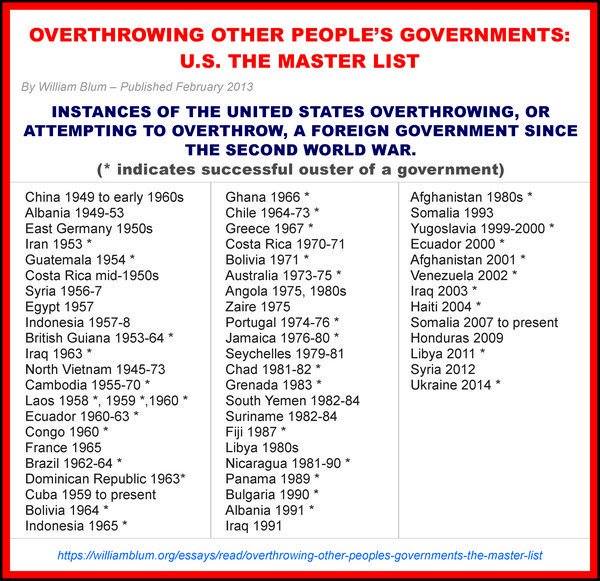
While our media prostitutes, many Hollywood celebs, and politicians and opinion shapers make so much noise about the still to be demonstrated damage done by the Russkies to our nonexistent democracy, this is what the sanctimonious US government has done overseas just since the close of World War 2. And this is what we know about. Many other misdeeds are yet to be revealed or documented.
Parting shot—a word from the editors
The Best Definition of Donald Trump We Have Found
 In his zeal to prove to his antagonists in the War Party that he is as bloodthirsty as their champion, Hillary Clinton, and more manly than Barack Obama, Trump seems to have gone “play-crazy” — acting like an unpredictable maniac in order to terrorize the Russians into forcing some kind of dramatic concessions from their Syrian allies, or risk Armageddon.However, the “play-crazy” gambit can only work when the leader is, in real life, a disciplined and intelligent actor, who knows precisely what actual boundaries must not be crossed. That ain’t Donald Trump — a pitifully shallow and ill-disciplined man, emotionally handicapped by obscene privilege and cognitively crippled by white American chauvinism. By pushing Trump into a corner and demanding that he display his most bellicose self, or be ceaselessly mocked as a “puppet” and minion of Russia, a lesser power, the War Party and its media and clandestine services have created a perfect storm of mayhem that may consume us all.— Glen Ford, Editor in Chief, Black Agenda Report


3 comments
I am, with Patrick Walker, incensed at Russiagate. But this is nothing new. We’ve seen one Big Lie after another for decades, perhaps centuries. Usually the two money parties of the USA blame each other for all the world’s problems, though the two parties get along fine when raising corporate welfare and the military budget and stripping the public of everything else. We need to think about why people in the USA are so susceptible to the tactic of The Big Lie. I’ve written a little about that elsewhere (https://leftymathprof.wordpress.com/big-lie/).
The term “climate injustice” is too mild; I would instead call that “climate insanity.” The ruling class is attacking not just 99.99% of humanity, but all of humanity, including themselves. They will discover too late that they cannot eat money. If present trends continue, including all the feedback loops and tipping points that most people aren’t aware of, I expect that our species will be extinct less than three decades from now.
How is this madness possible? Well, the rulers are powerful and sometimes clever, but they’re not wise. They are the puppets of the economic system, and it pressures them to seek short term profit without regard to long term consequences.
If we somehow manage to expose and lock up all the plutocrats, but we don’t change the culture, it will quickly generate a new batch of plutocrats. We need not only a revolution, but an awakening, an enormous cultural change, and we need it in a hurry. I’ve begun writing about that (https://leftymathprof.wordpress.com/wake-or-die/). The chief tactics I can recommend are writing and talking, to try to spread ideas.
A “movement of movements” already exists. Paul Hawken spoke brilliantly about this in the 6-minute video (https://www.youtube.com/watch?v=Xkz2OjMOg88) he made to promote his 2007 book “Blessed Unrest.” I am still inspired by that video, even though my views on economics have moved far to the left of Hawken’s. Admittedly, the movement Hawken describes is a bit disorganized. I don’t know whether it can become better organized, and perhaps that is Walker’s main point. Different people have different priorities. Someone who is being bombed today in Yemen or shot today in Chicago may not give highest priority to the extinction of the human race arriving 30 years from now. But I think it would help if more activists saw how all the problems are connected. We will only make the needed cultural change when more people see the need for it.
I do not understand Patrick Walker’s assertion that “defending all humanity is not—and perhaps, from sheer scope, can never be—the organizing principle of any on-the-ground activist movement.” I think that such a universal struggle is precisely what we need, and Patrick’s “RPEC” is simply too limiting to the imagination, too concrete and material. The changes we really need are enormous; they are far bigger than those of any past revolution. We need not just regime change, not just change in our material institutions, but culture change. Our present culture of separateness is to blame not only for the climate apocalypse, but also for wars, poverty, racism, sexism, and all our other problems. The problems described as “RPEC” are just symptoms, and I don’t think we will solve them until people see the underlying cultural problem. Jan Phillips said, and I agree, “No matter what our attempts to inform, it is our ability to inspire that will turn the tides.”
It’s true that the underlying cultural problem lacks a name. And it is not easily seen — it is as ubiquitous and invisible as the air. And it needs a name, and it needs more people to see it. What I call the “culture of separateness” is what Charles Eisenstein calls “the story of separation” in his book “The More Beautiful World Our Hearts Know Is Possible” (https://charleseisenstein.net/books/the-more-beautiful-world-our-hearts-know-is-possible/eng/separation/). The book brilliantly details the psychology of the problem, but barely mentions RPEC; I hope he will write a revised edition or a sequel.
But usually I just blame capitalism. That’s a bit of a simplification, but it’s close enough to the truth to be a good place to start. It’s a word familiar to most people, and they think they know what it means.
Here is a lesser point of disagreement: I don’t think it is useful to analyze the Democrats as “good cop” and the Republicans as “bad cop.” After all, the Republican voters see it just the other way around. Here is the biggest difference I would identify between the two money parties: Both parties support plutocracy, but they lie about it in different ways. The Democrats say “no, we’re putting the people before the plutocrats,” and this fools blind voters. The Republicans say “yes, we put the plutocrats first, but it works out better for everyone that way,” and this fools stupid voters.
Thanks for commenting. I’m glad, of course, that we agree on the odiousness of the Russiagate narrative; I imagine most readers of–and even more so, writers for–TGP “grok” the dangers of that lying story. Association with TGP very likely implies having “connected the dots” of political analysis in a principled leftist way. It’s hard to imagine any principled leftist not smelling a rat in Russiagate.
Just a quick answer to your closing “lesser point of disagreement.” On the one hand, I’m not addressing an audience very likely to include Republicans, so I only need to worry about whether my “Good Cop, Bad Cop” analysis is accurate, not whether it flatly contradicts Republicans or offend them rhetorically. On the other hand, I DO think a coalition with the right analysis NEEDS to boldly, publicly contradict the Republican narrative–especially since Democrats, as the Inauthentic Opposition Party–utterly lack the principles, passion, and conviction to do so. The preliminary to winning a public argument is to START the argument; most people don’t have a clue that the “Good Cop, Bad Cop” analysis exists. Since it’s in fact true–and we can defend it with compelling evidence and arguments–I wish to see principled leftists start that argument. Especially by organizing a powerful movement to voice it. Only by starting the argument will we receive the chance to make our case. When you’re totally blocked from public discourse, the last thing you wish to do is worry about giving offense to people who are flat-out WRONG.
As to our further disagreements, I suspect they arise from your theorizing about mental frameworks–quite well, I might add–without considerable experience in activist organizing. While my ultimate desiderata are probably close to yours, I’m much more inclined to take into account what organizing is actually on the ground. If people are already deeply invested in a given right-minded cause, we shouldn’t try to swing their allegiance to a different one–even if the cause we’re promoting has a deeper analysis and is of broader scope. The question is how to work with supporters of the existing organized cause to promote one’s bigger aims. Though “intersectionality” has become too much of a buzz word–with fluid meanings–I do take its prevalence as a VERY promising sign that people who support different causes like racial justice, peace, economic justice, and climate action are understanding that they’ll get nowhere if they don’t get together, Since we have a widely respected hero like Martin Luther King as our model for doing so–and the Poor People’s Campaign ALREADY putting King’s model into current-day practice, I say we build on that. If we can get the Poor People’s Campaign to use its moral credibility to attack Russiagate, we’re off to the races in building the needed movement.
REPRODUCED FROM OEN’S ORIGINAL THREAD
BY DAVID W PEAR
Excellent article that makes it clear that Democrats are so bankrupt morally and corrupt that the best they can come up with is Russiagate. It could be dismissed as annoying political folly except that World War 3 would be a terrible side effect.
A lot of careerists such as Rachel Maddow are getting exceedingly rich by playing pied piper to weakly committed liberals and progressives who think that being a progressive means turning out one day a year for Earth Day. The MIC has got the perfect growth market by producing more and more very expensive one use products.
Truly dedicated liberals and progressives can come up with creative and more effective ideas than the destructive narrative of Russiagate.
Submitted on Saturday, Mar 31, 2018 at 6:05:25 PM
BY PATRICK WAKER
Reply to David William Pear:
Hi David. Thanks for the kind comment.
One thing that always puzzles me is why opinion leaders like Naomi Klein and her new ally, Michelle Alexander, play so nice with self-serving establishment propagandists like Maddow. It should be obvious that Russiagate harms the causes of climate action and racial justice–and not only by crowding those issues out of “mainstream” political discourse. Climate justice will require vast expenditures of public funds and unprecedented international cooperation. Anyone who can’t see the harm to climate justice in fomenting unnecessary distrust and hatred of a populous nuclear power like Russia is truly blind or not paying attention.
I don’t believe Klein and Alexander are blind or not paying attention, so I’m puzzled why they’re not denouncing a discourse that clearly harms their causes. Their united followings could make a HUGE public stink. And I doubt Maddow would savor activists of their authority proclaiming her an enemy of climate and racial justice.
Submitted on Saturday, Mar 31, 2018 at 7:51:55 PM