Julian Macfarlane
Russia advances; the West retreats into madness
As Russian forces in the Ukraine continue their advances, cauldronizing the last remnants of Kievan occupation forces in Liman and Konstantinovka in preparation for taking the Slavyangrad - Kramatorsk agglomeration, and with Russian airpower strikes on all fronts, it would seem that the SVO is entering a decisive phase. Kiev is getting desperate with more and more terrorist strikes. Kiev will not give up easily. And the West is increasingly deranged. ]The Silovik myth
There are constant references to Putin’s KGB background, with the KGB understood as the USSR’s Gestapo. Putin is the ultimate silovik.
This word, “silovik” tells us much about the centuries old phobic response of Europe and the Anglosphere to Russian civilization and its values. And indeed Putin IS the “ultimate Silovik” have reinvented the concept of public service in the context of a renewed Russia.
For him, “Siloviki” are public servants who have dedicated their lives to serving Mother Russia. They represent service and sacrifice And the Russian public agrees. No world leader, other than Xi, is as popular with his people as Putinm One can keep in mind, that, if the Russian people, don’t support him, they won’t vote for him.
Of course, as Western academics will tell you, the siloviki were associated with the KGB in the context of the USSR, post Stalin.
Yet to understand the full meaning of what this kind of public service means you must also understand why Putin sought to join the KGB as a young man, despite the discouragement of family, friends, teachers — and the KGB itself! (That’s in a separate post for coffeebuyers. You can click on the link later.)
In my last post, we talked about honesty - an important idea in any country with complex hierarchies—and not something seen much in Washington DC. .
The honest man
Who would say that of any Western politician?
Nor is Putin’s association with the KGB and a its successor agencies a problem for Russians.
It may be hard for Western readers to grasp this, for lack of historical context.
The KGB was the successor to Stalin’s’ NKVD which was a massive organization including secret police, the regular police, the penal system and border and internal troops.
American Threat
The Soviet Union at this time was under constant threat from Western intelligence agencies, which were overthrowing governments around the world, Greece, Iran, etc.
The Soviet espionage networks at Los Alamos were organized and directed by the NKVD (People’s Commissariat for Internal Affairs) under the code name ENORMOZ. Soviet intelligence officers operating out of the New York consulate recruited scientists and set up a system to funnel research to Moscow.
The majority of these scientists were Jewish, including Ethel Rosenberg who was not a scientist. The only non-Jew was Klaus Fuchs who was German. Only the Rosenbergs were executed although records show Ethel Rosenberg was innocent of anything but marrying a spy.

She deserves exoneration, of course — but it will probably never happen. .
Why you don’t know?
The point is that the USSR had good reason to be afraid of American intentions. Its initial intelligence after WWII was thanks to the…
KVD / NKGB: foreign intelligence services
MGB: (Ministry of State Security), which handled collection of early U.S. war plans like Operation Fleetwood and Operation Charioteer.
GRU: which intercepted a large portion of Pentagon tactical planning.
These plans were partially revealed in the 70s, then more fully with the opening of Soviet archives in the 90s. which helped dispel Russian illusions about American benevolence.
It also revealed how much Russia owed its siloviki.
It also helped that the KGB which replaced the NKVD organizations had a much better image.
Beginning in the Khrushchev and Brezhnev eras, aware of the NKVD’s reputation, the USSR promoted “Chekist fiction” in literature and film (such as Yulian Semyonov’s Seventeen Moments of Spring).

These stories portrayed KGB officers as brilliant, incorruptible patriots, deeply devoted to the state rather than blindly serving a political party.
Whether or not ordinary people believed this, as you will see, the KGB did— and tried to live up to the new image, as I explain in the follow-up article on the coffee buyer’s site.
The KGB represented order and the rule of law (Soviet Style) And principles and integrity at the same time...
But with the economic and social chaos of the 80s and the geopolitical humiliations that broke the Soviet Union apart, the KGB foundered and was replaced by the FSB, created by Boris Yeltsin and the FSR and GRU.
The FSB handles domestic counterintelligence.

The SVR is the foreign intelligence branch.

The GRU handles military intelligence and offshore operations.

So, Yeltsin basically broke the KGB into three organizations. Putin was given the job of making them work. And he did, imposing on them the values he had hoped for in the old KGB.
Russia Under Threat
The Chechen War, which has been set up by the CIA and MI6 was raging with major terrorist attacks in Russia. Naturally, the Western media portrayed the Chechens as “freedom fighters”, although the rhetoric lost momentum after the Boston Bombing.

Budyonnovsk Hospital Hostage Crisis (June 1995): Militants led by Shamil Basayev seized a hospital in southern Russia, taking over 1,500 hostages. The siege resulted in the deaths of 129 civilians and hostages.
Kizlyar-Pervomayskoye Hostage Crisis (January 1996): Fighters attacked a military airbase and a hospital in Kizlyar, taking thousands of hostages and retreating to the village of Pervomayskoye, leaving dozens dead.
Moscow Theater Siege (October 2002): Chechen militants seized the Dubrovka Theater in Moscow, holding approximately 850 people hostage. Russian special forces stormed the building using gas, resulting in the deaths of 40 attackers and at least 129 hostages.
Beslan School Siege (September 2004): Attackers occupied School Number One in Beslan, North Ossetia, holding over 1,000 people hostage. The three-day siege ended in a violent chaotic rescue operation, leaving 334 people dead, including 186 children.
Russian Apartment Bombings (September 1999): A series of coordinated bombings targeted apartment blocks in Buynaksk, Moscow, and Volgodonsk, killing nearly 300 people.

Moscow Metro Bombings (February 2004): A suicide bombing on a crowded Moscow metro train during morning rush hour killed 41 people and wounded over 100.
Domodedovo Aircraft Bombings (August 2004): Two Russian passenger planes were blown up by female suicide bombers within minutes of each other, resulting in 90 deaths.
Yessentuki Train Bombing (December 2003): A suicide bombing on a commuter train near the Yessentuki station in southern Russia killed 46 people and injured 160.
That’s about 600 civilians – not counting Chechens. By comparison about 500 to 1000 Russian civilians have died as a result of Ukranian terrorism since 2022 – not counting those who died after 2014.
In Russia, the Russian intelligence agencies are credited with reducing casualties , but often criticized for being too liberal in their approach.
But today, Chechnya is thriving and very pro-Russian.

But the Russian public is tired of Western interference and increasingly vocal in demanding more extreme measures !
The responsibility of the siloviki is to protect not just the “state” but its people. Also to lead, not to be led by special interests. In the US the government is “led” by the wealthy. The Epstein Class does not serve — it is served. This is one reason why Putin’s anti-corruption efforts are so popular. “Don’t lie, don’t steal, don’t cheat”. It’s pretty simple.
As Cuban journalist Yeilén Delgado Calvo has observed, Cuba is experiencing its most serious multidimensional crisis since the Special Period, due to the intensification of the U.S. blockade since 2019, aggravated by the Executive Orders of the second Trump administration, constituting the most aggressive escalation of sanctions of recent history. The intensified blockade has impeded the arrival of petroleum tankers; has threatened companies that have businesses in Cuba, forcing their withdrawal; and has provoked the disconnection of the country from international systems of credit and financing. As a result, Delgado Calvo notes, Cuba has experienced an acute contraction of its economy during the first half of 2026, accompanied by a daily average of twenty hours without electricity.
In this context, the Central Committee of the Communist Party of Cuba, meeting in Extraordinary Session on June 16, approved a proposal consisting of 176 measures, organized in twenty-three themes, for submission to the National Assembly of People’s Power (ANPP for its initials in Spanish). To remind, ANPP is the highest political and legal authority in Cuba, constituted by a first stage of nomination of candidates by citizens sixteen years of age and older in neighborhood nomination assemblies; a second stage of direct elections by citizens in small voting districts, choosing one of two or more candidates in voluntary, secret voting; a third stage of nomination of the deputies of the ANPP by the elected delegates, acting with the recommendation of mass organizations, whose representatives also are elected directly and indirectly by the people; and a fourth stage of ratification of the nominated deputies in direct and secret voting by the citizens. These are the basic structures of a process of people’s democracy, an alternative to representative democracy. It functions without the political campaigns of representative democracies, and therefore without the need for electoral political parties and campaign financing. It was established in 1976, institutionalizing the process of direct democracy through mass assemblies, which had been developed in the 1960s.
The ANPP decides, while the Party guides and recommends. Prime Minister Manuel Marrero Cruz explained at the Extraordinary Session of the Party that the proposals are profound changes that respond to the harsh reality of the current historical moment. At the same time, the proposals are consistent with and complementary to the Economic and Social Program of the Government of 2026.
In a message to the Extraordinary Session of the Central Committee of the Party, Raúl Castro asserted that he had been consulted with the respect to the proposed economic and social transformations, and he is fully in agreement with them. Now 95 years of age, Raúl is often referred to as the leader of the Revolution, distinguishing him from Fidel, who is known as the historic leader of the Revolution.
The Party proposal was addressed at the Third Extraordinary Session of the Tenth Legislature of the National Assembly of People’s Power on June 18, presided by the President of the ANPP, Esteban Lazo Hernández. A report on the Party proposal was presented by Prime Minister Marrero, who also is a member of the Political Bureau of the Party. Marrero explained that the proposed changes were designed to preserve the gains of the Revolution without renouncing socialism. The objective is to stimulate foreign investment and introduce market mechanisms as an instrument in the utilization of resources, with recognition that socialist planning does not exclude—indeed it must incorporate—the rules of the market.
Provincial governments will have the capacity to create, combine, and liquidate state companies. At the same time, capitalization of companies can proceed without the participation of state funds. And state enterprises will be able to buy the stocks of other companies.
Non-state economic actors will be able to contract more than 100 workers, at which point they will be classified as private companies (distinct from small and medium enterprises), operating alongside the public companies of the state. Private companies will be able to develop productive and service activities in addition to their principal economic activity. One individual will be able to own stock in more than one private company.
Private companies will be able to operate in agricultural activities and animal husbandry. The concept of ownership of the land by the entire people is maintained, but state companies that administer the land will be empowered to grant use of the land by means of contracts, including contracts to agricultural cooperatives. It will no longer be necessary for those granted usufruct to work the land directly.
Agricultural cooperatives will have the capacity to engage in foreign commerce directly, importing supplies and exporting products in a direct form, without specific authorization. The prices will be established by contracts between the agricultural producers and the buyers.
The document asserts that all economic actors, state and private as well as national and foreign, have a social responsibility that must be expressed at the community level, including support for homes for the elderly, establishing different prices and discounts for those in need, support for transportation and health, backing public health institutions and educational centers, monthly support for persons and families in situations of vulnerability, directing basic products toward social institutions, offering employment and training to persons in situations of vulnerability, creating funds for local emergencies, and supporting funeral services for families without resources. They must strengthen Social Work in a proactive and preventive form. In general, the orientation is to move from subsidies to products to subsidies to persons in need.
The document proposes the modernization of the banking and financial system. The participation of private capital in banking activity will be stimulated. Restrictions on payment in foreign currencies among companies with foreign capital will be eliminated. Bank accounts in foreign currencies can be opened by persons and companies without prior authorization.
Foreign investment will be stimulated through the participation of foreign investment in private companies and cooperatives. Those who have commercial relations with foreign capital can open bank accounts in other countries, without prior authorization. Foreign investment will be permitted in zones of cultural heritage, such as Habana Vieja.
The document mandates the creation of a work group led by the Central Committee of the Party and composed of the ANPP and various ministries of the government, for the purpose of controlling and implementing the proposed changes.
Cuban President Miguel Díaz-Canel, following the presentation by the Prime Minister, pointed out that the proposed economic and social changes do not mean a renunciation of socialism, but a search for how to continue constructing socialism in the specific conditions of Cuba. The process was initiated, the President noted, with the Guidelines of Economic and Social Policy, proposed by the Party and approved by the National Assembly in 2012, following modifications based on extensive discussion by the people. The discussion of the current proposal has included the contributions of economists as well as study of the experiences of other countries constructing socialism. He noted that the proposed changes would have been made even if the economic context had been more favorable, because they advance the productivity of the economy, under the guidance of the Party and regulation by the state. He added, “We all speak of the need to maintain social justice. The first thing to be done is to produce. If we do not produce, if we do not generate wealth, if we do not provide inclusive and high-quality services, what social justice are we going to defend?”
Many deputies took the floor to express their support for the measures, stressing the importance of immediate implementation. Some indicated that they had been advocating for changes of this kind for some time.
The rector of the University of Havana, Miriam Nicado García, stressed that the reforms have the potential not only to stimulate productivity, but also to generate a greater concentration of wealth. She emphasized the responsibility of the Party and the government to carefully monitor the results and consequences, from a perspective of a continuation of the nation’s longstanding commitment to social justice.
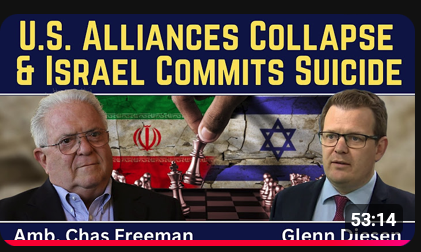
AMB Chas Freeman : Should Iran Trust Trump? (Silly question!)
Judge Nap chats with Amb Chas Freeman
The video opens by addressing the prevalence of undeclared wars and critiques the U.S. government’s use of preemptive war (aggression) without popular consent. It highlights a societal desensitization toward the illegitimate use of government force and stresses the need to understand and reject the initiation of force to achieve a truly free society. The segment references Thomas Jefferson’s political philosophy, pondering questions about government legitimacy, such as whether it is better to alter or abolish a government that is unjust, whether government should govern least, and if fighting for freedom is preferable to living in slavery. It sets a tone that freedom faces urgent threats today.
[02:40] Discussion shifts to the Strait of Hormuz, a critical global oil chokepoint. Ambassador Freeman states:
- Iran controls the Strait and its openness depends entirely on Iranian decisions.
- The U.S. Navy is no longer enforcing a blockade to restrict oil flow.
- The situation hinges on the implementation of a memorandum of understanding (MOU) between the U.S. and Iran, which stipulates no use or threats of force by either party.
However, the MOU is strained because:
- During ongoing talks in Bürgenstock, Switzerland, President Trump issued threats violating the MOU.
- This led Iran to terminate direct contact with the U.S. negotiating team.
- The Iranian side demands Israeli withdrawal from Lebanon as part of the MOU; Israel refuses categorically.
- Israeli leaders affirm they will not withdraw any territory and aim to annex southern Lebanon, creating major diplomatic ruptures.
[04:00] The complex geopolitical dynamic involving Iran, the U.S., and Israel is explored further:
- The U.S.-Israel alliance is fracturing due to disagreements over Israeli actions in Lebanon.
- Reports indicate the U.S. withdrew permission for Israel's free conduct in Lebanon, placing Israel "on a tether."
- Trump’s aggressive rhetoric and policies have created a political dilemma and an impending U.S.-Israel confrontation over regional policies.
[05:17] A key excerpt from President Trump’s threats during negotiations is highlighted:
"Within 48 hours of signing the MOU, you close the Strait of Hormuz and you won't have a country."
"You won't even make it back to your effing country."
Ambassador Freeman condemns these threats as potentially war crimes and violations of the MOU, noting they demonstrate a loss of presidential self-control, likening the behavior to someone with dementia. He emphasizes that:
- In negotiation, such threats are counterproductive.
- The threats likely caused Iran to walk out.
- These actions are unwise and incompatible with diplomacy.
[07:13] The segment continues on the dangers of mistrust:
- Iranian mistrust of the U.S. is reinforced by ongoing bombings during negotiations (notably in June and February).
- These attacks are seen as desperate measures related to the midterm elections.
- The MOU is more accurately a "memorandum of misunderstanding" due to lack of real consensus.
[08:36] The next focus is on the consequences of Israeli actions in Lebanon:
- Persistent Israeli military actions in Lebanon violate the MOU and exacerbate tensions.
- A joint U.S.-Iran monitoring effort over ceasefire and Israeli withdrawal from Lebanon is part of the MOU.
- Lack of trust from Iran toward Trump is stark and public.
- European allies are distancing themselves from the U.S., fearing arbitrary U.S. sanctions, including on AI technology exports.
- There is declining trust even within Trump's own domestic supporters, due to perceived failures in diplomacy and promises, including those to Zionist donors.
[11:25] The video then examines statements from Ben Gvir, an extreme Israeli cabinet member:
- He advocates for turning all of Lebanon into an Israeli target, refusing to differentiate between Lebanon as a country and Hezbollah.
- His rhetoric compares Hezbollah to Nazis and calls for applying the same harsh tactics used against Nazis.
- Amb. Freeman identifies this as an advocacy for genocidal policies akin to those in Gaza, extending them to Lebanon.
- These statements are not dismissed lightly, causing international backlash.
- Ben Gvir issues an implicit threat to Trump, suggesting consequences if demands are not met—an indication of Israeli political entitlement.
[15:11] Regarding Israeli public opinion and the June 2025 war:
- Israelis apparently recognize the war was a mistake but exhibit no evidence of introspection.
- Israel continues to apply military force in place of diplomacy, which has worsened regional conditions.
- The blame for failures is shifted onto Trump and the U.S., rather than sitting with Israeli policy responsibility.
[17:05] The segment turns to Iran’s nuclear inspections under the MOU:
- Vice President Vain claims Iran agreed to invite International Atomic Energy Agency (IAEA) inspectors back.
- Amb. Freeman states this is misleading, as inspections were already mandated under the Obama-era JCPOA.
- Iran denies any commitment on the nuclear agenda during talks.
- There may be an indirect Iranian openness to resuming interaction with the IAEA, but this remains uncertain.
- The June 2025 attacks on Iran appear to have been partly sourced from IAEA-linked information.
- The speaker categorizes U.S. announcements about inspection agreements as political spin with unclear prospects.
[19:40] Transitioning to a domestic issue, the discussion focuses on the reflecting pool controversy in Washington, D.C.:
- President Trump claimed the reflecting pool was vandalized with a 350-foot slit cut by a knife, asserting the pool’s repair and paint would last 50 years.
- Journalists found no evidence of such vandalism.
- Amb. Freeman explains the algae growth and discoloration are due to the heat retention from dark blue paint, which is scientifically predictable and unrelated to vandalism.
- The contract that paid for this work violated public bidding laws; it was awarded without competitive bidding to a Trump-favored contractor.
- The situation reflects broader themes of government inefficiency and corruption.
[23:12] The conversation expands on broader themes of corruption and incompetence in government:
- The upcoming midterm elections will focus heavily on corruption involving Congress and the presidency.
- A purge in the National Intelligence Department is underway, firing experienced personnel from past administrations without clear reasons.
- The current intelligence leadership is criticized as unqualified, specifically the acting head (“Mr. PY”), who lacks requisite experience.
- This purge is viewed as self-destructive, especially during international crises.
- The broader problem is described as the spoils system taken to extremes, with political loyalty prioritized over competence.
- This administration is characterized as the least competent in U.S. history.
[26:09] The video closes with a preview of upcoming guests and shows on "Judging Freedom," signaling continued coverage of geopolitical and domestic issues.
Key Insights and Conclusions
- Undeclared or preemptive wars are normalized but illegitimate under constitutional and moral grounds; force initiation must be rejected for freedom.
- The Strait of Hormuz is under exclusive Iranian control; its openness is a strategic bargaining chip tied to complex U.S.-Iran-Israel relations.
- The Trump administration’s threats and aggressive posture have damaged diplomacy and damaged U.S. credibility internationally.
- Israel’s policies in Lebanon, especially under extremist cabinet members like Ben Gvir, increase regional tensions and risks of confrontation with the U.S.
- Iranian distrust of the U.S. is profound and exacerbated by ongoing military attacks during negotiations.
- The Federal Reserve’s monetary policy is inflating the dollar, making gold and silver sound investments to protect wealth and liberty.
- Domestic governance issues, including corruption, incompetence, and political purges, compound the U.S.’s international difficulties.
- Scientific explanations contradict claims of reflecting pool vandalism, illustrating government mismanagement and misinformation.
Gustavo Petro: Israel Stole Colombia’s Presidential Election
Reason2Resist
WITH
DIMITRI LASCARIS
Increasing US pressure in combination with the region's comprador elites' machinations have delivered victories for the ultra right in several countries, including Chile, Ecuador, Argentina, Peru, Honduras, and now crucially, Colombia.
Gustavo Petro: Israel Stole Colombia's Presidential Election
[00:02] Overview of the Colombian Presidential Election and Its Geopolitical Stakes
- On June 22nd, 2026, Colombia held a contentious presidential runoff election between Abelardo de la Espriella, a far-right millionaire endorsed by Donald Trump, and Ivan Cepeda, a progressive lawmaker.
- Preliminary results showed a razor-thin margin: de la Espriella at 49.75% and Cepeda at 48.7%, with 99.9% of votes counted but no official winner declared.
- De la Espriella’s potential victory threatens to reverse the progressive policies of outgoing President Gustavo Petro, especially the plan for parallel peace negotiations with illegal armed groups, which was a hallmark of Petro’s presidency.
- De la Espriella holds dual Colombian and US citizenship, is a Republican Party member, and openly supported by Trump. Trump publicly celebrated de la Espriella’s success before official results were announced, raising concerns about election validity from Cepeda and Petro.
[02:35] Political Context and US Influence in Latin America
- Ajamu Baraka, a human rights defender and political commentator based in Cali, Colombia, contextualized the election within broader US efforts to reassert hegemony in the Americas through militarism, illegal sanctions, destabilization, and direct interventions.
- The US has actively intervened in regional politics, citing:
- The kidnapping of Venezuela’s sitting president.
- The siege of Cuba, modeled after tactics in Gaza.
- Support for right-wing candidates in Bolivia, Peru, Ecuador (Daniel Noboa), and now Colombia.
- Colombia was seen as a potential progressive stronghold under Gustavo Petro, whose administration adopted a social democratic agenda. De la Espriella’s rise signals a push to reintroduce a harsh national security state, opposing peace negotiations and embracing militaristic policies.
[04:07] Profile of Abelardo de la Espriella and Campaign Dynamics
- De la Espriella is:
- An attorney with a background in representing notorious figures such as drug dealers.
- A wealthy businessman.
- An individual with significant time spent in the US, which became a point of contention during the campaign.
- His campaign capitalized on:
- A narrative that progressive peace efforts led to increased violence and insecurity.
- Promises to “disembowel the left” and dismantle progressive political gains.
- The backing of the fragmented Colombian right, recognizing that they lacked strong candidates but were united behind him.
[10:26] Ivan Cepeda’s Progressive Platform and Petro’s Administration
- Cepeda represented continuity with Petro’s social democratic reforms, including:
- Negotiations with armed groups (left guerrillas like dissident FARC and ELN, paramilitary narco factions) aiming to stabilize the country.
- Increasing the minimum wage by over 30%, a significant rise after a long period without change.
- Enhancing social redistribution policies: easier access to college, job training, protections for Afro-Colombian and indigenous populations, and acceleration of land titling to marginalized groups.
- Over 60% of Colombia’s labor force is informal, making job stability central to Cepeda’s socio-economic agenda.
- Ajamu Baraka characterized these reforms as social democratic rather than radically left-wing, noting the Colombian state’s entrenched colonial capitalist nature and the limits of leftist power within this framework.
[16:24] Allegations of Electoral Fraud and Calls for Transparency
- Former President Gustavo Petro publicly raised concerns about the integrity of the electoral software controlled by the private company of the Bautista brothers, linked to multiple previous election irregularities.
- Petro requested:
- A full audit of electoral servers and software vulnerabilities.
- A recount and scrutiny of all polling stations.
- Calm and restraint amid political division.
- Petro accused the electoral system of being compromised, with altered IP addresses and manipulated data, implying unprecedented external interference, citing Israel as a likely actor in this cyber manipulation.
- Independent journalist Max Blumenthal corroborated concerns around the Bautista brothers, highlighting past loss of 400,000 votes in favor of Petro’s party in earlier elections.
- Ajumu described these allegations as serious and credible within the geopolitics of the region, tying them to US and Israeli collusion with right-wing forces throughout Latin America (mentioning “Hondurasgate” as precedent).
- Despite unresolved questions, US officials prematurely congratulated de la Espriella, implying a preemptive alignment with the right-wing candidate irrespective of verification.
[21:15] Regional Militarization and US-Ecuador Relations
- Ecuador’s government under Daniel Noboa, supported by the US, conducted punitive air strikes against narco-terrorist camps near the Colombian border and imposed tariffs on Colombian goods, escalating tensions.
- Colombia retaliated by suspending electricity exports to Ecuador.
- Ajumu indicated that Ecuador’s actions reflect US strategic interests to militarize and consolidate right-wing dominance in the hemisphere, particularly along the Pacific coast.
- The US operates approximately 72 military bases across South America and the Caribbean, with access agreements and joint operations with various countries including Ecuador.
- There is an attempt to reopen a former US military base in Manta, Ecuador, despite strong opposition in a civilian referendum.
- Ajumu also highlighted the manipulation of drug trafficking narratives as a pretext for militarization, noting Ecuador is a primary cocaine transshipment point despite official drug war posturing, likened to geopolitical tactics in West Asia and North Africa.
[31:18] Ajumu’s Analysis of Iran’s Internal Dynamics and Negotiation Stance
- Iranian society and state are marked by internal contradictions and competing power centers, with pressures from both war impacts and economy.
- There is a notable hardening of opposition toward the US, reinforced by public preparedness for ultimate sacrifice to defend Iran’s sovereignty.
- Some factions within Iran maintain hope for normalized relations with the US and reintegration into global economic systems, causing policy hesitations and contradictions.
- Ajumu emphasized the persistent threat from the US and Israel, who seek to destroy Iran, assert control over energy flows, and prevent US ejection from West Asia. He views the ongoing conflict as a pause, not a conclusion, predicting continued militarization and attempts to sustain global hegemony, particularly by the US through its extensive global military infrastructure.
[37:20] Iranian Society’s Changing Attitudes and Political Realignments
- In observing society from afar, Ajumu noted:
- A shift away from “moderates” toward “realists” who recognize the true nature of US hostility.
- Increased public resolve and demand that Iran’s government avoid compromise.
- Contradictions remain given some elites’ hopes for normalized relations despite ongoing aggression.
- Iranian commitment to resist is strong, but there is simultaneously a desire to create conditions for eventual cessation of hostilities.
[41:07] Evaluating Iranian Political Leadership Involved in Negotiations
- Responding to inquiries about key Iranian figures (e.g., President Masoud Pezeshkian, Abbas Araghchi, Speaker Ghalibaf), Ajumu:
- Does not view them as traitors or acting in bad faith.
- Recognizes they pursue a class-based strategy aiming to normalize relations with the US and the West as legitimate policy.
- Contrasts this with critics who see the US/Israel as irredeemable colonial-imperialist forces inseparable from racialized power structures targeting Iran’s destruction.
- Ajumu warns that Iran’s only assured defense will be through deterrence capabilities akin to North Korea’s, signifying a hard break with hopes for friendly US relations.
[45:14] Advising Iran’s Negotiating Team: Strategic Recommendations
- Ajumu’s advice to the Iranian negotiators includes:
- Taking a powerful stand by suspending negotiations and demanding clarifications/retractions in response to hostile US statements (such as Trump’s threats).
- Driving a hard bargain over asset releases and sanctions relief, ensuring any concessions translate into immediate and tangible benefits for Iran’s economy and defense preparation.
- Recognizing that the promise of a $300 billion reconstruction fund is unrealistic and that the current negotiated “pause” will ultimately serve US strategic aims more than Iranian interests.
- Using the temporary relief to offload oil, accumulate resources, and prepare for renewed confrontations.
- Expecting and preparing for continued militarized conflict, rather than peace, as US and Israeli goals remain unchanged.
Geopolitical Themes
- US Strategy in Latin America: Renewed aggressive attempts to re-colonize the hemisphere through militarization, political destabilization, and manipulation of elections.
- Electoral Integrity Concerns: Serious allegations of electoral fraud tied to private voting software manipulators with potential foreign interference.
- Regional Militarization: US-Ecuador collaboration in military activities along Colombia’s border as part of hemispheric right-wing consolidation.
- Drug War as Pretext: Drug trafficking narratives exploited to justify increased US military presence without addressing underlying causes or flows.
- West Asia Conflict Dynamics: Ongoing US-Israel versus Iran struggle marked by intermittent negotiation attempts, unresolved hostility, and a likely continuation of conflict with an emphasis on Iran’s sovereignty and deterrence strategy.
Key Insights
- Colombia’s election is a microcosm of global geopolitical struggle, specifically US and right-wing efforts to halt progressive political advancement in Latin America.
- Progressive reforms under Petro and Cepeda represent cautious social democracy, constrained by entrenched colonial capitalist structures and conservative opposition.
- Election results remain disputed, with credible claims of software manipulation, reflecting broader issues of election integrity in politically polarized environments.
- The US seeks to militarize and politically align South America under right-wing governments, using military bases, alliances, and proxy support.
- Iran’s situation is marked by internal divisions but united public resolve, balancing negotiation with preparation for conflict under continuous external threat from US and Israel.
- Negotiations with the US appear tactical and incomplete, serving as a temporary pause rather than a lasting peace, with fears of eventual escalations lingering
US Attack On Venezuela Represents 'Chaos' In The Region w/ Ajamu Baraka
Are the US and Israel really fighting? Or is something bigger happening?
Ben Norton
GER
Exposing the politics of institutionalised hypocrisy.
Jun 22, 2026