

 [su_spoiler title=”HELP ENLIGHTEN YOUR FELLOWS. BE SURE TO PASS THIS ON. SURVIVAL DEPENDS ON IT.” open=”yes” style=”fancy” icon=”arrow-circle-1″]
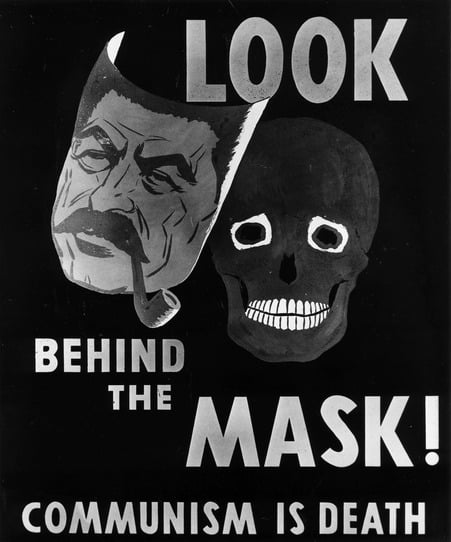
Western anticommunism has used innumerable tricks and deceptions, but few are so cynical as the equation of communism with fascism.
In the Western, capitalist, telling of history, “Stalin” and “Stalinism” almost invariably equal “socialism/communism,” which, of course, all equal “bad.” One major experiment (forgetting about what happened in China, and perhaps with more relevance, Cuba) and that’s it. Socialism, communism, the old term “Bolshevism,” was tried and failed in the Soviet Union and boy, it just couldn’t possibly work anywhere, anyhow, at any time in the future. This is a view that is adhered to not only by capitalist historians and political scientists. As well, it is adhered to by many self-styled “left-wingers” in the West. Without naming names, these folks, when talking about left-wing analyses of what is currently happening in the capitalist world, due to capitalist causation, like climate change and the coming Sixth Extinction, always start with a self-exculpatory statement.The latter usually begins with something like: “of course ‘Stalinism’ [usually without defining what they mean by that term] was awful, the Soviet Union was a complete horror show, and we are definitely not talking about anything like that.” They often add that because of what happened over the next 75 years in the Soviet Union following the Bolshevik Revolution of 1917, which was carried out on Leninist principles, nothing like that sort of revolution could ever possibly succeed. Some self-styled leftists go further, to say that any such attempt must be opposed with as much fervor as that with which they claim to be opposing capitalism. Of course the capitalist analysts don’t have to engage in such exculpation, but use the same sort of analysis nevertheless.
For many years I have thought about what might have happened in the development of capitalism from early on. Let us say that if, following the collapse of the Cromwellian Revolution in England and the Restoration of the Stuart Monarchy in 1661 (which among other things brought us Restoration Comedy and all those cute dogs), both its critics and original supporters had said something like: “well, that’s it. It’s obvious that mercantile capitalism [which was the driving force behind the Cromwellians] cannot possibly work, feudalism is here to stay forever, and well, folks, just live with it.” Of course that didn’t happen. In England, next came the Glorious Revolution of 1688, the Stuarts were replaced by an imported King who, coming from Holland, favored Constitutional Monarchy. It also happened that Holland was one of the inventors of mercantile capitalism. Then, indeed the doors were opened to the development through the 18th century of mercantile capitalism on a grand, English scale, and then industrial capitalism in the 19th century.
In my view, there is no reason why much the same sort of historical development could not take place for the replacement of capitalism with some sort of socialism that, without going into any detail here, learns much from both the positive and negative elements of the Soviet experience. In fact, if that some-sort-of-true-socialism replacement doesn’t happen, our species is doomed to become a very different, much smaller, rather miserable one over the next century. (I am not talking here about the social capitalism which is seen in most European countries, but a political/economic form in which there is a transfer of the ownership of the means of production from private to public hands and a concomitant transfer of state power. But that’s another story.) In that process we will take many other species with us as we shrink in size and world-coverage. We will have been driven towards that end by the profits-first-and-only capitalism that refuses to do anything meaningful to deal with global warming.
Returning to the Soviet experience, one must acknowledge (which Western analysts, neither capitalist nor self-styled “socialist” do) that it was shaped in a significant part by what someday will come to be known as “The 75 Years War Against the Soviet Union, 1917-1992.” One must also acknowledge, that every other attempt at some sort of socialist experiment following World War II (except for Cuba) was beaten back and eventually destroyed by Western Imperialism, most often led by the United States. That is, the Soviet experience did not take place in a neutral environment. “Peaceful Co-existence” a la Khrushchev, and indeed a la John F. Kennedy in his “American University Speech” of 1963 (with which he signed his own death warrant), was never tried.
Thus the Soviet Union always operated in a hostile global environment. It knew that from the time of the Intervention in the Russian Civil War, 1917-1921, so strongly supported by Winston Churchill, through the Nazi invasion (which Neville Chamberlain had so strongly wished for, without, he hoped, the UK having to go to to war itself), through the “Cold War” and the concomitant arms race which it could never hope to win, the number one intention of its capitalist rivals was to destroy it. (On Chamberlain and what “Munich” was really about, see In Our Time: The Chamberlain-Hitler Collusion, by Clement Leibovitz and Alvin Finkel, New York: Monthly Review Press, 1998.) Nevertheless, we have the mantra “Stalin Equals Socialism/Communism, Bad, and nothing like it could ever possibly work.”

The putative “evil twins”. A big hit with ignorant minds.
Interestingly enough, somehow one never hears “Hitler Equals Capitalism Equals Bad, and it could never work.” Of course, the first reason for that is that there are other models for capitalism and its preservation/expansion than the Hitlerian one. (And so why could not one also say that there are other models for revolutionary/Leninist socialism which could work?) But more importantly, for both capitalist and non-Communist analysts of 20th century history, Hitlerism/Nazism/Fascism is almost never openly associated with capitalism as the driving force for its development. But indeed it, and it brother fascist states in Italy (the first major one, which gave the governmental form its name) and Japan, were created by capitalist ruling classes that no longer wanted to entrust their control of the economy and the state to the (bourgeois) “democratic process.”
In Germany, the Nazis came to power on January 30, 1933 because a significant element of the German ruling class had decided that they could no longer stay in control of the German state and economy if the prominent and powerful German Socialist and Communist Parties and the equally German powerful trade union movement stayed in existence. (It happened that the German Nazi Party had received significant international support since 1923, when one George Herbert Walker and Brown Brothers Harriman began contributing to their cause.) The Nazis outlawed the German Communist Party (KPD) almost immediately, the Socialist Party (SPD) was gone by the end of March, 1933, and the trade unions were shut down in April, 1933. The capitalists now had no opposition of any kind, and they maintained their position of power and profit-making throughout the War. Hitler lost the war militarily, of course. But to the bitter end, with all the state power controlled by the Nazis, Germany remained a capitalist country (as did Italy and Japan).
However, with the victory of the allies, including the Soviet Union, there was no reaction to fascism of the “look to where capitalism leads [or can lead]” kind. Rather the United States, unscathed physically by the war, moved immediately to re-secure capitalism in Western Europe and made sure that no alternatives were made available. The Marshall Plan was designed specifically to restore Western Europe’s industrial base, especially that of (Western) Germany, which had been so heavily damaged during the war. No Marshall Plan aid for the Soviet Union, of course. On the contrary, wasting no time, Winston Churchill announced in his famous “Iron Curtain” speech of March 1946 that it was the Soviet policy to divide Europe. That policy had actually been developed in the West from before the end of World War II. Indeed, the “75 Years War Against the Soviet Union” was resumed almost immediately. At the same time, major efforts to prevent the spread of any kind of socialism by either peaceful or forceful means, were immediately undertaken around the world.
The very powerful Italian Communist Party was prevented, due to US and Papal intervention, from winning the election of 1948, for which it had been heavily favored. Immediately after the war, with British support the Rightists in Greece fought, and won, a two-year civil war with the Greek communists, who had borne the brunt of the resistance against the Germans. The British fought an 8-year war against communists in Malaya, who had borne the brunt of Malayan resistance to the Japanese. The Philippine communists, who likewise had borne the brunt of the resistance to the Japanese, were likewise put down hard by the puppet US government of the newly “independent” country.
The French Communist party, which had led the French Resistance during the war, was excluded from the French post-war government by the US-backed Gen. Charles DeGaulle. France attempted to re-establish its colony, “French Indo-China,” but a communist-led coalition defeated them. That defeat however, led directly to the U.S. ultimately successful effort to undermine the Geneva Agreements of 1954 which had ended it. And then came, of course, the decades-long world-wide campaign, led primarily by US imperialism to forcibly shut down any socialist or proto-socialist movements, all around the world, from the War on Viet Nam onwards. And capitalism flourished, or seemed to.
But now we come to the modern era, when capitalism, as combined with “democratic” forms is beginning to fail, as noted above. Just as in Germany, Italy and Japan, in which the capitalist ruling class turned to fascist forms to save their collective skins, so could that happen again, as, for example, the “wealth gap” increases around the world and poverty spreads. The ruling classes of certain smaller countries, like Hungary, are now turning towards fascist forms, even while maintaining the appearance of electoral democracy. Interestingly enough, it was in Hungary that the first proto-fascist regime in history appeared, in 1920. That followed the defeat of the Hungarian Revolution of 1919 by the combined armies of Czechoslovakia, Romania, and Yugoslavia. The regime was fascist in the sense that it was the first authoritarian/totalitarian government in history to be headed not by a monarch, but in this case by a military officer, Admiral Miklos Horthy.
[/su_spoiler]
[su_box title=”About the Author” style=”bubbles” box_color=”#7ea2c0″]
 Steven Jonas, MD, is a Professor Emeritus of Preventive Medicine at StonyBrookMedicine (NY) and author/co-author/editor/co-editor of over 35 books. In addition to his position on OpEdNews as a “Trusted Author,” he is a Deputy Editor, Politics, for The Greanville Post; a Contributor for American Politics to The Planetary Movement; a contributor to the “Writing for Godot” section of Reader Supported News; and a contributor to From The G-Man. Furthermore, he is an occasional contributor to BuzzFlash Commentary Headlines and The Harder Stuff. He is also a triathlete (34 seasons, 250 multi-sport races).
Dr. Jonas’ latest book is Ending the ‘Drug War’; Solving the Drug Problem: The Public Health Approach, Brewster, NY: Punto Press Publishing, (Brewster, NY, 2016, available on Kindle from Amazon, and also in hardcover from Amazon). His most recent book on US politics is The 15% Solution: How the Republican Religious Right Took Control of the U.S., 1981-2022: A Futuristic Novel (Trepper & Katz Impact Books, Punto Press Publishing, 2013, Brewster, NY), and available on Amazon. This book is currently being serialized on OpEdNews, a project that will likely continue throughout the 2017 calendar year. [/su_box]
[premium_newsticker id=”154171″]

This work is licensed under a Creative Commons Attribution-NonCommercial 4.0 International License.


4 comments
I agree with all of what Professor Jonas is saying, but I would add a few comments.
Socialism should not be judged by Stalin, but also Stalin should not be judged by any particular history of him. I have seen histories that are favorable to him, and histories that are unfavorable to him, and quite honestly I don’t know which to believe. The only thing that I’m certain about Stalin is that he saved the world from Hitler. I thank Oliver Stone, and his “untold history,” for making me aware of that. But once you’ve thought about it, and backed away from the “western” propaganda, it’s easy to see. You just have to look at the troop movemens, and which fronts were opened when by the allies.
Whoever is reading these words, I’m sure you have your own preferred version of the history of Stalin, and you’re quite sure you’re right. But you should admit this much: Other people disagree with you, and we’re probably not going to reach a consensus on that subject anytime soon. I maintain that the history is IRRELEVANT: We can condemn capitalism on the basis of what we see happening all around us right NOW, regardless of history.
I think that many things in history are, in a similar fashion, controversial and unsettled but actually irrelevant. Perhaps the most blatant example of this is what happened on 9/11. You may have a strong belief about what happened on 9/11/01, and you may be quite certain that you have the facts and the evidence on your side, but still you have to concede this: Not everyone is seeing things the way you do, and our society is not likely to reach a consensus on that history anytime soon. I maintain that it’s irrelevant. Following is my analysis. Simplifying a bit, there are two main possibilities:
(a) the attacks of 9/11 were an inside job, done by the USA’s own military-industrial complex, or
(b) the attacks of 9/11 were angry retaliation for past crimes by the USA’s military-industrial complex.
In either case, the task before us is the same: We need to reduce, or shut down entirely, the USA’s military-industrial complex. But we should not wait to do that until after we have reached consensus on whether (a) or (b) is the reason. Likewise, we need to end capitalism, and not wait until we’re all agreed about Stalin.
Brilliant argument, as usual. No question we can not afford the luxury of waiting for a consensus on these highly divisive matters (rendered more so by invidious decades long propaganda and massive ignorance, also not an accident)to get seriously to work on the dismantlement of these evils. We have tolerated this nonsense too long.
Historical truth matters, which is why the victors dictate how they want the truth to be perceived. When myths are deconstructed, the institutions that they uphold collapse. If that were not the case, there would be no need for the MSM, or for Greanville Post. The MSM to promote them and GP to debunk them.
Whole populations have been controlled for centuries based on the demand that a husband and wife traveling together had a baby in manger but the wife was a virgin anyway. And the son grew up, got nailed to a cross and rose from the dead. “So give us your money and fight our wars for us”.
Stalin was evil evil evil because because because, so therefore hate Russia because Russia will always be Stalin. Well, if it turns out that Stalin wasn’t as evil as the propaganda depicted, it’d be a lot harder to justify today’s military budget. Likewise every other war, all of which are based on lies. Thus, to say the difference between lies and truth historically speaking is irrelevant, does not hold up in light of the consequences. Of course, the current policies need to be opposed as being so obviously destructive.
But to overlook the foundation, which is based on lies, is to oppose it with one hand tied behind ones back. Both tracks are necessary, so let those who oppose the MIC corporate state do what they do, and let the debunkers of pernicious propaganda myths do what they do.
Both are useful.
Lenin wrote of Russia in 1918: ‘reality says that State capitalism would be a step forward for us; if we were able to bring about State capitalism in a short time it would be a victory for us’ (The Chief Task of Our Time).
Thatcher: ‘there is only one economic system in the world, and that is capitalism. The difference lies in whether the capital is in the hands of the State or whether the greater part of it is in the hands of people outside of State control,’ ( House of Commons speech, 24 November, 1976).