 PATRICE GREANVILLE
SPECIAL FEATURING
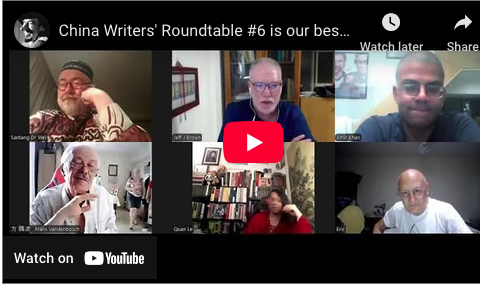
China Writers' Roundtable #6 is our best yet!
Amir Khan, Eric Arnow, Frans Vandenbosch, Jeff J. Brown, Kwan Lee, Patrice Greanville and T.P. Wilkinson tell it like it is
| Traducir—Translate! | |
| Make fonts bigger>>> | Resize text-+= |
I thought this roundtable would be of interest to people looking for an unusually clear and candid analysis of the state of the world, focusing on the clash between the US empire and the BRICS bloc, led by China, Russia and Iran. An in-depth summary is also provided.—PG
NOTE: We are using Brighteon as a backup due to YouTube's (Google) extreme propensity to censor and ban materials that contravene the accepted imperialist narrative (massive lies!)
AND HERE'S THE YOUTUBE VERSION. As warned above, it may vanish suddenly. If so, no worries, the Brighteon copy will hopefully remain.
The discussion is a comprehensive, multi-faceted dialogue among experts concerning current geopolitical tensions, the dynamics of power, and the ideological and cultural underpinnings of global conflict. It begins with an analysis of regime change operations in Serbia and Azerbaijan, highlighting Western covert influence and deep infiltration by intelligence agencies. The conversation expands to explore the role of secret societies like Freemasonry in geopolitical maneuvering, and the strategic projects linking Turkey, Azerbaijan, and Armenia aimed at destabilizing Russia and Ukraine.
The panel delves into the nature of Western dominance, emphasizing the fusion of hard power (military and economic) and soft power (psychological, cultural, and religious influence). They discuss the ideological rigidity and dualistic thinking embedded in Western monotheistic religions, contrasting it with Eastern philosophies like Confucianism and Buddhism, which promote meta-awareness and empathy. The speakers critique the Western capitalist system as inherently self-destructive due to its foundation in selfishness and exploitation.
A significant portion is devoted to the strategic posture of China, Russia, and Iran as they confront the decaying Anglo-American-led global order, referred to as the “kakistocratic feudal conglomerate.” The panel debates the feasibility and ethics of decisive military action (“kill shot”) versus a protracted, multifaceted strategy involving economic strangulation, technological control, and diplomatic maneuvering. They underscore nuclear weapons as a critical limiting factor, enforcing extreme caution in direct conflict.
The conversation also touches on the cultural and psychological challenges in transforming Western societies, where mass consciousness is deeply shaped by propaganda and entrenched narratives. Meditation and education are proposed as long-term remedies to loosen rigid dualistic mindsets. The participants acknowledge the inevitability of systemic collapse due to internal contradictions but stress the importance of intellectual and moral preparation for a post-collapse world.
Finally, the group reflects on personal motivations for activism and writing, emphasizing authenticity and the role of individual example over mass persuasion, while recognizing the difficulty of changing entrenched systems. The dialogue ends with plans for future meetings and expressions of gratitude for the shared intellectual engagement during this exceptional historical moment.

Key Insights
️ Western Regime Change and Intelligence Penetration: The discussion reveals that Western powers maintain deep covert influence in strategic regions like Serbia and Azerbaijan. The presence of US military and intelligence personnel in Serbia since at least 2016, combined with cultural infiltration through secret societies such as Freemasonry, illustrates a long-term strategy of destabilization and control. This highlights the sophisticated and layered nature of geopolitical power projection beyond conventional military means.
Freemasonry as a Geopolitical Tool: The panel underscores Freemasonry’s role as a bonding and infiltration mechanism for the Anglo-American establishment. Its historic roots in strategic hubs like Baku and connections to Ottoman-era covert groups illuminate how secret societies serve as conduits for influence, blending ideology, espionage, and elite networking. This insight deepens understanding of how non-state actors and cultural institutions interact with hard geopolitical interests.
Hard Power Underpins Soft Power: Contrary to common perceptions that Western soft power is based on cultural or philosophical superiority, the speakers emphasize it is fundamentally the result of organized violence and hard power (military and economic strength). The West’s ability to dominate global narratives and psychological influence stems from its historical military and economic supremacy, which is now being challenged by China, Russia, and Iran through coordinated multifaceted strategies.
☯️ Dualistic Thinking and Its Consequences: The conversation provides a profound cultural and psychological analysis, tracing Western monotheistic religions’ rigid dualistic worldview (good vs. evil, us vs. them) as a root cause of aggressive and exclusionary politics. In contrast, Eastern philosophies like Confucianism and Buddhism encourage a meta-representational awareness of self, fostering empathy and reducing dogmatic conflict. This cultural divergence shapes how civilizations engage with power and conflict.
⚠️ Limits Imposed by Nuclear Deterrence: Nuclear weapons create a paradox in global conflict dynamics. While many express frustration with the West’s hegemonic behavior, the existence of nuclear arsenals imposes caution and restraint on direct military action from China and Russia. This reality necessitates a strategic approach relying on economic, technological, and diplomatic pressure rather than outright war, highlighting the delicate balance of modern geopolitics.
♻️ Capitalism’s Self-Destructive Dynamics: The panel critiques capitalism as a system predicated on selfishness, hyper-individualism, and exploitative financial mechanisms (e.g., usury and compound interest). These inherent contradictions lead to systemic crises that weaken Western powers internally. This insight supports the view that the current global order is unsustainable and will eventually collapse under its own contradictions, creating a historical turning point.
Activism as Authentic Example Rather Than Mass Conversion: Recognizing the near-impossibility of changing entrenched systemic power or mass consciousness, the discussion stresses the importance of individual authenticity and living as an example. Activism and writing are framed not as efforts to convert others en masse but as expressions of personal truth and contributions to a gradual expansion of awareness, embodying the principle of enlightened engagement despite prevailing adversities.
Additional Contextual Insights
- The discussion about the “Zangu corridor” project linking Turkey and Azerbaijan to destabilize Russia and Ukraine sheds light on how regional conflicts are interconnected within larger geopolitical strategies.
- The role of China’s global initiatives—development, security, civilization, and AI governance—as an alternative empire model contrasts with the Western plutocratic oligarchy, emphasizing a civilizational competition rather than mere power struggle.
- The reference to the psychological impact of mass media control in the West, termed the “information fortress,” explains why objective truths and military capabilities of adversaries are often dismissed or suppressed in Western public discourse.
- The emphasis on meditation and education as tools to dismantle rigid dualistic thinking and foster empathy offers a long-term cultural strategy to counteract destructive ideologies.
- The candid recognition of “western plebs” as largely brainwashed and politically powerless illustrates a pessimistic but realistic assessment of societal transformation challenges in the West.
This extensive and nuanced conversation provides a rich analysis of the current geopolitical landscape, revealing the complexity of power, culture, ideology, and strategy shaping the global order’s future trajectory.

THe views expressed herein are solely those of the author and may or may not reflect those of The Greanville Post. However, we do think they are important enough to be transmitted to a wider audience.
All image captions, pull quotes, appendices, etc. by the editors not the authors.
YOU ARE FREE TO REPRODUCE THIS ARTICLE PROVIDED YOU GIVE PROPER CREDIT TO THE GREANVILLE POST VIA A BACK LIVE LINK.
 This work is licensed under a Creative Commons Attribution-NonCommercial 4.0 International License




3 Comments
Amazing collection of formidable brain power:
The dominating discourse was disagreement between Amir and Kwan Lee. Emotionally I am on Amir’s side, I agree you need to give the bully a bloody nose to make them stop, and the Palestinians have run out of time. But intellectually I think the more prudent approach is that of Kwan Lee.
Dimitry Lascaris said our main task this century is to manage the decline of the US empire* without getting us all killed.
*that includes the rabid dog Israel.
A head on confrontation with a rabid dog is dangerous. If Israel is backed into a corner they may be crazy enough to resort to their Samson option, and it is best to force them into the Samsonite option, to pack their bags, together with their nuclear weapons and to bugger off, as the diehard racists did in South Africa.
This nuanced view is well explained by a brilliant Palestinian/Syrian journalist based in Lebanon, Laith Marouf, a must see interview.
https://www.youtube.com/watch?v=0CAcPSmUoTc
Beyond the grave urgency of stopping genocide, time is on the side of China and Russia. My view is that de(US)dollarisation is the key – pull the financial rug out from under the USA, which will then lose their ability not only to fund Israel but will have to pull back from its 800 military bases around the world. This is happening faster than ever.
https://podbay.fm/p/multipolarista-146684/e/1756305336
You’re right, and you may have noted that we publish Laith frequently. The vid you suggest was run back in June: https://www.greanvillepost.com/2025/06/25/laith-marouf-the-resistance-rises-stronger-than-ever-before/
I am not quite in agreement with the things said here. First of all, I do not believe in psychological explanations. Few real elite owners are crazy or even unbalanced. Their class is very clever in getting and holding power. They own the police and the army. They control education, getting their children into universities and laming high school education.
They own the propaganda mills of radio and television. One cannot be crazy and attain to all that. Throughout human “civilization”, the pyramidal class system has reigned, already from earliest China, to Mesopotamia, to Egypt, to Rome, all ruled by smarts, crime and stealth. To reform society, a full re-orientation is needed, away from the Stockholm Syndrome.
This was understood by Lenin and how tough it is to break the bondage of such societies. Nothing much changed for 5000 years except for the French and Russian revolutions. In both countries the masses have changed, in one more than the other. China is way ahead and it is there one should look for the right methods and tools for change. With its success, the world will follow. Till then we will have to endure the last convulsions of a dying system.