
 Billy Bob's Blowback Roundtable
THE WORLD THROUGH AN INDEPENDENT LEFT LENS


| Resize text-+= |

Streamed live on Aug 29, 2025
Episode 160 of Blowback: Exposing Imperial Decline with special guest Greg Rosen.
Summary
The episode 160 of Blowback: Exposing Imperial Decline features hosts Billy Bob, Ian Kummer, Carlo Parcelli, and guest Greg Rosen discussing the concept of “liberal genocide”—the paradox where liberal democracies, often proclaiming human rights values, have historically engaged in or facilitated genocides to sustain oligarchic power and imperial interests. They examine multiple examples of genocidal actions post-World War II—including U.S.-backed death squads in Latin America, mass killings in Indonesia, devastation in Vietnam and Korea, and the ongoing genocide in Gaza. The conversation highlights Western hypocrisy, especially the stark contrast between proclaimed liberal values and actions taken abroad, with Gaza as a particularly egregious example where Western media and governments have largely ignored or justified atrocities.
The discussion extends to the manipulation of historical narratives, particularly the framing of the Holocaust to prioritize certain victim groups while sidelining others, which has influenced Cold War politics and support for Israel. The panel critiques U.S. foreign policy, Israel’s actions, and the Western media’s role in obfuscating realities. They also analyze geopolitical dynamics involving Russia, China, India, and the BRICS nations, noting the failure of Western sanctions and attempts to isolate Russia, and the growing multipolar world order challenging Western imperialism.
Furthermore, Greg Rosen introduces a nuanced discussion on China’s ideological evolution, emphasizing that Chinese socialism is pragmatic rather than dogmatic. He explains China’s shifts from Mao’s era of radical egalitarianism to Deng Xiaoping’s market-oriented reforms, arguing these changes aimed at improving material conditions for the working class within the constraints of global capitalism. The conversation critiques Western leftist misconceptions about China and stresses the importance of understanding Marxism and socialism as adaptive, material-condition-driven philosophies rather than rigid ideologies.
The episode closes with reflections on the challenges of ending the Ukraine conflict, the strategic limitations of U.S. policy, and the broader struggle within Western ruling classes regarding imperial priorities.
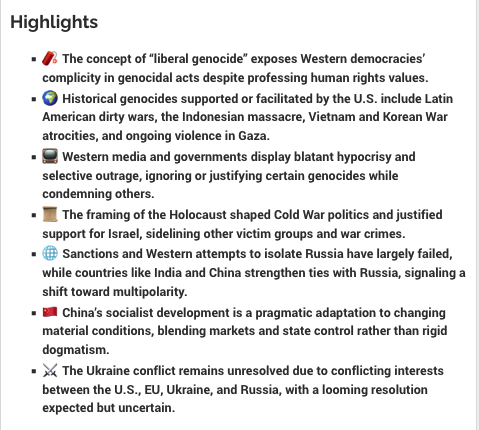
Key Insights
Liberalism as a Facade for Oligarchic Interests: The discussion reveals that liberalism, often idealized for its defense of human rights and democracy, primarily functions as a system to maintain the power of oligarchs and imperialist agendas. Human rights rhetoric is subordinate to material interests, allowing liberal states to engage in or enable genocidal violence without moral accountability. This reframes liberalism not as a pure ideology of justice but as a strategic tool for empire preservation.
⚔️ Genocide Beyond Classical Definitions: The hosts expand the concept of genocide beyond mass murder to include systemic destruction of societies, such as environmental devastation (Vietnam’s jungles), forced displacement (Gaza), and economic strangulation (sanctions against Xinjiang). This broader interpretation challenges conventional legal and moral frameworks, forcing a reconsideration of what constitutes genocide in contemporary geopolitics.
Hypocrisy in Western Media and Policy: The Western media and government responses to genocides are inconsistent and politically motivated. For instance, the alleged “Xinjiang genocide” is heavily propagandized despite lack of concrete evidence, while the Gaza genocide is largely ignored. This selective outrage reveals the instrumentalization of human rights narratives to demonize geopolitical adversaries while protecting allied actors, thereby undermining genuine human rights advocacy.
Multipolarity Undermining Western Imperialism: The episode highlights how nations like India, China, Russia, and the BRICS coalition resist Western pressure, particularly in economic and geopolitical arenas. India’s refusal to cease Russian energy imports despite U.S. sanctions demonstrates the limits of Western coercion and the shifting global order toward multipolarity. This evolution threatens the unipolar dominance of the West and redefines international relations.
Reconceptualizing Chinese Socialism: Greg Rosen’s detailed analysis challenges Western misconceptions that equate Chinese reforms with capitalist betrayal. Instead, China’s approach is portrayed as pragmatic Marxism, adjusting policies based on material conditions to advance the working class’s interests. This dialectical method—oscillating between egalitarianism and technocratic reforms—illustrates socialism’s adaptability rather than ideological rigidity, offering a more nuanced understanding of global socialism.
The Role of Ideological Warfare in Maintaining Oligarchy: The panel stresses that ideological control, through propaganda and shaping historical narratives (e.g., Holocaust branding), is central to preserving oligarchic dominance. By framing certain narratives, the ruling class justifies imperial wars, suppresses alternative viewpoints, and divides opposition. Understanding this ideological battle is crucial for comprehending contemporary political conflicts.
⚖️ Complexity of Conflict Resolution in Ukraine: The discussion reveals the multiplicity of actors and conflicting interests preventing a fair and just resolution to the Ukraine war. While the U.S. under Trump appeared open to ending hostilities and normalizing relations with Russia, the EU and Ukraine remain committed to prolonging the conflict for their own strategic aims. This internal division within the Western alliance complicates peace prospects and prolongs suffering, underscoring the geopolitical stakes involved.
Conclusion
This episode offers a critical deconstruction of Western liberalism, exposing its complicity in genocidal violence and imperialist strategies. It situates contemporary conflicts like Gaza and Ukraine within a broader historical and ideological framework, highlighting the selective nature of human rights advocacy under empire. The conversation also provides an insightful reevaluation of China’s socialist path, emphasizing pragmatism and dialectics over dogma. Finally, it underscores the global realignment toward multipolarity as a key challenge to Western hegemony, with profound implications for future international politics and the struggle for justice worldwide.
[t4b-ticker id="1"]
ABOUT THE AUTHOR / SOURCE Editor at Large Billy Bob is a dedicated anti-imperialist activist and blogger. He hosts the Blowback roundtable. You can reach him at his Facebook page HERE.
 Editor at Large Billy Bob is a dedicated anti-imperialist activist and blogger. He hosts the Blowback roundtable. You can reach him at his Facebook page HERE.
 Print this article [bws_pdfprint display=’print’]
The views expressed herein are solely those of the author and may or may not reflect those of The Greanville Post. However, we do think they are important enough to be transmitted to a wider audience.

Unfortunately, most people take this site for granted.
DONATIONS HAVE ALMOST DRIED UP…
PLEASE send what you can today!
JUST USE THE BUTTON BELOW
 This work is licensed under a Creative Commons Attribution-NonCommercial 4.0 International License


1 comment
For practical reasons:
https://www.wsws.org/en/articles/2025/09/01/jhnj-s01.html