Please make sure these dispatches reach as many readers as possible. Share with kin, friends and workmates and ask them to do likewise.

 Billy Bob's Short Takes
Provocative discussions of contemporary events
by a remarkably astute observer



Trump bloviating his usual jingoist effluvia at Mt Rushmore (July 4, 2026)
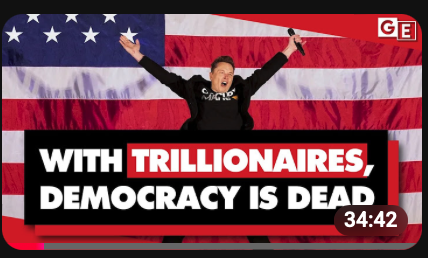
Let me do my best to promote, summarize, and critique these superb presentations by Ben Norton on the question of oligarchy (and resultant fascism), a topic no free citizen concerned with justice and genuine democracy can remain indifferent to.
In these videos, Ben elaborates on the oligarchs' perceived necessity to make changes to global economic relationships in a way which will continue to guarantee US global hegemony and maintain the US dollar as the global reserve currency throughout the rest of the 21st century.
Ben observes that the current system was put into place by the US in order to benefit the US and give them extreme power and privilege which they ultimately used to enrich themselves and to crush alternative and superior systems.
As the decades have gone by, the system the US created and benefitted from, has resulted in a situation where the US is no longer the system's prime beneficiary. Other countries, especially China, have analyzed the system, learned the game, and have played it so well that the US must now change the game if they are going to maintain their preeminence and avoid being usurped ("usurped" as much as a thief and a sociopath can be), and surpassed as the most important, influential, and powerful country on the planet.
Ben shares numerous clips of the oligarchs conceding this reality and explaining in no uncertain terms, the problems that they perceive themselves to be facing and the solutions that they propose. These gangsters of capital are really no different than any criminal enterprise as they lack any concern whatsoever for principles of justice, morality, or improvement, and are simply and solely concerned with destroying rivals and maintaining pre-eminence.
DATELINE—JUNE 13, 2026
The oligarchs tell themselves that their violently imposed and exploitative system has been a blessing (sic) to the world and they assert that the world should be thankful for the global economic system that the US has not only created, but which maintains through its 800+ overseas military bases. Like true narcissistic psychopaths, the US oligarchy sees itself as having sacrificed for the good of the planet, although recentlym the rest of the world has been taking advantage of US largesse and has not been paying its fair share. (This is a favorite complaint of demagog Trump against NATO members. Trump, of course, conveniently forgets NATO was created first and foremost to benefit the US, and to project offensive power against Moscow, which it continues to do till this day).
Instead of accurately perceiving themselves to be ruthless and violent exploiters that have created a rigged system that is incompatible with democracy and which perpetuates poverty, war, and unstable cycles of boom and bust which the elites are able to become even more obscenely wealthy from, the oligarchs treat the current system as ideal, optimal, and un-improvable. And it certainly is, *IF YOU ARE AN OLIGARCH*. This is the best possible system from the perspective of the oligarchs who are the primary beneficiary of the oligarchic system (known in the West as liberal democracy).
Rule by the rich: Western governments are oligarchies, not democracies
So Trump tells his oligarch vassals that if they appreciate and value this system that the US maintains and guarantees through a system of violently imposed sanctions, assassinations, wars, regime change operations, genocides, a global military network that includes 800+ foreign military bases, and the greatest propaganda apparatus the world has ever seen, then they need to start paying more tribute, it is as simple as that. And really, Trump is correct. America's vassal oligarchs that have set themselves up as the legitimate government of all the capitalist states, truly have no alternative but to increase tribute to the Don. After all, no other country is remotely prepared to replace the US Don and the only other alternative to that is socialism and an end to the entire oligarch system. This is the threat that China poses.
Recently, we saw the truth of everything explained above borne out in real time, when the US suspended for 90 days, the tariffs against every other nation except for China. The Communist Party of China represents the existential threat to the Western oligarchy and Trump is doing his best, on behalf of the global oligarchy to sound the alarm, rally the oligarchs to this cause, get them to wake up to the seriousness of the threat, and to start sacrificing more in order to defeat this would be usurper.
This is no easy task. Oligarchs are often non-ideological and have no concern for anything other than their own ability to exploit and profit. Trump has accepted the difficult task of waking up, cajoling, and uniting, the global oligarchs who take this system for granted and who are ignorant of the threat that the system is under, and who naively believe that the system will simply last forever without any kind of decisive effort to destroy the rising tide of democracy and socialism.
It is fascinating to listen to the actual messaging from the spokespeople charged with accomplishing this task. They tell a story of benevolent virtuous rulers who are being taken advantage of by freeloaders who put everything at risk because of their refusal to give more in order to defeat the evil threat.
Ben Norton's presentations are a superb expose on this situation but it did not touch on one important issue. Norton ignores the fact that the tariff war is only one minor aspect of the growing effort to "contain" (weaken) China and guarantee US preeminence throughout the rest of the 21st century. Ben does not touch on how the US Marine Corps has been re-tooled over the last decade to specifically counter China by choking its maritime trade, thereby interdicting Chinese imports and exports, while manning forward assault bases, all of which would supposedly bring China's skyrocketing economy to a grinding halt.
Ben focuses on the weaknesses of the US tariff strategy which he correctly points out, is highly unlikely to achieve any of its desired aims. But what I think he should not have left out, is the fact raised above that the global oligarchy truly has no choice but to side with the US and go all-in on a combined effort to weaken and destroy China. This effort has barely gotten underway and we have yet to see the most dangerous aspect rolled out, which will be the violent imposition of a global trade embargo against China enforced by the US Marine Corps. If necessary (probably inevitably) their newly formed anti-shipping units, stationed at all the strategically important choke points of global commerce, will utilize their anti-shipping missiles and autonomous drones, to enforce an embargo against China. This is the sword of Damocles that folks like Mearsheimer believe provides the US likely victory in the security competition with China.
For the record, I believe that China won this security competition about ten to fifteen years ago and all of these efforts and plans by the global oligarchs will only result in global economic catastrophe and anacceleration of their own decline. But it will be absolutely painful and devastating to the global economy and people need to understand that there is an obvious alternative than the global oligarchs fighting to their death to maintain their shitty exploitative system. But history has seen this paradigm played out ad infinitum. Privileged elites will kill and die before they allow improvement to usurp their own wealth and power. This is the Marxist dialectic and it will be once again playing out in real time, right before our eyes.

 This work is licensed under a Creative Commons Attribution-NonCommercial 4.0 International License