
[su_spoiler title=”Please make sure these dispatches reach as many readers as possible. Share with kin, friends and workmates and ask them to do likewise. ” open=”yes” style=”fancy” icon=”arrow-circle-1″]

 DISSENT IN BLOOM
| Traducir—Translate! | |
| Make fonts bigger>>> | [wpavefrsz-resizer] |
Google Is Handing Data of ‘ICE Critics’ to DHS
DISSENT IN BLOOM • FEB 14, 2026

If you have an Android, if you use Google Chrome, or if you use Google Search? It records every search, every email, every location ping, every app download, every photo you take, every late night purchase, every quiet curiosity. It remembers what we forget.
But that shadow stretches further. Google also runs the cloud infrastructure government agencies use. It stores our metadata until investigators request it, and even builds artificial intelligence systems that can sift through human lives at a scale no person ever could.
If you have a Google account, you can actually see just how much data Google has collected on you by clicking here.
They told us that it was only for advertising. That the massive amounts of data that they’ve stored on us stayed inside the company because no corporation would ever jeopardize its edge. Self interest would keep us safe, and greed was framed as a safeguard.
Now, with big tech’s alignment with the Trump administration, that very logic collapses. The same private data they once mined for profit is slowly being positioned as a tool of governance. For Google, that shift is subtle, layered in administrative subpoenas from DHS, government contracts with CBP, and complex legal infrastructure, structured just carefully enough to preserve plausible deniability.
THE DEPARTMENT OF HOMELAND SECURITY WANTS YOUR DATA
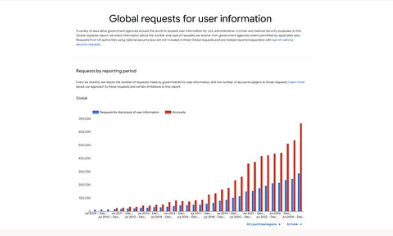
Over the last decade, Google has overwhelmingly complied with millions of government requests for user data, and those requests have been climbing for five years. There is no rule requiring platforms to tell you when it happens, and many people never find out at all.
For example, Amandla Thomas-Johnson, a journalist who advocated for Palestinians, only learned he had been targeted by DHS weeks after the fact. Google notified Thomas-Johnson in April with a brief email informing him that his metadata had already been shared with the Department of Homeland Security.
The damage was done before the message ever arrived. ICE had requested and was given a list of his usernames, addresses, an itemized list including any IP masking tools, telephone numbers, subscriber identities, and credit card and bank account numbers.
Yes, requested. This was a request. Not legally required.
In the letters, they talk about how DHS’s subpoenas are unlawful, and the government already knows this. Which is why when a small number of targeted users challenged those subpoenas in court with help from ACLU affiliates in California and Pennsylvania. DHS did not wait for a judge to rule. It withdrew the subpoenas before any decision could be made.
Unlike a search warrant, an administrative subpoena is not approved by a judge. If a technology company refuses to comply, an agency’s only recourse is to drop it or go to court and try to convince a judge that the request is lawful.
But this is what the federal government is using to compel private companies to unmask its critics by name.
It’s happening alongside DHS’s existing contract with Zignal Labs, which is already scanning your social media around the clock using AI. This data is all fed into Palantir, a program used by ICE to identify protestors with face scans during the Minnesota ICE protests, even going as far as following some home because it aggregates extensive personal data from phone numbers, physical addresses, names, and more.
And in 2026, the department plans to open multiple government-funded facilities running around the clock, dedicated entirely to monitoring what you post online.
There was once a moment in history when Google forced the NSA into the light by publicly requesting permission to disclose their surveillance requests, knowing that even asking would expose the pressure behind the scenes as the NSA collected data for PRISM. It is hard to believe this is the same company.

For years, Donald Trump publicly attacked Google almost as often as he attacks immigrants. He has accused the company of rigging search results, suppressing conservatives, and amplifying Obama over him.
At one point, he openly said that Google was working hand-in-hand with China:
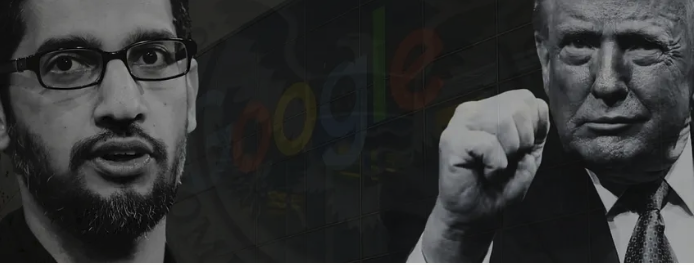
In July 2021, Trump filed a class-action lawsuit against YouTube LLC (Google owns this) and its CEO, Sundar Pichai, claiming his post January 6 suspension from YouTubeamounted to unconstitutional censorship and a direct assault on his First Amendment rights.
In 2022, despite banning Trumps YouTube account, Google approved Truth Social for Google Play Store.
Google settled that YouTube lawsuit giving Trump $24.5 million in September 2025. That same month, the company was forced to implement remedies in the antitrust caseit had lost to the Department of Justice in July that year.
Googles CEO later thanked Trump for anti-trust resolution during the billionaires dinner at the Oval Office.
But the alignment did not begin there. If anything, the ruling formalized what was already in motion.
In January 2025, Google donated $1 million to Trump’s inauguration fund. It was not alone. Uber, Amazon, Robinhood, Chevron, and Pilgrim’s Pride all made similar contributions for the same amount or more.
Google also donated millions to Trump’s ballroom fund in 2025.
Across Silicon Valley, the number seemed to settle at the around the same figure. One million dollars or more. Nearly every major tech player contributed at that level, often paired with personal donations from their CEOs.
Companies like Perplexity AI, C3 AI, Nvidia, J.P Morgan, Microsoft, Amazon, Bank of America, Blackrock, Coinbase, Goldman Sachs, and even Adobe joined the list.

Sam Altman of OpenAI (ChatGPT), and Tim Cook of Apple each donated $1 million dollars. Personally. From their own bank accounts.
And it paid off. They knew it would. You could see it in their faces at the 2025 inauguration, Google’s CEO among them. The CEO of Google, Sundar Pichai, officially reached“billionaire” status in 2025, and Palantir just boasted to their shareholders that 2025 was their highest earning fiscal year yet.
You can view the entire list of Trump’s inauguration donors by clicking here.
The technocratic class has only grown richer, our civil liberties have decreased, and the surveillance state grows.
TERMS AND CONDITIONS OF POWER
When Trump illegally extended the TikTok ban, and then Trump demanded that Google and Apple put it back on the app store. They did. In 2025, Google, Microsoft, and Meta ended ‘DEI reporting’ on workplace diversity in alignment with the Trump Administation..
Google Search prohibits autocomplete for the phrase, ‘impeach Trump’
And of course, they have aligned with the White Houses “AI Action Plan” and the U.S. government uses Googles AI, Gemini. They are also among the companies pursuing Project Vault and FORGE, a program built around extracting the critical minerals that power EVs, batteries, semiconductors, and the entire architecture of the AI economy.
Earlier this year, Google (who owns the Android operating system) discretely removedPride Month, Black History Month, Indigenous Peoples Month, and Hispanic Heritage Month from its default Android calendar.
Google went on record stating that their recognition was, “not sustainable” while whole chapters of history removed under the guise of a ‘routine update.’ (2026).
GOOGLE POWERS ICE?
In 2025, hidden in federal contract documentation, it was confirmed that Google had been secretly powering CBP border surveillance towers with AI capable of automated human detection and mass-scale video storage. The company had previously said it wasn’t doing this. It had been doing this.
As of February 2026, more than 800 Google employees have formally petitioned leadership after it was revealed DHS was using Googles cloud servers, condemning Google for allowing its technology to be used this way.

STEPS YOU CAN TAKE TO PROTECT YOUR DATA
These settings allow Google to track your movements, save your searches, and build an ad profile on you — so turning them off is a quick win.
Next, delete the data Google has already collected on you. You can wipe your search and location history and set up auto-delete so it doesn’t pile up again.
Small habit changes also go a long way. Swapping Google Chrome for a browser like Firefox or Brave, and using DuckDuckGo instead of Google Search, cuts down on how much data gets collected in the first place.
The truth is, if you use Google services, some tracking is unavoidable. But taking these few steps can seriously limit how much Google knows about you.
You can also download all the data they have on you at www.takeout.google.com

This is not just a story about Google. It is a story about what happens when the most powerful surveillance infrastructure ever built decides that power is more valuable than principle. Every search you have ever made, every location ping, every quiet 2 a.m. curiosity — that data was never just for ads. It was always a resource waiting for the right buyer, the right administration, the right moment. That moment has arrived. What we are watching in real time is the architecture of a surveillance state being assembled not through legislation, not through public debate, but through contracts, donations, quiet policy deletions, and unanswered subpoenas.
Once it is fully built, it will not be dismantled easily or willingly. The question is not whether you trust Google. The question is whether you trust every government that will ever exist, now and in the future, with a complete and detailed record of your life. Because that is precisely what is being handed over — not to this administration alone, but to the institution of state power, permanently and without your consent.
The steps listed above are small, but they matter. Take them anyway, and then demand more from the companies that built this shadow and from the representatives who are supposed to keep it in check. Silence, at this point, is not neutrality but permission.

If you enjoyed this article, if you learned something, or if you find yourself reading my work often feel free to the heart down below, and hit that subscribe button above. You can choose a free or paid subscription. None of my articles will ever cost money to read. Paid subscriptions and one-time-donations allow me to continue doing this work but are never expected. Only appreciated. Thank you for taking the time to read, like, comment, and restack to spread the information. I hope I’ll see you in the next one.
BEFORE you leave, PLEASE pay attention to this alert.
[t4b-ticker id=”1″]
[/su_spoiler]
Print this article [bws_pdfprint display=’print’]
[su_note note_color=”#f1efef” radius=”0″]The views expressed herein are solely those of the author and may or may not reflect those of The Greanville Post, although, if we publish them, we obviously find them noteworthy and valuable. [/su_note]
 This work is licensed under a Creative Commons Attribution-NonCommercial 4.0 International License •
ALL CAPTIONS AND PULL QUOTES BY THE EDITORS NOT THE AUTHORS

