Wednesday, June 24 2026 - Welcome • Bienvenidos • Bienvenu
Putin the Silovik
Cuba adopts emergency measures
AMB Chas Freeman : Should Iran Trust Trump? (Silly question!)
Gustavo Petro: Israel Stole Colombia’s Presidential Election
Are the US and Israel really fighting? Or is something bigger happening?
How This Is The Worst World Cup Already
Wondrous Seahorses Are Threatened
Seyed M. Marandi & Larry Johnson: Iran Demands Lebanon Withdrawal as U.S....
Alastair Crooke: An Irreversible Blow to Israel
Can China Resist the Temptation of Empire?
  • HOME
  • ESSENTIAL
  • MYTH-FREE HISTORY WITH JACQUES PAUWELS
  • MUST VIDEO
  • BLOWBACK
  • NATURE
The Greanville Post
Knowledge Ammo to Combat the Reigning Sociopathy
  • HOME
  • ESSENTIAL
  • MYTH-FREE HISTORY WITH JACQUES PAUWELS
  • MUST VIDEO
  • BLOWBACK
  • NATURE
Home Author
Author

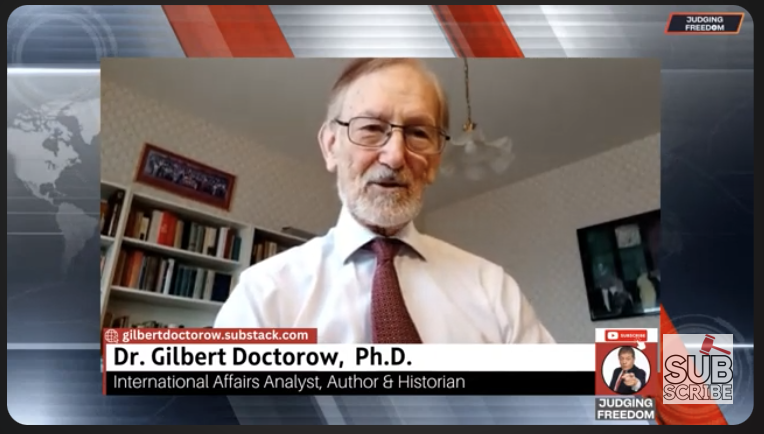
Gilbert Doctorow

  • Author Profile
  • Posts by the Author
  • Gilbert Doctorow: Restoring Russia’s Deterrent or Emboldening NATO?
  • JUDGE NAP: Guest Gilbert Doctorow sees enormous changes in Russia’s leadership as a result of Western unceasing pressure
  • DISPATCH FROM JUDGE NAP—G. Doctorow : Are Russians Losing Patience?
  • From power of the pen to power of civil disobedience: Blinken’s farewell presser interrupted by courageous journalist protesters
  • Prof. Gilbert Doctorow : Ukraine War’s Impact on Russia.
  • Dr. Gilbert Doctorow: Russia’s Next Move, The Trump Factor Shakes Washington
Gilbert Doctorow

Gilbert Doctorow is an independent political analyst based in Brussels. He is a magna cum laude graduate of Harvard College and holds a doctorate in Russian history from Columbia University.

Gilbert Doctorow: Restoring Russia’s Deterrent or Emboldening NATO?

by Gilbert Doctorow Published: October 8, 2025
written by Gilbert Doctorow Approx 44 Mins * Watch / read
Doctorow Diesen
Please make sure these dispatches reach as many readers as possible. Share with kin, friends and workmates and ask them to do likewise.

Glenn Diesen
CHATS WITH
Dr. Gilbert Doctorow
Traducir—Translate!
Make fonts bigger>>>
Resize text-+=


Gilbert Doctorow: Restoring Russia’s Deterrent or Emboldening NATO?

Glenn Diesen

Oct 4, 2025
Dr. Gilbert Doctorow discusses Putin's Valdai speech, which Doctorow believes sent the wrong signals. A common concern in Moscow is that its efforts to de-escalate are interpreted in the West as weakness, and this is likely the consequence of Putin's speech.


Summary

The discussion centers on Vladimir Putin’s recent speech at the Valdai Discussion Club in Sochi, a significant annual geopolitical forum, and its implications amid the ongoing Russia-Ukraine war and rising global tensions. Historian and international affairs analyst Gilbert Doctor provides a critical assessment, highlighting that Putin’s speech fell short of expectations, particularly regarding Russia’s deterrence posture and response to Western military support for Ukraine. Despite widespread anticipation that Putin would deliver a stern warning against Western involvement—especially the supply of long-range missiles like Tomahawks—his message was notably vague and conciliatory, even praising former U.S. President Donald Trump and proposing closer U.S.-Russia relations while dismissing Europe as a strategic irrelevance.

Doctor and the program host dissect the contrast between Putin’s optimistic tone and Russia’s harsh military realities, including ongoing battlefield attrition, Western deep strikes inside Russian territory, and the escalating risk of broader conflict. They note the inconsistency between Putin’s apparent downplaying of threats such as Western missile supplies and blockade efforts in the Baltic, and Russia’s actual military and political vulnerabilities. The conversation also considers internal Russian dissent, with polling data suggesting growing dissatisfaction with the war’s conduct despite Putin’s official popularity. The possibility of Putin’s removal or weakening within Russian power structures is raised, alongside concerns about miscalculation risks due to unclear escalation boundaries.

Overall, the discourse reveals a fractured and ambiguous Russian strategy marked by mixed signals: public optimism and diplomatic overtures on one hand, and intensifying military conflict and strategic risks on the other. The analysts caution that Putin’s softened rhetoric may embolden NATO and Western actors, potentially escalating the conflict and destabilizing global security.


Doctorow Putin warning Highlights


Key Insights

  • ⚠️ Erosion of Russian Deterrence Posture: Putin’s failure to reiterate the “red line” threat against countries supplying long-range missiles to Ukraine signals a weakening of Russia’s deterrence narrative. This could embolden NATO to escalate military aid, raising the stakes and potential for direct conflict. The ambiguity in Putin’s message undermines Russia’s strategic leverage and creates uncertainty about Moscow’s red lines.

  •  Putin’s Unusual Embrace of Trump and U.S. Relations: Putin’s praise of Trump’s peace plan and his expressed approval of closer U.S.-Russia ties mark a shift from his usual hardline stance. This signals that Russia may prioritize a bilateral détente with the U.S. over European concerns, reflecting a calculated geopolitical pivot away from Europe toward a reconfigured global power dynamic with the U.S. and BRICS countries. However, this approach risks alienating key Russian allies and domestic constituencies.

  •  Strategic Marginalization of Europe: Putin’s dismissive remarks about Europe portray it as a “strategic vacuum” and a collection of “weirdos,” indicating Russia’s diminished interest in European affairs and a strategic abandonment of the continent in favor of focusing on the U.S. and BRICS partners. This reflects Russia’s recognition of Europe’s growing hostility and its own isolation from the West, but also raises questions about the future security architecture in Eurasia.

  • ⚠️ Risk of Miscalculation and Escalation: The absence of clear and credible Russian deterrence threats creates dangerous ambiguity in the proxy war’s escalation ladder. Western incremental steps to support Ukraine, such as missile supplies and maritime blockades, may provoke unpredictable Russian responses, including potential strikes on NATO member states. This lack of escalation management increases the risk of unintended broader conflict, including nuclear brinkmanship.

  •  Potential Leadership Crisis in Russia: The discussion opens the possibility that Putin’s prolonged rule and perceived mishandling of the war could lead to internal challenges or even his removal, despite his high official popularity. The fatigue of key figures like Foreign Minister Lavrov and dissatisfaction within the military and political elites underscore an end-of-era dynamic. Such a development would profoundly impact Russia’s domestic stability and foreign policy trajectory.

Conclusion

The analysis of Putin’s Valdai speech reveals a complex and contradictory Russian stance amid one of the most dangerous geopolitical crises in recent history. While Putin projects optimism and seeks closer ties with the U.S., his ambiguous messaging on deterrence, combined with the harsh realities of military setbacks and Western escalation, paints a picture of a Russia under strain and at strategic crossroads. Internal dissent and the risk of leadership instability add further uncertainty. The lack of clear communication and credible deterrence increases the likelihood of miscalculations with potentially catastrophic consequences. Observers must therefore pay close attention to both Moscow’s rhetoric and actions as the conflict evolves.

BEFORE you leave, PLEASE pay attention to this alert.
[t4b-ticker id="1"]


Print this article [bws_pdfprint display=’print’]

The views expressed herein are solely those of the author and may or may not reflect those of The Greanville Post, although, if we publish them, we obviously find them noteworthy and valuable. 

Creative Commons LicenseThis work is licensed under a Creative Commons Attribution-NonCommercial 4.0 International License • 
ALL CAPTIONS AND PULL QUOTES BY THE EDITORS NOT THE AUTHORS

Published: October 8, 2025 0 comments
0 FacebookTwitterPinterestEmail

JUDGE NAP: Guest Gilbert Doctorow sees enormous changes in Russia’s leadership as a result of Western unceasing pressure

by Gilbert Doctorow Published: October 8, 2025
written by Gilbert Doctorow 20 Mins * Watch / read
Please make sure these dispatches reach as many readers as possible. Share with kin, friends and workmates and ask them to do likewise.

Judge Napolitano
CHATS WITH
Gilbert Doctorow
Traducir—Translate!
Make fonts bigger>>>
Resize text-+=


Judge Napolitano
Oct 8, 2025
Summary

The discussion --between Judge Nap and his guest Gilbert Doctorow--centers around the political future of Russian President Vladimir Putin and the evolving geopolitical tensions between Russia, the West, and Europe amidst the Ukraine war. Doctorow argues that Putin may soon voluntarily relinquish power due to his declining ability to respond effectively to Western threats and maintain deterrence. Despite Putin’s long tenure of 25 years, there is a growing perception within Russia’s political elite that a generational change is necessary, with capable successors like Prime Minister Mishustin, Moscow Mayor Sobyanin, and Foreign Minister Lavrov’s potential replacement, Yermakov, being visible. However, these discussions are largely covert, not publicly acknowledged, and the general Russian population still shows high approval for Putin, driven by economic improvements in certain sectors since the war began.

The conversation also highlights the strategic missteps of Putin, particularly his reliance on Donald Trump’s potential return to power as a geopolitical safeguard, which is seen as naïve given ongoing Western escalations, including sanctions and arms deliveries to Ukraine. Doctorow foresees the West, especially the EU, preparing to confiscate substantial Russian state assets as collateral for Ukraine’s war financing, a move tantamount to economic warfare that Russia may interpret as an act of war. There is growing concern about Europe’s ramped-up militarization, especially Germany’s rearmament plans, and the geopolitical ambitions of European leaders who seek to transform the EU into a geopolitical, rather than purely economic, entity by opposing Russia.

Doctorow perceives a risk of prolonged conflict fueled by Western financial and military support to Ukraine, potentially serving as a “bridging loan” until a broader confrontation with Russia is deemed feasible. This scenario is complicated by internal European divisions and skepticism toward war policies among some member states. Doctorow concludes that Putin faces a critical choice: either to assert Russia’s red lines firmly or step down, as continued hesitation and ambiguity weaken his position and Russia’s strategic posture.


Key Insights

  •  Putin’s Political Viability is Eroding Internally: Despite his public popularity, Putin’s ability to maintain deterrence and respond effectively to Western pressures is weakening. This internal erosion is more acute among Russia’s political elite than the general populace, signaling potential shifts in power dynamics that are not yet openly acknowledged but simmer beneath the surface. The presence of capable successors indicates an emerging transition, albeit a cautious and controlled one given the risks of instability.

  •  The Taboo of Discussing Putin’s Departure: The political class in Russia does not openly debate Putin’s potential exit due to the regime’s closed nature and fear of destabilizing narratives. However, private conversations and the expert’s analysis suggest this is a real and pressing concern. This secrecy reflects the authoritarian context where public discourse is tightly controlled, but private dissent and strategic planning continue.

  •  Putin’s Strategic Miscalculation on US Politics: Doctorow criticizes Putin for placing unrealistic hope in Donald Trump’s return to the US presidency as a way to mitigate Western hostility. This misplaced reliance has blinded Moscow to the accelerating Western measures, including sanctions and arms supplies to Ukraine, exacerbating Russia’s strategic vulnerabilities. It highlights the dangers of tying national security strategy to unpredictable foreign political developments.

  •  Economic Warfare as a New Front: The EU’s move to seize Russian state assets and use them to fund Ukraine’s war effort marks a novel and aggressive approach to economic warfare. This tactic skirts around direct asset confiscation by framing funds as collateral for loans, but effectively acts as resource denial to Russia. Such economic measures risk escalating tensions into outright conflict, as Russia may interpret these as acts of war, potentially justifying military responses.

  • ⚙️ Europe’s Geopolitical Transformation and Militarization: The EU is shifting from a primarily economic union to a geopolitical actor, driven by leaders seeking to assert Europe’s global role, often through military empowerment. Germany, in particular, is reactivating its military-industrial capacity, signaling a significant rearmament phase. This strategic pivot is as much about internal political survival for European leaders as it is about countering Russia, indicating a complex interplay between domestic politics and international security.

  • ⏳ Prolonged Conflict as a Strategic Tool: Financial support to Ukraine is viewed as a “bridging loan” to sustain the war effort until European powers are prepared for a potential direct confrontation with Russia. This suggests that the Ukraine war is not just a regional conflict but part of a longer-term geo-strategic calculation involving preparation for a future broader conflict. It underscores the risks of escalation and the difficulty of achieving a timely resolution.

  • ⚖️ Internal European Divisions and Risks: Despite the push for militarization and confrontation with Russia, Europe faces significant internal divisions, with countries like Hungary, Slovakia, and the Czech Republic expressing Euroskepticism and resistance to war policies. These divisions complicate the EU’s unified geopolitical ambitions and could undermine the sustainability of its confrontational stance, adding unpredictability to the evolving security landscape.

Overall, the expert’s analysis presents a nuanced and sobering view of Russia’s internal political challenges, the strategic missteps of its leadership, and the complex and escalating geopolitical contest unfolding in Europe and beyond. The discussion emphasizes the interplay between domestic politics, international strategy, and the risks of miscalculation in a volatile environment.


SELECT COMMENTS

Comrades,

Well, I've been living in Yalta for nearly six years now, and been coming here since 2016, so I think I know a little something about how Russians see President Putin. His favorability rating has been over 80% since the Special Military Operation! Dramatic improvements have been since he was elected in 2000, and since I've been living here, they have accelerated.

Construction is booming everywhere, new highways and roads; new hospitals and schools; a dramatic increase in the quality of living, wages are rising; unemployment is at 2%, and inflation is under control. There are more women with baby carriages and a toddler lagging behind than I can count!

There is no such thing as crime, much less violent crime. Wherever one goes, large cities or small towns, people are safe. Young kids 7-10 yrs are walking home along and taking public transport...alone!

The economy is stable in spite of massive US sanctions. The only ones hurt by them are all of us expats! No mail, no credit cards working.

An Irish economist and analyst who has been working in Russia for 20 some years told a group I was with that if Putin ever lost the support of the Russian people he was finished! He explained that Putin's main task was to balance two opposite poles. On the one hand there are powerful intellectuals and oligarchs who are western-leaning liberals and capitalists. On the other are equally powerful intellectuals and oligarchs who are patriotic Russians, like Putin.

Every Russian I know from ordinary people to journalists and academics believes that this war will go on for another "few" years, and they are supporting the troops and the government in many civic and volunteer ways.

There is no political chaos here. 180 or so different ethnic groups live peacefully together. Different religions live side by side with no difficulties. There is a very large Muslim community scattered across Russia. There are many Jews, and even Catholics and Protestants.

Russians have strong family values. In fact, strong families is one of the things that hold this society together.

Finally, Russians do not want war. Russia has never attacked Finland or Sweden, France, Germany, Italy or England. Ask anyone, and they will all tell you that Russia is a peaceful country that only wants to live in peace and harmony with all peoples.

Russia was provoked to enter Ukraine! The "core" issues go back to 1991 when Clinton broke the agreement made to Gorbachev that NATO would not advance one inch Eastward. Now NATO has surrounded Russia and was intending to make Ukraine a NATO country. The coup in 2014 was organized, funded, and directed by Joe Biden, Victoria Nuland, John McCain, Lindsey Graham and others, and it has been the USA that has funded the war in the Donbas Republics for these past  11 years! Russia had no choice but to intervene to prevent Ukraine from entering NATO, and to protect large numbers of ethnic Russians, and Orthodox Christians. Russia is fighting this war to defend the Motherland, and for no other reason.

I see no hope for a peaceful resolution to this conflict, nor to any other conflict the USA is waging militarily or with the use of soft power around the world. The empire will end when it collapses on its own, and the conflict in Ukraine will end when Ukraine raises the white flag and surrenders. Russia will dictate the terms, and no one else.

Regis

Regis Tremblay
Independent Filmmaker

Companeros,

I think Doctorow's theory is wrong, but it's important to have this discussion.
Garland Nixon

THE FOLLOWING FROM OUR DISTINGUISHED COLLABORATOR AMARYNTH FLOWER:

There are complexities here so this is a short summary of thought all of which is supported in the detail.

  • Gilbert Doctorow and Paul Craig Roberts - Meh!
  • Russia just in the last hours started decoupling from talks with the US.
  • Our near-term future increasingly looks like more war
  • Doctorow and cronies are kicking back to the Seymore Hersh piece that Trump is in cognitive decline.

Doctorow: 5th Column nonsense.  I listened to the Doctorow video with the judge, and this was my commentary in our Hearty Salon.

Doctorow is a twat. He is another Paul Craig Roberts.  (Paul Craig Roberts wants Putin to fight on behalf of Paul Craig Roberts and gets very worried if Putin does not do what Paul Craig Roberts wants Putin to do.  He wants Putin to make him feel better about his administrations.  This has now been for years, and about 7 years ago, my boss at the time and I made a joint decision to not even post his work, or pay attention to him in relation to Russia).

Now for Doctorow, treating Putin as if Putin is stupid and always but always pretending knowledge from a ‘higher class’ that nobody knows about. Of course, people talk about when Putin will go — and they talk about who will take over. That is normal.

If nobody heard it yet, Putin serves the Russian people and with China, the world.  He will go when they want him to go, or when he cannot continue or when he feels he is slowing down. And he will leave Russia in excellent hands.

Mr Lavrov looks tired these days, but there are a number of people who can take over from him. Not with the same flair, except for one or two that have flair but a little differently. Ryabkov? A very clever person, of course, but he is a little dumpling.

I think the comments from Doctorow are 5th column work, and thumbs up and thumbs down on a video, according to Doctorow, is not a reliable metric except for quantity. One certainly cannot derive quality or meaning from it. And if he gives an anti-Putin speech, just imagine how many ‘Putin Must Go’ westerners will turn up.

The following is what this is all about and what the kickback is all about.  The types of Doctorow are all over the media, trying to cancel this message. It is behind a pay wall and we can only see a little. We will probably find it with a bit of searching. Of course Seymour Hersh reports “what his contacts say”.

IS TRUMP IN COGNITIVE DECLINE?
==============================

The view from inside is that the president has been slipping
Seymour Hersh / Oct 7

Perseveration is a medical term used in the fields of psychology, psychiatry, and speech-language pathology to describe a particular response such as a phrase that is repeated or a gesture that is inappropriate. It’s a symptom most commonly seen in patients who have PTSD, autism, traumatic brain injury, or dementia. I thought of the term, which I heard many times over several years when a close relative was experiencing the degeneration of dementia, while viewing President Donald Trump’s seventy-one minute speech to an estimated eight hundred US military leaders who were assembled, for reasons still not clear, at the order of Pete Hegseth, the Army National Guard reserve major who is now the secretary of war, at the Marine Corps base in Quantico, Virginia, on September 30.

After a rah-rah opening speech by Hegseth, the president delivered his usual mixture of personalized history and complaints—most notably, he has repeatedly claimed credit for solving international crises that he did not solve—that some of his close aides in the White House understand to be yet another sign of his increasing mental disorganisation and inability to focus at high-level meetings.

Most significantly, I was told, Trump, always masterful in dealing with crowds, large or small, is no longer able to “read the room”—quickly size up the audience and let his instincts as a showman take over and get the audience engaged. It would have been refreshing, and perhaps unprecedented, for Trump to outline his views on foreign policy and give the assembled generals and admirals a chance to ask questions of their president. Instead, they got a reprise of Trump’s greatest triumphs. The president returned to one of his most misguided views—that of himself as a settler of wars. “I have settled so many wars since we’re here,” he said. “I’ve settled seven and yesterday we might have settled the biggest of them all,” referring to ongoing talks between Israel and Hamas. “Although,” Trump added, “I don’t know. Pakistan, India, was very big, both nuclear powers. I settled that.” There have been many newspaper reports from around the world disputing Trump’s accounts of the issues at hand, as well as his definition of what it means to “settle” a conflict…

---
And then, commentary from one of our commentators ...

Yeah, I distrust Gilbert…, even if they’re sincere, their class pretensions or affiliations seem false. The old IWW used to say that the employing class and the working class have nothing in common. I’m skeptical about unequivocal statements like that, but they do have a point. Academies exist, in measure, to capture and bring to heel otherwise dangerous intellectuals… and so I tend to distrust westzone academics…There are “rogue” intellectuals, however…and they never get tenure, and seldom even get hired….they find work in other areas…
And then, on the quo vadis question.  Dear heavens, we are in trouble.  I compiled a list of the wartalk from the last few days plus my commentary.  It does not look good.   https://sovereignista.com/2025/10/08/the-topic-is-war-cutting-to-the-chase-a-discussion/
Please also understand that Russia, in the name of Mr Ryabkov, just the past hours made announcements that means that the Russian/US talks are over.   Russia is decoupling from talks with the US.

There is no talk of extending the New START Treaty – Deputy Foreign Minister Ryabkov

He noted that Russia will manage without a response from the US if they are not interested in the New START initiative.
The momentum for Ukrainian settlement that emerged after the Putin-Trump meeting in Alaska has been exhausted — Ryabkov

My comments:  The US or the EU or NATO never wanted a settlement.  They wanted Russia to bend and the circus was set up.  They want this war as a perpetual war.  We need to understand now that Trump is only the circus master in his entirety.  In terms of the so-called Gaza peace plan, we need to again understand now that Trump is only the circus master – the fellow who reads out with much fanfare, the next act – a part of the crew.  Let the US Americans think deeply on this, and reconsider what exactly is happening with fear-pumping groups such as ICE.

The State Duma of the Russian Federation has just denounced the intergovernmental agreement with the United States on the disposal of weapons-grade plutonium.

The Russian government submitted the bill on denunciation. In addition to the agreement, it is proposed to denounce all accompanying documents. In particular, this concerns protocols regulating financing and civil liability for damage, as well as agreements on the disposal of plutonium covered by the agreement through irradiation in nuclear reactors.

So, we have decoupling going on here.
We are in a complex world.  Putin did speak about this in his Valdai speech quite in detail.  Those that say he was too soft, well ... I liked his quip about a crowbar .. “There’s no counter to a crowbar, except another crowbar”.  It is not hard to figure out where he stands if one reads that speech and if you see the decoupling over the past number of hours.   It is neither weak, nor is it desperate.  In fact he was incredibly comfortable in his skin so to speak and very clear.
All the best.  I've been living in this for the past few days.
Amarynth
https://sovereignista.com
Donations:  https://sovereignista.com/donate/


BEFORE you leave, PLEASE pay attention to this alert.
[t4b-ticker id="1"]


Print this article [bws_pdfprint display=’print’]

The views expressed herein are solely those of the author and may or may not reflect those of The Greanville Post, although, if we publish them, we obviously find them noteworthy and valuable. 

Creative Commons LicenseThis work is licensed under a Creative Commons Attribution-NonCommercial 4.0 International License • 
ALL CAPTIONS AND PULL QUOTES BY THE EDITORS NOT THE AUTHORS

Published: October 8, 2025 0 comments
0 FacebookTwitterPinterestEmail

DISPATCH FROM JUDGE NAP—G. Doctorow : Are Russians Losing Patience?

by Gilbert Doctorow Published: October 2, 2025
written by Gilbert Doctorow Approx 1 Hr • Watch / read
Please make sure these dispatches reach as many readers as possible. Share with kin, friends and workmates and ask them to do likewise.

Judge Napolitano
Judge NapCHATS WITH
Lt. Col Karen Kwiatkowski  • Gilbert Doctorow
Traducir—Translate!
Make fonts bigger>>>
Resize text-+=


Prof. Gilbert Doctorow : Are Russians Losing Patience?

Judge Napolitano
Streamed live on Oct 1, 2025


Summary

The video features Judge Andrew Napolitano hosting a discussion primarily focused on the evolving situation in Russia and Ukraine as of October 1, 2025. The key guest, Professor Gilbert Doctorow, provides a nuanced analysis of Russia’s internal political climate, public sentiment, and the ongoing war in Ukraine. The dialogue explores the rising criticism within Russia’s political and elite circles toward President Vladimir Putin’s cautious military strategy and his restrained response to NATO’s incursions. There are indications of dissatisfaction among Russia’s political class and hints of a potential palace coup against Putin, although his general popularity among the working class remains relatively stable due to economic benefits they have experienced despite the war. The discussion also touches on the strategic implications of the war’s slow pace, the impact of Western sanctions and military aid to Ukraine, and the psychological warfare being waged by U.S. political figures such as Donald Trump and others, who publicly mock Russia’s military capabilities to unsettle Moscow’s leadership. The conversation ends with reflections on the uncertain future of the conflict, including the possibilities of a shift to a more aggressive Russian military stance or leadership changes in Moscow, highlighting the complexity and fluidity of the situation.


Key Insights

  •  Gold as a Safe Haven Amid Currency Instability: The dramatic rise in gold prices reflects widespread distrust in paper currencies globally, with investors seeking tangible assets to preserve wealth. The narrative highlights how geopolitical instability and financial uncertainty are intertwined, driving demand for gold. This underscores the interconnectedness of global finance and geopolitics, where war and economic policies directly influence market behavior.

  •  Internal Russian Elite Dissatisfaction vs. Popular Support: The divide between Russia’s political elite and the general populace is crucial. While working-class Russians enjoy economic gains such as higher salaries and subsidies despite the war, the political class is frustrated with Putin’s slow war strategy and perceived indecisiveness. This schism could destabilize governance if elite dissatisfaction translates into political action, indicating potential vulnerabilities in authoritarian regimes when faced with prolonged conflict.

  •  Putin’s War Strategy: Attrition and Patience: The war is characterized as a war of attrition, deliberately slow to methodically degrade Ukrainian military capabilities for future security. This strategy reveals a long-term perspective rather than quick victory, suggesting Putin aims to weaken Ukraine over generations rather than through decisive battles. This approach, while cautious, risks prolonged conflict and escalates the potential for further international involvement and instability.

  •  Psychological Warfare by Western Political Figures: The video reveals a deliberate use of public insults and provocations by figures like Donald Trump and U.S. officials as a tactic to unsettle Russian leadership and elite morale. This shows that modern conflict extends beyond battlefield engagements into information and psychological domains, where public narratives and media influence play strategic roles in political pressure and destabilization efforts.

  •  Signals of a Potential Palace Coup: The increasing open criticism of Putin on Russian state-controlled television and discussions of leadership dissatisfaction suggest that factions within Russia might be preparing to challenge Putin’s authority. Although a coup would be illegal and dangerous, the video notes that historical patterns show such moves are often framed as necessary reforms to maintain stability, reflecting the opaque and precarious nature of elite power struggles in authoritarian contexts. [This is wrong: Russia has a president freely elected with almost 85% of the total vote.]

  •  Restricted Media Access and Information Warfare: Difficulties in accessing Russian media programs from the West hint at the ongoing battle over information control. Both sides attempt to manage narratives, restrict opposing viewpoints, and influence international perceptions. This emphasizes the vital role of media and technology in modern conflicts, where information access can shape global understanding and diplomatic decisions.

  •  Uncertain Future and Escalation Risks: The discussion closes with the acknowledgment that the future trajectory of the war and Russian politics remains unpredictable. The possibility of escalation to tactical nuclear strikes or leadership changes looms, and the extended conflict risks provoking further militarization in Europe. This uncertainty underscores the fragile nature of peace and the constant risk of sudden, transformative developments in geopolitical crises.

Extended Analysis

The video offers a comprehensive examination of the multifaceted crisis surrounding Russia’s war in Ukraine. Professor Doctorow’s insights illuminate the complex interplay of military strategy, political stability, public opinion, and international pressure. The slow, attritional approach to warfare suggests a leadership focused on long-term degradation of Ukraine’s military strength rather than rapid conquest, which frustrates some Russian elites who may desire a more decisive outcome. This internal conflict within Russia’s ruling class could weaken Putin’s grip on power and open the door to political upheaval.

The economic context is equally significant. Despite the ongoing conflict, many ordinary Russians experience economic improvements, which bolsters Putin’s popular support base. This economic cushion may explain why public approval remains high even as dissatisfaction spreads among the elites. It highlights how economic factors can provide authoritarian leaders with resilience during crises, complicating predictions about regime change.

Western political figures’ use of public taunts as psychological warfare reflects the modern nature of conflict, where media narratives and symbolic gestures are weaponized to erode adversaries’ morale. These tactics complement traditional military confrontations and emphasize the hybrid nature of contemporary geopolitical struggles.

Concerns about a potential palace coup reveal the delicate balance within Russia’s political system, where loyalty, power struggles, and perceptions of leadership efficacy shape the stability of the regime. Russian state media’s role in signaling elite dissent while maintaining control demonstrates the government’s attempt to manage internal dynamics carefully.

Lastly, the video underscores the broader geopolitical stakes. The war’s continuation threatens to escalate tensions in Europe, potentially drawing in NATO and increasing risks of wider conflict. The future could bring either a negotiated peace, a shift to more aggressive Russian military actions, or a sudden political upheaval in Moscow, each with profound global consequences.

This detailed analysis, paired with market commentary on gold and economic indicators, paints a holistic picture of the interconnectedness of war, politics, economics, and global stability in this critical moment in history.


Lt. Col Karen Kwiatkowski : Trump Spoils Hegseth’s Party

Judge Napolitano - Judging Freedom
Streamed live on Sep 30, 2025
Summary

The video transcript features a detailed conversation between Judge Andrew Napolitano and Colonel Karen Kwiatkowski , focusing on a recent controversial speech delivered by Secretary of Defense Pete Hegseth to a gathering of U.S. admirals and generals, followed by remarks from President Donald Trump. The discussion critically examines the military leadership’s reaction to Hegseth’s address and Trump’s subsequent speech, highlighting concerns about their competence, understanding of military affairs, and constitutional boundaries. Col. Kwiatkowski and Judge Napolitano analyze how Trump’s approach, rhetoric, and policies—especially regarding the militarization of domestic law enforcement and the use of troops on American streets—pose significant constitutional, operational, and morale challenges for the military. The conversation also touches on the broader implications of politicizing the military, the disconnect between civilian leadership and military professionals, and the consequences for national security and civil liberties.

Pete Hegseth’s speech is characterized as uninspiring and disconnected, with his youthful age and lack of military career experience undermining his credibility among seasoned generals and admirals. His use of military slang and attempts at humor, such as the acronym “FAFO” (an aggressive phrase meaning “F around and find out”), fall flat with the audience, reflecting a lack of seriousness appropriate for the occasion. The military’s bloated budget and failure to win wars over decades are highlighted, along with the problematic influence of partisan politics on defense policies.

Trump’s speech is described as rambling, self-aggrandizing, and deeply troubling due to its militaristic, aggressive tone towards American cities labeled as “unsafe” and his framing of internal unrest as a “war from within.” His signing of a memorandum to federalize local police forces and use military troops domestically is flagged as unconstitutional and dangerous, evoking fears of authoritarianism and civil conflict. The conversation references Governor Pritzker’s denunciation of these actions in Illinois, where the National Guard was ordered to protect ICE facilities amid protests, sparking concerns about the militarization of civilian law enforcement and violations of First Amendment rights.


Pritzker calls for Trump to be removed from office

NBC Chicago
Sep 30, 2025
Gov. Pritzker is calling for President Donald Trump to be removed from office after he told military leaders “dangerous cities like Chicago should be used as a training ground for the military.” Mary Ann Ahern reports.


‘Acting like jack booted thugs’: Gov. JB Pritzker slams Trump’s Chicago military deployment 

MSNBC

Sep 29, 2025 #trump #tomhoman #chicago
Illinois Governor JB Pritzker speaks live on MSNBC to discuss the latest developments in the city of Chicago as the Trump Administration continues to inflict chaos and fear with the deployment of armed border patrol agents and other federal law enforcement agents on the streets of Chicago.

The discussion underlines the frustration and potential loss of confidence among military leaders, who are portrayed as caught between their duty to obey civilian leadership and their professional skepticism of the current administration’s understanding and handling of military and national security matters. The military culture, shaped by experiences in post-9/11 conflicts and nation-building efforts, is contrasted with Trump’s simplistic and aggressive approach. The dialogue concludes with a cautionary note on the risks of mismanagement of the military at a time when its role and legitimacy are under critical strain.


Key Insights

  •  Military Leadership’s Disdain for Inexperienced Civilian Leaders: The military officers’ reaction to Hegseth’s address underscores the importance of experience and respect in military-civilian relations. Generals and admirals, who have dedicated their lives to service, expect competent leadership grounded in military knowledge. Hegseth’s failure to meet this standard reflects a broader problem when political appointees lack the requisite expertise, potentially eroding the chain of command’s effectiveness and morale.

  • ⚖️ Constitutional Crisis from Militarization of Domestic Policing: Trump’s memorandum to federalize local police and deploy military troops domestically represents a profound constitutional challenge. U.S. law traditionally prohibits the use of military forces for domestic law enforcement under the Posse Comitatus Act. The administration’s move blurs these boundaries, risking civil liberties, provoking public backlash, and threatening the balance of power between federal and state governments.

  •  Dangerous Rhetoric Framing Internal Unrest as War: Labeling cities like San Francisco and Chicago as battlegrounds and referring to unrest as “war from within” militarizes social and political issues, escalating tensions unnecessarily. Such rhetoric not only alienates citizens but also risks normalizing violent responses to protests, undermining democratic norms and fueling polarization.

  •  Mismatch Between Military Spending and Strategic Outcomes: The discussion highlights the paradox of a trillion-dollar military budget alongside a prolonged failure to achieve decisive victories in conflicts over the last 80 years. This points to systemic issues in military strategy, procurement, and policy influenced by political interests, which undermine the effectiveness and credibility of U.S. defense forces.

  •  Erosion of Military Morale and Confidence: The absence of applause and visible enthusiasm at Trump’s speech signals a deep disconnection and disillusionment within the military ranks. When leadership fails to inspire or commands disrespect, it can lead to attrition, early retirements, and diminished operational readiness, all detrimental to national security.

  •  Influence of Foreign Military Models on U.S. Policy: The transcript draws parallels between Trump’s national security approach and Israeli military doctrine, particularly in the blending of internal and external military functions. This foreign influence, without adequate understanding of U.S. constitutional and cultural contexts, poses risks of inappropriate militarization and civil-military relations.

  •  Public Resistance to Militarized Policing: Governor Pritzker’s vocal opposition reflects broader societal concerns regarding the use of military force against civilians exercising First Amendment rights. This tension highlights the fragile relationship between government authority and citizen freedoms, emphasizing the need for clear limits on military involvement in domestic affairs.

Conclusion

The conversation between Judge Napolitano and Col. Kwiatkowski paints a stark picture of the U.S. military’s current challenges under civilian leadership perceived as inexperienced, erratic, and constitutionally reckless. The militarization of domestic law enforcement, coupled with aggressive rhetoric from the highest levels of government, threatens to undermine the military’s role as a professional, apolitical institution dedicated to national defense. The transcript reveals deep fissures between military professionals and political appointees, raising urgent questions about leadership, constitutional governance, and the future of civil-military relations in America.

BEFORE you leave, PLEASE pay attention to this alert.
[t4b-ticker id="1"]


Print this article [bws_pdfprint display=’print’]

The views expressed herein are solely those of the author and may or may not reflect those of The Greanville Post, although, if we publish them, we obviously find them noteworthy and valuable. 

Creative Commons LicenseThis work is licensed under a Creative Commons Attribution-NonCommercial 4.0 International License • 
ALL CAPTIONS AND PULL QUOTES BY THE EDITORS NOT THE AUTHORSdia

Published: October 2, 2025 0 comments
0 FacebookTwitterPinterestEmail

From power of the pen to power of civil disobedience: Blinken’s farewell presser interrupted by courageous journalist protesters

by Gilbert Doctorow Published: January 17, 2025
written by Gilbert Doctorow 60 Mins • Must Watch— read
Judge Nap Col Wilkerson
Please make sure these dispatches reach as many readers as possible. Share with kin, friends and workmates and ask them to do likewise.

Gilbert Doctorow

<• Choose your  language • Elija su idioma
Resize text-+=
 

From power of the pen to power of civil disobedience: Blinken’s farewell presser interrupted by courageous journalist protesters

I commend to this community yesterday’s interview with Colonel Larry Wilkerson on ‘Judging Freedom’:


One reason for this suggestion is that you may see the complete alignment in my and the good colonel’s thinking over the final responsibility of Washington for all of the atrocities that Israel has been committing these past 15 months in Gaza and more broadly in its neighborhood. In other words, we have no doubt that Washington is the head that wags the Israeli dog, however much John Mearsheimer and a host of other analysts insist that the Israeli Lobby is the force shaping American foreign policy.

However, the main reason for my recommending this program is because Judge Napolitano has put up on screen short videos of the forcible removal of two dissident journalists – Sam Husseini and Max Blumenthal – from Secretary of State Tony Blinken’s farewell press conference, both of them denouncing Blinken for his awful role as enabler of the Israeli genocide in Gaza.

Max Blumenthal is surely well known to many followers of alternative media in the United States and possibly also in Europe. Sam Husseini is less likely to be a familiar name. I know him going back seven years when he was an active Washington-based journalist who was at the same time an events promoter. In that capacity, he did what he could to bring in attendees to a presentation in The National Press Club of my newly published book entitled Does the United States Have a Future? a book which, I might add, has still more relevance today than it did in 2017. Indeed, readers of this essay may also wish to take a look at a video of that book presentation and hear the introduction to the event delivered by my good friend Ray McGovern who arranged the video recording of the presentation.


I have an ulterior motive for mentioning Ray here, because he later exercised the same right of peaceful protest as Max and Sam at a conference in CIA headquarters when a new director was being presented to staff and former employees. Ray interrupted the proceedings to denounce that individual’s involvement in unlawful torture practices being carried out by the Agency or by its proxies. Ray was viciously attacked by several beefy CIA security men, who were not so tender as the ones at State who manhandled Sam and prodded Max. Ray was thrown to the floor and nearly had his shoulder broken.

We, journalists are not known to be particularly courageous when facing possible physical violence at the hands of the upholders of public order. But those who do exercise the right, rather the obligation to peacefully protest the grossly illegal behavior of government officials deserve our highest respect.

This is the courage of our convictions that I had in mind in my recent discussions of collective responsibility for crimes against humanity in our own age, when protest really counts.

I write to you from Brussels, the capital of Europe. Sadly, I can think of no exemplars of civil disobedience on this side of the Atlantic. Perhaps readers will come forward with names and dates.


©Gilbert Doctorow, 2025

Armageddon Newsletter is a reader-supported publication. To receive new posts and support my work, consider becoming a free or paid subscriber.


Print this article [bws_pdfprint display=’print’]

The views expressed herein are solely those of the author and may or may not reflect those of The Greanville Post, although, if we publish them, we obviously find them noteworthy and valuable. 

Creative Commons LicenseThis work is licensed under a Creative Commons Attribution-NonCommercial 4.0 International License • 
ALL CAPTIONS AND PULL QUOTES BY THE EDITORS NOT THE AUTHORS

Published: January 17, 2025 0 comments
1 FacebookTwitterPinterestEmail

Prof. Gilbert Doctorow : Ukraine War’s Impact on Russia.

by Gilbert Doctorow Published: January 16, 2025
written by Gilbert Doctorow 25 Mins • Must watch read
Doctorow
Please make sure these dispatches reach as many readers as possible. Share with kin, friends and workmates and ask them to do likewise.

Judging Freedom
Judge Napolitano chats with Gilbert Doctorow

<• Choose your  language • Elija su idioma
Resize text-+=


Prof. Gilbert Doctorow : Ukraine War’s Impact on Russia.

Judge Napolitano
15 Jan 2025
Go to top
Transcript of ‘Judging Freedom’ edition of 15 January

Transcript submitted by a reader

Napolitano: 0:32
Hi, everyone. Judge Andrew Napolitano here for “Judging Freedom”. Today is Wednesday, January 15th, 2025. Professor Gilbert Doctorow joins us now. Professor Doctorow, always a pleasure, my dear friend. Thank you for joining us. In your ability to read the tea leaves in the Kremlin, what do you think the Kremlin thinks about the end of the war in Ukraine? How close do they think Russia is to achieving its military goals?

Gilbert Doctorow, PhD: 1:10
Well, the tea leaves are giving us various readings. I was surprised when the premier talk show that I follow quite closely, “Vladimir Solovyov” came back on air on Sunday.

And he and his panelists were jubilant, celebrating what Trump had said at Mar-a-Lago in his big press conference regarding Greenland, regarding Panama, and his other statements, because they– they rejoiced, because they saw that he had completely scrapped the democratic ideology, Democratic Party ideology, of foreign policy based on values and was speaking the language that they understand best, they and the Chinese, called realpolitik, that he had no embarrassment about saying what America wants in its own neighborhood.

They took this to mean, as well, that there will be a meeting with Trump, whether it comes in a few weeks or it comes in April or it comes in August. They expect there to be a summit, and they anticipate that Ukraine will not be on the agenda, because the Ukraine problem will be allowed to be solved by the Russians themselves. Instead, the subject for the summit will be a new security architecture for Europe and maybe more broadly for the world, based on the kind of Yalta II principle, which is real politik in practice, the good old days of spheres of influence, which Mr. Biden and the cold warriors had denied entirely when they proceeded up to Russia’s borders.

Napolitano: 2:54
How much longer do you think _they_ think this war will go on? I mean, at some point Russia will say, we’ve achieved our goals. That’s one less negotiating lever that General Kellogg will have. And as you say, this will be off the table by the time presidents Putin and Trump meet. But when do you think this will happen?

We are getting reports in the West, sorry for the triple question, this morning that the Ukrainian military is now utterly incapable of resisting the Russian military. Do you get the same reports?

Doctorow: 3:38
There’s a little bit more to it than that. It’s not just the Ukrainian weakness, it’s Russian strategic brilliance. The “Financial Times”, none other than the Russia-hating “Financial Times”, has had a number of articles on front page in the last few days explaining what the Russians are up to.

And to be precise about it, the idea that Russia would lose time and lose a lot of men in urban warfare, taking over the strategically valuable hub of Pokrovsk. This is what everybody’s been talking about. And this was in our mind when we were saying that the war could go on, well, it could go on for a while longer. It won’t. The Russians have now made a move around Pokrovsk in direction of Dnepropetrovsk, which is I think the third-largest city in Ukraine, and they are cutting off Pokrovsk from its supplies, so that the whole Ukrainian defense force sitting in Pokrovsk will probably be lucky to withdraw at night and get out of there. So the Russians may well take the city without storming it.

4:52
That gives you a sense. Once they move past Pokrovsk, they have a straight line to Dnieper. Therefore, what I’m saying is that the Russians may solve the capitulation question for the Ukrainians in a much shorter time than we had envisaged, by this strategic brilliance that they’re now demonstrating.

Now let’s consider something else. Today’s news, or yesterday’s news, was the remarks of Nikolai Patrushev, who was the secretary, as they call it, of the Russian National Security Council. He was removed from that position. He’s three years older than Putin, and he’s moved into a more, quieter place. But he remains a close advisor to Vladimir Putin. And he was interviewed by Moskovsky Komsomolets, This is a Soviet-era title for daily newspaper that still has a very large following and very good quality journalists. They interviewed him.

5:55
The key remark he made is that Ukraine may cease to exist during 2025. That is the answer to your question. I mentioned before the kind of jubilation over the fact that Trump shows himself to be a realist and recognize the rules that Russians like, but now we have the other side of the story. It’s a very clear message to Washington that the problem can be solved much more quickly in our favor than you imagine.

Napolitano:
Is that him on the frame, Chris, if you’ll put that back up, is that the gentleman of whom you speak?

Doctorow:
Yes, that is Mr. Patrushev. And he was saying that– he didn’t explain exactly what he meant by “cease to exist”. But he gave us a hint. He said, well, you know, these cities, several cities that really have, they’re Russian-oriented. And they, we could take them over.

And the first one he mentioned was precisely Dnepropetrovsk, which is where the Russian army is headed right now. And then he added to that Kharkov, which they’re also closing in on. That’s in the northeast, right on the Russian border, from which these assaults on Belgorod region and Kursk region have been staged. And then he said, “Oh, and by the way, Nikolaev and Odessa”, these are Russian cities where there’s resistance to the regime in Kiev that was installed by an illegal coup d’etat.

7:26
Well, if you look at the map, what he’s saying is, it’s not his own personal opinion alone. What he was describing, the cities he named, are very widely discussed among Russian patriots as what they want the war to end with, which is the whole Black Sea littoral of Ukraine. That would give them a direct line of supply to the Russian-populated eastern part of Moldova, and that’s called Transnistria. This has been in the news recently because of the cutoff of gas through Ukraine to that area.

8:06
In any case, the Russians have peacekeepers there. They would like to have a secure line to it. And if they take over Nikolai and Odessa, then it’s part of their territory. And the last thing I’ll say about Mr. Patrushev, and he said another country may disappear this year, a country called Moldova. It may just disappear, pure and simple, which means the Russians gobble it up, or it may disappear into another state, which is what the Russians really would prefer, the other state being Romania, which– it always was part of Romania, except until Mr. Stalin had different ideas. So it’s quite conceivable that Moldova will in fact depart to Romania, and the Russians will get what they want.

Napolitano: 8:49
Right, a couple of follow-up questions. Is it more likely than not that what this gentleman says reveals the thinking of Vladimir Putin?

Doctorow:
Mr. Putin can juggle a number of balls in the air at the same time. This is one of them. It’s not the only one. I think he’s also quite happy to believe that they can find a common language with Trump and work something out. But if failing that, this is where the Russians will go.

Napolitano:
All right. But when he says Ukraine– Chris, can you put the headline up again? I want to quote it to precisely– when he says Ukraine may cease to exist in 2025, does he mean all of Ukraine or just the Eastern, Russian part, which has been the subject of the special military operation?

Doctorow; 9:39
Well, I think we’re in a name game, because certainly something of the present- or the 1992-defined Ukraine will continue to exist. That’s clear. Russia has no intention of gobbling up Ukraine, for its own security reasons. But what would you call what’s left over after the Russians take what they want and other neighboring countries like Hungary and Romania take the bits and pieces that they want, will it still be called Ukraine? That’s an interesting question.

Napolitano:
I want to play a clip for you, both Secretary Blinken and National Security Advisor Sullivan have been giving these farewell, boost-up-our-own-legacy interviews in the past couple of weeks.

Secretary Blinken gave one that went on for about 90 minutes to the “New York Times”. And though it’s a print publication, it was a video interview. We’re not going to play all 90 minutes, but we do have a one-minute clip of Secretary Blinken in which, in my view, he says utterly outrageous things, almost as if he’s been on a cloud for the past three years. But I’d like your comments on it. Secretary Blinken from about six or seven days ago.

Blinken: 10:58
Where the line is drawn on the map, at this point, I don’t think is fundamentally going to change very much. The real question is, can we make sure that Ukraine is in a position to move forward strongly?

Interviewer:
You mean that the areas that Russia controls, you feel will have to be ceded?

Blinken: 11:12
Ceded is not the question. The question is, the line as a practical matter in the foreseeable future is unlikely to move very much. Ukraine’s claim on that territory will always be there. And the question is, will they find ways, with the support of others, to regain territory that’s been lost? I think the critical thing now going forward is this: if there is going to be a resolution or at least a near-term resolution, because it’s unlikely that Putin will give up on his ambitions, If there’s a ceasefire, then in Putin’s mind, the ceasefire is likely to give him time to rest, to refit, to re-attack at some point in the future. So what’s going to be critical to make sure that any ceasefire that comes about is actually enduring is to make sure that Ukraine has the capacity going forward to deter further aggression. And that can come in many forms.

12:07
It could come through NATO, and we put Ukraine on a path to NATO membership. It could come through security assurances, commitments, guarantees by different countries to make sure that Russia knows that if it reattacks, it’s going to have a big problem. That, I think, is going to be critical to making sure that any deal that’s negotiated actually endures and then allows Ukraine the space, the time to grow strong as a country.

Napolitano: 12:30
So here are my takeaways. And of course, I invite yours, Professor Doctorow, which is fine. We played this for you. Regain territory that has already been lost — he’s crazy. Ceasefire — he’s totally misread President Putin. Ukraine on a path to NATO — if he honestly believes that, he really has been in another world the past three years. Your take, sir.

Doctorow: 12:58
Well, I subscribe to the views that two other members of the “Judging Freedom” team have been saying in past weeks. I’m thinking now of Larry Johnson and Ray Macgovern. They’ve been saying that the head of the CIA, Burns, has been lying to the White House, telling them what they want to hear. And essentially, been passing along to the White House and to Congress, to federal entities that consult with the CIA. They’ve been passing along Kiev’s propaganda, all of it. Everything that you cited, they could have taken, they certainly did take, verbatim from Mr. Zelensky’s office.

13:42
Therefore, it’s not something absurd that Blinken has thought up or retained. No, no, it’s something he’s receiving in his daily briefings, clearly. And there’s the problem. It’s easy to say, yes, the deep state is behind this, this kind of delusional thinking. But I’d like to say one thing on behalf of the deep state.

The deep state is not a permanent condition. The deep state is in principle a staying power or a factor in consistency from one party in power to another over a long period of time. As a principle, the deep state is a moderator so that excessive swings in policy don’t take place. However, the deep state itself can be subject to purges. And Dick Cheney purged the American deep state.

14:36
Any balance of real Russian expertise was chased out of the CIA and out of other intelligence agencies, because their expertise was no longer needed, according to Dick Cheney. Instead, they need only experts in Islamic extremism and Arabic speakers. And so the Russian experts were sent home on retirement and they were not replaced.

Napolitano: 15:03
All right, I get that, but why do you think Blinken would say, other than pure propaganda purposes, “we put Ukraine on a path to NATO”? Ukraine is as far away from NATO as it is from the moon right now.

As I was saying, he’s preparing his lectures for Columbia. These are all self-justification. They’re false, they have no relation to reality, but they are his narrative, that is his identification, and he can’t walk away from it because people will pin it on him if he tries to. Therefore, he’s taking pride in these absurdities and he will be continuing to say that for a long time. That is not unusual among the political losers.

Napolitano: 15:47
All right. Here’s another absurdity. President Zelensky just a few moments ago, while we were on air, Professor Doctorow, to the Polish press agency, quote, “The sooner Ukraine becomes a member of the EU and NATO, the sooner we will all achieve geopolitical stability.” Now that must be propaganda. He surely, if he has any rational ability between his ears, cannot expect that that will happen.

Doctorow:
Well, the British have an expression to cover eventualities like this. They say in a kind of snide way, “You would say that, wouldn’t you”. Of course you said that.

Napolitano:
Do you know, my father, God rest his soul, used to say that to me as a kid at the dinner table when I said things that sort of upset the prevailing conversation. Go ahead, please.

Doctorow: 16:50
Of course, he has been a salesman within Ukraine. And I wouldn’t say this, that these remarks by Zelensky had Washington or Berlin or London as the addressee. They were addressed to his own people. He’s trying to prove to them to continue the faith, because he is going to bring them into the Holy Land, meaning the EU and NATO.

Napolitano: 17:17
All right. Here’s a follow-up. This interview is going on as we speak, Professor Doctorow. This is President Zelensky:

“Donald Trump’s inauguration in five days. We count on active cooperation in the spirit of peace through strength. We count on maintaining sanctions imposed on Russia.”

Where is he getting that from?

Doctorow: 17:45
As I said, it’s self-justification to his own people, to explain why they should lower the mobilization age and steal from the cradle, as we could say. This is deeply opposed within the country. There are a lot of people who would like to lynch him for that. And so he’s trying to justify himself to this vast silent opposition to what he’s about to implement, this broad mobilization.

Napolitano: 18:13
Here’s– I was talking to you about the farewell interviews. Jake Sullivan did a series of them– And here’s a brief clip from National Security Advisor for five more days, Jake Sullivan, on Russian sanctions. Chris, cut number two.

Sullivan: 18:33
If we had sanctioned Russia’s oil 18 months ago, at a time when oil prices were high, gas prices were high, it would have meant a spike at the pump in a way that would have put pain on working people in the United States.

Today, oil prices are much lower. The oil market globally is very well supplied. And so we have an opportunity to hit Putin in his pocketbook without hitting the American people in theirs. What we’re giving the incoming team, the incoming administration is real leverage in a negotiation.

Napolitano: 19:06
I think the incoming administration wants Russia to be as prosperous as it wants the United States to be, and for that prosperity to be manifested through the free market. What do you say?

Doctorow:
Well, the remarks from Sullivan, they show his utter incapacity to think strategically. What he was describing was tactics to cover up a strategic move, and one is not sufficient to the other. He is ignoring completely the state of the war. The whole thing is about a war, And the war is reaching its climax and its culmination.

19:48
When these penalties, sanctions, had they been introduced 18 months ago, as he said, they could have caused Russia a lot of harm. They were not, for strictly domestic political reasons in the States, which overruled military considerations that would have had a bearing on the status of the war in Ukraine. So he’s imposing them at a point where they make no sense. They’re imposing them in the belief that the war will go on to 2027. It will not.

20:21
Going back to the question you asked me, the war will end in 2025. Therefore, the notion that these sanctions could impact Russia’s ability to conduct the war is utter folly. He has no strategic thinking.

Napolitano:
In response to what President Zelensky has been saying, again, as we speak, Professor Doctorow, the Polish Prime Minister Tusk said, quote, “The Polish presidency of the EU Council will break the deadlock.” He’s referring to the decision over Ukraine entering the EU.

“We will work together with Ukraine and our European partners to accelerate the accession process.” This interview is going on in Poland even as we speak.

21:13
Question: is the Kremlin opposed to Ukraine in both the EU and NATO, or just NATO, since the latter purports to be so weak, a military organization and the former purports to be administrative and financial?

Doctorow:
Well, I don’t think this is the uppermost in the minds of the Kremlin at this moment. They have more important things to do to end the war.

As to what will be left of Ukraine, that will have a decisive influence on who wants it. It’s a basket case that the Russians proceeding as they are now will leave what whatever rump Ukraine is as a basket case. That’s one issue. The other issue is: Mr. Tusk is assuming a unanimity of opinion within the EU, which is collapsing as we talk.

The likelihood of other countries joining the group of Fico in Slovakia and Orban in Hungary is rising with the day. I don’t know if indeed the Alternative for Deutschland will succeed in breaking the cordon sanitaire and in having a role in the coalition, not to mention possibly its own majority government in Germany. That’s improbable. But nonetheless, this is significant change in the thinking of the most important country in Europe, which is facilitated, which is magnified by Trump and his emissary in this case, which is his Twitter, X colleague. The changes that are going on since this interview with Weidel was held last week– which was featuring, promoting her to the German public and to the American public– that change is only beginning to be felt.

23:18
She has a 20 percent that is the Alternative for Deutschland, which is against the sanctions, which is for restoration of the Nord Stream 1 pipeline. They have 20 percent; the long-established centrist party of the Christian Democrats has 31 percent. We’ll see how this difference narrows in the coming six weeks.

Napolitano:
Right.

Doctorow:
But with American support, I think we will see a significant change in the German political language. So Tusk is just whistling in the dark.

Napolitano: 23:55
Professor Doctorow, thank you very much, my dear friend. Always wonderful, wonderful incitement from your very fertile brain. Much appreciated. We look forward to seeing you next week.

Doctorow:
Well, thanks so much. Bye-bye.

Napolitano:
Of course. Thank you. And coming up later today at noon, Aaron Mate; at 1 o’clock, Kivork Almasian with the latest on whatever is going on in Syria and between Hamas and Israel; at two o’clock, Pepe Escobar; at three o’clock. Phil Giraldi.


Print this article [bws_pdfprint display=’print’]

The views expressed herein are solely those of the author and may or may not reflect those of The Greanville Post, although, if we publish them, we obviously find them noteworthy and valuable. 

Creative Commons LicenseThis work is licensed under a Creative Commons Attribution-NonCommercial 4.0 International License • 
ALL CAPTIONS AND PULL QUOTES BY THE EDITORS NOT THE AUTHORS

Published: January 16, 2025 0 comments
0 FacebookTwitterPinterestEmail
  • 1
  • 2

Choose your language

Recent Posts

  • Putin the Silovik

    Published: June 23, 2026
  • Cuba adopts emergency measures

    Published: June 23, 2026
  • AMB Chas Freeman : Should Iran Trust Trump? (Silly question!)

    Published: June 23, 2026
  • Gustavo Petro: Israel Stole Colombia’s Presidential Election

    Published: June 23, 2026
  • Are the US and Israel really fighting? Or is something bigger happening?

    Published: June 23, 2026

Search

Gateway

  • Log in
  • Entries feed
  • Comments feed
  • WordPress.org

SPEAK FOR THE PEOPLE OF GAZA—ESPECIALLY THE CHILDREN!

Most Important Info Sources


Most Trusted:
Andrei Martyanov
Black Agenda Report
Caitlin Johnstone
Caleb Maupin
China Rising/Jeff J. Brown
Consortium News
Danny Haiphong
Don Hank
Free PalestineTV–Laith Marouf

Garland Nixon
George Galloway
George Hazim
Gilbert Doctorow —Armageddon
Glenn Greenwald
Godfree Roberts / Here Comes China
Information Clearinghouse
In Defense of Communism
Jim Kavanagh/The Polemicist
Jonathan Cook Blog
Julian Macfarlane
Michael Roberts
Mondoweiss
Moon of Alabama
Multipolarista
Oliver Boyd-Barrett
Orinoco Tribune
Revolutionary Blackout Network/ Nick Cruse
Richard Medhurst
Roger Boyd
Sabby Sabs
Scott Ritter/AskThe Inspector
Seek Truth From Fact Foundation (STFF)
Simplicius the Thinker
Sonar21/Larry C Johnson
The Cradle
The Electronic Intifada
The Grayzone
The Jimmy Dore Show
The New Atlas/ Brian Berletic
The Vineyard of the Saker
Thomas Fazi Dispatches
Voltairenet.org
William Schryver / imetatronink

DONATE to The Greanville Post! It’s your media.


“Nothin’ tougher than cat herding!”

NOW IN THE TOP 1% OF AMAZON’S ASIA TITLES. WITH A SPECIAL FOREWORD BY PEPE ESCOBAR. 568 PP, ILLUSTRATED.

About Us

Kitty studious philosopherTHE GREANVILLE POST (TGP) is an antidote to and refuge from the ubiquitous brainwash long afflicting most people in the United States and the rest of the collective West. TGP is an independent, (barely) reader-supported, non-dogmatic publication dedicated to seeking the truth wherever it may be found. Thus, we publish voices from any point in the political spectrum, left, right, up, down, except shitlibs, professional disinformers, media whores, and demagogues of the extreme right. TGP is already heavily shadowbanned; it could be gone tomorrow. That’s the lousy, uber-hypocritical times we inhabit, so read it while you can, and do pass its carefully selected articles to others: friends, kin and workmates. Incidentally, if you can send a donation, do so. For obvious reasons, we do not operate behind a paywall. Defeating the Big Lie is too important and urgent to subject the truth to the test of wallet power.

He does not believe in Western “objectivity”.

bandido no stinking badge

Legalities: Disclaimer, etc.


Disclaimer Notice
  • Facebook
  • Twitter

@2021 - All Right Reserved. Designed and Developed by PenciDesign


Back To Top
The Greanville Post
  • HOME
  • ESSENTIAL
  • MYTH-FREE HISTORY WITH JACQUES PAUWELS
  • MUST VIDEO
  • BLOWBACK
  • NATURE