

As Cuban journalist Yeilén Delgado Calvo has observed, Cuba is experiencing its most serious multidimensional crisis since the Special Period, due to the intensification of the U.S. blockade since 2019, aggravated by the Executive Orders of the second Trump administration, constituting the most aggressive escalation of sanctions of recent history. The intensified blockade has impeded the arrival of petroleum tankers; has threatened companies that have businesses in Cuba, forcing their withdrawal; and has provoked the disconnection of the country from international systems of credit and financing. As a result, Delgado Calvo notes, Cuba has experienced an acute contraction of its economy during the first half of 2026, accompanied by a daily average of twenty hours without electricity.
In this context, the Central Committee of the Communist Party of Cuba, meeting in Extraordinary Session on June 16, approved a proposal consisting of 176 measures, organized in twenty-three themes, for submission to the National Assembly of People’s Power (ANPP for its initials in Spanish). To remind, ANPP is the highest political and legal authority in Cuba, constituted by a first stage of nomination of candidates by citizens sixteen years of age and older in neighborhood nomination assemblies; a second stage of direct elections by citizens in small voting districts, choosing one of two or more candidates in voluntary, secret voting; a third stage of nomination of the deputies of the ANPP by the elected delegates, acting with the recommendation of mass organizations, whose representatives also are elected directly and indirectly by the people; and a fourth stage of ratification of the nominated deputies in direct and secret voting by the citizens. These are the basic structures of a process of people’s democracy, an alternative to representative democracy. It functions without the political campaigns of representative democracies, and therefore without the need for electoral political parties and campaign financing. It was established in 1976, institutionalizing the process of direct democracy through mass assemblies, which had been developed in the 1960s.
The ANPP decides, while the Party guides and recommends. Prime Minister Manuel Marrero Cruz explained at the Extraordinary Session of the Party that the proposals are profound changes that respond to the harsh reality of the current historical moment. At the same time, the proposals are consistent with and complementary to the Economic and Social Program of the Government of 2026.
In a message to the Extraordinary Session of the Central Committee of the Party, Raúl Castro asserted that he had been consulted with the respect to the proposed economic and social transformations, and he is fully in agreement with them. Now 95 years of age, Raúl is often referred to as the leader of the Revolution, distinguishing him from Fidel, who is known as the historic leader of the Revolution.
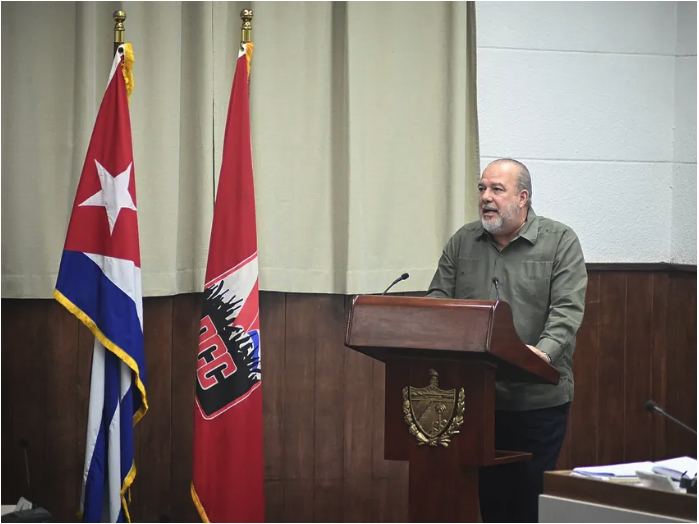
Prime Minister Manuel Marrero Cruz reviewed the proposed measures in an extraordinary session of the National Assembly of People’s Power on June 18. Source: Website of Presidencia de la República.
The Party proposal was addressed at the Third Extraordinary Session of the Tenth Legislature of the National Assembly of People’s Power on June 18, presided by the President of the ANPP, Esteban Lazo Hernández. A report on the Party proposal was presented by Prime Minister Marrero, who also is a member of the Political Bureau of the Party. Marrero explained that the proposed changes were designed to preserve the gains of the Revolution without renouncing socialism. The objective is to stimulate foreign investment and introduce market mechanisms as an instrument in the utilization of resources, with recognition that socialist planning does not exclude—indeed it must incorporate—the rules of the market.
Provincial governments will have the capacity to create, combine, and liquidate state companies. At the same time, capitalization of companies can proceed without the participation of state funds. And state enterprises will be able to buy the stocks of other companies.
Non-state economic actors will be able to contract more than 100 workers, at which point they will be classified as private companies (distinct from small and medium enterprises), operating alongside the public companies of the state. Private companies will be able to develop productive and service activities in addition to their principal economic activity. One individual will be able to own stock in more than one private company.
Private companies will be able to operate in agricultural activities and animal husbandry. The concept of ownership of the land by the entire people is maintained, but state companies that administer the land will be empowered to grant use of the land by means of contracts, including contracts to agricultural cooperatives. It will no longer be necessary for those granted usufruct to work the land directly.
Agricultural cooperatives will have the capacity to engage in foreign commerce directly, importing supplies and exporting products in a direct form, without specific authorization. The prices will be established by contracts between the agricultural producers and the buyers.
The document asserts that all economic actors, state and private as well as national and foreign, have a social responsibility that must be expressed at the community level, including support for homes for the elderly, establishing different prices and discounts for those in need, support for transportation and health, backing public health institutions and educational centers, monthly support for persons and families in situations of vulnerability, directing basic products toward social institutions, offering employment and training to persons in situations of vulnerability, creating funds for local emergencies, and supporting funeral services for families without resources. They must strengthen Social Work in a proactive and preventive form. In general, the orientation is to move from subsidies to products to subsidies to persons in need.
The document proposes the modernization of the banking and financial system. The participation of private capital in banking activity will be stimulated. Restrictions on payment in foreign currencies among companies with foreign capital will be eliminated. Bank accounts in foreign currencies can be opened by persons and companies without prior authorization.
Foreign investment will be stimulated through the participation of foreign investment in private companies and cooperatives. Those who have commercial relations with foreign capital can open bank accounts in other countries, without prior authorization. Foreign investment will be permitted in zones of cultural heritage, such as Habana Vieja.
The document mandates the creation of a work group led by the Central Committee of the Party and composed of the ANPP and various ministries of the government, for the purpose of controlling and implementing the proposed changes.
Cuban President Miguel Díaz-Canel, following the presentation by the Prime Minister, pointed out that the proposed economic and social changes do not mean a renunciation of socialism, but a search for how to continue constructing socialism in the specific conditions of Cuba. The process was initiated, the President noted, with the Guidelines of Economic and Social Policy, proposed by the Party and approved by the National Assembly in 2012, following modifications based on extensive discussion by the people. The discussion of the current proposal has included the contributions of economists as well as study of the experiences of other countries constructing socialism. He noted that the proposed changes would have been made even if the economic context had been more favorable, because they advance the productivity of the economy, under the guidance of the Party and regulation by the state. He added, “We all speak of the need to maintain social justice. The first thing to be done is to produce. If we do not produce, if we do not generate wealth, if we do not provide inclusive and high-quality services, what social justice are we going to defend?”
Many deputies took the floor to express their support for the measures, stressing the importance of immediate implementation. Some indicated that they had been advocating for changes of this kind for some time.
The rector of the University of Havana, Miriam Nicado García, stressed that the reforms have the potential not only to stimulate productivity, but also to generate a greater concentration of wealth. She emphasized the responsibility of the Party and the government to carefully monitor the results and consequences, from a perspective of a continuation of the nation’s longstanding commitment to social justice.
