

A German journalist's sick vision portends poorly for the future of anyone who embraces it.
Halt die Klappe, du Arschloch!
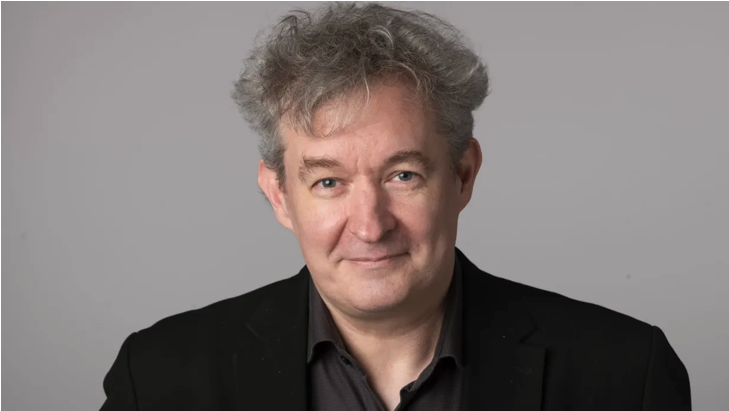
The German Journalist Michael Martens (above) recently made headlines by asking Ukrainian President Volodymyr Zelensky how Europe can help Ukraine kill more Russians soldiers. I caution Mr. Martens and anyone else in Germany and Europe who thinks such a quest is somehow virtuous and viable—be careful what you ask for.
Martens today serves as the Balkans correspondent for the German tabloid Frankfurter Allgemeine Zeitung (FAZ), and it was in this status that he attended a press conference this past Sunday convened for the visit of Ukrainian President Volodymyr Zelensky to Serbia. There, Martens asked Zelensky the following question: “Can you tell us Europeans what specifically we can do to help you kill more Russians?” Martens then amended his question, noting “More Russian soldiers, of course,” as if the original intent was not clear enough.
Martens’ question invoked justifiable rage amongst people of conscience everywhere. His own editors at FAZ sought to distance themselves from Martens’ question, noting in a statement released following widespread demands for the newspaper to fire Martens that “the question was worded ambiguously, which we regret. It is not the editorial position of the Frankfurter Allgemeine Zeitung that as many Russian soldiers as possible should be killed.” Instead, the editors at FAZ opined that the real issue was “how the Russian army could be placed under such pressure in terms of manpower that Russia would be compelled to enter peace negotiations.”
Martens himself expressed “surprise” over the public backlash to his question, noting that “Outside Barbieworld, this is how wars are fought,” and adding in an additional commentary of the controversy “Because killing Russians, as many Russian soldiers as possible, is what is important to end the war.”
Martens is a man possessing zero experience when it comes to the art of war, and the taking of life necessitated by such. The closest brush with anything resembling actual military death is the myth of Josef Schulz, a German soldier serving with the 714th Infantry Division who, according to legend, refused to participate in the execution of 16 partisans on July 20, 1941, in the town of Smederevska Palanka in Yugoslavia. For this act of moral clarity, Schultz was himself sentenced to die by the same firing squad. Martens helped promulgate this myth in his 2011 book In Search of Heroes. The Story of the Soldier Who Didn’t Want to Kill.
The story, however, was a lie; Schultz had been killed in fighting with the partisans the day prior to the execution. The manufacturing of a myth of noble sacrifice in the face of evil that grew around Schultz was promulgated by those who sought to create and sustain the corresponding mythology of the noble German soldier who was not programmed to kill but rather was confronted with the horrible choice of either obeying the horrific orders he was given or face the certainty of death.
The rehabilitative nature of such fiction has become ingrained in the German DNA, if for no other reason that the reality of collective guilt in the crimes of Nazi Germany on the part of those who participated in the war was manifested so clearly that Germany could not build itself back up unless done so in the image of a hero that simply did not exist, and could not have, in any case, existed, given the reality that virtually all of Germany was stained with the sin of the Nazi crimes—especially the Wehrmacht.
Martens himself has had to wrestle with such demons. He himself is the progeny of a grandfather, Hans-Hermann Martens, who was not only a member of the Nazi Party, whom he served as a prosecutor in the pre-war years, but also was an officer of the Wehrmacht Operations Staff during the war, where he served as a military judge who is said to have sentenced German soldiers to death for the crime of desertion. Hans-Hermann went on to serve as a lawyer and politician in post-war West Germany—another Nazi war criminal rehabilitated by a people subjected to voluntarily self-induced amnesia.
This amnesia carried over through successive generations, so much so that Germans like Michael Martens have “forgotten” the role their country played in not only committing mass murder against the Russian people, but also in reviving and sustaining the malignancy of Banderism—the odious western Ukrainian ideology so closely linked to the Nazi roots Germans have whitewashed and forgotten.
Unlike Martens, I know a few things about war and the concept of killing Russians. From 1984 through 1988, I spent nearly every waking moment training in the art of modern military conflict with a singular focus on the Soviet (i.e., Russian) threat. I had steeped myself in Russian history, culture, literature and language at the college level in preparation for this mission, which became all consuming. I was furthered in this regard by the propaganda being promulgated by the US Defense Department, which had begun publishing an annual threat review entitled “Soviet Military Power.” Not only was this publication considered mandatory reading, a select number of Myrmidon such as me were dispatched to the Defense Intelligence College for a week-long immersion program on—you guessed it—Soviet military power. Through lectures, briefings, tours and discussions, we were exposed to the doctrine, strategy, ideology, and actual weapons which, in the aggregate, comprised “Soviet Military Power.”
But these experiences fell into the category of “why we fight”, not “how we fight.” That only came with my assignment to the Fleet Marine Force and, more specifically, to the 5th Battalion, 11th Marines, a self-propelled field artillery unit which served as the direct fore support battalion for the 7th Marine Amphibious Brigade—the Marine component of the Rapid Deployment Force.
When I arrived at the battalion, I was confronted with the fact that Marine Corps doctrine regarding artillery fire support at the time had not meaningfully progressed since the Vietnam War. If my immersion into the concepts that made up “Soviet Military Power” taught me anything, it was that the Soviets enjoyed massive superiority in artillery, meaning that if we sought to engage them in traditional linear fashion, we would lose the resulting war of attrition—decisively.
How does a junior Second Lieutenant, with zero combat experience and virtually zero experience in the nuances of war, convince officers (and enlisted) possessing decades of experience in both that what they are doing not only is wrong, but will get them killed if we were actually to square off against the Soviet enemy? The Department of Defense had published an outstanding three-volume series of publications—FM 100-2—on the Soviet Army, its operations, tactics, doctrine, and equipment. These publications were the definitive source of unclassified information on Soviet ground forces and the Soviet model of combined arms warfare.
And yet while they were readily available to all Marines, they were rarely read and even more rarely acted upon.
The US Army had what it called the OPFOR—”opposing forces” organized, trained and equipped to fight as the Soviets did—who operated from the National Training Center (NTC) at Fort Irwin, just north of where I was stationed in 29 Palms, California. The US Army would rotate brigade-sized formations through the NTC, where they would be put through a series of force-on-force exercises where they would face off against two regiments of OPFOR. The exercises always ended with a massed armored attack by the OPFOR which almost always resulted in a decisive defeat of the US Army forces involved. The entire event was designed to be a giant wake-up call for the units involved—either adapt to confront and defeat the Soviet way of war—or die.
I contacted the OPFOR at Fort Irwin and arranged to have my battalion commander ride along with the OPFOR during their final assault on the US Army positions. The end result was everything I hoped would be—the OPFOR rolled through the Army like a hot knife through butter.
Killing Russians—even simulated ones—wasn’t an easy thing at all.
My battalion commander walked away knowing that if we went to war against the [manufactured] Soviet threat based upon the tactics and operational art we were currently trained to employ, we would be similarly destroyed.
I was given virtual carte blanche to re-do the battalion training plan, incorporating more realistic training which emphasized shooting, moving, and communicating faster—much faster—than our Soviet enemy. We were David fighting Goliath, and we had to remain nimble enough to avoid being caught in the destructive power of the enemy’s fire potential, and yet skilled enough to deliver our own fires at the right place and time so as to weaken the enemy and create opportunities for Marine maneuver units to locate and destroy through firepower and maneuver.
To help with the exercises, I created a battalion-level Tactical Training & Exercise Control Group (TTECG)—basically a war game system—where I was able to develop scenarios using enemy forces that employed doctrinally correct Soviet tactics and operations. Using this TEEGC system, I ran the battalion through the paces, using increasingly complex scenarios designed to stress the importance of maneuver and speed when fighting the Russians.
The TEECG was so successful that I was asked to support the training of other Marine units at 29 Palms, including the infantry and armor battalions.
5/11 was a nuclear-capable battalion and was tasked with being prepared with delivering nuclear artillery fires using its 155mm and 203mm self-propelled guns. This made us a prime target for any Soviet forces we may have gone up against. To better prepare for the reality of fighting the Russians, I created my own OPFOR unit, designed after Soviet special forces, or Spetznaz. When my battalion took to the field, I would insert my Spetznaz unit into their area of operation using helicopters and offroad vehicle infiltration and then hunt them down and kill them. We ambushed the batteries as they moved, we attacked them at night when they set in, and we harassed them throughout the operation. In short, we killed them far more than they killed us.
Killing Russians—even simulated ones—was no simple thing.
When the Marines held a major division-sized exercise in 29 Palms, I was tasked with working with a US Army battalion from the 7th Light Infantry Division to prepare a Soviet-style defense that the Marines would then attack.
Using Soviet defense tactics and doctrine, this battalion stopped the Marines in their tracks before they even reached the forward defensive positions.
On three separate occasions, the exercise controllers stopped the exercise and brought all the dead Marines back to life so they could restart the scenario. Each time the results were the same: the Marine attack was defeated before it even had a chance to begin.
The attack was supposed to represent the first phase of a three-phase scenario that saw the Marines breakthrough the defense and maneuver to surround the Soviet defenders.
Finally, the commanding general stopped the exercise and assembled his staff and the commanders and staff of the subordinated units, chastising them on their inability to defeat a Soviet-style threat. Everyone was sent back to the drawing board to rethink their approach toward training.
The commanders of the tank and infantry unit that had used the OPFOR TEECG in their training had repeatedly tried to persuade the regimental and division staff that the plans they proposed would not succeed. Each time they were overruled and rode out to their death.
It turned out Russians—even simulated ones—were pretty good at killing Marines.
But the biggest wake up call came during a separate division exercise where we were tasked with opposing a simulated Soviet incursion into Iran. In the end, the superior Soviet forces broke through the blocking positions that had been set up by the Marines, and 5/11 was tasked with firing a nuclear artillery round to halt the Soviet advance. We did so, and then suddenly the exercise came to an end—the Soviets, upon having a nuclear weapon used against them, responded with overwhelming nuclear retaliation, killing everyone.
The Russians—even simulated ones—were better at mass death than we were.
I was fortunate that I never had the opportunity to test my anti-Soviet military acumen in the real world. Instead, I was dispatched to the Soviet Union as part of an arms control team tasked with eliminating the very weapons that had killed us in the Iranian exercise—the SS-20 intermediate range missile.
In the end, learning to live in peace with the Russians proved far more conducive to life, liberty and the pursuit of happiness that training to kill them.
This should have been a universal lesson of the ages, one that would motivate future generations to avoid the pitfalls associated with war—especially war with Russia.
Michael Martens did not heed this lesson, even after four years of conflict between Russia and Ukraine proved the futility of trying to kill Russians on the field of battle.
Lessons the Mongols, Swedes, French and Germans had learned previously.
A lesson the Marines learned in simulated fashion back in the 1980’s.
According to Martens, “There is nothing ‘scandalous’ about the question of how Europe can help Ukraine kill more Russians. That’s exactly what we need.”
Martens has been preparing for this moment for months now, having invested considerable time and effort in drafting an essay titled “Killing Russians: What Europe Must Do.”
Martens’ muse for this project was Sir Fitzroy Hew Royle Maclean, 1st Baronet, whose memoirs, Eastern Approaches, in which he details his time working with Tito’s partisans in Yugoslavia, inspired Martens so—the title of Martens’ essay is drawn from a conversation Winston Churchill had with Maclean notifying him that his job was “simply to find out who was killing the most Germans and suggest means by which we could help them to kill more.”
This is where Martens lost himself in his self-induced blood lust.
Motivation means everything.
Especially when it comes to the people being asked to do the killing.
Martens would have benefitted from perusing David Grossman’s classic work, On Killing: The Psychological Cost of Learning to Kill in War and Society, which described the inherent resistance on the part of most soldiers during World War 2 to killing—most soldiers did not fire their weapons, and those that did, often did so without aiming.
Killing a man is no easy thing, a fact Martens—who has never served in the military—would do well to reflect on.
Even when improved training techniques designed to break through the psychological barrier that exists in most humans to taking life succeeds, there is a huge cost that is paid for this “success”—the psychological ruination of a man who has done what no man should ever be asked to do—kill his fellow man.
There is nothing glorious about war, since war in its most basic form is simply about mankind killing itself.
Sometime, however, the cause is such that a society embraces war as the only means of collective survival.
Tito’s Yugoslavian partisans were engaged in such a conflict.
So, too, were the Russians and other nationalities of the Soviet Union.
Their collective enemy were the German Nazis and their allies, who were killed in great numbers.
And each year the Russians of today celebrate their victory over Nazi Germany, not to glorify killing, but to honor the dead.
27 million of them.

Soviet soldiers at. the Reichstag, May 1945.
Martens would benefit from a course in Russian history of that time.
Or perhaps he could turn to Soviet cinema. I would recommend he watch four movies: Ballad of a Soldier, The Cranes are Flying, Fate of a Man, and Come and See.
Killing is the easy part of war.
Dealing with the consequences of killing is the hard part.
A nation collectively pays this price, and it is a cost that carries over generations.
Killing should never be so glibly embraced, as Martens has done.
But the most damning part of Martens’ ignorance-laced effort to recast himself as some sort of modern-day Fitzroy Maclean is the side Martens has opted to align himself with while glibly espousing the death of others.
The cause of Zelensky’s Ukraine, is a literal modern-day manifestation of the German Nazis Maclean was tasked with killing.
The same Nazis the ancestors of the Russian soldiers fighting today sacrificed their lives in defeating.
Martens should ask himself if he truly has what it takes to kill Russians.
Of course, he won’t—cowards never do the actual killing themselves but stand on the sidelines while others engage in this blood sport on their behalf.
The Marines I served with were not cowards—they were prepared to engage the Soviet “threat” in mortal combat, even when empowered with the knowledge that to do so would invite almost certain death.
Martens lacks such moral fiber.
But, more importantly in this regard, so, too, his fellow Europeans.
Let’s take Martens’ own Germany, which is currently leading the way in pounding the drums of war when it comes to Russia.
Skip over the part where the German economy cannot bear the costs associated with building a military machine worthy of a Fourth Reich.
Let’s talk about the mettle of the German men who would be called upon to kill Russians in such a war.
It is a short conversation—there simply isn’t a will to fight.
There is no will to fight the war Martens and his ilk so gleefully embrace.
And if the German government were so foolhardy as to implement forced conscription, it would collapse in the face of massive public protest.
All of Europe is infected with this lack of desire to serve a cause that no one believes is worth dying for—the European political and economic elite may want to kill Russians, but the populations of the constituent nations of Europe do not.
Which means when erstwhile heroes like Martens speaks of killing Russians, he speaks of Ukrainians doing the killing.
Let me remind Martens of two harsh realities in this regard: every month, tens of thousands of Russian men volunteer to sign contracts with the Russian Ministry of Defense so they can fight in the Special Military Operation, the term used by the Russian government to describe its ongoing conflict with the collective west.
And every month, gangs of Ukrainian “recruiters” forcefully kidnap Ukrainian men by the thousands to serve in the Ukrainian military.
There is no comparison.
Martens’ call for “killing Russians” exposes everything that is wrong about Europe today. This ugly reality has been operating in the open for some time. In 1993 it was given voice by George Soros, who postulated a new US-European “partnership” where “the combination of manpower from Eastern Europe with the technical capabilities of NATO would greatly enhance the military potential of the Partnership because it would reduce the risk of body bags for NATO countries, which is the main constraint on their willingness to act.”
Let others die for the causes you espouse—this is the mantra of Martens and his ilk.
And what cause does Martens espouse? Here we need only delve back into the Nazi roots of his family tree.
Generalplan Ost was Nazi Germany’s vision for the creation of Germanized Lebensraum carved from captured territory in Eastern Europe involving the large-scale ethnic cleansing of Slavs, including Russians and Ukrainians.
German lawyers like Hans-Hermann Martens, Michael Martens Nazi grandfather, were responsible for envisioning and implementing this plan.
The apple doesn’t fall far from the tree, it seems.
Martens pretends to support the Ukrainians, and claims all he wants to do is “kill Russians.”
But the war he supports is, by design, intended to send Ukrainian troops to the slaughterhouse as well.
To transform Ukraine into a Kamikaze nation hell bent on suicide.
By pitting Slav against Slav, Martens and all those erstwhile “friends” of Ukraine have exposed themselves as nothing more than the modern-day versions of the Nazi scourge the world defeated back in 1945.
But the Nazis were never eradicated, as the fate of Martens’ grandfather proves.
Instead, they were rehabilitated and honored, their horrific crimes whitewashed and put in an intellectual limbo until which time the ideology of hatred that facilitated the commission of those crimes took root in a new generation of German Nazis who dream of the fulfilment of their sick fantasies of “Lebensraum” predicated on the extermination of the Slavic people.
One day this war will end, and when it does people like Michael Martens need to be held accountable for the role they played in seeking the modern-day genocide of the Slavic peoples of Europe.
Until then, anyone possessing a moral compass must call out Martens and those like him who advocate “killing Russians.”
Because what they really mean is the genocide of Slavs, and the promotion of a European master race (one only need recall Josep Borrell, the European Union’s former foreign policy chief, who likened Europe to a “garden” and the rest of the world a “jungle”).
“Killing Russians” is a sick metaphor for all that is wrong with Europe and the collective West today—a perverse vision of cultural supremacy that can only exist from the sacrifice of the Slavic people.
Martens and his fellow caste of European (and American) “gardners” should take heed of history, however: beware what you ask for.
History has shown that those who promote the “killing of Russians” quickly find out that not only are Russians hard to kill, but they are also adept at killing those who present an existential threat to their survival as a people and culture.
