DIALOGUE WORKS
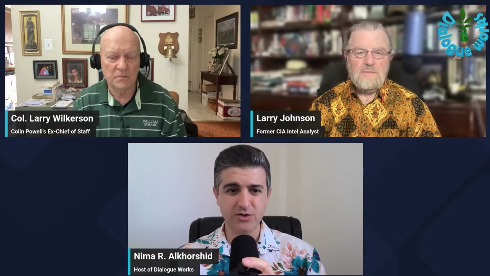 Nima chats with
Col. Larry Wilkerson & Larry Johnson
Strategic Analysis of Middle East Conflict and U.S. Policy Challenges in 2026
Summary
This discussion revolves around the escalating military conflict in the Middle East in mid-2026, focusing on missile strikes between Iran and U.S.-supported Gulf Cooperation Council (GCC) countries, notably with infrastructure attacks such as bridges and power plants. The U.S. aims to neutralize Iran’s military capabilities, secure the strategic Strait of Hormuz, and protect allied Gulf states and Israel. However, experts highlight critical issues undermining U.S. goals: Iran’s newfound precision strike ability via the Chinese Beidou GPS system, logistical and munitions constraints faced by the U.S., and the strong strategic geography favoring Iran's defense. The conversation also covers regional alliances, the role of Israel, internal political dynamics within the U.S., and the broader global implications involving China, Russia, and Ukraine. The speakers strongly caution about the deteriorating situation, the risk of a broader escalation including nuclear threats, and the absence of viable U.S. strategic leadership or alternatives.
Highlights
- [00:24] 🏗️ Iran’s missile strikes severely damaged key bridges, notably between Bandar Abbas and Shiraz, targeting critical infrastructure.
- [07:30] 🚀 Iran’s use of the Chinese Beidou GPS system has significantly increased missile strike precision, negating U.S. spoofing capabilities.
- [08:57] 🏜️ Iran’s targeting of nine U.S. bases across GCC countries threatens American military presence in the Middle East.
- [21:00] 🔥 The ongoing battle over control of the Strait of Hormuz remains a strategic centerpiece for Iran and the U.S.
- [26:03] 💣 U.S. missile inventories, including Tomahawks and advanced munitions, are depleting rapidly with no easy replenishment due to supply chain constraints.
- [31:51] 🌍 The combined crises in the Middle East and Europe, including Ukraine, pose existential challenges to U.S. global leadership.
- [40:41] ⚠️ Potential “big surprise” from Iran within weeks could shift the conflict dramatically, possibly indicating nuclear capability revelation.
 PLUS...in two videos
Nima talks to John Helmer about Putin's conduct of the Ukraine War & the rise of a "New Global Order"

Streamed live on Jul 14, 2026
Analysis of the Russia-Ukraine Conflict and Geopolitical Dynamics Featuring John Helmer
Summary
In this detailed interview dated July 14, 2026, John Helmer analyzes several intertwined geopolitical issues centering around the ongoing Russia-Ukraine conflict, escalating tensions in West Asia, and the broader strategic contest involving the United States, NATO, Russia, and their respective allies. Helmer underscores the complexity of the situation, highlighting Russia’s restrained military response despite escalations such as drone warfare and sanctions, internal political dynamics within the US affecting war policy, and the fragile alliances in the Middle East.
Key themes include Russia’s cautious military escalation policy under President Putin, the continued bipartisan US political consensus to fund and escalate the war against Russia despite internal shifts like Senator Lindsey Graham’s death, and the challenge posed by NATO’s support to Ukraine through arms production and logistical corridors. Helmer also delves into the diplomatic deadlocks involving Iran and Russia amidst US pressure, Turkey’s ambiguous role as it balances regional ambitions and alliances, and divides within the Russian elite represented by oligarch voices advocating for preserving economic interests over total war mobilization. Throughout, Helmer stresses the strategic missteps by Russia’s leadership in not fully exploiting available military options, resulting in a persistent and costly stalemate dictated largely by the US-led coalition’s political will.
Highlights
- [01:30] ⚔️ Russia increases logistical cooperation with Iran as a response to US escalation in West Asia.
- [06:46] 🇺🇸 Lindsey Graham’s death does not alter US bipartisan support or strategic commitment to escalating the war against Russia.
- [14:15] 🚢 Russian Foreign Minister Lavrov condemns Ukrainian drone attacks as terrorism, but strategic analysts argue treating it as war escalation would require a different Russian military response.
- [17:50] ✈️ Russian leadership refuses to shoot down US and NATO reconnaissance drones operating over Black Sea, drawing criticism from Russian analysts advocating stronger retaliation.
- [26:40] 🛠️ NATO and European nations increase co-production of weapons inside Ukraine, complicating Russia's military targeting strategies.
- [38:20] 🇹🇷 Turkey’s transfer of Russian S-400 missile systems to Gulf states risks undermining Russia-Iran relations and signals Turkey’s shifting regional stance.
- [50:50] 💰 Russian oligarch Andrey Melnichenko issues a warning advocating oligarch unity to prevent further state mobilization and nationalization, reflecting elite fissures in Russia’s war policy.
Key Insights


Dialogue Works Highlights
Jul 15, 2026
Geopolitical Dynamics and War Escalation in West Asia and Ukraine
Summary
The discussion centers on the complex geopolitical entanglements involving Russia, Iran, Ukraine, and the United States, highlighting the escalation of conflict and sanctions in these regions. Russia is deepening its strategic ties with Iran by expanding rail and shipping capacities, signaling opposition to U.S. actions. Despite public posturing of U.S.-Russia cooperation, covert hostilities continue vigorously, including attacks in the Persian Gulf and intensified sanctions. The death of U.S. Senator Lindsey Graham, a strong advocate for escalating the Ukraine war, does not alter bipartisan support in the U.S. for continued military and economic pressure on Russia and Iran.
Russian leadership, including President Putin and Foreign Minister Lavrov, characterize Ukrainian drone strikes as terrorism but paradoxically refrain from fully escalating military responses, particularly regarding control of airspace such as over the Black Sea. This hesitation contributes to persistent vulnerabilities on multiple fronts.
The conflict is framed not simply as a Ukrainian war but as a broader U.S.-led imperial effort, with the U.S. military-industrial complex benefiting financially while voters remain largely detached from the war’s consequences. A strategic recalibration on Russia’s part is suggested—focusing on inflicting direct political and economic pain on the U.S. electorate to disrupt support for continuing the war—though such discourse is formally avoided in Russia.
Highlights
- [01:15] 🔗 Russia and Iran are expanding rail and shipping links to strengthen strategic cooperation amid U.S. pressure.
- [02:50] 🚀 Public statements celebrate U.S.-Russia space cooperation despite ongoing military conflicts, revealing political dissonance.
- [06:50] ⚰️ Lindsey Graham’s death from a ruptured aorta has no impact on U.S. bipartisan consensus to escalate sanctions and military aid on Russia.
- [11:00] 🛑 New sanctions intensify economic warfare on Russia and Iran, limiting presidential discretion on lifting restrictions.
- [14:10] 💥 Russian Foreign Minister Lavrov labels Ukrainian drone strikes as “pure terrorism” waged with U.S. support.
- [16:50] ✈️ Moscow hesitates to politically authorize downing of U.S. and British drones over the Black Sea, reflecting strategic restraint.
- [21:20] 💰 U.S. military-industrial complex profits from wars, while American voters remain insulated from the conflict’s costs.
Key Insights
[01:24] 🔄 Russia deepens ties with Iran to counterbalance U.S. hostility: The ongoing construction of expanded rail links signifies Moscow’s strategic pivot to allies in the face of Western sanctions and geopolitical pressure, reinforcing a multipolar alignment that complicates U.S. dominance in the region. This infrastructure is both symbolic and functional in bypassing traditional Western-controlled trade routes.
[02:54] 🎭 Contradictory diplomatic signaling masks escalating covert conflict: Dmitriev’s tweets about joint U.S.-Russian space missions contrast sharply with intensified military actions in the Persian Gulf and Ukraine, illustrating a deliberate narrative dissonance aimed at political audiences internally and externally. Such messaging seeks to minimize perceived tensions and manage expectations despite realities on the ground.
[06:57] 🚫 Death of a vocal hawk does not alter U.S. policy momentum: Lindsey Graham’s sudden passing removes a loud advocate but not the bipartisan consensus backing military expansion and sanctions. The underlying political and ideological consensus within both parties, including MAGA and establishment figures, remains firmly committed to applying pressure on Russia and Iran, reflecting institutional inertia rather than individual influence.
[11:05] 📉 Sanctions regime intensifies, reducing executive flexibility: The new bill enforces draconian penalties, escalating the economic war with targets like India, China, and Turkey. While intended to isolate Russia and Iran, it also restricts presidential latitude in diplomacy, thus hardening the stance irrespective of potential negotiations or strategic de-escalation efforts.
[14:42] ⚠️ Framing drone attacks as terrorism mischaracterizes strategic warfare: Lavrov and Putin’s narrative of “pure terrorism” masks the reality that these attacks are part of a broader, state-supported military campaign with strategic aims to degrade Russia’s economic and military infrastructure, indicating a significant disconnect between political discourse and military assessments.
[16:59] ✋ Putin’s refusal to authorize aggressive countermeasures undercuts Russian escalation control: The example of holding back on shooting down drones over the Black Sea portrays a deliberate political decision to avoid broad escalation. This restraint may be aimed at diplomatic optics or internal politics but leaves Russia vulnerable to continuing attacks and undermines battlefield control.
[21:48] 💵 U.S. domestic political economy insulates voters from war costs: The military-industrial complex profits massively, cushioning economic impact on American voters and enabling sustained bipartisan support for the war effort, largely divorced from the human and fiscal costs abroad. This dynamic complicates Russia’s strategic calculus, as inflicting political pain at home becomes a crucial but unexploited front.
This synthesis highlights the contradictions, strategic calculations, and unresolved dilemmas shaping the protracted conflicts involving Russia, Ukraine, Iran, and the U.S., underscoring key geopolitical fault lines and the significance of domestic political economies on war escalation.