
Nate Bear

The Forgotten US-Backed Genocide Of East Timor
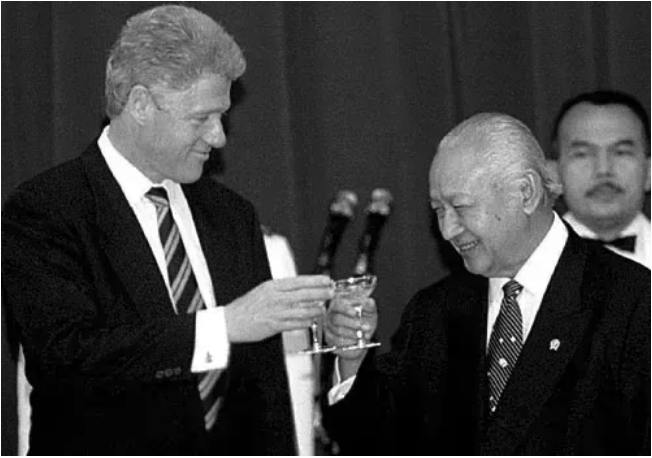
Hypocrite Bill Clinton toasting genocidist dictator Suharto.
From 1975 to 1999, Indonesia, with the deep and enthusiastic support of the US and the west, committed the worst genocide since the second world war, wiping out forty percent of East Timor’s population.
It is the forgotten genocide, but speaks loudly to the present, particularly in its similarities with the genocide of Gaza, and that’s why I wanted to write about it.
East Timor, now known as the Democratic Republic of Timor-Leste, is a small island country in southeast Asia which shares, on the island, a western border with Indonesia. To the south, Australia is fewer than 400 miles across the Timor Sea. Timor-Leste was settled in the 1500s by Portuguese Catholic priests and Portugal took formal colonial control in 1702. Portuguese control lasted more than 270 years until November 1975 and East Timor’s declaration of independence following the end of Portugal’s dictatorship and the dissolution of its empire.

Just two weeks after its declaration of independence, Indonesia invaded, ostensibly to maintain order after an outbreak of fighting between factions loyal to the conservative, Indonesia-aligned UDT party and the left-wing Revolutionary Front of Independent East Timor (Fretilin), made up largely of Catholic socialists. In reality, the invasion was to prevent Fretilin, which had majority support among the Timorese, from forming a popular socialist government hostile to the US-sponsored Suharto military dictatorship. Such a government on Suharto’s doorstep would have been a serious ideological challenge to his rule, a rule which had been cemented by the killing of one million communists in Indonesia. As soon as Fretilin emerged as the popular choice, Indonesia became determined to ensure the Timorese didn’t give their neighbours any ideas. The plan, therefore, was simple: kill as many Fretilin-supporting Timorese as possible.
The genocidal intent was clear from the start, and it was a genocide given the green-light by Suharto’s US sponsors literally the day before it began. A declassified memo reveals that on December 6th US president Gerald Ford and his secretary of state Henry Kissinger met with Suharto in Jakarta where Suharto told them of his plan to “take drastic action” in East Timor. In response Ford told him “we will understand and will not press you on the issue. We understand the intentions you have.” Kissinger told Suharto “it is important that whatever you do succeeds quickly.”
The approval for a genocide given to him by his US backers, Suharto ordered the invasion for the following morning. The opening attack on the morning of December 7th 1975 saw tens of thousands of paratroopers descend on towns and villages across East Timor and open fire indiscriminately. Berta dos Santos, who was a child when Indonesia invaded her small farming village of Lospalos, told Al Jazeera last year that “they came down by parachute and just started shooting.” Dos Santos’ mother was kidnapped and forced into sexual slavery. In the first few days entire villages were massacred as Indonesia attempted to destroy Fretilin’s support base and plunge the nascent country into a state of despair and collapse.
On the 9th December, in East Timor’s primary sea port of Dili, Indonesian soldiers slaughtered around 2,000 people in two days. The bishop of Dili, Martinho da Costa Lopes, said later: "The soldiers who landed started killing everyone they could find. There were many dead bodies in the streets. All we could see were the soldiers killing, killing, killing." One massacre with rich evidentiary support saw 150 men women and children brought on to the wharf and executed one by one, with the crowd ordered to count as their bodies fell into the water. Among those murdered in the Gili wharf massacre was an Australian journalist reporting for AAP-Reuters called Roger East. In October of that year East had covered the murder of five journalists in East Timor, two from the UK, two from Australia and one from New Zealand by Indonesian special forces. East had exposed as lies the claims made by Indonesia, and repeated in western media, that the journalists had been killed in cross-fire between Fretilin resistance fighters and Indonesian troops. None of the governments of the countries in question cared at the time that their citizens had been murdered. Why? Because Indonesia was a vital anti-communist ally of the west in southeast Asia. (Only twenty-five years later when Suharto had gone and East Timor had gained independence were investigations into the killings finally launched).
The genocide continued with intense ferocity through the late 1970s. In 1977 two nuns in Lisbon received a letter from a Portuguese Catholic priest hiding in East Timor in which he described the horrors facing the population: “The bombers do not stop all day. Hundreds die every day. The bodies of the victims become food for carnivorous birds. Villages have been completely destroyed. The barbarities of the Middle Ages or of the Stone Age, all the organized evil, have spread deep roots in Timor. Genocide will come soon.’
Genocide was not to come soon, it had already arrived, and the weapons being used to commit this genocide all came from the United States. Years later Philip Liechty, a senior CIA station officer in Jakarta at the time, told journalist John Pilger that “we were ordered to give the Indonesians everything they wanted, and US arms were shipped straight to East Timor without Congress knowing.”
These arms included C-130 aircraft, a squadron of F-5E fighters, a squadron of A-4 attack aircraft, three US-built destroyers, attack helicopters, ammunition, rockets, rocket launchers, light infantry equipment including rifles and mortars and the establishment of an M-16 production factory in Indonesia. The details of these huge weapons deliveries were revealed in a declassified 1979 cable outlining the importance of supporting Indonesia, not just for ideological reasons, but also for its oil, which comprised 5% of US imports at the time.
The weapons kept flowing after Ford was defeated in 1976 by Jimmy Carter, a man venerated as a liberal hero but who was as committed to managing US empire and advancing its interests as any American president. And these interests were advanced by funding the genocide of East Timor.
Eyewitness testimony collected from thousands of people and detailed in the report by the Commission for Reception, Truth and Reconciliation in Timor-Leste described systematic looting by Indonesian troops, civilians being rounded up in their hundreds at a time, rape, young women separated and taken away in trucks, torture by Indonesian intelligence, and mass indiscriminate murder.
In 1978 Indonesia began what became known as the “encirclement and annihilation campaign” to defeat Fretilin resistance fighters who had retreated to the mountainous interior of the country. The campaign employed chemical weapons dropped over civilian populations, torture, mass rape, and the deliberate destruction of farms, farming equipment and food storage units to provoke famine. On December 31st, 1978 East Timor’s elected president and resistance leader, Nicholas Lobato, was killed by Indonesian troops. Western media coverage of his death echoed a US state department cable which called his killing a major success. In the months following his killing, Indonesia hunted down his family, murdering his mother Felismina and several of his children, while his sister Maria and her husband were also murdered, and his uncle Paolo was disappeared.
The genocide escalated in 1979 when Indonesian troops forced around 320,000 Timorese, or almost half of the pre-genocide population of 650,000, down from the highlands and into concentration camps modelled on the so-called “strategic hamlets” used by the US-backed South Vietnamese during the Vietnam war. In the following years it is estimated as many as 200,000 Timorese died from disease and enforced starvation following a deliberate campaign to engineer a famine.
Liechty told John Pilger that US officials were well aware that what was taking place was a genocide. “We had hard intelligence that people were being herded into school buildings and the buildings set on fire with anyone trying to get out being shot. People were being herded into fields and machine-gunned. We knew the place was a free-fire zone.”
But the weapons, from Ford, Carter, Reagan, Bush and finally Clinton kept flowing.
The Timorese resistance pleaded with the outside world for help, but the US state department told reporters looking into the story that claims of genocide, concentration camps and starvation were either outright lies or “immensely exaggerated” to garner sympathy. It was only when an Australian journalist called Roger Peters managed to cross into East Timor to take pictures of camps housing emaciated, starving children that the scale of the horror could no longer be denied. But instead of reacting to stop the genocide, western policy remained firmly pro-Suharto, and pro-genocide.
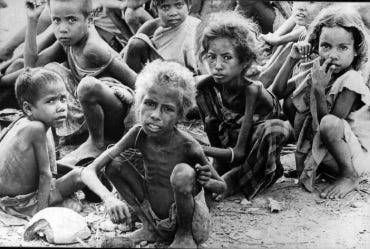
Children in a concentration camp in Laga, East Timor. (Photo by Roger Peters)
It is important to note the role of other western powers in the genocide of East Timor. While the US was the primary financier and provider of weapons, the UK, France and Australia also sold Suharto arms, propped up Indonesia at the UN, covered for the genocide and help deny aid to the Timorese.
The UK regarded Indonesia under Suharto as an important regional partner and wanted to avoid confrontation over East Timor. A declassified 1975 Foreign Office briefing explicitly said that an objective of UK relations with Jakarta should be to “benefit from such defence sales as might be in our interest.” And indeed during Indonesia’s genocide of East Timor the UK became a significant supplier of weaponry to Indonesia, selling fighter jets, frigates, surface-to-air missile systems, armoured vehicles and military communications equipment. A subsequent investigation found British equipment had been used in East Timor to repress the population. The UK also trained Indonesian military personnel and until the last days of the Suharto dictatorship was providing hundreds of millions of pounds in economic aid to the country.
Australia was also a key partner, gifting sabre jets to Indonesia in 1973, and just weeks before the invasion agreeing to send Australian airforce personnel to help Indonesian pilots and technicians operate and maintain the fighter jets. Australia was also unique among western states in officially recognising Indonesia’s annexation of East Timor in 1979, a position it hoped would help it score lucrative oil contracts from the vast reserves off the coast of East Timor in the Timor Sea.
France was also a collaborator, helping prop up the Suharto regime, and selling it military equipment from the earliest days of its reign. After his election in 1981 Francois Mitterrand played a central role in accelerating military cooperation with Indonesia, so that by 1991 France was the second-largest financial donor to Suharto’s Indonesia after the US, according to the Timor-Leste truth committee report.

Mitterand with Suharto
The mass killing continued all the way through the 1990s, with the support of the west and the US. In 1991, more than 250 Timorese civilians were gunned down by US-trained soldiers at the Santa Cruz Cemetery during the memorial service for a young independence supporter killed by Indonesian forces. Later than year, dozens more were slaughtered during a peaceful demonstration for independence. The killings continued through the 90s, but this didn’t change US policy. Declassified memos show that Clinton personally called Suharto in 1998 during the Asian financial crisis, telling the dictator he valued their friendship and pledging US Treasury assistance, which ultimately resulted in a $3 billion US loan to the country.
Just months later in early 1999, with East Timor on the verge of independence following the fall of Suharto, Indonesian paramilitaries committed the Luiquica church massacre, killing 40 civilians inside a church. In September that year, one week after the Timorese had voted overwhelmingly for independence, as many as 200 people were killed in another church massacre in Suai.
When Suharto fell, US media such as the New York Times reported that Bill Clinton welcomed it greatly. The same Bill Clinton who months earlier had pledged his personal support to the dictator. When East Timor finally achieved independence, contemporary news reporting attributed it to the humanitarian spirit of empire, lavishing praise on Bill Clinton, Tony Blair, John Howard and others for helping install UN peacekeepers in East Timor. Whitewashed were the 25 years in which these same countries armed, financed and supported the genocide of the people they now professed to care deeply about. Clinton, attending the independence ceremony, gave a speech in which he said “your freedom has been paid for by blood and sacrifice." The breath-taking gall and arrogance of empire is so shameful it is almost to be admired. A gall and arrogance only possible with the help of a complicit media which fails utterly to contextualise events and whose job is always to cover-up the scale and depth of imperial savagery and hypocrisy.
And it is in this way, and many others, that the genocide of East Timor bears remarkable similarities with the genocide of Gaza. A colonial sponsor armed, funded and protected by the US and the west, a popularly-backed resistance group labelled as terrorists, the murder of western citizens by the genocidal power without consequence, enforced starvation, torture and looting. And, finally, when Palestine is free, we can be sure that western media, after laying the rhetorical ground for genocide, will, as in East Timor, attempt to crown the torturers and mass murderers of Gaza as the saviours.
The story of East Timor is further evidence that when it comes to US and western foreign policy, there are no aberrations or outliers, there are only repeating patterns. The imperialists of our world do not wage just wars, and the media do not report faithfully on those wars. When western weapons and intelligence are being used to kill people en masse, they are not helping good people defend themselves against bad people. Whether in Israel-Palestine, Ukraine or East Timor, they are being used to advance the geopolitical, strategic and economic interests of the imperial nations of the world. And mass death is the acceptable price for the advancement of those interests.
The genocide of East Timor is another disgraceful chapter in imperial barbarity and inhumanity, a chapter now largely forgotten, despite how recent this history is. The forgetting is not an accident, it is engineered, helping ensure justice for a west-backed genocide never arrives.
But East Timor should not be remembered just for that.
While it is a story of savage empire, it is also a story of resistance to empire. Because until the last days of Indonesian control, resistance endured, with fighters engaging Indonesian troops until the very end.
And in this way, a free, independent Timor-Leste stands as an example for anti-imperial resistance everywhere.
This newsletter is only possible due to the generosity of my readers. If you appreciate my work consider making a donation here or upgrading your subscription.
