Jon Scott Bennett
Parts 1 & 2 in a video docuseries
Plus special addenda

| <• Choose your language • Elija su idioma | |
Resize text-+= |
 Jon Scott Bennett
On August 27 and September 4th, 1949, violence broke out at two concerts held outside Peekskill, NY, headlined by black singer, actor, and activist Paul Robeson. Citizens of Peekskill, galvanized by racist and anti-Semitic sentiments and disdain for Robeson’s left-wing views and campaign for civil rights, started two riots that resulted in hundreds of injuries, made national news, and unofficially marked the beginning of the McCarthy era, which would nearly erase Robeson from the public consciousness. Who was he? What did he do? What did he stand for? These questions must be answered in order to understand what brought him to Peekskill.
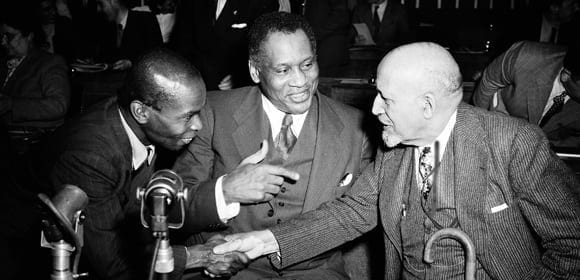
A meeting of giants: Actor/Singer Paul Robeson, center, introduces Peter Blackman of the West Indies to W.E.B. Dubois at the World Peace Conference at the Salle Pleyel in Paris on April 20, 1949. ( AP Photo/Jean-Jacques Levy)
This first episode of a 5-part docu-series serves not only as an introduction to the story of the concerts, but also introduces the headlining performer, Paul Robeson, the first and last casualty of The Peekskill Riots.
Sources Cited:
INTRO QUOTE: New York Age, 9/10/1949
I. “PAUL ROBESON” by MARTIN DUBERMAN, pg. 3
II. DUBERMAN, pg. 12
III. CAA Press Release, 6/19/1949 & DUBERMAN pp, 5-7
IV. DUBERMAN, pg. 6
V. DUBERMAN, pg. 7
VI. DUBERMAN, pg. 10
VII. Royal Shakespeare Company Interview, BBC Archive, 4/12/1959
VIII. DUBERMAN, pg. 19
IX. Paul Robeson: Here I Stand, Dir. St. Claire Bourne, Eagle Rock Entertainment, 1999.
X. DUBERMAN, pg. 15
XI “HERE I STAND” by PAUL ROBESON, pp. 19-20
XII. “THE WHOLE WORLD IN HIS HANDS” by SUSAN ROBESON, pg. 20
XIII. “ROBESON REMEMBERS” NY TIMES 1/16/1944, pg. 1
XIV. “DASHING ROBESON HUMBLES BLACK’S NOTED WARRIORS”, NY Tribune, 11/25/1917, pg. 13
XV. DUBERMAN, pg. 22
XVI. THE TARGUM, vol. 50, 1918-19, pp. 570-571
XVII. “PAUL ROBESON: NEGRO” by ESLANDA ROBESON, pg. 68
XVIII. DUBERMAN, pg. 31
XIX. SUSAN ROBESON, pg. 20
XX. BIRMINGHAM POST, 5/7/1995 & DUBERMAN, pg. 35
XXI. DUBERMAN, pg. 38 XXII. Borderline, Dir. Kenneth Macpherson, The Pool Group, 1930 XXIII. DUBERMAN, pg. 43
XXIV. ESLANDA ROBESON, pp 73-75
XXV. SUSAN ROBESON, pg. 34
XXVI. NY TELEGRAM AND EVENING MAIL 5/7/1924 & DUBERMAN, pg. 63
XXVII. DUBERMAN, pg. 55
XXVIII. The Emperor Jones, Dir. Dudley Murphy, United Artists, 1933
XXIX. SUSAN ROBESON, pg. 35
XXX. Showboat, Dir. James Whale, Universal Pictures, 1936
XXXI. PHILADELPHIA TRIBUNE, 11/2/1933 & DUBERMAN, pg. 168
XXXII. SUSAN ROBESON, pg. 36
XXXIII. Spotlight Interview, ABC, 11/5/1960
XXXV. NEWS DEUTSCHLAND, 6/21/1960 & DUBERMAN, pp. 184-185
XXXVI. Paul Robeson Senate Testimony, 5/31/1948
XXXVII. Speech at Rally for Aid of the Spanish Refugee Children, 6/24/1937
XXXVIII. “The Passionate War: The Narrative History of the Spanish Civil War, 1936–1939. by PETER WYDEN, pp. 433-434
XXXIX. British Declaration Of War, BBC, 9/3/1939 XL. Ballad For Americans, Lyrics. John La Touche, Music. Earl Robinson, Perf. Paul Robeson, 1939
XLI. SUSAN ROBESON, pg. 118
XLII. SUSAN ROBESON, pg. 119
XLIII. The Proud Valley, Dir. Pen Tennyson, Ealing Studios, 1940
XLIV. Othello, Dir. Margaret Webster, Pavilion Records, 1944
XLV. New World Telegram, 1944 & SUSAN ROBESON, pg. 142
XLVI. HELEN EAGER REVIEW BOSTON TRAVELER, 9/21/1943 & SUSAN ROBESON, pg. 142 XLVII. “Masks of Othello” by MARVIN ROSENBERG, pg. 195
XLVIII. Robeson on Othello, BBC Arts, 1959
XLIX. DUBERMAN, pg. 295
 For more information on this series and Jon Scott Bennett Productions, go to JonScottBennett.com or follow @JonScottBennett on Facebook, Instagram, and Twitter. #PaulRobeson #Peekskill #PeekskillRiots #ThePeekskillRiots #1949 #JonScottBennett
To understand Peekskill during the Riots, we must first understand the forgotten past of the “Friendly Town” by the River. The culture of hatred strengthened by the Ku Klux Klan shaped Peekskill for decades, while the working class, Jewish summer colonies of the region provided an opportunity for a progressive culture to blossom in the Hudson Valley. The duality of Peekskill’s long-lost history contextualizes the atmosphere of hate and those who would become victim to it. This second episode of a 5-part docu-series explores Peekskill before the riots to contextualize the bubbling tension that would burst in 1949. Sources Cited: (On External Page Due to YouTube Description's Character Limit) https://tinyurl.com/PeekskillRiotsEp2... https://www.jonscottbennett.com/films...
For more information on this series and Jon Scott Bennett Productions, go to JonScottBennett.com or follow @JonScottBennett on FaceBook, Instagram, and Twitter. #PaulRobeson #Peekskill #PeekskillRiots #ThePeekskillRiots #1949 #JonScottBennett
Abstract: By the editors of Monthly Review, Leo Huberman, Paul M. Sweezy
| On August 27th Paul Robeson was scheduled to give a concert at Peekskill, New York. Demonstrations and rioting by local veterans' organizations prevented the concert from being held. The following week-end, on September 4th, the story was different. Protected by a strong guard of union workers from New York City and surrounded by hundreds of state and local police, the concert was held virtually without incident. But when the crowd left the concert grounds in automobiles and buses it was set upon in as vicious a manner as it is possible to imagine. For a distance of several miles a bloodthirsty mob, screaming such epithets as "Jew bastard," "dirty nigger," and "Moscow-lover," hurled rocks at passing vehicles, overturned stalled cars, and heat up hapless stragglers. More than 150 people required medical treatment. The police did nothing to prevent this orgy of hate and violence.—LH/PS |


Remembering the Peekskill riots of 1949
“Peekskill bears the same relationship to the Civil Rights Movement as Fort Sumter does to the Civil War,” one author wrote

Paul Robeson singing “Old Man River” at the Sept. 4, 1949 concert in Peekskill. New York Daily News Archive/
By First published on Aug 25, 2023 • Our thanks to the editors of the Times-Union for helping to keep important history alive.
It was August 1949. The best-selling Communist novelist, Howard Fast, was sitting at home with his children in Manhattan and had just been delivered a third subpoena to appear before the House Un-American Activities Committee when the phone rang.
It wasn’t the FBI or the press, but a member of a singing group led by folk singer (and Communist) Pete Seeger. A peace concert was being planned in Westchester County with singer and actor Paul Robeson headlining. They were hoping Fast would be the chairman.
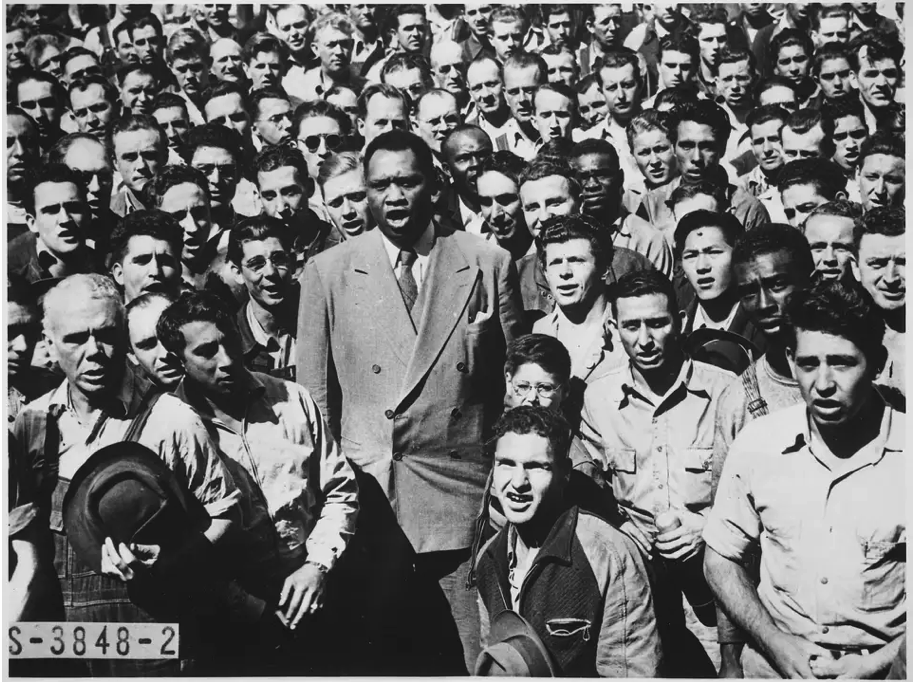
Robeson leading Moore Shipyard workers in Oakland, Calif. in singing the “Star Spangled Banner” in September 1942. U.S. National Archives and Records Administration
At the time, Fast was engulfed in writing “The Proud and the Free” and would have rather avoided being arrested, as had often happened when he was a chairman or marshal of a progressive action. He said no. So Pete Seeger himself called.
“No one can speak for peace the way you can,” Seeger told Fast. He reassured Fast that the event, far from sparking reactionary violence, would be peaceful and family-friendly.
And so, with much hesitation, Fast agreed to the position.
As it happened, the event was far from peaceful. As Robeson biographer Charles H. Wright wrote in “Paul Robeson: The Great Forerunner,” “Subsequent events suggest that Peekskill bears the same relationship to the Civil Rights Movement as Fort Sumter does to the Civil War.”

Howard Fast at home in Teaneck, N.J. in August 1959.
The concert that wasn’t
The concert was planned for the evening of Aug. 27, 1949, with Seeger and Robeson scheduled to perform before an audience of thousands in Lakeland Acres, just north of Peekskill. It was to benefit the Civil Rights Congress, a civil rights organization that defended Black Americans sentenced to death. But neither Seeger nor Robeson made it to the stage that day.
Howard Fast, however, did. An aggressive crowd was gathered at the entrance when he arrived an hour early. They were there to protest.
Hundreds of white men from the American Legion and various veteran groups had organized a parade nearby to coincide with the concert, which they’d unsuccessfully petitioned to have canceled. Fast walked back to the entrance with 30 or so trade unionists and merchant seamen to assess the situation. The moment the group emerged, they were ambushed by a hundred white supremacists with clubs and brass knuckles.
“(W)e were able to beat them back, but the mass of them filled the entranceway, and behind them were hundreds more, and up and down the road, still more,” Fast later recalled in his report for the Civil Rights Congress.
Abandoned by the police, Fast recognized that no one could enter or leave. He regrouped with his small contingent of union men, transformed from a quiet novelist to a guerilla leader. He sent for the rest of the men in the picnic area and for someone to get the word out to the press. Then he organized the modest group into three lines of 12 and a spare behind to defend the road, its flanks guarded by a ditch on one side and water on the other.
As the sun began to set, the mob moved in for another attack, this time with bottles, rocks and knives. The first line took the brunt of the violence, swapping out with people in the second line as they fled to deal with their bloody injuries. They were, as Fast said in his report, “fighting like a well-oiled machine.” The mob, wailing and yelling things like “We’ll finish Hitler’s job,” and “Give us Robeson, we’ll string that big n------ up,” couldn’t break the line and retreated.
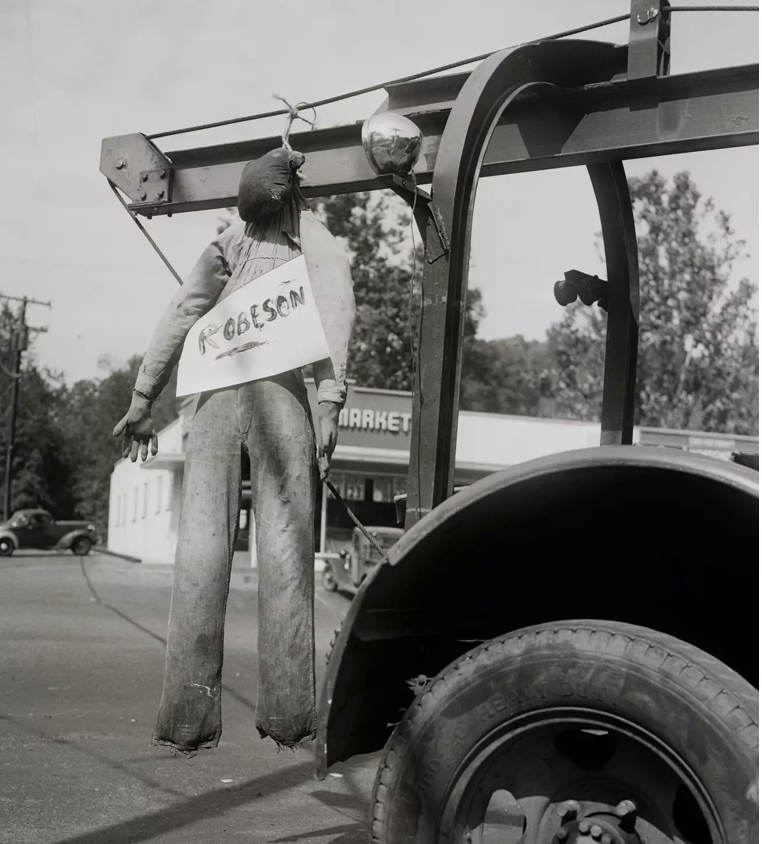
Robeson hangs in effigy from the rear of tow truck in Oregon Corners, Peekskill.
By then, the press and two FBI agents had arrived. They were just in time to witness the third attack. This time, the lines of union men, arms linked, began to sing, “We shall not be moved.” The mob, confused, stopped their hand-to-hand combat and began throwing rocks. Fast heard the cracking of one man’s skull. He feared they wouldn’t survive the night.
Fast and his men retreated to the picnic grounds where 2,000 wooden chairs sat empty and songbooks sat unopened. In the blinding dark, all of the men, women and children got up on the stage to fend off the white mob that was now chanting “Kill a commie for Christ!” The women on the stage sang the “Star-Spangled Banner” as the men kicked at those who got near. The angry mob took to building a large fire out of the chairs, throwing the table of songbooks and pamphlets into it, reenacting Nazi book burnings.
“Standing there, arms linked, we watched the Nuremberg memory come alive again,” Fast recalled in his report.
The mob eventually dispersed when state troopers came in.
Fortunately for Robeson, he arrived late at the Peekskill train station. A woman quickly smuggled him into her car before anyone noticed him.
Backlash
After arriving home at midnight, Fast feared the country would never hear about the vicious attacks that had unfolded. But by the time he awoke the next day, the entire world was talking about it. Fast’s wife had even read about it in the Paris Tribune.
New York Gov. Thomas Dewey requested a full report from Westchester County District Attorney George M. Fanelli, although Fanelli responded that he “didn’t know anything about the disorders but was sure that concert-goers were responsible.”
Robeson, who was himself dealing with the House Un-American Activities Committee and the effects of blacklisting, returned to New York City outraged but undaunted. At a mass meeting to support him in Harlem, Robeson vowed to return to Peekskill for another concert, receiving a standing ovation.
After a new location — the Hollow Brook Country Club — was set for Sept. 4, the home of the club’s owner was shot up and four separate attempts were later made to burn down the house. When the owner tried to collect for damages, his insurance contract was canceled.
This time, Gov. Dewey deployed 904 men to garrison the concert, assuring that there’d be no violence at the concert. But like Seeger before him, his prediction would prove wrong.
A violent triumph
On the day of the rescheduled concert, 25,000 people flowed into the Peekskill meadow on buses and in cars. Mostly trade unionists from unions like the Furriers, Clothing Workers, United Electrical, and the Newspaper Guild, they drove past a large, armed, anti-Robeson crowd, but entered unharmed. Surrounding the meadow was a wall of 2,500 union men and Robeson supporters, their arms interlinked.
The show played out uninterrupted. Seeger, relatively unknown at the time, sang songs for the first part of the program as Robeson was ushered in by a strong group of rather serious-looking union men. He sang out with his low-baritone voice spirituals like “Go Down Moses” and “Ol’ Man River” as well as labor songs.
The concert was a success. But the high spirits were short-lived.
A white mob lined the roads out of the meadow, armed with a stockpile of rocks, sticks and other projectiles. Around 3:30 p.m., violence erupted as concertgoers exited, with some police and troopers joining in.
Newspapers reported 145 people were injured and hundreds of cars were damaged, the mob violence spanning over 10 square miles, dragging in innocent bystanders. “When my wife and I got home,” Seeger later recalled in “Paul Robeson: The Great Forerunner,” “we rinsed the broken glass out of the heads of our babies.” One victim was Furriers Union organizer Irving Potash, who suffered a blow that caused him to lose sight in one eye and fractured his skull.

An angry mob held in check by state troopers protested the concert on Sept. 4.
On returning to the city, Potash joined with thousands of other union workers in protests calling on U.S. Attorney General Howard McGrath to prosecute the attackers. On Sept. 20, 5,000 marched on the state Capitol in Albany to demand action from Dewey, only to receive a half-hearted meeting with his assistant council, Lawrence Walsh.
The Wages of Racial Anti-communism
Eighty-three Peekskill riot victims eventually filed suit against Westchester County officials for official negligence, totaling over $20,000 in damages. All charges were dismissed. Robeson and Fast filed a civil suit against the county and two veterans’ groups that September, but it was dismissed in 1952. None of the individuals in the mobs would be held responsible.
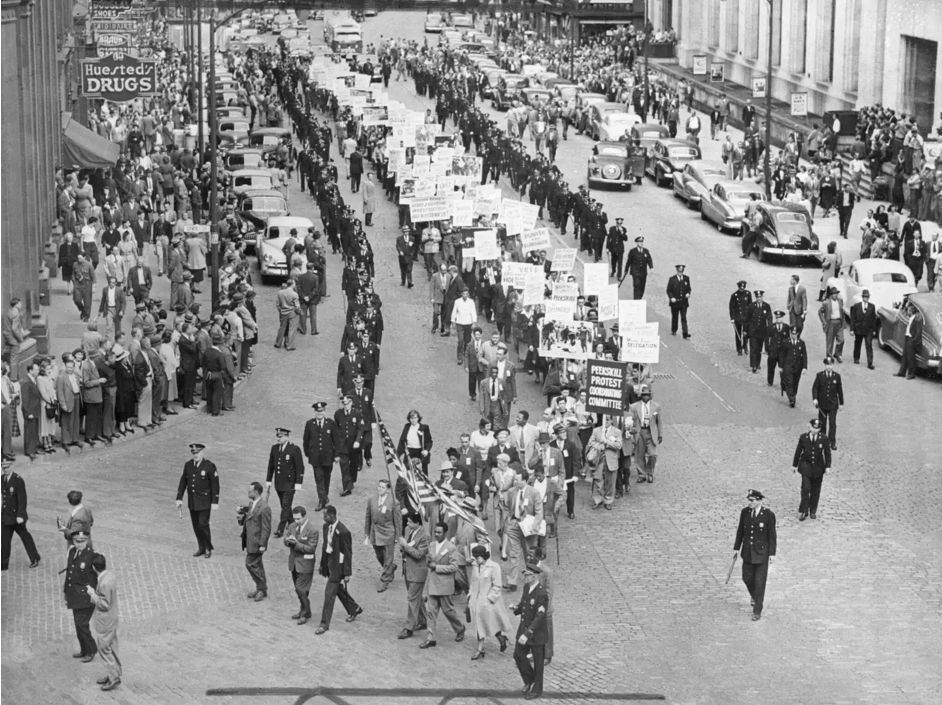
Flanked by police, a delegation of about 200 markers from New York City is shown parading to the state Capitol to protest the disorders in Peekskill when followers of Paul Robeson were stoned by protesters.
But even so, much of the history has been erased or forgotten. Stories like the Peekskill Riots still have yet to be integrated into the historical memory of the country. As Charles H. Wright put it, “Despite the vindication of time and circumstance, Robeson remains a prophet without honor in his own land.”
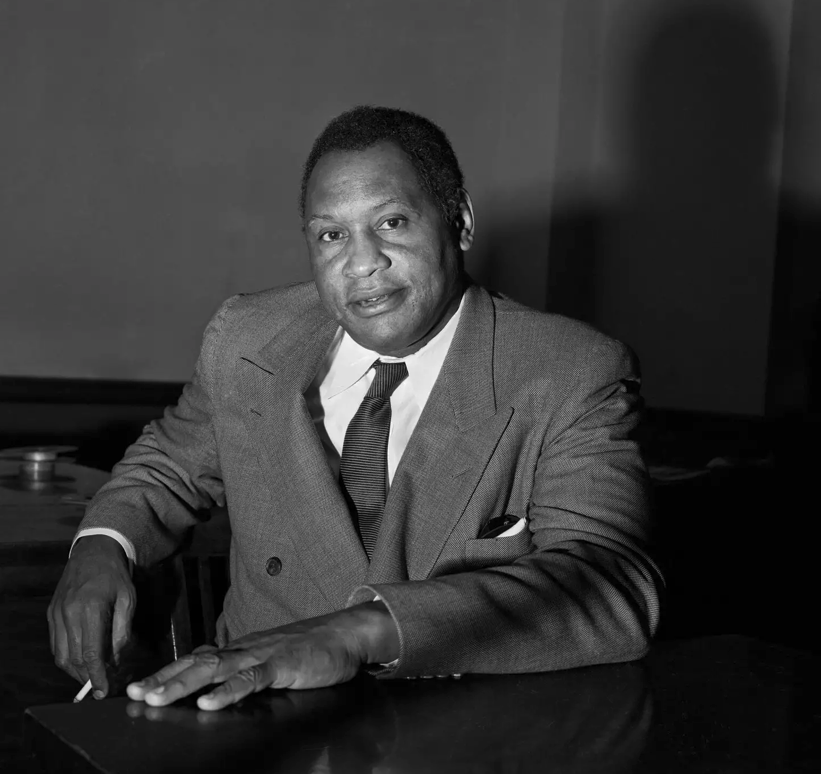
Singer Paul Robeson holds a press conference on Sept. 20, 1949. An example for generations to come.
Source: Times-Union, Albany/ Hudson Valley
Print this article [bws_pdfprint display=’print’]
 This work is licensed under a Creative Commons Attribution-NonCommercial 4.0 International License •
ALL CAPTIONS AND PULL QUOTES BY THE EDITORS NOT THE AUTHORS