Print this article [bws_pdfprint display=’print’]
This work is licensed under a Creative Commons Attribution-NonCommercial 4.0 International License •
ALL CAPTIONS AND PULL QUOTES BY THE EDITORS NOT THE AUTHORS

ELECTRONIC INTIFADA| Traducir—Translate! | |
| Make fonts bigger>>> | Resize text-+= |
You can watch the full show here:
• Breaking news and analysis on day 895 of t...
Your gift supports The Electronic Intifada's independent journalism on Palestine: • Donate by credit card, ApplePay, PayPal, Venmo or US bank account via Kindful: https://bit.ly/EIKindful
BEFORE you leave, PLEASE pay attention to this alert.
[t4b-ticker id="1"]
This work is licensed under a Creative Commons Attribution-NonCommercial 4.0 International License •
ALL CAPTIONS AND PULL QUOTES BY THE EDITORS NOT THE AUTHORS
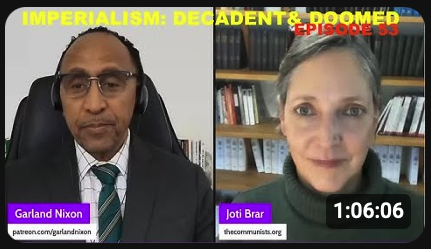
Garland chats with Joti Brar| Resize text-+= |
The video features Garland Nixon in conversation with Joti Brar, discussing the complex and ongoing conflict in the Middle East, particularly focusing on imperialism, anti-imperialism, and the strategic roles of various state and non-state actors.
The discussion centers on the dynamics between the United States, Israel, Iran, and their regional and global allies, including China, Russia, Syria, and North Korea. Joti Brar explains how the imperialist powers, driven by economic desperation, particularly seek control over Iran’s oil and the strategic Strait of Hormuz, but face significant resistance from a coalition of anti-imperialist states that employ asymmetric warfare and long-term strategy rather than direct military projection. The conversation delves into the historical roots of Iran’s missile program, highlighting Syrian and North Korean support in the 1980s, and how this cooperation reflects a broader anti-imperialist alliance quietly operating worldwide.
Joti emphasizes that the imperialist method of diplomacy and warfare is coercive and aggressive, relying on economic threats and military bases encircling sovereign nations, while the anti-imperialist powers focus on defending sovereignty through deterrence, asymmetric defense tactics, and patient strategy. The conversation also explores the media’s hostile portrayal of anti-imperialist countries, which complicates global understanding of these conflicts. The war in Ukraine is framed as a broader theater of imperialist versus anti-imperialist struggle, with parallels drawn to the Middle Eastern conflict, underscoring that Russia and Iran are fighting defensive wars against imperialist aggression.
Economic consequences of the conflict are discussed in detail, including the disruption of critical supply chains, inflation, and the potential for social unrest in Western countries due to rising energy prices and scarcity of industrial materials. Joti points out how Iran’s “mosaic defense” strategy turns the entire country into a guerrilla-like military structure, complicating imperialist efforts to achieve a quick victory. The conversation highlights the growing internal pressures within Gulf states, Lebanon, Iraq, Jordan, and Saudi Arabia, where popular uprisings against pro-imperialist regimes are increasingly likely. The discussion closes with a call for anti-imperialist activists, especially in the West, to educate and organize working-class populations to support the global resistance against imperialism, stressing that the ultimate defeat of imperialism requires both external and internal struggle.
The discussion underscores that the current Middle East conflict is not merely a regional war but a front in a broader global struggle between imperialism and anti-imperialism. It calls for a reorientation of understanding away from imperialist narratives and towards recognizing the legitimacy and strategic sophistication of anti-imperialist resistance. The ultimate resolution depends not only on battlefield victories but also on the political engagement and awakening of populations, especially in imperialist countries, to support and join the fight against global domination.
GARLAND'S ROFKIN & RUMBLE PLATFORMS:
ROFKIN: https://www.rokfin.com/garlandnixon
RUMBLE: https://rumble.com/user/garlandnixon/videos
DONATIONS:
BUY ME A COFFEE • https://www.buymeacoffee.com/garlandnh
PayPal - garlandn@gmail.com
/ garlandnixon
Unfortunately, most people take this site for granted.
DONATIONS HAVE ALMOST DRIED UP…
PLEASE send what you can today!
JUST USE THE BUTTON BELOW
This work is licensed under a Creative Commons Attribution-NonCommercial 4.0 International License


| Traducir—Translate! | |
| Make fonts bigger>>> | Resize text-+= |
There was the time in the Civil War when the rebel army thrashed Union forces, and its cavalry roamed at will north of the Capitol.
The stock market crash of ’29 and subsequent Great Depression put millions out of work and nearly wrecked the country.
In 1941, the Japanese destroyed many American ships at anchor in Pearl Harbor, and defeated our troops in the Philippines.
After billions of dollars wasted and 50,000 men killed, the victorious Viet Cong ran America out of Vietnam on 30 April of ‘75. [Imperial pursuits, of course, are moral disgraces that should not be crowned with victory, despite the human tragedy they represent to all sides involved.]
After the Twin Towers fell in ‘01, America’s wars on Afghanistan and Iraq ended with many deaths in costly disgrace and failure.
Since the period of The Empire’s inexorable decline began, many years—actually all of them—might be classified as horrible, but none so indelibly dreadful as those of the second Trump term.
It is not possible to assess the totality of what made Trump the monstrous thing he is. Whatever perverse conditioning produced this ugly moral freak, one has to use the record of what he has done and tried to do to capture a comprehensive description of this repulsive and appalling human failure.
His first act on assuming office was to mount a violent assault on established governance. He made vicious, unhinged Elon Musk his riptooth hitman, to shrink, eliminate and randomly destroy. The State, Education, and HHS Departments were crippled, and flunkies and yes-men put in charge. He simply eradicated AID. [Granted, USAID was deeply compromised by being yet one more devious tool to meddle, infiltrate and regime-change targeted countries.]
Next, he took his chainsaw into Justice, Homeland Security, the FBI, and NSA, and installed a set of furious, deranged right-wing zealots and sycophants as bosses. This enabled him to use the terms security and justice while ignoring them in practice, and to launch a domestic war on speech, principles, and ideas, with a scorched earth blitz on immigrants, student activists, people of color, political opponents, and civil liberties, across the board.
Internationally, he has directly funded and promoted two of the most criminally unconscionable military disasters in a recent history that includes The Empire’s bloody, costly humiliations in Afghanistan and Iraq.
Trump perpetuated the charnel house of Ukraine, planned and initiated under the evil twin party running what is now universally derided as “American Democracy”. He blamed Democrats for starting it—true—while continuing to fund it, never recognizing Russia’s plainly stated security requirements. He sent bumbling nonentities with a set of fool’s notes to con one of the world’s premier statesmen into undermining his own country’s interest.
He has, from his earliest days, been in the pockets of vicious, racist Zionist Jewish billionaires, funding their monstrous, neo-Nazi genocide of Palestinians and, with Gaza pulverized, he continues to plot with these murderous fiends their Greater Israel obscenity, the uber-Orwellian entity denominated Board of Peace.
There have been comic aspects to his spastic thrashing, and the fulminating of his diseased mind, such as renaming the Gulf of Mexico, annexing Canada, bombing Mexican drug gangs, and declaring “White genocide” in South Africa, but he has carried out a few of his most barbarous fever dreams.
He obliterated unidentified speedboats, saying they were running drugs, killing their crews. He bombed poor villages in Nigeria on the grounds that they were persecuting Christians. He ordered a violent assault on Venezuela that killed dozens, and kidnapped its head of state, an open act of war, bent on stealing its oil, and celebrated the flagrant murder of an innocent American woman by his ICE Gestapo assassins.
Clearly, his most insane threats are not necessarily empty. He is now deep in the effort to annex Greenland, an independent part of Denmark which, naturally, refuses. NATO and all Europe is aghast and against him, and though he has said he will not use the military, no one takes the word of a proven habitual liar.
After Davos, it appears the Greenland caper, like so many of his bellowed diktats, has been put on an indefinite hold and gone the TACO route. He seems to have been checked by the solidarity of the pathetic EU clique’s refusing to knuckle under, even after the threat of imposition of high tariffs on all its goods.
His China Shop Bull behavior has deeply alienated most of the world, and deeply provoked his most powerful adversaries. He believes The Empire can rule the Americas, binding them in a giant Capitalist dollar prison, under money elites led by fascist criminals like himself, and it may be so with Bolsonaro, Milei, Noboa, Bukele, Boric, (and certainly the just elected José Kast, an avowed Pinochet admirer) in power positions already.
The worst of all horrible years is coming. America has never been so mortally at risk as it is now with this Anus Horribilis.
BEFORE you leave, PLEASE pay attention to this alert.
[t4b-ticker id="1"]
This work is licensed under a Creative Commons Attribution-NonCommercial 4.0 International License •
ALL CAPTIONS AND PULL QUOTES BY THE EDITORS NOT THE AUTHORS

| Traducir—Translate! | |
| Make fonts bigger>>> | Resize text-+= |
[00:27] 🏝️ Real Estate as Conflict Framing: Trump’s emphasis on Gaza’s “location” reduces a complex, deeply political and humanitarian crisis to a matter of land value and development potential. This commodification overlooks the historical suffering and political rights of Gazans, framing them instead as passive stakeholders in a real estate transaction rather than as a people with legitimate aspirations for sovereignty.
[01:55] 📊 Zoning and Urban Planning as Political Statement: The division of Gaza into tourism zones, data centers, parks, and limited residential areas is not just urban planning but a political map that relegates Palestinians to the margins. The emphasis on commercial and recreational zones over residential space implies a deliberate strategy to minimize Palestinian presence and autonomy, effectively transforming Gaza into an economic enclave subordinate to external interests.
[03:01] 🏨 Luxury Tourism on a Mass Grave: The plan’s proposal to build luxury resorts on land described as a “mass grave” is a stark metaphor for the erasure of Palestinian suffering and history. It highlights the grotesque juxtaposition of profit-driven development amid sites of recent mass violence, reflecting a broader pattern of exploiting trauma for economic gain.
[05:15] 💼 Employment as Servitude: The promise of full employment is critically framed as a euphemism for servitude—Palestinians working in low-level service roles within luxury hotels owned or operated by those who perpetrated violence against them. This dynamic echoes colonial labor structures where indigenous populations were confined to subordinate economic roles under the guise of development or modernization.
[07:17] 🔫 Demilitarization as Control Mechanism: The insistence on Hamas’s demilitarization as a prerequisite for rebuilding underscores how security concerns are leveraged to enforce political control. Without disarming Gaza’s resistance, the plan cannot proceed, effectively linking reconstruction to political submission and curtailing legitimate Palestinian self-defense and sovereignty.
[10:25] 🕵️ Systematic Humiliation and Political Erasure: Critical voices in the transcript argue that the plan is less about peace than about systematic humiliation and political disenfranchisement. By turning Gaza into an economic zone without political rights or sovereignty, the project perpetuates a form of structural violence that denies Palestinians dignity and self-determination.
[14:47] 🎭 Neo-Colonial Exploitation: The comparison of the Gaza redevelopment to colonial practices—where indigenous people were made entertainers or servants on their own lands—illuminates how the plan replicates historical patterns of domination and exploitation. It exposes the moral contradictions of those who claim to bring peace and prosperity while perpetuating inequality and subjugation.
The transcript reveals a deeply troubling vision of peace that is fundamentally tied to real estate and economic control rather than justice or political reconciliation. Trump’s framing of Gaza as a “great location” epitomizes a reductionist approach that prioritizes economic value over human rights. Kushner’s master plan, with its distinct zoning and rapid development timeline, reflects a technocratic vision that ignores the complex social, historical, and political realities on the ground.
The zoning plan’s allocation of land reveals the underlying agenda: coastal tourism zones for the elite, industrial data centers inland, and limited residential space for Palestinians. The disproportionate emphasis on commercial zones, particularly luxury hotels, suggests that Gazans are envisioned primarily as laborers serving global capital and foreign visitors rather than as autonomous citizens with political agency. This echoes colonial-era urban planning where indigenous populations were marginalized spatially and economically.
The transcript’s biting commentary exposes the racial and political implications of this planning. The description of Palestinians working as bellhops or bartenders in hotels built on sites of genocide is a powerful indictment of the plan’s dehumanizing logic. It highlights how economic opportunity is presented as a substitute for political freedom, a trade-off that perpetuates servitude under occupation rather than liberation.
The requirement for Hamas’s demilitarization underscores the security paradigm that governs the entire project. Reconstruction is conditional on disarmament, effectively ensuring that Gaza remains politically and militarily subordinate. This dynamic underlines the inherent power imbalance and the use of security concerns as a tool of political control.
Critics in the transcript interpret the plan as a form of systematic humiliation and political erasure. The minimal residential zoning is seen as evidence of genocide’s aftermath, with Gaza’s population effectively displaced or reduced. The project is not framed as a genuine peace initiative but as a real estate development on a “mass grave," a spatial metaphor for the destruction and displacement of Palestinian life.
Finally, the transcript situates the project within a broader historical and geopolitical context by drawing parallels to colonial exploitation. The idea that Palestinians will be “entertainers” or servants on their own land evokes painful histories of indigenous populations subjugated under colonial regimes. The sarcastic comparison to British colonial paternalism exposes the moral justifications often used to mask domination and exploitation—a pattern that appears to be repeating in this 21st-century context.
Overall, the transcript offers a critical lens on the “Board of Peace” project, challenging its narrative of peace and prosperity by revealing the underlying dynamics of control, dispossession, and neo-colonial exploitation embedded in the Gaza redevelopment plan.
This analysis provides a comprehensive understanding of the speech’s content, its inaccuracies, and the broader geopolitical and cultural implications, situating Trump’s rhetoric within the context of an evolving global order and domestic political dynamics.
This work is licensed under a Creative Commons Attribution-NonCommercial 4.0 International License •
ALL CAPTIONS, insults, AND PULL QUOTES BY THE EDITORS NOT THE AUTHORS

DIALOGUE WORKS| Traducir—Translate! | |
| Make fonts bigger>>> | Resize text-+= |
The video provides an in-depth geopolitical and economic analysis focusing on Central Asia’s strategic significance amidst competing global powers, the evolving U.S. foreign policy under Trump’s second term, and China’s rapid technological and economic advancements. The discussion opens with skepticism over the Trump administration’s claimed massive investment deal with Uzbekistan, questioning its feasibility and intent. The emphasis then shifts to Kazakhstan’s pivotal role as a strategic energy exporter and geopolitical bridge between Russia, China, and the West. Despite U.S. efforts to engage Central Asian states, Russia and China maintain predominant influence, with Kazakhstan recently reinforcing its strategic partnership with Russia.
The conversation further explores the historical context of U.S. attempts to penetrate Central Asia’s energy markets, notably the failed Cheney-era efforts to divert Turkmen gas away from China. The discussion highlights the complex regional dynamics, including Turkey’s cultural claims versus the geopolitical realities shaped by Russia and China’s dominance. It also touches on covert operations, color revolutions, and intelligence activities by Western and British agencies aimed at destabilizing the region.
A significant portion of the dialogue critiques the longstanding “war on terror” as a fabricated narrative designed to justify geopolitical agendas, particularly to facilitate the Zionist entity’s expansion, revealing the U.S. tacit support for terrorist figures like (CIA-created and supported) Al Jolani. This exposes the duplicity of Western policies in the Middle East and Central Asia.
The latter part of the transcript shifts to China’s technological triumphs, particularly Huawei’s breakthrough in developing indigenous EUV lithography machines, challenging the global semiconductor monopoly held by the Dutch company ASML and the broader U.S.-led tech embargo. This technological advance is framed as part of China’s broader “Made in China 2025” strategy and its meritocratic, highly coordinated innovation ecosystem. The discussion contrasts China’s productive, planned economy with the West’s financialized, speculative model, emphasizing China’s advantages in clean energy, AI integration, and socio-economic stability.
Finally, the video touches on China’s emerging missile defense systems ("Dragon Dome"), and the ongoing ideological and strategic confrontation between the Chinese meritocratic system and the Western oligarchic model. The overall tone is one of critical realism about U.S. foreign policy failures, the resilience and ascendancy of Eurasian integration led by Russia and China, and the profound transformations underway in China’s socio-economic landscape.

This comprehensive analysis presents a nuanced understanding of the current geopolitical tensions, technological competition, and the shifting balance of power in Eurasia and beyond.
BEFORE you leave, PLEASE pay attention to this alert.
[t4b-ticker id="1"]
This work is licensed under a Creative Commons Attribution-NonCommercial 4.0 International License •
ALL CAPTIONS AND PULL QUOTES BY THE EDITORS NOT THE AUTHORS