
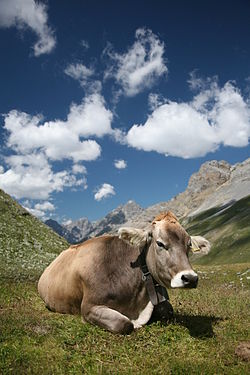
A cow, unperturbed, in her natural state, as nature would have it.
Editor’s Note: People in the animal rights movement long ago advanced the slogan: “Meat is Murder”. It was designed to shock a largely indifferent and willfully ignorant public into recognizing that the eating of animals is not a normal thing, no matter how we wash the matter and our consciences, that it involves very much the involuntary, painful death—for our pleasure or convenience— of a creature who has as much a right to live on this earth as any of us.
Some people will never change, and we understand that. But we do hope that the arguments presented here by Dr. Abelow, along with the video (courtesy of Mercy for Animals), will make those who read this piece think twice before continuing unperturbed with the habit of eating animals. Simply put, it’s ethically wrong, and since we’re not tigers, lions or crocodiles, and we do have many choices, quite unnecessary. What’s more, eating animals is not only an ethical question of great importance; it’s also an ecological issue. Factory farms are today one of the biggest—if not the biggest—contributors to climate change, and all that this dreadful shift in the planet’s temperatures entail. In any case, after examining this article, and watching the images on this video, ask yourself honestly: are these animal rights activists so extreme? Are they so unreasonable? And, isn’t meat just a fancy name for murder?—Patrice Greanville
The reality of meat-eating
By Benjamin Abelow, M.D.
New Marlborough, Massachusetts
A recent lead story in The Berkshire Eagle on the ammonia-treated hamburger filler known as “pink slime” drew attention to the integrity of our food supply [“Meat markets’ pink boon,” April 4, 2012]. But as consumers, we need to ask a basic question: Where does hamburger come from and, ethically or otherwise, is pink slime really any worse than the meat itself?
I recently spent time with calves on a Berkshire dairy farm. The experience was unusual, in that I got to know the calves well and personally. For six months, I visited up to four times a week, in some cases starting on the day of birth. I formed close bonds with some of the calves.
I learned that calves are warm and gentle creatures with distinct personalities. When happy, they sometimes kick up their rear legs like a foal. They express affection and show courage.
I witnessed a calf standing watch over a dying mate in a cold and dark barn. I saw another calf trying to escape her tiny pen by boldly—yet impossibly—attempting to hurdle a high fence. She failed, and ended up leaping painfully, face first, into the fence. I saw another calf slowly drop to her forelegs, deliberately lowering herself into the layer of feces and mud that covered the floor of her dank enclosure. She spent several minutes trying vainly to push herself under the metal gate that held her captive. When she stood up, filth was smeared on her torso and face.
On most commercial farms, calves are permanently separated from their mothers—some are literally dragged away—within a day of birth. They pine for their mothers and their mothers pine for them. Some of the calves become despondent. More than a few die. The male calves, which have no role in a dairy operation, are shipped off. Many are reared for veal—isolated, tightly confined, utterly alone—and killed at a few months of age.
Those females who survive to maturity endure their own particular nightmare. They are artificially inseminated on a scientifically determined schedule and have their own calves repeatedly taken away. They spend most of their lives crowded together in a small, cement world. Through breeding, tightly managed impregnation cycles, special feeds, intensive milking, and sometimes artificial growth hormones, these cows are driven to produce many times more milk than they would for their own calves. Some develop mastitis or arthritis and live in chronic pain.
The intense lactation exhausts the cows quickly. In four or five years—about a quarter of their natural lifespan—their milk slows. Their purpose served, the cows are now worth more dead than alive and so are taken to slaughter. Smelling the blood of those who came before them, they are stunned with a bolt gun, have their throats slit, and are ground up for hamburger and processed meats. Yes, this is the source of most hamburger we eat: frightened, spent dairy cows who started life as gentle and playful creatures longing for their mothers.
Is the ammonia used to make pink slime any worse than the antibiotics and hormones that are often given these cows? Is the meat that we use for ordinary hamburger ultimately any less horrific than the leftover butchering scraps that are used to make the filler?
I have focused here on calves because I know them best, but the suffering of other farm animals is equally acute. Think of times you’ve accidentally stepped on the foot of your cat or dog—and how they reacted. Now think of a piglet being castrated and having its tail cut off without anesthetic—standard practice on most pig farms.
The scope of the disaster we inflict on sentient farm animals is almost beyond imagining—incomparably worse than any “tooth and claw” they might experience in nature. Each year in the U.S., over nine billion farm animals, including 150 million mammals, are killed for food. These numbers come from the USDA. The situation has much in common with slavery, with a gulag, with a concentration camp. The scale is infinitely more vast than anything humans have ever done to other humans.
Animal products are not necessary for a healthy diet. This means we do all this for nothing more important than a personal taste preference. In fact, these food preferences contribute to rampant cardiovascular disease and cancer.
If you are moved by the plight of these animals, keep feeling. Bring your behavior into accord with your empathy and your ethics. Educate yourself. Adjust your lifestyle. Perhaps you will wish to start spreading the word yourself. If you stop eating animal products, you will save dozens of feeling animals every year from intensely painful lives and terrible deaths. You don’t need to do this all at once. Start gradually. If you eat half as many animals, you will cause half as much suffering.
To learn more, watch the 12-minute film narrated by Paul McCartney at Meat.org. Or watch the equally good short video at MeatVideo.com, narrated by James Cromwell. These mini-documentaries are graphic and hard to watch but are necessary to see if we wish to understand the consequences of our diet and farming practices.
Or read a book. Eating Animals by Jonathan Safran Foer is one of many volumes on the subject that helps communicate what it really means to eat hamburger and other animal products.
Benjamin Abelow, M.D.
New Marlborough, Massachusetts
_____________________________________________________________
Cruel Cuts – Illegal Slaughter Exposed in Los Angeles
Courtesy of Mercy for Animals
Hidden-camera footage obtained by Mercy For Animals has led to the arrest of Roberto Celedon for three felony and 10 misdemeanor criminal charges related to his illegal slaughter operation in Los Angeles County, California. The shocking video evidence shows animals being violently pinned down, having their throats crudely sawed open, and slowly bleeding to death.
After reviewing the hidden-camera footage, Dr. Armaiti May, a practicing veterinarian and farmed animal welfare expert in Santa Monica, stated: “The blatant cruelty towards the goat and sheep at this facility is nothing short of horrifying and must be punished to the full extent of the law. My overall impression is that the facility where this footage was taken shows extreme disregard for the basic welfare of the animals in its practices as well as lack of appropriate hygiene.”
Roberto Celedon was arrested and charged with a felony under California Penal Code 597(b)which states that every person who “tortures, torments,” “cruelly kills any animal” or “subjects any animal to needless suffering” is guilty of a crime punishable by a fine of not more than $20,000 and/or imprisonment in excess of one year.
Celedon was also cited for numerous violations of the California Food and Agriculture Code for operating without a license. He not only subjected animals to needless cruelty and suffering, but also failed to meet building and sanitation standards required by California law.
During a raid of the facility, Los Angeles County Animal Control officers seized dozens sick,injured and emaciated animals. These animals are now being rehabilitated at The Gentle Barn, a sanctuary for farmed animals in California. MFA praises law enforcement for its swift and decisive action in pursuing justice in this important case.
This case graphically illustrates the cruel, inhumane and illegal abuses that farmed animals are all too often subjected to in California and across the nation. In a civilized society, it is our moral obligation to protect all animals, including animals raised and killed for food, from needless cruelty and suffering.
Read more:
• Undercover investigations group Mercy for Animals to go international
• Backyard butcher reports to serve time
Let’s keep this award-winning site going!

| Yes, audiences applaud us. But do you?If yes, then buy us a beer. The wingnuts are falling over each other to make donations…to their causes. We, on the other hand, take our left media—the only media that speak for us— for granted. Don’t join that parade, and give today. Every dollar counts. |
|---|
| Use the DONATE button below or on the sidebar. And do the right thing. Even once a year. |

Use PayPal via the button below.
THANK YOU.


8 comments
“It is the essential characteristic of a wise person that he/she does not kill any living being.
One should know that non-killing and equality of all living beings are the main principles of religion” Jain sutra
Meat consumption is a moral failure endorsed by the judeo.christian doctrine of dominion, which sanctifies slaughter as a god-given right. The efforts described in your distribution skirt around this issue. Exposing the most extreme abuses as Mercy for Animals is prone to do, implies that when these conditions are remedied one may eat meat without remorse. Mercy for animals consults with Temple Grandin, a diabolical promoter of compassionate meat, in an effort to assess levels of cruelty during slaughter.
In a recent distribution MFA boasted of its triumph of exposing cruel treatment of animals during slaughter:
“Upon reviewing the undercover footage, Temple Grandin, PhD, animal welfare advisor to the USDA, wrote: “The handling was very rough and kicking animals is not acceptable. If this auction had been a federally inspected meat packing plant, they would have suspended inspection and shut them down.” Mercy for Animals
Within the constraints of dominion, kicking an animal is not acceptable, but slitting his throat is, if it is done to the highest standards.
Organizations such as Mercy for Animals work with the meat industry to create an illusion of compassion, so that sales will not be hampered. Mercy For Animals, along with Farm Sanctuary, HSUS, Compassion Over Killing, and several other national animal organizations joined ranchers, animal farmers, and animal product sellers to endorse Ohioans for Humane Farms whose mission is to “protect” animals by advocating for “humane” animal farming practices. This coalition worked on a ballot initiative which sent consumers a positive message about eating so-called “humane” animal products.
The preponderance of organizations such as Mercy for Animals is a direct result of the reluctance of so called ‘welfare’ organizations to grapple with the morality of slaughter. In reality there can be no welfare for animals, if it is assumed that they may be slaughtered, provided it is done with a loving hand. There is no welfare as long as their right to remain free from slaughter is denied. There is no welfare when they do not have the right to their own lives.
Before jumping on the bandwagon of Mercy for Animals, as an organization that promotes an end to animal suffering, consider the following videos presented by Peter Wollen of the Kindness Trust. In the first he states that the most beautiful word the world has ever known originated in India: AHIMSA. With this view slaughter is always prohibited. The life of an animal has inherent value:
http://www.youtube.com/watch?v=jC0-Kkb5ZDw&feature=email
http://www.youtube.com/watch?v=vgbGGZgnp88&feature=relmfu
http://www.youtube.com/watch?v=P3TeJZ1RBsE&feature=relmfu
http://www.youtube.com/watch?v=3LF6n3k-u2o&feature=relmfu
http://www.youtube.com/watch?v=OENbC91v4Wo&feature=relmfu
Welfare advocates, on the other hand, are seeking the right way to do the wrong thing. The roots of this effort lie in the judeo.christian tradition, where the pretense of compassion outweighs the reality. The precursor to the welfare approach can be seen in the writings of Maimondies:
“It is prohibited to kill an animal with its young on the same day,
in order that people should be restrained and prevented from
killing the two together in such a manner that the young is slain
in the sight of the mother; for the pain of animals under such
circumstances is very great…” Maimonides,Guide for the Perplexed, 3:48
Another failure to deal directly with the issue of the morality resides in the effort to dissuade consumption of meat based on health concerns. Truth be told, moderate amounts of meat are perfectly healthy. This is understood by the public, so that it is not a persuasive deterrent. As to the quality of meat, here again exposing contamination of meat products has led to an ‘organic meat’ industry. Whole Foods boasts of the quality of its chemical free, grass fed beef, who are allowed to roam freely until the day when their lives are taken by the exacting standards of organizations such as Mercy For Animals. Dominion will always find a way and a reason to kill.
The approach of the peaceful slaughterers and the health groupies serves to ensure the increased production of healthful, properly kept and slaughtered meat, as both of these factions do not have the moral courage to tackle the underlying morality of meat.
One person who understands that negotiating with the evil of the meat industry can never result in compassion is Professor Gary Francione. For this he has been ostracized from the animal rights community and criticized as divisive. Animal organizations so desperate to attain seemingly apparent results, have instead created a never ending cycle of salughter and abuse spurred on by the delusion that sanctified violence can lead to compassion. As long as we continue to placate cruel industries and the religious traditions that enable them, by refusing to tackle the moral implications of the exploitation of animals, the status quo will persist. We would do well to heed the words of Gary Francione:
“I reject animal welfare reform and single-issue campaigns because they are not only inconsistent with the claims of justice that we should be making if we really believe that animal exploitation is wrong, but because these approaches cannot work as a practical matter. Animals are property and it costs money to protect their interests; therefore, the level of protection accorded to animal interests will always be low and animals will, under the best of circumstances, still be treated in ways that would constitute torture if applied to humans.
By endorsing welfare reforms that supposedly make exploitation more “compassionate” or single-issue campaigns that falsely suggest that there is a coherent moral distinction between meat and dairy or between fur and wool or between steak and foie gras, we betray the principle of justice that says that all sentient beings are equal for purposes of not being used exclusively as human resources. And, on a practical level, we do nothing more than make people feel better about animal exploitation.” Gary Francione
It is dominion that has codified animals as human property, who are therefore unworthy of justice and compassion. If we fail to grapple with the roots of their abuse, the cycle of violence will remain unbroken.
Thank you for your excellent piece on the unimaginable suffering animals sustain for our palates. I hope it wakes up many people from their comas. It’s hard to imagine that with all the information out there, in print and on the internet, people choose to remain oblivious. Years ago, before the internet, before undercover exposes, when factory farms and slaughterhouses were doing a good job of concealing the horrific cruelty inherent in their businesses, it was understandable that people (except for a precious few) were not aware of the magnitude of the horrors inflicted on non-humans. Now that we know, there is no excuse.
Based on the expose by Mercy for Animals, what is known is that the worst abuses are addressed. Unfortunately compassionate slaughter and meat are still on the menu. Addressing the excesses of factory farming, rather than the morality of all slaughter, leads straight to Temple Grandin, who creates pleasant rides down the slaughter assembly line. Whole Foods supplies meat with the highest welfare rating, so that consumers can eat meat, convinced they are compassionate. By the standards of domnion they are.
Attacking an autistic women. Sheer class.
There is a wide spectrum of autism disorders. Temple Grandin is able to write books, lecture and design abbatoirs. It seems likely that she can understand the concept of animals’ suffering. It could be considered demeaning to imply that she is not able to consider questions of morality simply because she suffers from a form of autism. It is also a slippery slope to state that anyone with certain forms of disability should never be criticized for things they do that are within their control and done by conscious choice.
As someone who has worked with autistic kids, including full time care? You may not be aware that while some cognitive functions work, more complex ones are very difficult. They take everything literally, and most have a complete inability to concetualize anything beyond concrete. Temple “thinks” in pictures, and could comprehend circles, mooing and panic. Yet she remained totally unaffected by her dear friend’s death. Unable to “see” what happens afterword would leave her totally unable to moralize the actual killing. To her, they are there then not there. She could see the panic and wanted to alleviate that – again because there was visual evidence.
You can be critical of what others have done with her work… but to demonize her is to totally, willfully misunderstand how the autistic mind works.
She admits she cannot even understand what “love” is. Not even with her own Mom.
You cannot say things like “I’m on fire” metaphorically around some of these kids without expecting to get a glass of water poured on you. (This by one boy who is a brilliant pianist)
Saying she should be able to moralize because she wrote a book reinforces negative thinks about mental disorders. It smacks of you think they are faking it.
Temple Grandin is one of many who promote so called compassionate routes to slaughter. Defending Temple Grandin because she is autistic, deflects from the main issue at hand: is the slaughter of an animal ever morally appropriate? Those who believe it is not, just as the murder of a human is not, find the slippery slope taken by many animal organizations and the meat industry towards portraying slaughter as benevolent is a devaluation of the sanctity of life.
Leonardo Da Vinci understood the idea that murder, even most sweet, is still murder:
“The time will come when men such as I will look upon the murder of animals as they now look on the murder of men.” Leonardo da Vinci
These words are echoed in the following sutra from the Jain religion:
“For there is nothing inaccessible for death.
All beings are fond of life, hate pain, like pleasure,
shun destruction, like life, long to live. To all life
is dear.” Jain Acharanga Sutra.
As a socialist I normally come to this site for political “sustenance” but I was pleased to see this article on the diet dilemma concerning animals. It’s a topic frequently talked about in animal rights circles for quite some time, but (thus far) not in other precincts where by rights it should also be discussed. Like among people who regard themselves as being on the left, or environmentalists. Or people who would never dream of harming their own mascots.
I began my own trip from meat-eating toward vegetarianism (still incomplete I must admit) about 10 years ago (I’m 57 now) so I can testify firsthand how tough it can be. During that time I have expanded my knowledge about this issue and picked up more than a few tricks on cooking vegetarian dishes, especially these days when I can use really good substitutes. Such things did not exist even a few years back so I suppose some progress is being made in that direction.
Frankly at this point I could not foresee ever going back to my prior self. Anyone who has been near an abbatoir—let alone inside, face to face with the horrors that await the unfortunate beasts that end up in such places—has to reconsider meat-eating as a matter of simple decency. I once had a job fixing some seriously clogged piping in a large slaughterhouse near Sydney and must say it was the worst, most stressful job I ever did in my entire life. My mate was momentarily similarly affected but soon went back to his usual diet. Only now, due to a heart attack, and on his doctor’s advice, has he quit eating meat on most days, although he still puts away a big chunk of beef every weekend.
The way I see it, this is not an overnight thing. But being at least open to the plight of these creatures is a moral duty that people everywhere should contemplate.
Incidentally, it must have been hard for you to run that video of the poor sheep and goat being killed in such a brutal manner. The images still haunt me, so I realise how other readers must feel. I guess it has to be done. I thank you for that.
If it opens the eyes of just a few people, it will be worth the effort, albeit if any liberation from human tyranny ever happens, it will come much too late for these victims and countless more.
Ron Bardie,
Former member, Plumbers Union
Brisbane, QLD