

 [su_spoiler title=”HELP ENLIGHTEN YOUR FELLOWS. BE SURE TO PASS THIS ON. SURVIVAL DEPENDS ON IT.” open=”yes” style=”fancy” icon=”arrow-circle-1″]
[su_panel background=”#e9eaef” radius=”11″] 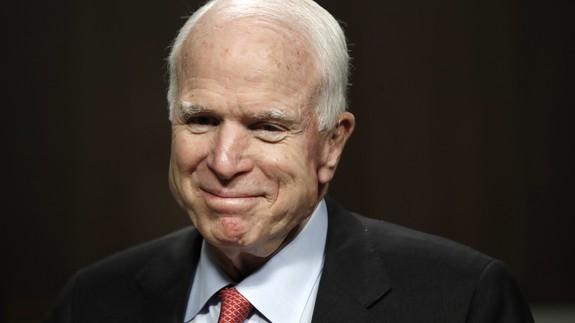 This tweet by Glenn Greenwald yesterday reminded us of the necessity to warn people against falling for the inevitable gush of phony praise upon the death of one of the great scumbags of our time, a man who managed to stand out in a crowded field of despicable criminals and phonies in the service of imperialism and entrenched privilege, while waving the flag of patriotism. In fact, even his military credentials are contested —and by fellow vets no less, many of whom have a completely different take on this opportunistic and sociopathic politician. —The Editors [/su_panel]
With John McCain evidently fading, and the hagiographies emerging, it’s a good time to remember that the taboo against speaking ill of the recently deceased is a nice etiquette rule wholly inapplicable to powerful political figures who are being sanctified https://t.co/FYWIrkg3C4
— Glenn Greenwald (@ggreenwald) May 6, 2018

Glenn Greenwald
The Guardian (UK)
{This is when the Guardian was still publishing some pieces of genuine anti-establishment journalism}
Margaret Thatcher and misapplied death etiquette

[su_dropcap size=”5″]N[/su_dropcap]ews of Margaret Thatcher’s death this morning instantly and predictably gave rise to righteous sermons on the evils of speaking ill of her. British Labour MP Tom Watson decreed: “I hope that people on the left of politics respect a family in grief today.” Following in the footsteps of Santa Claus, Steve Hynd quickly compiled a list of all the naughty boys and girls “on the left” who dared to express criticisms of the dearly departed Prime Minister, warning that he “will continue to add to this list throughout the day”. Former Tory MP Louise Mensch, with no apparent sense of irony, invoked precepts of propriety to announce: “Pygmies of the left so predictably embarrassing yourselves, know this: not a one of your leaders will ever be globally mourned like her.”
This demand for respectful silence in the wake of a public figure’s death is not just misguided but dangerous. That one should not speak ill of the dead is arguably appropriate when a private person dies, but it is wildly inappropriate for the death of a controversial public figure, particularly one who wielded significant influence and political power. “Respecting the grief” of Thatcher’s family members is appropriate if one is friends with them or attends a wake they organize, but the protocols are fundamentally different when it comes to public discourse about the person’s life and political acts. I made this argument at length last year when Christopher Hitchens died and a speak-no-ill rule about him was instantly imposed (a rule he, more than anyone, viciously violated), and I won’t repeat that argument today; those interested can read my reasoning here.
But the key point is this: those who admire the deceased public figure (and their politics) aren’t silent at all. They are aggressively exploiting the emotions generated by the person’s death to create hagiography. Typifying these highly dubious claims about Thatcher was this (appropriately diplomatic) statement from President Obama: “The world has lost one of the great champions of freedom and liberty, and America has lost a true friend.” Those gushing depictions can be quite consequential, as it was for the week-long tidal wave of unbroken reverence that was heaped on Ronald Reagan upon his death, an episode that to this day shapes how Americans view him and the political ideas he symbolized. Demanding that no criticisms be voiced to counter that hagiography is to enable false history and a propagandistic whitewashing of bad acts, distortions that become quickly ossified and then endure by virtue of no opposition and the powerful emotions created by death. When a political leader dies, it is irresponsible in the extreme to demand that only praise be permitted but not criticisms.
Whatever else may be true of her, Thatcher engaged in incredibly consequential acts that affected millions of people around the world. She played a key role not only in bringing about the first Gulf War but also using her influence to publicly advocate for the 2003 attack on Iraq. She denounced Nelson Mandela and his ANC as “terrorists”, something even David Cameron ultimately admitted was wrong. She was a steadfast friend to brutal tyrants such as Augusto Pinochet, Saddam Hussein and Indonesian dictator General Suharto(“One of our very best and most valuable friends”). And as my Guardian colleague Seumas Milne detailed last year, “across Britain Thatcher is still hated for the damage she inflicted – and for her political legacy of rampant inequality and greed, privatisation and social breakdown.”
To demand that all of that be ignored in the face of one-sided requiems to her nobility and greatness is a bit bullying and tyrannical, not to mention warped. As David Wearing put it this morning in satirizing these speak-no-ill-of-the-deceased moralists: “People praising Thatcher’s legacy should show some respect for her victims. Tasteless.” Tellingly, few people have trouble understanding the need for balanced commentary when the political leaders disliked by the west pass away. Here, for instance, was what the Guardian reported upon the death last month of Hugo Chavez:
To the millions who detested him as a thug and charlatan, it will be occasion to bid, vocally or discreetly, good riddance.”
Nobody, at least that I know of, objected to that observation on the ground that it was disrespectful to the ability of the Chavez family to mourn in peace. Any such objections would have been invalid. It was perfectly justified to note that, particularly as the Guardian also explained that “to the millions who revered him – a third of the country, according to some polls – a messiah has fallen, and their grief will be visceral.” Chavez was indeed a divisive and controversial figure, and it would have been reckless to conceal that fact out of some misplaced deference to the grief of his family and supporters. He was a political and historical figure and the need to accurately portray his legacy and prevent misleading hagiography easily outweighed precepts of death etiquette that prevail when a private person dies.
Exactly the same is true of Thatcher. There’s something distinctively creepy – in a Roman sort of way – about this mandated ritual that our political leaders must be heralded and consecrated as saints upon death. This is accomplished by this baseless moral precept that it is gauche or worse to balance the gushing praise for them upon death with valid criticisms. There is absolutely nothing wrong with loathing Margaret Thatcher or any other person with political influence and power based upon perceived bad acts, and that doesn’t change simply because they die. If anything, it becomes more compelling to commemorate those bad acts upon death as the only antidote against a society erecting a false and jingoistically self-serving history.
[/su_spoiler]
[su_box title=”About the Author” style=”bubbles” box_color=”#7ea2c0″] Glenn Greenwald, a distinguished journalist with a history of anti-establishment and anti-imperialist work, is currently a co-editor of The Intercept. He is also an animal rights campaigner. He lives in Rio de Janeiro with his Brazilian companion. [/su_box]

This work is licensed under a Creative Commons Attribution-NonCommercial 4.0 International License.


Appendix
A tame example of what Glenn is recommending NOT to do, this ludicrous panegyric was penned by the odious free marketeer David Frum and published on the rightwing rag The Daily Beast. The only thing Frum gets right is that the Falklands War unintentionally triggered the crash of the vicious anticommunist Argentinian military junta, supported all along till that point (but on the stealth) by the Americans and the Brits and everyone else in the usual global capitalist enforcer gang. See the excerpt below to get a taste of this disgusting brew.
IRON LADY
How Margaret Thatcher Saved Britain and Changed the World
David Frum on the legacy of Britain’s ‘Iron Lady’

04.08.13
Thatcher was a woman of fierce principle. Yet – and here contemporary conservatives can take another lesson from her – she lived by facts, not theories. She was among the first world leaders to recognize the reality and threat of climate change. She appreciated the devotion of her country to its National Health Service and never challenged that deeply rooted British institution. She met and mastered the challenges of her time; she bequeaths to her successors the responsibility to do the same with the very different challenges of their time.
https://www.thedailybeast.com/how-margaret-thatcher-saved-britain-and-changed-the-world
Or you can just read it on P. 2 of this post.


