[su_spoiler title=”Please make sure these dispatches reach as many readers as possible. Share with kin, friends and workmates and ask them to do likewise. ” open=”yes” style=”fancy” icon=”arrow-circle-1″]

Edited by Patrice Greanville
[su_testimonial name=”—The Editor” photo=”https://www.greanvillepost.com/wp-content/uploads/2022/03/Screen-Shot-2022-03-08-at-5.30.06-PM.png”]While encouraging and undeniably touching in its human dimensions, this report by 60 Minutes (US) could have been way better. The advances on glioblastoma—a brain cancer notorious for its lethality—are simply impressive, and the 60 Minutes report does a good job “humanizing” the topic, but, still, there are some grave shortcomings. Some important angles were missed and that, in a report on what is a major commentary on the American way of healthcare, diminishes the value of the dispatch. For starters, the piece is very ethnocentric: the focus is exclusively on the US. Second, while mentioned, what are the actual implications for this kind of vital research if the project is hitched to private sourcing? What are the details about the plans to get “more capital” from investors, or turn the discoveries made by the Duke team of doctors to Big Pharma? (This is almost standard practice by the NIH, and it should simply be abolished.) The doctors working on the project (all of whom, granted, appear admirable in their dedication) are also said to have a financial stake in the outcome of this medical exploration. <> America’s TV networks are first and foremost commercial vectors and, even more importantly, propaganda megaphones for the status quo. They instinctively avoid anything that might reduce the population’s allegiance to capitalism, dishonestly billed as “the American Way of life,” which, naturally, features profit at the center of all healthcare. They are therefore specialists at lying, by commission (outright distortion) and omission. The omissions here, as noted earlier, are serious. This report could have been a series of reports, covering this subject as it deserves. If any television system has torrents of money to spend on anything they want, especially when we take a look at the garbage they routinely present, it is the American system. Second, they should have given us a panoramic view of how humanity is battling this disease across the globe. Many countries, from Europe to Asia are engaged in promising research on many fronts. Besides “the West”, where Italy, France, Switzerland, Germany, and Britain also carry on various types of cancer research, China and Russia have also achieved notable advances in this field. In the addendum below we present some more interesting facts about this topic.[/su_testimonial]
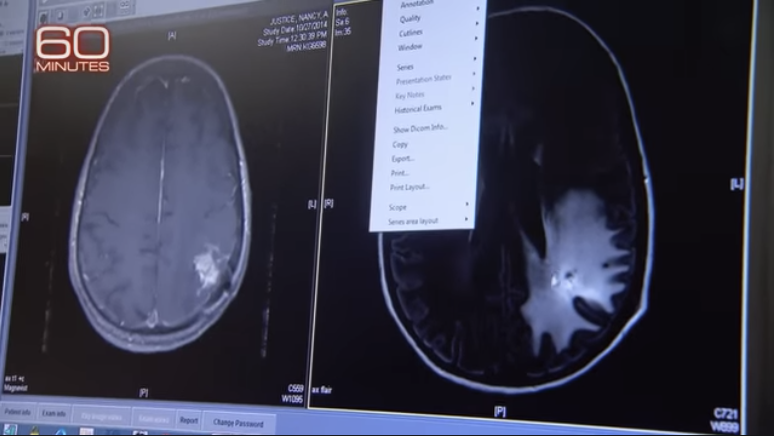

Nurse Lipscomb: one of the first survivors of glioblastoma thanks to poliovirus immunotherapy.
Addendum
ITALY: Novel treatment shows promise against rare cancer in kids
A novel treatment using supercharged immune cells appears to work against tumors in children with a rare kind of cancer, researchers reported Wednesday.
Nine of 27 children in the Italian study had no sign of cancer six weeks after the treatment, although two later relapsed and died.
The treatment – called CAR-T cell therapy – is already used to help the immune system fight leukemia and other cancers in the blood. This is the first time researchers have achieved such encouraging results in solid tumors, experts in the field said, and raises hopes that it can be used against other kinds of cancers.
It’s too soon to call it a cure for neuroblastoma, a nerve tissue cancer that often starts in infancy in the adrenal glands near the kidneys in the abdomen.
Standard treatment can be intense, involving chemotherapy, surgery and radiation, depending on the cancer’s stage and other factors. The children in the study had cancers that had come back or were particularly hard to treat.
Eleven children were alive when the three-year study ended, including some who only partially responded to treatment and got repeat doses of the modified cells.
“Those kids were all destined to die without that therapy,” said University of Pennsylvania’s Dr. Carl June, a pioneer of CAR-T therapy who was not involved in the new research.
“No one’s ever had patients responding like this before, so we just don’t know what it’s going to look like a decade from now,” June said. “For sure, there are going to be more trials now based on these exciting results.”
CAR-T cell therapy harnesses the immune system to create “living drugs” able to seek and destroy tumors. T cells from the patient’s blood are collected and strengthened in the lab, then returned to the patient through an IV where they continue to multiply.
Six CAR-T cell therapies have been approved by the U.S. Food and Drug Administration for blood cancers. Some early patients have been cured.
But success in solid tumors has been elusive. The latest study was done by researchers at the Vatican’s Bambino Gesu pediatric hospital in Rome.
“They seem to have found a unique combination” to get the modified cells to multiply initially, then last a long time to continue their cancer-killing work, said Dr. Robbie Majzner of Stanford University School of Medicine, who was not involved in the new study.
Study co-author Dr. Franco Locatelli said they also added a safety switch to eliminate the cells if a patient had a severe reaction. When one patient had problems, they flipped the safety switch, showing that it worked, although later they determined the patient’s problem was caused by a brain bleed unrelated to the CAR-T cells.
Many of the children had a side effect that is common with CAR-T therapy – an immune overreaction called “cytokine release syndrome.” It can be serious, but was mild in most, the researchers reported.
They concluded that CAR-T therapy was “feasible and safe in treating high-risk neuroblastoma.”
China makes breakthrough in cancer treatment via immunotherapy
Chinese researchers identify hormone receptor MC5R as a potential target for immunotherapy. /CFP
Chinese researchers have made a breakthrough in the treatment of cancer via immunotherapy, identifying a particular hormone receptor as a potential target, the University of Science and Technology of China (USTC) said.
The receptor, MC5R, acts with a hormone called α-MSH, which is produced by the pituitary gland, to promote the growth of tumors, according to a paper published in the journal Science on August 4.
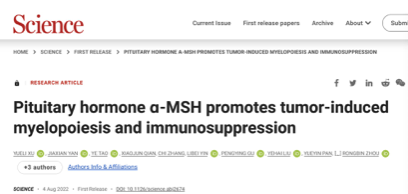
Screenshot of published study. /Science
According to the paper, increased levels of the hormone can lead to tumor growth in the human body by promoting myeloid cell accumulation and immune suppression through its receptor MC5R.
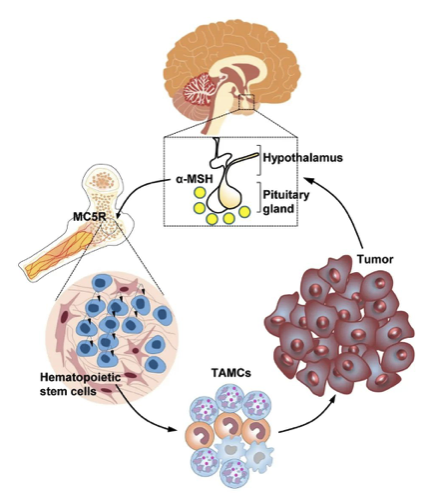
An illustration depicting the hypothalamic-pituitary axis’ role in tumor immunity. /USTC
The researchers identified MC5R as a possible target for immunotherapy that could provide a means of interrupting the hormone.
According to the university, previous studies have found that patients suffering from long-term depression and stress show more rapid development of tumors and a weakened response to cancer immunotherapy, indicating that the nervous system and its mediated stress reactions play an important role in tumor growth and immune regulation.
(With input from Xinhua)
Recommended additional materials:
Worldwide cancer data
plus:
Print this article [bws_pdfprint display=’print’]

[su_animate type=”fadeInRightBig” duration=”1.5″]
Unfortunately, most people take this site for granted.
DONATIONS HAVE ALMOST DRIED UP…
PLEASE send what you can today!
JUST USE THE BUTTON BELOW[/su_animate]

[/su_spoiler]
[premium_newsticker id=”211406″]
 This work is licensed under a Creative Commons Attribution-NonCommercial 4.0 International License
ALL CAPTIONS AND PULL QUOTES BY THE EDITORS NOT THE AUTHORS
Read it in your language • Lealo en su idioma • Lisez-le dans votre langue • Lies es in Deiner Sprache • Прочитайте это на вашем языке • 用你的语言阅读