

 Julian Macfarlane
NEWS FORENSICS



| Traducir—Translate! | |
| Make fonts bigger>>> | Resize text-+= |
Wet Gaps
Strategy and legacy
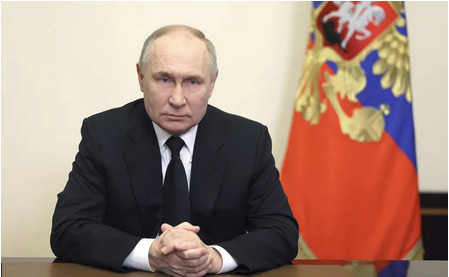
Putin, when asked by Oliver Stone about his reported “wealth”, just smiled and replied to the effect that the only “wealth” that matters is the richness of one’s legacy—what one believes he or she has accomplished when he departs this world.
So, as I wrote, what matters to Putin is this “legacy”, which is the resolution of the Ukraine conflict, correcting the mistakes of the past which go right back to the time of Lenin and Stalin. If Moscow was the brain of Russia, then Ukraine was its heart.
What we know as “the Ukraine” is the key to a new and better Russia.
Stalin’s policy of “Korenizatsiia}” or “indigenization” was a mistake because it encouraged an exclusionary, separatist nationalism that easily morphed into fascism—not just in Galicia (Western Ukraine) but in Poland and the Baltics, often at the expense of other ethnicities.
Towards 2030
I expect the SMO to move into a new phase by the end of this year, with major gains, as it breaks the “Maginot Grid” of fortified villages and towns all across Donbas and Lugansk and other regions. Resolution is unlikely before 2030- but it will come.
Once logistics hubs like Prokrovsk and Chasov Yar have fallen, the next challenge is across the Dniepr in various sectors, and also other rivers elsewhere. That means crossing those rivers.
It’s called “Wet Gap” warfare for a reason. In military operations, territory doesn’t matter== but terrain does, especially control of natural barriers like rivers, which are ironically often supply routes.
The focus, of course, right now is the Dniepr, which literally splits the Ukraine into two parts, east and west, but connects main cities, north and south. Kiev is Ukraine’s biggest city in the north, to the south is Zaporoshzhya, and Kherson— all on this one big river.
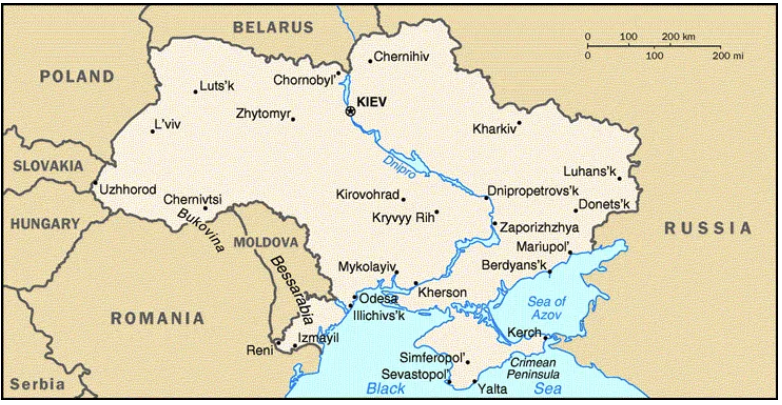
The map is a little misleading — since, while Kherson is on the Dnieper, Nikolaev is not, nor Odessa—although they might appear to be.
So to get to Nikolaev from Kherson you have to cross the Southern Bug River. To get to Odessa from Nikolaev, there are more rivers in between.
Rivers, rivers, rivers.
Fortunately for the Russians, Russia is also a country of rivers and they have gotten very good at this kind of stuff – far ahead of NATO or the US.
In addition to having trained for this kind of warfare and invested in developing equipment and technologies for it , the Russian military have the advantage of superiority in firepower -artillery, drones, and air power—which the Ukrainians don’t have.
To stop a “wet gap” assault, the Ukrainians need to concentrate their forces and need the protection of terrain. But they don’t have enough tanks or artillery or drones or missiles and no airpower at all.
In the initial assault, the Russians may suffer greater casualties than usual-- but after that, much less. And the Ukrainians will lose more – which they cannot afford.
The Russians are not going to attack any major city.
‘Cause, “you break it, you gotta fix it”. There will be no Ukrainian Fallujahs. Nor Dresdens. Nor Hiroshimas.
Moscow wants to liberate cities like Kharkov, Zaporizhzhia, Kherson, Nikolaev, and Odessa. And finally Kiev.
The deal they offer Ukraine is so much better than Trump’s or von der Leyen’s or the Azovs. Freedom and a future.
Chappy keeps an eye on me


And our previous post....
How to win a war
You would think the Americans would know better. After all, the Revolutionary War could not have been won (and it was barely “won”) if the Americans had followed the rules. They adapted and innovated.
That’s pretty much the case in every war. You have to fight “smart”.
Right now, the West is just following an outdated textbook.
In 2022, with Russian victory in Mariupol, I thought that the Russians would next take Nikolaev, a big city, of about 460,000. I was wrong.
It is Russian speaking—and, strategically, the gateway to the much larger city of Odessa. While the Ukrainians insist that all these Black Sea cities are Ukrainian with majority Ukrainian populations, Nikolaev and Odessa voted for Yanykovych, before the Maidan Coup. The Kiev regime is not popular on the Black Sea.
Odessa is, of course, the key to control of the Black Sea. But taking it would be a problem. It’s huge. The geography is complicated with a lots of fortifications. It would require a combined land /sea / air assault, but that would lead to a lot of civilian casualties. A siege would be the best way, cutting off supply lines for the UAF forces, who now comprise a lot of conscripts, many of which have Russian sympathies. But that would require taking Nikolaev, first.
Lessee…3 months for Nikolaev. More for Odessa.
So I was right about Nikolaev insofar as it probably was easier to take in 2022 – and wrong in another—nobody knew what the West was going to do at that point. And the West was then still a force to be reckoned with.
The Russians were well-positioned strategically. But Putin elected to negotiate the Istanbul agreement. One step at a time.
That might have been a mistake if this conflict was a war, as the West defines it.
But Russia regarded it as a fraternal conflict. It wasn't fighting a “war”.
If negotiation would prevent death and destruction and guarantee the rights of ethnic Russians, it preferred peace. After all, by March, Ukrainians had been defeated.
Of course, we all know what happened afterwards. Odessa became the launching point for strikes on Crimea while NATO escalated supply of weapons and equipment, trainers and operators, and provided valuable ISR.
Was Putin right to try to negotiate?
Was he being too careful?
One must look at the results today three years on.
Istanbul might have brought peace –for a while—and certainly Putin did not have the kind of support for the SMO then that he has now, nor the military, industrial and economic capabilities. Nor was NATO then proven to be second-rate militarily,
Yet, how could Istanbul have achieved the Kremlin’s two main goals – demilitarization and denazification?
The Kiev regime opted for greater militarization and greater Nazification, with greater oppression of Russians particularly in the Black Sea coast! The active involvement of NATO, and the US escalated.
So the Russians adapted.
Now the goal was to liberate all of Donbas, Lugansk, Kherson and Zaporozhye, and, at their request, incorporate them into the Russian Federation, dismantling and untangling the web of fortified villages and towns in the area created over a decade— carefully sparing civilian lives and the lives of Russian soldiers.
Now, the work is almost done. As many as a million Ukrainian soldiers have died, with huge number of refugees fleeing to the West, to Europe, or east to Russia. There are many more Ukrainian deserters than Russian KIAs!
The key hubs of Chasov Yar, Krasny Liman, Prokovosk are about to fall. The major city of Kharkov is partly depopulated, opening the way to a siege. With Sumy under control, Russia will soon be able to control much of the Dniepr, cutting more supply lines.
Ukrainian terror attacks have intensified Russian support for Putin – but also demands for a harder line. There will be no forgiveness for Ukraine until the Ukrainians beg for it.
The city of Zaporozhye is under threat. And when it falls, the way is open to Kherson.
Once again, we are back to Nikolaev. And then Odessa.

Ukraine map
The map shown here was June 2023. It is likely that Russia will want to control the East bank of the Dniepr with key cities on the West Bank, as well as Kryvyi Rih.
A key to control will be Kiev. Once a Russian city, now “Ukrainian” – it will likely choose to be “Russian Ukrainian”. Russia can offer its people a future. The West, especially the US, just wants to rape it.
Without taking control of what amounts to the heart of Ukraine, Russia cannot denazify it.
How long does this take?
There will be no “Big Arrow”.
Probably, it will take a year. But, then, I have been wrong before — and things can happen very fast sometimes, as we saw in Vietnam, and later in Afghanistan. In addition, we can rely on the West making every possible mistake.
A major recession is forecast for the US – and that will also destabilize Europe. Trump has done nothing since taking office but double-down and triple-down on the mistakes of his first term. He has surrounded himself with people just as loony as himself.
As I said, in my last post, time is on Putin’s side. He leaves office in 2030. Ukraine will be his legacy. By that time I wager a much larger chunk of the region will be part of Russia.
But nobody wants Galicia and Lviv. Even the Poles don’t want it. Maybe Trump can turn it into a golf course.
Special Article
In addition to 3 Special Articles in the Putin series, the download links include 3 previous special articles, as well. When you buy a coffee you get access to all 6.

Print this article [bws_pdfprint display=’print’]
 This work is licensed under a Creative Commons Attribution-NonCommercial 4.0 International License •
ALL CAPTIONS AND PULL QUOTES BY THE EDITORS NOT THE AUTHORS